Custom Halloween Tapestry, Printed Poly Wall Hanging
$2.50
Custom halloween tapestry printed edge-to-edge on lightweight flat-woven polyester, no pile, single-layer sheet whose reverse carries a dimmed ghost of the art — sold as one hemmed panel at 130 x 150 cm or your custom cut. Built for dorm walls, party retail and seasonal pop-ups: MOQ 100 pcs per design, samples in 3-5 days, bulk in 7-15 days after artwork approval, and sea, air or DHL / UPS / FedEx / TNT freight quoted backward from your September shelf date. Bring your own artwork at 150 dpi for a free digital mock-up; FBA labeling and flat-fold or rolled packing available on every order.
A Halloween Print Business That Runs on a Shelf Calendar
Custom halloween tapestry orders follow retail dates, not moods. Campus shops hanging dorm-wall stock, party retailers planning window sets, seasonal pop-up operators dressing blank walls for October — all three buy the same object: a lightweight printed polyester wall panel that photographs loud on a plain wall, packs thin, and lands before the shelf change. This page covers that panel in two artwork families from our own sample set, sold at 100 pcs per design minimum and built to your size, with seasonal lead math spelled out below so your September window works instead of hoping.
The sample scenes on this page are staged interiors — sofa, console, futon and cushions in them are set dressing, not part of any shipment. What is on offer is the printed cloth itself: one rectangular panel, edge-to-edge artwork, hung flat.
What the Photographs Prove About the Build
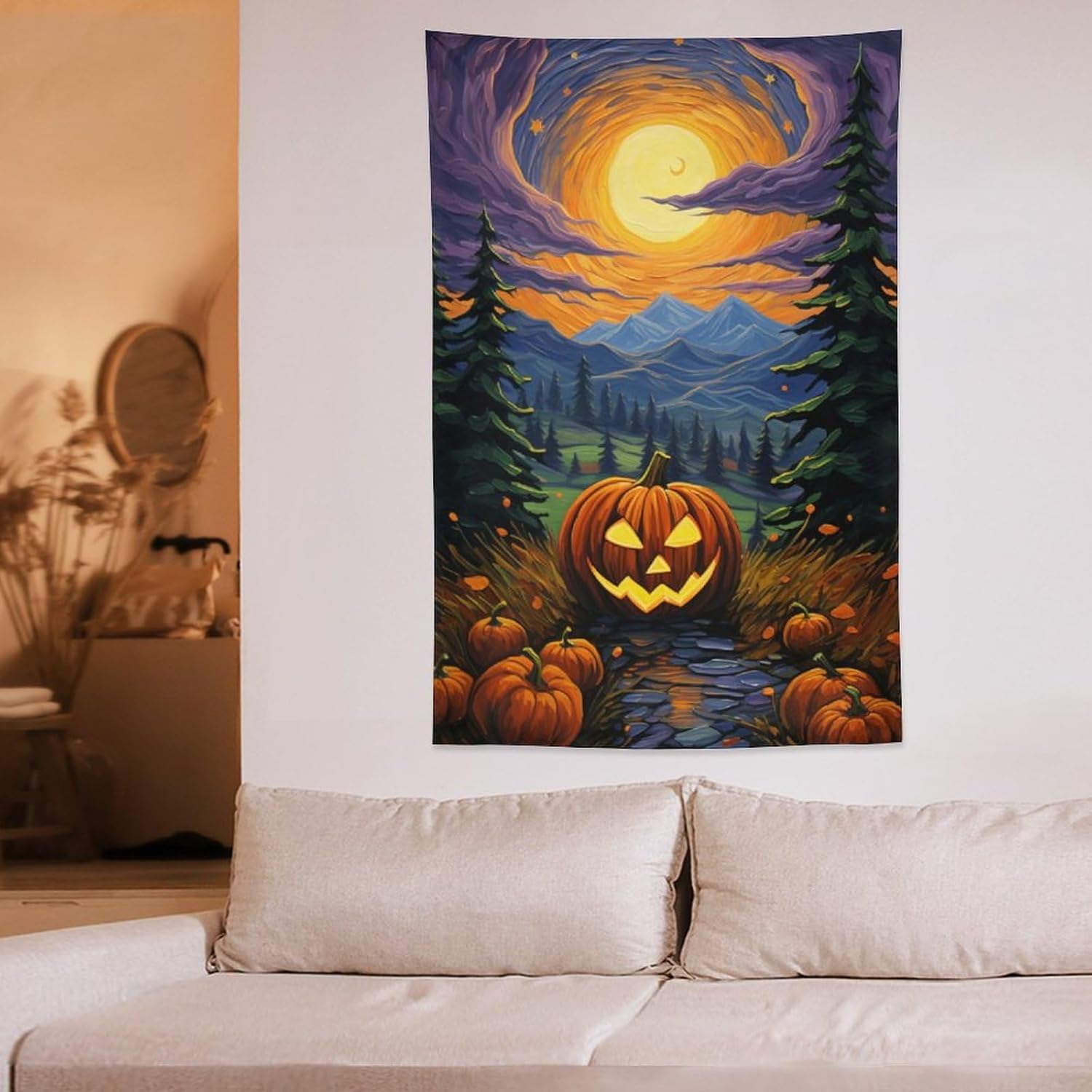
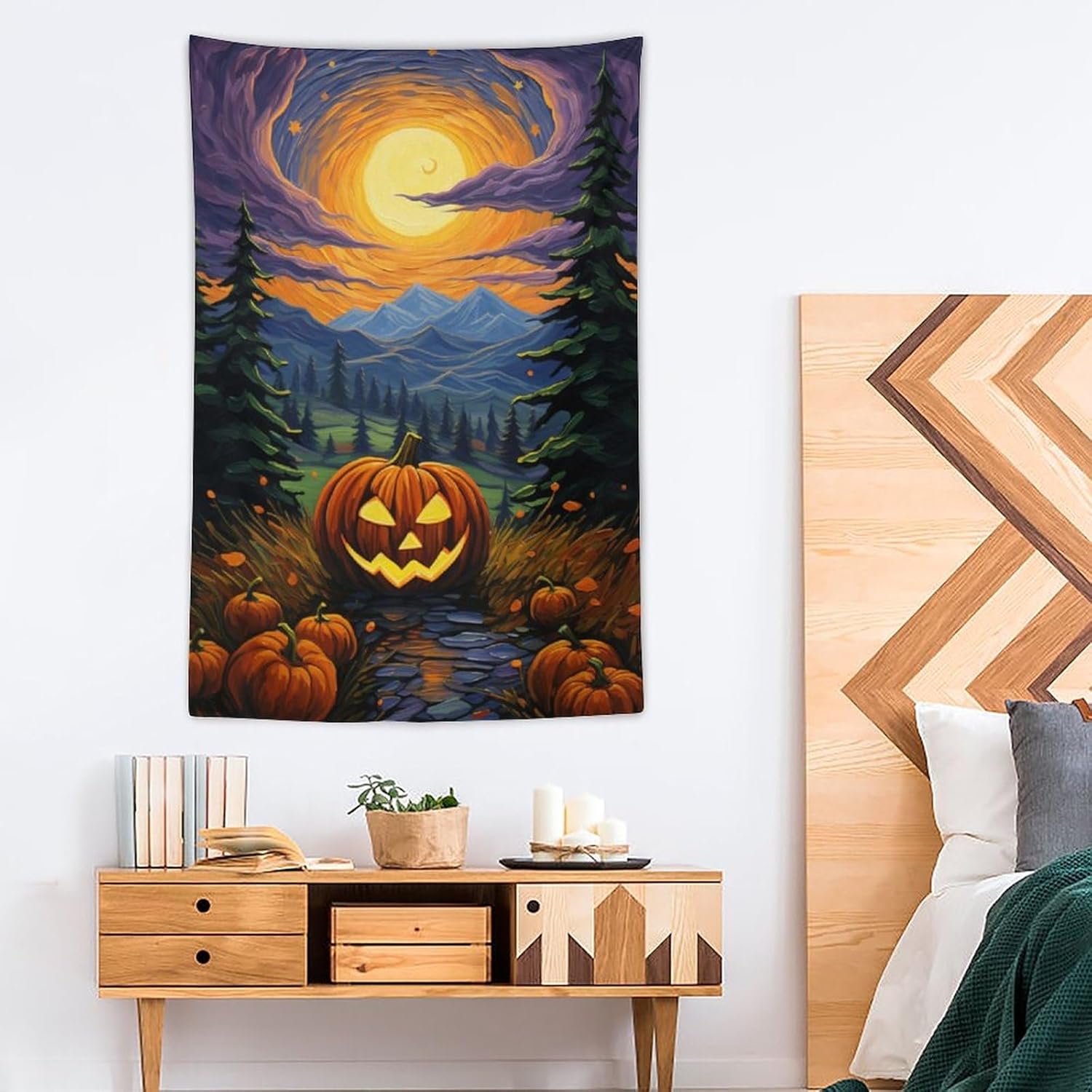
Zooming into the hung panel tells you more than a spec bullet would. The face is a smooth, flat woven polyester with no pile, no nap and no texture direction — the artwork is printed onto the cloth rather than woven into it, which is exactly why a continuous-tone illustration with dozens of brushstroke tones reproduces at all. The print runs full-bleed: the scene carries to every edge with no white margin and no visible border, and the perimeter finishes as a narrow, straight, clean edge that reads as a thin turned-and-stitched hem. There is no fringe, no decorative border tape, and no rod channel showing on the face in any of the photos.
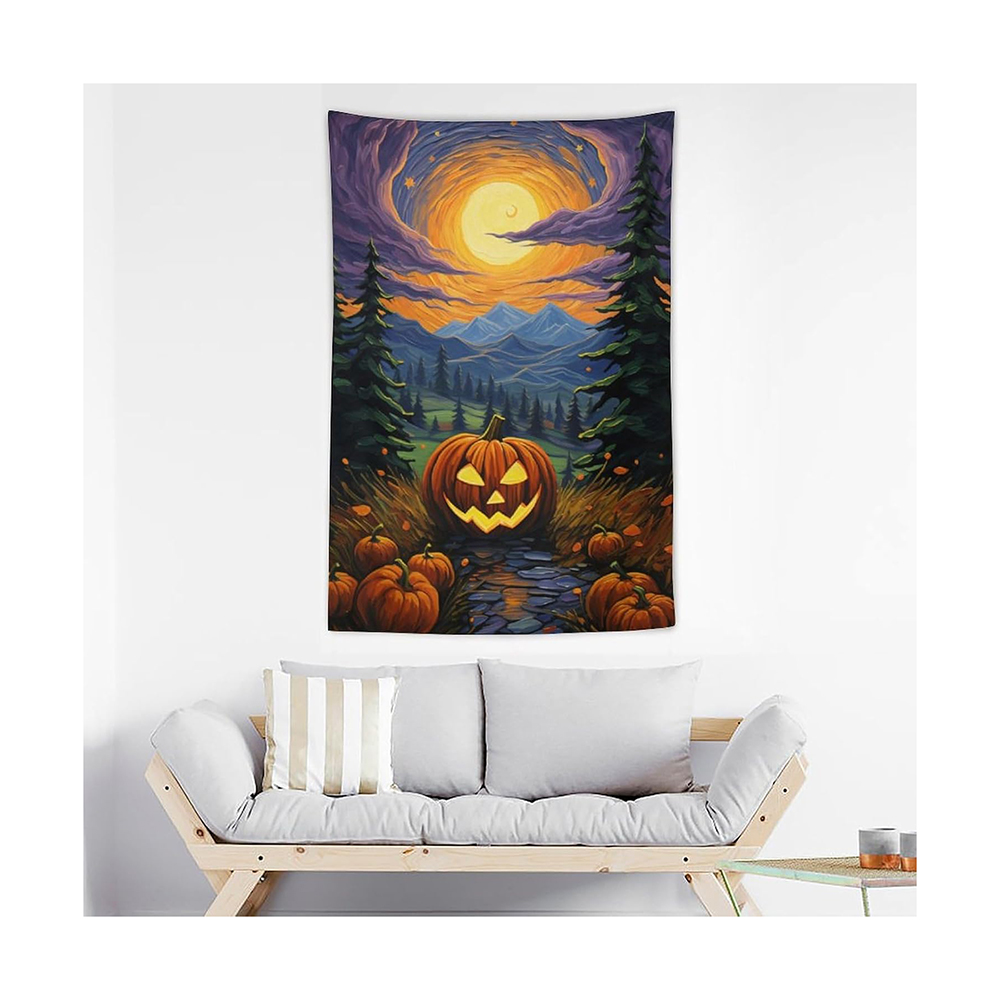
The artwork in these samples is a painterly Halloween scene: a glowing carved jack-o-lantern with triangular eyes and a jagged grin sitting at the head of a blue-grey cobbled lane, smaller pumpkins clustered in tall grass down each side, two dark conifers framing the composition, layered slate-blue mountains behind, and a swirling indigo-to-ember sky turning around a large golden moon pricked with stars. That is a stock sample motif — generic folk imagery in an impressionist swirl style, no licensed character anywhere in the frame — and it functions here the way any seasonal artwork would: one continuous image scaled to one panel.
Print method matters here for a merchandising reason, not a technology-tidbit reason. Continuous-tone painterly artwork — dozens of blended sky tones, soft gradients inside the moon’s glow, brushstroke edges that fade instead of stopping — lives or dies by how it lands on the cloth. Sublimation-style digital printing dyes the polyester fibers themselves rather than laying ink on the surface, which is why the swirl reads as color inside the weave at arm’s length and why a folded panel opens flat in a dorm room without crack lines along old creases. Silk screen remains available for flat-color spot-graphic artwork where a shop wants a two-color logo-style print instead of a photographic field; the quotation names whichever route your file goes down, and the sample you approve is printed the same way bulk will be.
Thin fabric is a feature in this lane, not a compromise. In the bedroom mock-up the top corners curl slightly forward off the wall, which is how light printed polyester behaves: it drapes, it takes a soft fold, and it snaps back flat once hung. The same behavior shows in the futon scene, where the side and bottom edges sink into the artwork’s dark corners — a narrow hem that blends instead of framing.
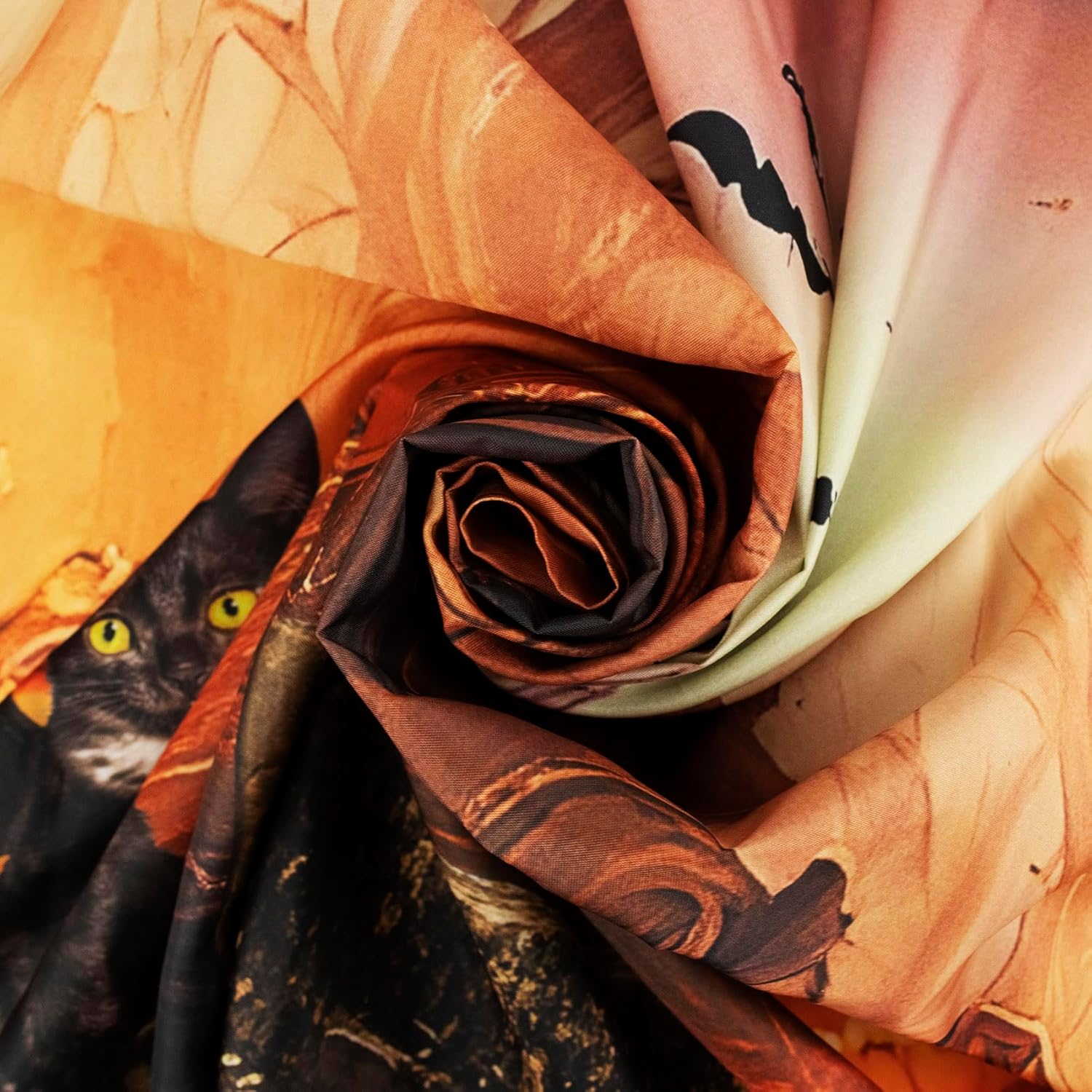
The Second Artwork Family, Read From a Rolled Sample
Not every buyer wants the pumpkin lane. The rolled-spiral photo shows a second Halloween artwork from the same production: a black cat face with wide yellow-green eyes and a white muzzle half-tucked behind an orange fold, solid black bat silhouettes on a pale peach ground, and a watercolor-style wash moving from cream through apricot and rust into near-black with a few scattered gold flecks. Same construction logic as the first design — flat printed face, soft satin-ish sheen, no pile, continuous artwork with no repeat and no border.
The coil does one thing a hung shot cannot: it exposes the reverse. Inside the spiral, the back of the cloth shows a dimmed, muted impression of the same artwork rather than a crisp mirror of the front. Two practical readings for retail buyers. First, this is a single-layer sheet, not a bonded double-panel — one print pass, ink visible faintly through from the back. Second, it means the piece is designed for wall-facing use: against a dorm wall or a party backdrop the image side does the work, and nobody is shopping a second image on the reverse. If a truly double-sided graphic matters for your set, that is a different construction and belongs on a quotation, not on this listing.
No size tag, care label, or dimensional print appears anywhere on the rolled sample or the hung panels. Printed grams-per-square-meter figures are deliberately absent from this page as well — there is no photo evidence for a number, and we do not quote one.
How These Panels Are Hung — What We Can and Cannot Promise
Here is the honest version of the mounting story, because the photos set it up. Across all three hung scenes, no rod, rail, clip, hook or grommet is visible. The top edges lie flat or bow gently, with at most two small dark marks near the upper corners of one shot that could be fixing points or could be printed stars — the image cannot resolve it. So this page makes no claim that hardware ships in the box, and no claim of a built-in rod pocket, because neither is photographed.
What the staged shots do demonstrate is the outcome: a light polyester panel held at its upper edge, flat to a painted wall, with concealed fixing. In practice that means the cloth goes up on two or three points — adhesive mounting dots, straight pins or small nails at the corners, or a picture rail behind a folded top edge — and the fabric’s own weight keeps the rest flush. For dorm deployments that matters commercially: residents cannot drill, adhesive points and pins cover the wall without tools, and a seasonal panel that came down without damage resells as an endcap deal instead of a complaint.
If your program needs a defined header — a sewn rod sleeve, metal eyelets at the corners, or looped tabs — specify it on the quote before the sample run, so the finished edge arrives matching your wall plan instead of improvising one. The stock build as photographed is a clean hemmed edge with no exposed hardware, and that is what we ship unless your approval file says otherwise.
Display economics push retailers toward this header style for a second reason: facing count. A framed canvas needs shelf depth and stand hardware; a hemmed printed sheet can face out flat on a wall or slat-wall run at almost zero footprint, which means a seasonal aisle can show four artwork families side by side in the space a framed product gives to one. The staged photos on this page are exactly that argument — panel flat on a bare wall at eye level above furniture, artwork doing all the visual work while the cloth itself disappears into the scene. That is also why darker night-sky artwork photographs so well for e-commerce cards: the panel reads as a window on the wall instead of a rectangle of fabric, and the listing thumbnail sells the glow rather than the textile.
Who Reorders These, and on What Rhythm
The order file for seasonal wall panels splits into recognizable shapes. Campus bookstores and dorm-supply shops run one or two artwork families in short depth between late August and early October, restocking the print that moved in the first week and dropping the one that did not. Party-supply chains buy wider depth per SKU but demand the same artwork for twelve consecutive Septembers, which makes file re-runs, not redraws, the real revenue — the stored print file comes back matching last year’s color because nothing about the process needs fresh tooling.
Event and venue decorators buy differently: quantity per project, one artwork, a date that cannot move. A haunted-house operator lining a corridor every weekend of October orders against a hard install day, and a 7-15 day production window after artwork approval only helps if the artwork gets approved. The math is therefore backward from your shelf or your opening: allow 3-5 days for a physical sample, one approval loop, then the production window, then transit. Air and express compress the last leg when the math fails; sea freight only works if you asked for the quote in July.
A third pattern keeps this page busy outside October: spares. Retail sets get handled, coffee gets spilled, corners get torn from adhesive pulls, and a store that ordered 200 panels for a window program is happy to reorder 40 of the identical print in January when the next season’s display borrows the layout. Reorders run against the stored file, so a restock matches the original batch instead of approximating it.
Bringing Your Own Halloween Artwork to the Panel
Custom work is the point of the listing, so here is the file standard the print room actually wants. Send artwork at or above 150 dpi at the panel’s final dimensions, in the exact aspect ratio you want printed, RGB or CMYK both accepted because the proof converts and shows you the result before anything runs. Full-bleed is the default layout in our samples — the scene should over-run the cut by the bleed margin we name on the mock-up sheet, because a print-to-edge panel with a thin unprinted stripe at one edge reads as a defect on a shelf card.
The free digital mock-up renders your artwork onto the panel proportions, marks where a fold or header would sit if you specified one, and states plainly whether your image scales cleanly to the size you picked. Artwork rules are on you, not on us: we reproduce designs you own or are licensed to print, and seasonal folk motifs — carved pumpkins, cats, bats, moons — carry no rights to clear, which is precisely why they photograph well on a dorm wall at a student price.
Tonal guidance from the sample set: the two photographed designs both lean on deep shadow fields (indigo night, near-black folds) with one bright focal glow. Dark-ground artwork hides shipping creases better than pale flat colors, which is a real merchandising argument when the panel reaches a consumer unpacking it at home after a transit leg.
Specification Table
| Item | Custom halloween wall tapestry, single-layer printed polyester panel |
| Face & structure | Flat woven polyester, no pile; print reads faintly through to a paler reverse (photographed) |
| Edge-to-edge custom printing — digital/sublimation for continuous-tone artwork, silk screen on request | |
| Size | 130 x 150 cm as listed; other cuts and aspect ratios confirmed on the quote |
| Edge finish | Narrow straight hemmed perimeter as photographed; rod sleeve, eyelets or tabs added only when specified pre-sample |
| Mounting shown | Concealed top-corner fixing in staged scenes; no hardware is claimed as included |
| Packing | Individually poly-bagged, flat-folded or rolled, master export carton |
| MOQ | 100 pcs per design |
| Sample time | 3-5 days |
| Production lead | 7-15 days after artwork approval |
| Capacity | 1,000,000 pcs per month across our gift lines |
The listed 130 x 150 cm is the sample scale this artwork was photographed at; aspect ratio changes are free on the artwork side because there is no tooling tied to a format — your file simply re-fits to whichever cut your shelf plan needs.
Packing, Freight, and Beating the September Problem
Packing follows the panel’s physics. Flat-folded, individually poly-bagged units stack into thin export cartons and win on sea freight and FBA shelf fit; rolled cores avoid crease lines entirely and win when your artwork runs pale or geometric where a fold would read. Both layouts quote from the same artwork file, and cartons carry your marks plus FBA labeling when the order routes to a fulfillment center instead of a store dock.
Freight choices are sea, air, or DHL / UPS / FedEx / TNT door-to-door, and the seasonal argument is simple arithmetic: a September shelf date met by ocean freight means a production slot booked while school is still out in July; the same date by express courier can start two weeks later at a shipping line your margin sees. We quote both against the same approved file so the choice is yours with numbers on it, not folklore. Monthly output across our gift lines runs to 1,000,000 pcs, which makes a 30,000-panel chain order a slot booking rather than a negotiation.
Carton practice for wall panels follows the same logic as the cloth: folded units ride at high density because a hemmed polyester sheet tolerates its own stacked weight, and the inside-out poly-bag protects the printed face from abrasion against the next panel during a long sea leg. Rolled units ship telescope-shipped — the tube inside the carton, the carton labelled this-end-up — and cost you cube on the freight quote but zero crease risk on a pale artwork. Tell us which artwork register you’re printing — dark night scenes or pale wash fields — and the packing recommendation comes back on the mock-up sheet with the dimensions already worked out, so the carton count per master and the master count per pallet are on the same page as the price.
Pricing follows the standing rule for this catalog: the figure displayed on the listing anchors the 100-piece tier, and every other quantity prices on the quotation — email [email protected] or send the form below, both reach the same desk at +86-15967739086.
One last packing decision buyers should make at quotation stage, not after: whether the retail unit needs to look gift-shelf-ready. Panels shipped for store backrooms can ride in plain brown master cartons at the lowest freight math, but panels landing on a consumer-facing endcap usually want an OPP poly-bag with a folded header card printed in your Halloween artwork, bagged so the front image is visible on the shelf. Both flows use the same cloth and the same print file; what changes is the bag, the insert and the carton count per master, and both get priced on the same quotation so the decision is a margin calculation, not a re-order.

Buyer Questions, Answered Plainly
Does the tapestry ship with hooks, rods or mounting hardware?
Can you print our own Halloween design instead of the sample artwork?
Is the back of the panel as sharp as the front?
When must we order to hit Halloween shelf dates?
Which sizes are available beyond 130 x 150 cm?
Can a reorder match last season’s colors exactly?
Where This Panel Sits in the Wall and Textiles Range
Seasonal print is only half the wall business. The tapestries category carries the sibling programs: a Christmas tree panel that owns the November-January rotation on the same cloth and process, and an evergreen printed tapestry line for gallery, dorm and photo-artwork demand that sells all twelve months. Buyers dressing a full dorm room add the printed cushion covers cut from the same seasonal artwork files, and the wider home textiles collection keeps throws nearby for the same shelf story.
Send artwork, quantity and shelf date to the quote desk and the mock-up sheet comes back with the September math already run against your chosen freight.