Custom Christmas Tree Tapestry, Backdrop Wall Decor
$2.50
Custom christmas tapestry wall decor built for the repeat-use backdrop business: photo studios, retail windows and market lanes that hang one flat polyester panel every December and store it flat between seasons. A photographed hem close-up proves the construction — double-serged turned edge, single-layer cloth, dye-set print that ghosted faintly through to a paler reverse, no pile, no glare under strobes. Listed at 130 x 150 cm with other cuts quoted free of tooling; full-bleed or white-margin layout is your choice on the approval sheet; no hanging hardware is claimed as included. Folded-flat or rolled-on-tubes packing both quote off the same file. MOQ 100 pcs per design, samples in 3-5 days, bulk in 7-15 days after artwork approval — and the Christmas lane closes in October, so sea, air or DHL / UPS / FedEx / TNT freight gets counted backward from your in-season date, not hoped for. The listed price anchors the 100-piece tier.
One Panel, Four Walls a Season: The Backdrop Business
A custom christmas tapestry wall decor panel earns its freight cost differently from a living-room print. Photo studios hang it behind holiday mini-sessions for six weekends. A retail window dressers’ crew staples a run of them behind gift tables. Mall operators put one at each end of a pop-up market lane. The artwork is a winter scene, but the buyer here is the repeat-use operator: someone who needs one flat panel that survives being hung, shot, folded, boxed, stored against spring, and pulled back out next November — the same image, the same colors, because the stored file reprints it exactly. That reuse cycle, not decoration talk, is what this page quotes against: 100 pcs per design entry, 3-5 day physical samples, 7-15 days of production after artwork approval, and freight backward from an October shelf date.
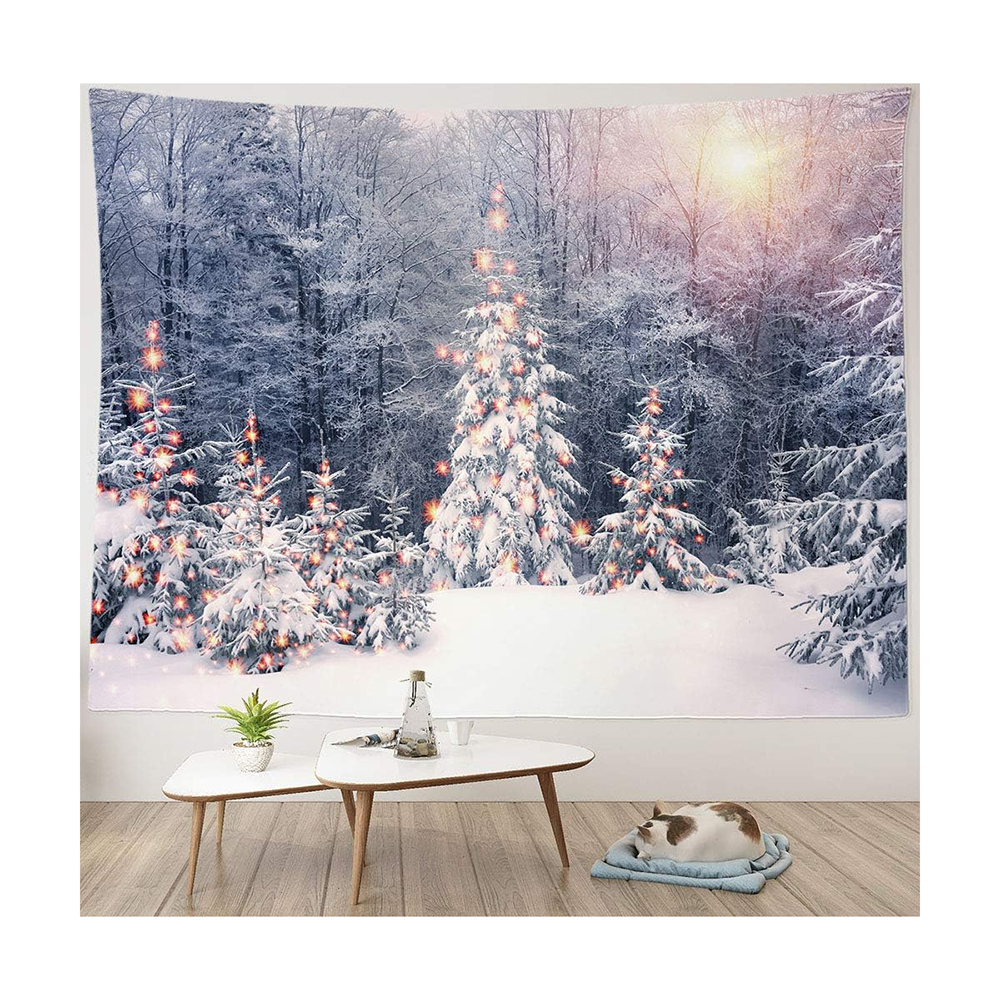
Start with the image itself. The stock artwork shown here is a snow-heavy conifer standing dead-center in a frosted woodland, capped branch by branch like a natural tree, framed by two smaller saplings at the lower corners, with a wall of pale frozen trunks behind it. Dozens of star-shaped glints climb the tree from base to crown — warm orange halos with white-hot cores, the photographed light of fairy lights rendered as lens starbursts — and a soft peach glow bleeds across the upper corner like a film light-leak. It reads festive without a single ornament, garland or greeting in frame, which is why it keeps working as backdrop art across several December programs.

What the Source Photo Is — and Why Studios Pick This Register
Plainly, because it changes how you brief your own art: the tree image above is the source artwork, a treated winter photograph, not a panel lying on a table. You are looking at what goes onto the cloth. Photographers and studio buyers pick this register for a technical reason — contrast. A subject photographed in front of a blue-white frosted field with small warm pinpoints of light keeps skin tones clean in flash, because the backdrop stays cold and desaturated while the sparkles give the frame holiday warmth. A busy red-and-green print behind a subject fights the face; an almost-monochrome snow field with glow accents does not.
The same logic sells in retail windows and market lanes. Warm interior light against a cold backdrop reads as glow from the street; flat warm-on-warm reads as wallpaper. That is why the sample set for this lane leans to deep shadows and pale snow rather than saturated festive color — and it is exactly the kind of register decision your artwork file inherits when you brief us for a studio set, a branded window version, or a matching run of smaller panels for a gift wall. The free digital mock-up renders your artwork at panel scale so you can see the contrast argument before approving, not after.
The Hem Close-Up: Construction You Can Actually See
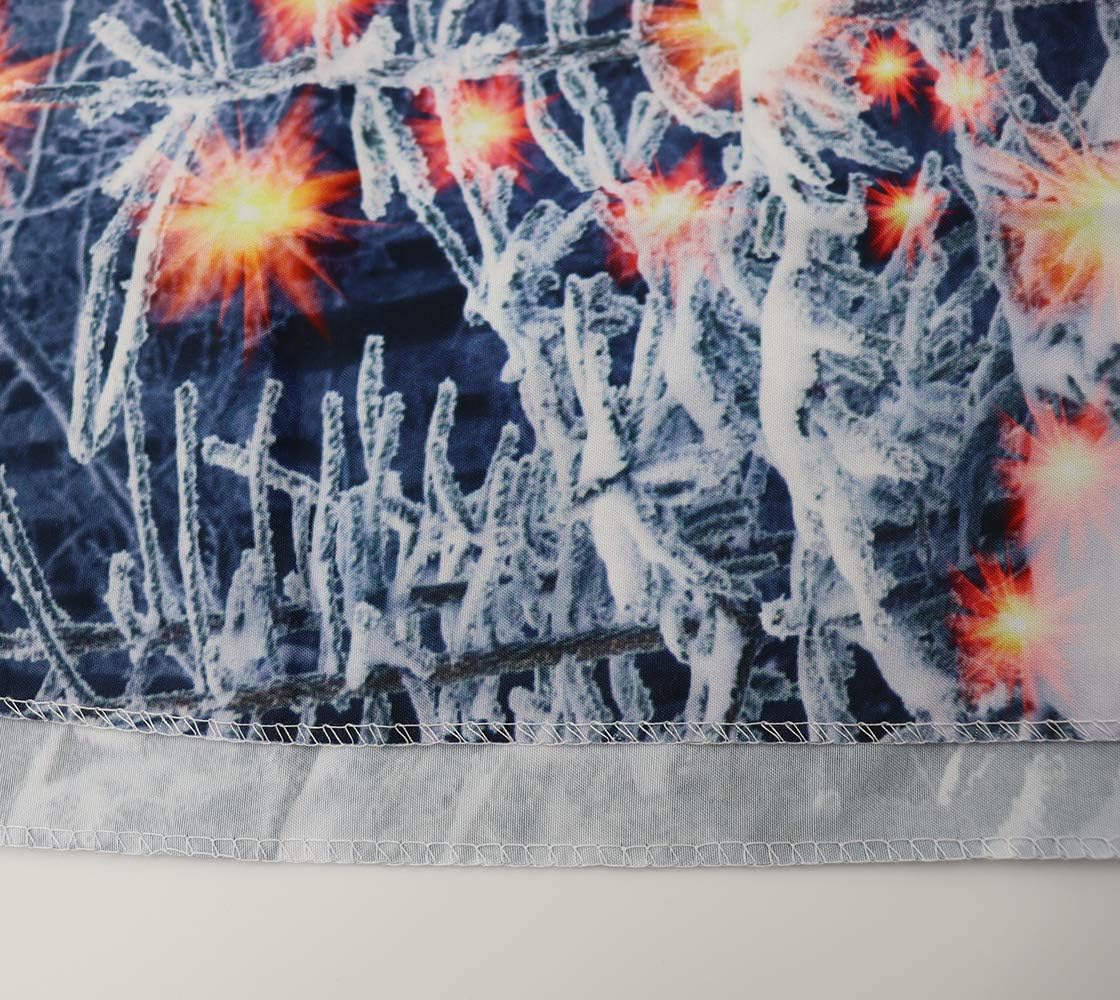
The second photograph is a bottom-edge detail shot, and it is the most honest construction image on this page. What it proves, point by point: the face is a flat woven cloth with a fine crosshatch structure and zero pile — not plush, not fleece, nothing that holds a directional nap. The edge is turned up into a plain hem band, and that band shows the reverse of the same fabric: much paler, faintly ghosted with the print’s pigment bleeding through from the front, with a smoother, slightly satiny sheen than the face. Two parallel rows of white overlock stitching run along the hem, one near the fold and one at the cut edge — the serged line that keeps a polyester sheet from raveling through a hundred hang-and-take cycles.
Three commercial readings from that single crop. First, single layer: what you buy is one printed sheet, not a lined or bonded double panel, which is why it packs thin and drapes flush. Second, the print-through ghost confirms dye-set-into-fiber printing rather than a surface ink film — the finish that survives folding and unfolding without crack lines along old creases, the exact failure mode that kills a studio backdrop in year two. Third, the double serged hem is the stock edge; no rod pocket, no grommets, no loops appear in frame, and this page makes no hardware-included claim, because none is photographed. Your fixing scheme is a line on the quotation — sewn sleeve, eyelets or clips at corners — agreed before the sample, not improvised at load-in.
Color Range Across the Cloth, Read From a Folded Sample
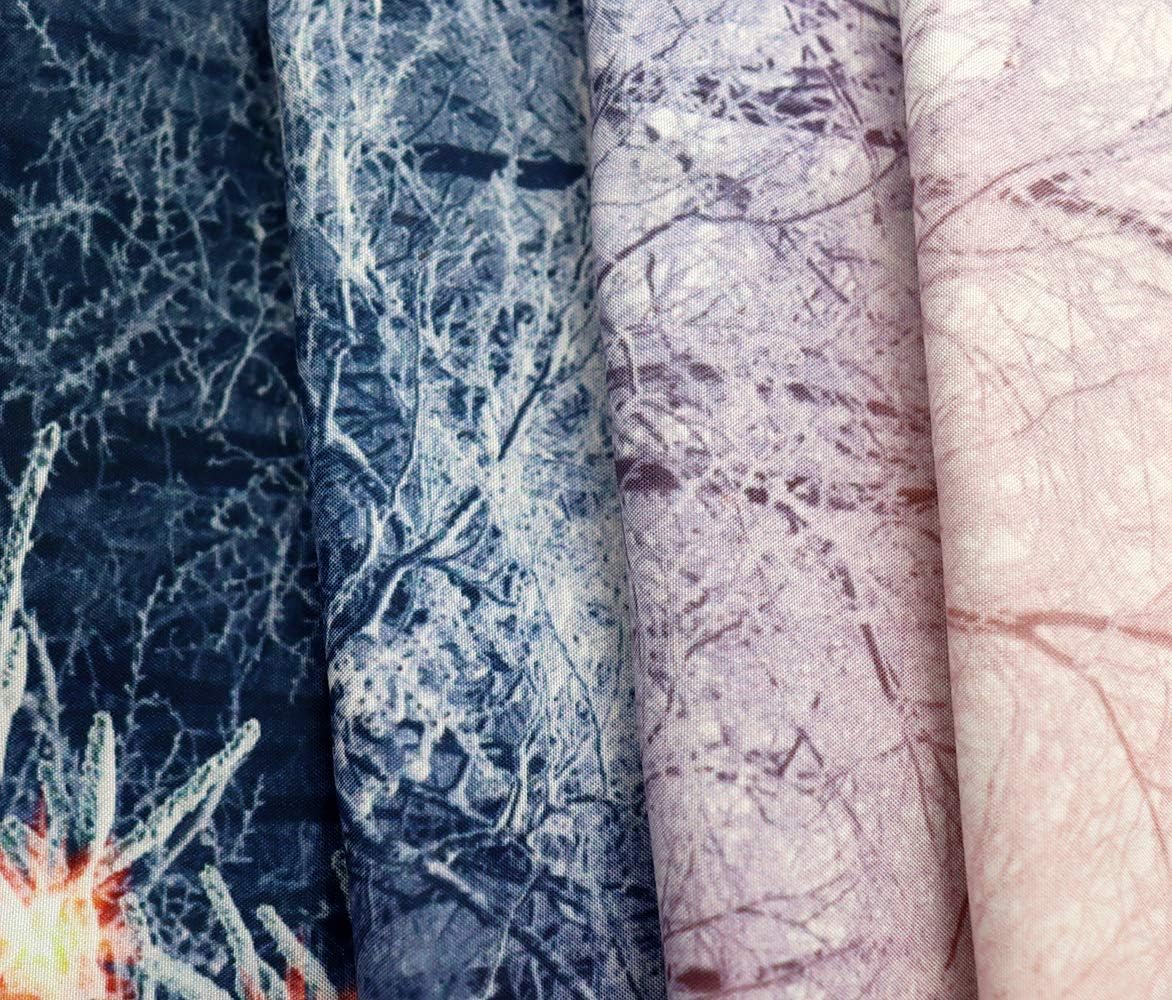
The third photo shows printed cloth gathered in soft vertical folds, and it carries a second artwork family for the same backdrop program: a fine branching frost-or-coral motif that moves through four tonal bands from deep indigo with a warm orange spark burst, through slate blue, into pale lilac and finally a soft pink ground. Whether you read those bands as gradient positions of one print or a tonal set, the image proves the thing operators care about: the dye-sub printed cloth holds a smooth, continuous tonal sweep with no banding and no dot pattern visible at close range, on a matte flat-woven face with no sheen hot-spots that would flare under studio strobes.
Folds matter too. The panels hang and drape with rounded creases that fall out on their own — thin single-layer polyester behaves like that — which is why backdrop users like this cloth over canvas for pop-up work: it unrolls or unfolds, hangs for an hour, and reads flat on camera. For storage, the fold lines you will live with are chosen, not random: fold along the motif’s dark bands, box flat, keep the panel under nothing heavier than another panel. Crease discipline is worth writing into your own customer-care insert when these sell into consumer hands, and we can print that insert language right onto the header card if you want shelf-ready retail units.
For the reseller angle on this artwork family: operators selling backdrop time by the hour often retail the panel itself at session end — parents love the snow-forest frame and will buy the hanging they just posed under. That only works if the retail unit looks like merchandise rather than studio consumable, which is a layout decision made before printing: add a white margin border like the hung panel below and the piece reads as a framed winter print that fits a living room; keep it full-bleed and it stays scenery. Same file, one checkbox, and the studio recoups its purchase across the season instead of warehousing the proof that six weekends of December sessions walked out the door wearing it.
Artwork practicalities from the print room: send files at 150 dpi or better at final panel size. Snow fields and pale gradients are the register where a low-res upload shows first, so for winter artwork specifically, we check softness on the mock-up sheet and flag it before the run. Full-bleed or bordered layout is your choice — see the hung panel below, which demonstrates the bordered look this lane also produces.
The Hung Panel: White Margin, Concealed Fixing, Zero Glare
The lifestyle shot completes the argument. A winter-forest panel — snow-laden spruces, frosted trunks, a sun-glow corner, warm star accents — hangs flat on a plain wall above two nested coffee tables, and the details a buyer can verify: the print carries a narrow white margin border on all four sides instead of running to the edge, a deliberate layout option; the face shows no pile and no glare even where daylight crosses it, confirming the matte printed weave; the cloth hangs slightly proud of the wall with a soft top shadow, fixed at the upper edge with nothing exposed — no rod, no clips, no hooks visible, and no corner hardware that would let this page honestly claim any of them. The top fold line could conceal a sleeve and the two dark corner marks could be fixing points; the photo cannot resolve it, so the spec table states only what is photographed: a hemmed panel mounted by concealed means.
That bordered-versus-bleed choice is worth money in this lane. Photo studios print the bordered version when the backdrop is meant to read as a picture plane inside the frame — it gives an editor something to crop to. Window and market crews order full-bleed so the scene runs past the edges of the wall and sells the illusion. Same cloth, same file, one layout flag on your approval sheet. Scale too: the listed panel is 130 x 150 cm, and custom cuts quote free of tooling implications — change the format, and the artwork re-fits rather than being remade.
Mounting the bordered version is where install notes save operators real time. For studio use, most crews run a length of dowel or light pipe through a sewn sleeve specified on the quote, so the panel squares up in seconds between setups and the top edge stays dead-straight on camera. For window and market use without a sleeve, the photographed approach holds: two upper fixing points, letting the cloth hang on its own weight with a gentle catenary curve between them — soft, not taut, and that curve reads natural on film. Whatever scheme you standardize on, put it on the approval sheet once, and every reorder arrives ready for the same install without teaching the crew twice.
And the reuse math that decides whether this product works for you: a backdrop panel that hangs flat in year one, stores under flat weight through the spring, and comes back without crack lines or faded spark fields is the difference between one December purchase and a six-December asset. The dye-set print and single-layer cloth above are why operators in this lane keep reordering against the same stored file — proofed once, re-run on demand, matched year to year.
Specification Table
| Item | Custom christmas tapestry wall decor — single-layer printed polyester backdrop panel |
| Face | Flat woven polyester, no pile, matte under lighting (photographed) |
| Reverse | Paler, dimmed print-bleed ghost of the front; single sheet, unlined |
| Hem | Turned edge with two parallel rows of white overlock stitching (detail photo) |
| Layout options | Full-bleed artwork, or narrow white printed margin as shown on the hung panel |
| Size | 130 x 150 cm listed; other formats confirmed on the quote before sampling |
| Edge-to-edge custom printing; dye-sub digital for photographic/tonal art, silk screen on request | |
| Mounting | Concealed top-edge fixing shown; no hardware claimed as included |
| Packing | Individual poly bag; folded flat or rolled; export master carton; FBA prep available |
| MOQ | 100 pcs per design |
| Sample time | 3-5 days |
| Lead time | 7-15 days after artwork approval |
| Capacity | 1,000,000 pcs per month across our gift lines |
No fabric weight is printed on these panels and none is quoted here; the gsm figure on your order comes from the physical sample you approve, not from listing copy.
Packing Two Ways, Ordering One Season Late Never
The flat-versus-rolled decision is the packing headline for this product, and both are real options off the same file. Folded-flat units poly-bag individually and stack into thin masters: maximum units per container, cleanest FBA shelf fit, and — against the dark-band fold discipline described above — creases that fall out in a day of hanging. Rolled units ride on telescope tubes, nothing folded at all, which is what backdrop operators with pale snow-field artwork actually want: a studio shooting December 1 has no time for a break-in hang, and zero-crease arrival beats cube economics when the panel must photograph perfect on load-in day. Quote both layouts against your artwork register and the sheet comes back with per-carton counts and both freight numbers, so the choice is arithmetic.
Calendar first: Christmas orders close in October. Count backward from your in-store or studio-season date — 3-5 days sample, one approval loop, 7-15 days production after artwork approval, then the freight leg. Sea works when the file is signed while it is still summer; DHL / UPS / FedEx / TNT door-to-door rescues the September-approval shop at courier prices, and air sits in between. The displayed listing figure anchors the 100-piece tier; every other quantity is bracket-priced on the quotation, and a 40,000-panel chain program books against monthly capacity of 1,000,000 pcs across our gift lines without queueing.
Questions or artwork files go to [email protected] or +86-15967739086; the form below reaches the same desk, the same mock-up schedule, the same October countdown.

Buyer Questions, Answered Plainly
Will the backdrop survive being folded, stored, and hung every December?
Should we order these folded flat or rolled?
Does it come with hooks, a rod, or hanging hardware?
Can our own holiday artwork or logo go on the panel?
Is the printed side the only side with image?
When must a Christmas order be placed to arrive in season?
Fit With the Rest of the Wall Range
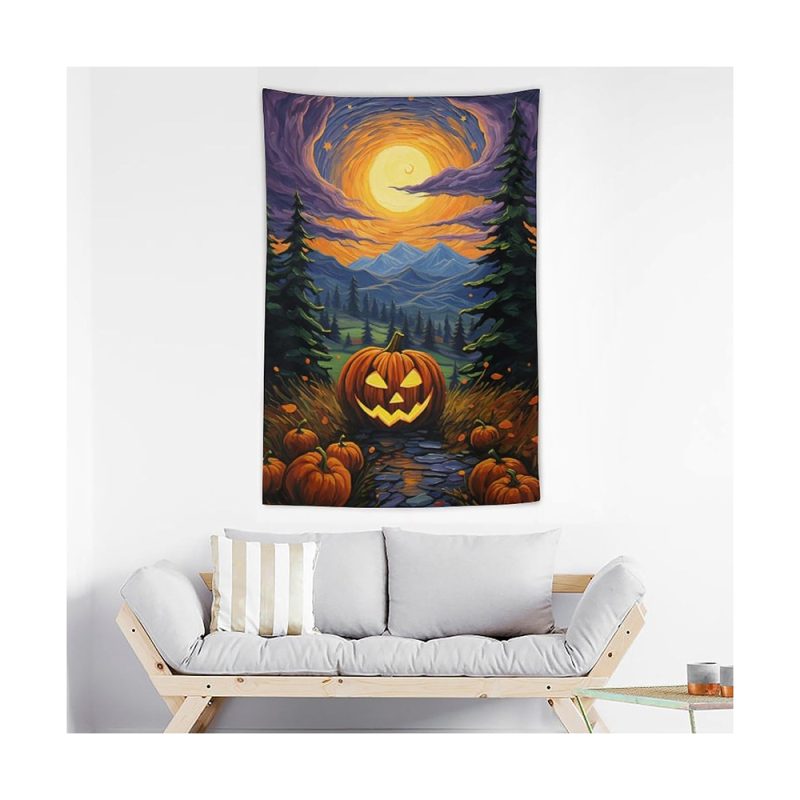
This panel owns the winter-backdrop corner of the wall program. For the rest of the seasonal calendar, the Halloween edition prints the October lane on the same cloth and file pipeline, and the general printed tapestry page covers year-round artwork programs for galleries, dorms and photo-print resellers. All three live in the tapestries category beside the wider home-textiles line, where backdrop buyers often add printed throws as the gift attach next to the wall art.
Send the File, Run the Countdown
Artwork, panel count, layout choice and in-season date to the quote desk: the reply carries the digital mock-up, flat-versus-rolled carton math, and a production slot named against your October deadline — before you commit, not after.