Acrylic Standee with Moving Parts | Spring-Mount Cutouts
$1.80
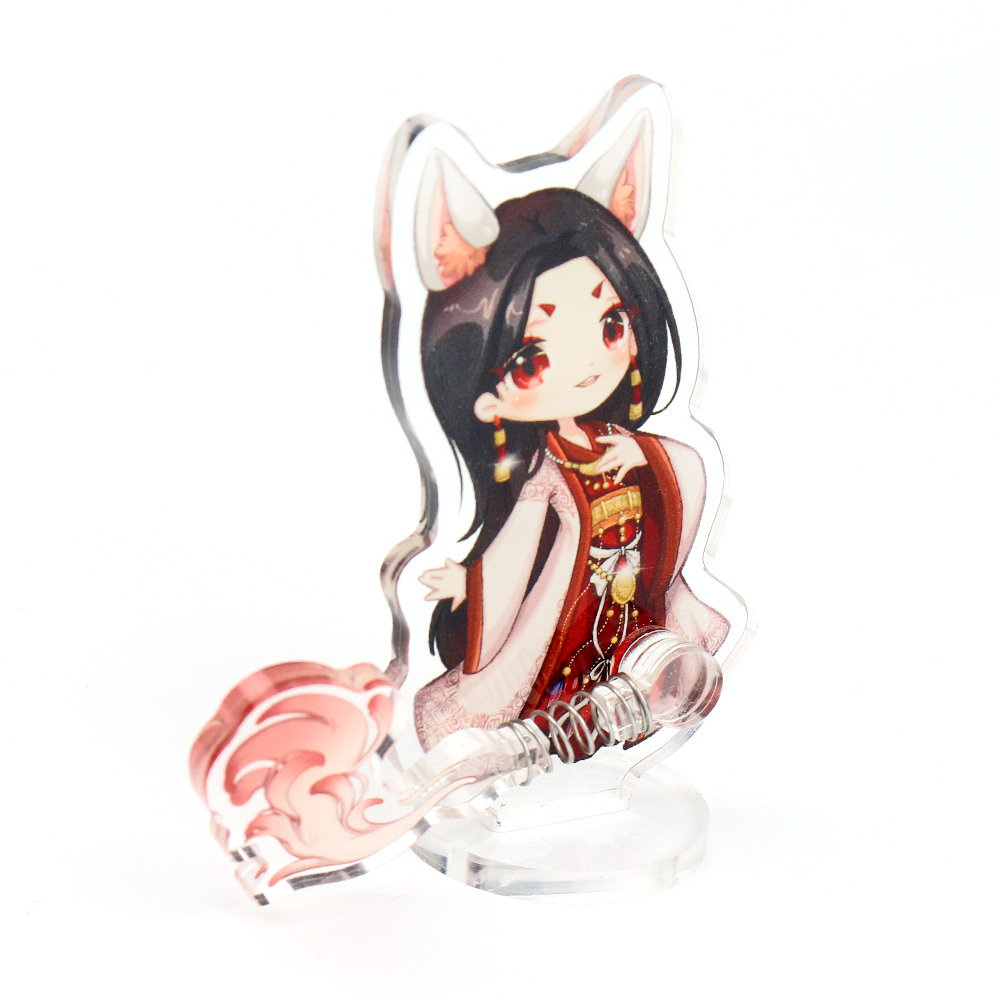
A custom acrylic standee with moving parts on this line means one proven mechanism: a contour-cut printed figure whose tab seats into a metal coil spring anchored in a clear base, so the whole character leans, wobbles, and settles when tapped at a booth or counter. The samples show the full anatomy — silhouette-cut sheet with polished edges and a thin clear margin, the helical wire joint, and unprinted block or dome feet scaled to figure width. Slider and flap linkages are engineered separately and quoted on request against a mechanism sketch. MOQ 100 pcs per design, samples in 3-5 days tuned to your figure’s weight, bulk 7-15 days after artwork approval. Components ship bagged separately — cutouts flat, coils sleeved, bases interleaved — so replacement is a part, not the unit, and FBA prep runs on the same packing line.
A custom acrylic standee with moving parts lives or dies on one component nobody photographs well: the joint. On this line the joint is a metal coil spring seated between a die-cut printed figure and a clear block base, and the finished piece does exactly one kinetic trick — it wobbles. When a customer at a booth table taps the figure, the spring absorbs and releases the energy, the character leans and settles, and the piece earns three more seconds of attention than any static print on a shelf can buy. That interaction is the product; the artwork rides on top of it.
Positioning first, because this format gets confused with its cousins: if you need a portrait likeness on a rigid panel, that is the photo-standee branch; if you need a premium solid keepsake, that is the block branch. This page is for the toy-adjacent buyer — expo merch, kids-line collectibles, counter giveaways, content drops where movement is the hook. MOQ 100 pcs per design, physical samples in 3-5 days, bulk 7-15 days after artwork approval.
Anatomy of the Assembly, Piece by Piece
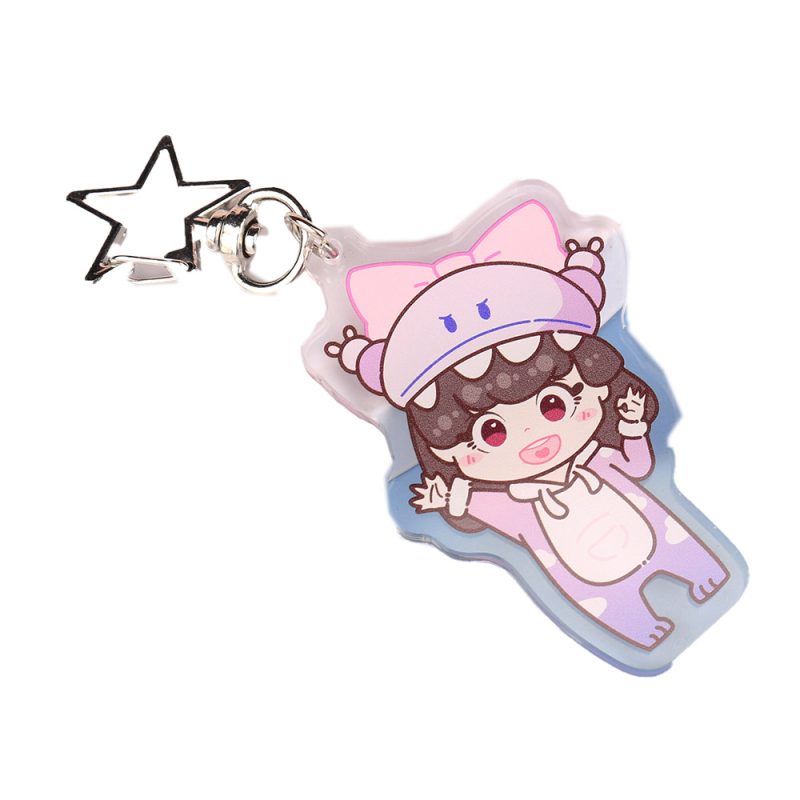
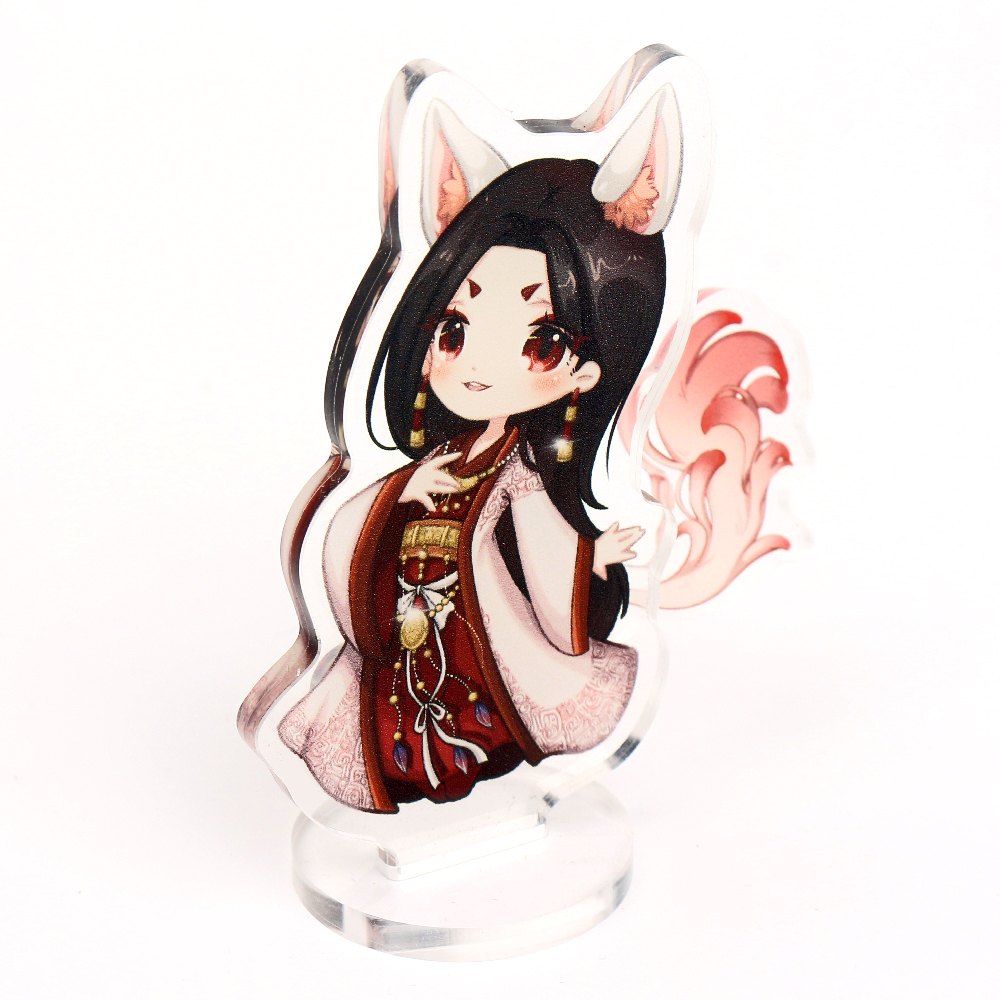
Three components, no adhesive, no tools. First, the figure: a contour-cut sheet of clear acrylic with full-colour artwork printed inside the silhouette, the cut path following ears, hair, robe, and — in the sample shown first — a long tail sweeping out to one side. A narrow rectangular tab extends below the figure’s hem; that tab is the interface that carries the character into the mount.
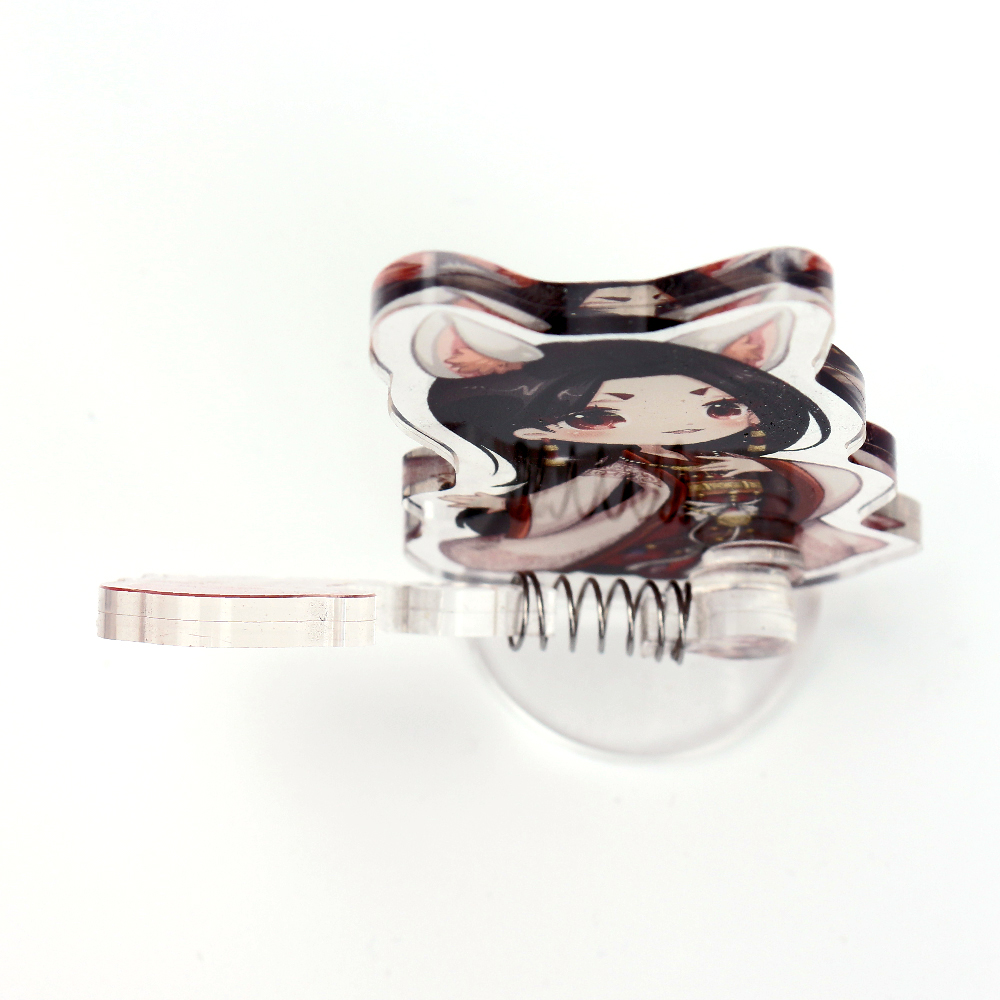
Second, the coil: a short helical metal spring, several turns of wire, fixed at its lower end into the base and receiving the figure tab at its upper end. In the studio shot it sits low-right of the figure, holding her reclined at a few degrees off vertical — the angle that makes a wobble figure look about to move even in a still photo. Third, the base: one sample uses a flat clear block with a central slot; another shows the coil footed into a rounded dome. Both bases are unprinted, fully transparent, and sized to the figure’s width so the hardware disappears under the character.
The cut itself deserves attention because it is where quality shows. Along the ears and outer fluff, a thin unprinted clear margin runs parallel to the contour — the laser path leaves polished, refractive edges rather than frosted stress marks, and print-to-cut registration holds even through the tight turns of hair strands and tail lobes. A silhouette cut that drifts a millimetre reads instantly as cheap on a counter; the studio pieces are the standard you are buying against.
Two sample bases in the set tell you more than a spec card. The oval block version sinks the tab deep and hides the coil root completely — right for retail units a stranger will handle, because there is no gap for a fingernail to lever the figure off its spring. The dome-foot version in the third photo leaves the coil visibly exposed, which reads playful on a display shelf and costs nothing extra; the same photo also shows a loose flat tab component resting beside the assembly, the kind of alignment piece that ships with multi-layer figures so crews index the insert before pressing it home. Neither base is printed on the samples, which is the default — an unprinted foot keeps the unit at one artwork surface and one price line, and a logo band on the foot, if a brand wants it, is a second print pass quoted separately against the same gauge.
Why a Spring, and What Else Moves
Every moving-part claim on this page is bounded by what the photos prove, so here is the honest split. Proven and stocked: the spring-wobble mount described above — one assembly, one motion, tuned by wire gauge and turn count to the figure’s size so a small desk piece settles in under a second and a taller expo figure keeps swaying a beat longer.
A spring earns its place in this format for reasons beyond the motion itself. It carries no tooling of its own: the coil is a standard component matched to your figure, which is why a new character on the same spring-and-base spec does not restart the clock or add a mould to the cost sheet. It survives vertical compression in a shipping carton far better than any rigid glued joint, since a coil simply returns to shape while a bonded tab snaps once. And it invites touch — a static cutout asks to be photographed, a wobbling one asks to be poked, and at a convention table the difference between those two behaviours is the difference between a glance and a purchase.
Requested often and engineered case by case: slider windows that push one printed layer across another, hinged flaps on doubled cutouts, and lever linkages for booth installations where a visitor’s pull moves an arm or a prop. Those routes need a mechanism sketch, not a stock card, so they quote on request against your artwork and target size — the desk will say plainly which motions survive 100-piece production and which ones are beautiful prototypes that never clear a bulk run. The tail on this product’s name is printed motion on a wobbling body, exactly as the samples show; anything more elaborate is a project conversation, not a hidden promise on this listing.
Artwork Built for a Cutout That Bends
Designing for this format changes two habits from flat artwork. Read the silhouette first: the cut line wants a character with limbs, ears, tail, or hair that give the contour personality — a square torso with nothing sticking out cuts down to a rectangle no matter how good the drawing is. The sample fox character works as merch precisely because her ears and tail sweep outside the body mass, and the spring mount lets that tail shift a few millimetres when the piece wobbles, which reads as the tail itself moving.
Weight distribution is the second habit, and it is invisible until you order by feel alone. A cutout top-heavy at the head — big hair, oversized props — holds its lean differently from one with mass low in the robe, because the tab sits under the figure’s centre and the coil has to carry that offset without sagging toward one shoulder over months on a display shelf. The studio pieces land their mass low and rearward, which is why they sit upright instead of nose-diving; if your character design is head-heavy, the desk tunes the anchor point and spring pairing to compensate, on your quote, with your file, before the mock-up closes.
Then plan the tab zone. The insertion tongue below the hem is unprinted working hardware — art that runs down into it gets bisected by the coil joint, and fine detail there snaps under repeated wobble. Keep the lower third of the composition simple, mark any area you want held clear, and send line art at print scale; the free digital mock-up lays your figure onto the cut path and tab position so nothing important disappears into the mount.
Who Buys Kinetic Standees by the Carton
The reorder list reads like a toy trade floor plan: convention booths that sell the wobbling character at the same table where they display it, café and shop collabs that want counter pieces customers touch, kids-line brands packaging a figure-and-spring set as a shelf-ready two-part unit, and creators running a drop where the movement is the reveal. Each of them reorders on the same logic: the mechanism is fixed, the artwork rotates — a new character slotting onto the same spring-and-base spec is a new design line, not a new tool.
For mixed launches, quantities split per design against the 100 pcs per design floor, and a booth kit of three characters in one size runs as three qualifying lines in one carton group. Double-sided printing — same art mirrored, or a second pose on the back for aisle-facing placement — is offered on this format and confirmed on the proof; the studio angles shown here face one side, so treat the reverse as your choice on paper, not a photo claim.
Configuration Checklist
- Figure height and contour complexity — send art with outer shapes the cut can follow
- Spring spec: wire and turns tuned to figure size for settle-speed and lean angle
- Base choice: flat clear slot block or rounded dome foot, scaled to figure width
- Board gauge for your height so the tab holds repeated wobble; thickness quoted on request against a physical sample
- Print: full-colour face art, optional mirrored or second-pose reverse
- Tab and clear-zone marking on the artwork file, confirmed on the mock-up
- Per-unit bagging: figure, coil, and base separated so nothing scratches the print face
- Retail add-ons: hang-hole top cutout or shelf card backing, quoted with the size
Specification Table
| Parameter | This build |
|---|---|
| Item | Moving-part acrylic standee: contour-printed cutout on metal coil spring with clear base |
| Size | Desk to counter heights cut to your figure; dimensions return with the mock-up sheet |
| Board & Thickness | Colourless cast acrylic sheet, polished contour cut; thickness quoted on request against a physical sample once figure scale is set |
| Decoration | Full-colour print inside the silhouette, one face or optional second-pose reverse; white-ink backing for opaque colour |
| Assembly or Mounting | Figure tab seats into coil spring anchored in clear block or dome base; snap-together, zero adhesive |
| Packing | Components bagged per unit with face protection, foam between rows, double-wall export cartons; pallets on request |
| MOQ | 100 pcs per design |
| Sample time | 3-5 days |
| Lead time | Bulk in 7-15 days after artwork approval |
| Capacity | 1,000,000 pcs per month across our gift lines |
The Test We Run Before You Do
A wobble figure has a fatigue problem nobody thinks about until convention day two: thousands of taps, and the tab is the hinge that takes every one of them. The sample route exists so the desk can tune that joint to your piece — lean angle from spring geometry, tab fit snug enough to hold alignment without stress-whitening the acrylic at the coil contact point, and settle behaviour checked on the physical sample you approve, not estimated from your render. Reorders inherit the tuned spec through the stored proof reference, so series six behaves exactly like series one at a booth table.
Freight math follows the same logic: three loose components assemble faster at the venue than any glued single piece breaks in transit, which is why carton counts per design are conservative and weight lands low. Approve the artwork and the clock runs 7-15 days after artwork approval for the bulk lot, with the displayed page figure anchoring the entry tier of a single design — coil spec changes and taller figures re-tier on the quote, and sea, air, or courier legs (DHL, UPS, FedEx, TNT) price from the same packed cartons.
One planning note for first-time kinetic buyers: the sample you approve is a three-part kit, not a photo of a three-part kit. It arrives assembled exactly the way your venue crew will receive bulk units, with the same tab resistance and the same lean angle, because “it stood up in the picture” is not a functional acceptance test. If the wobble settles too fast or too slow for the character’s personality, that is a spring-geometry change caught at the cheapest possible moment — one unit, three days, before any contour file is nested onto a board sheet.
Carton Plan for Parts That Do Not Glue

Because the figure ships outside its base, a carton of this line is three nested populations: printed cutouts face-bagged flat, coils in a sleeve layer so wire tips cannot print through a bag, and clear bases interleaved. The packing build absorbs corner strikes the way any acrylic export carton must — rigid double-wall board, foam between rows — but the split-population plan is what keeps the last-mile failure mode of this format (a bent coil reading through a bag and crushing a print edge) off your restock shelf. FBA prep, carton marking to your SKU scheme, and mixed-design loads all run through the same line; tell the desk which population counts matter for your shelf display and it adjusts the ratio before the first carton closes.
What exactly moves on these spring-mounted figures?
Will repeated handling at a booth wear the joint out?
Can the same spring-and-base spec carry six different characters?
Is the figure printed on both sides?
How do replacement parts ship if a coil or base breaks?
Related Lines Worth a Second Look
The standee category keeps all three motion-free formats one click apart: compare the printed photo panel with slot foot for likeness drops and the solid illustrated block for premium keepsake tiers before you split a budget. The acrylic items parent index reaches the engraved recognition branches — disc plaques with stands, faceted sports boards, and ribbon medals — for buyers consolidating merch and awards into one container. Non-acrylic print runs sit in printed items. Mechanism ideas, figure heights, and launch dates go to the request-quote desk in a single message.
Prototype the Wobble Before the Drop
Send the character art and a target height; the desk returns the cut-path mock-up and a tuned sample in the 3-5 day lane. One joint, one motion, proven on your file before a thousand units commit to it.