Custom Acrylic Photo Standee | Likeness Prints From 100 pcs
$1.50
Our custom acrylic photo standee puts one uploaded portrait straight onto colourless cast board: full-colour direct face print, optically polished edges, rounded corners, and a low clear slot-foot that holds the panel at a slight rearward lean. The studio samples show two orderable layouts — print inset behind a transparent frame margin, or artwork running edge-to-edge to the cut line — plus optional see-through zones left bare inside the design. MOQ is 100 pcs per design, so multi-portrait drops plan cleanly; samples leave in 3-5 days and bulk runs 7-15 days after artwork approval. Every order starts with a free digital mock-up that checks crop, DPI, and head placement against the slot line before tooling. Panels ship individually poly bagged with foam interleaves in rigid export cartons, by sea, air, or courier, with FBA prep available. Send the file and the target height to price the tier.
A custom acrylic photo standee is the fastest way to turn one uploaded portrait into a retail-ready display piece: a printed face on optically clear board, standing on its own at a checkout counter, a birthday table, or a convention booth. No frame, no insert sleeve, no assembly beyond dropping the panel into its base. The panels below are studio samples with photographic artwork; your own file replaces them 1:1, and every purchase order starts from a free digital mock-up so you see the print before any board is cut.
For buyers reselling likeness products — fan-gift shops, event decor suppliers, personalized-gift e-commerce sellers — this listing covers the whole path: artwork checks, board and gauge choice, print route, base selection, bulk packing, and the numbers that matter for planning (MOQ 100 pcs per design, sample time 3-5 days, bulk lead time 7-15 days after artwork approval).
What the Studio Samples Actually Show
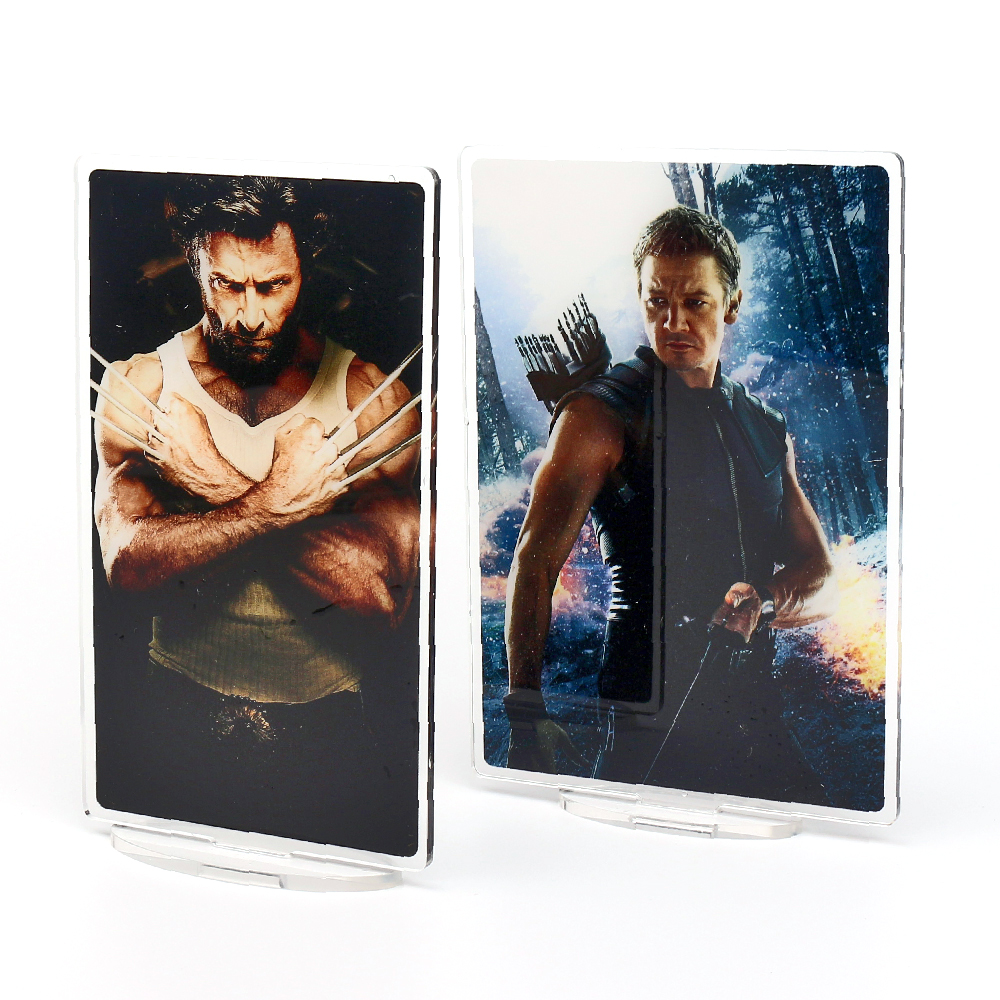
Two portrait panels stand side by side in the first shot, each dropped into its own clear slot foot. Read from that photo the construction details you can verify before you order:
The panel bodies are colourless cast acrylic with no visible tint. Corners carry a moderate radius, and the exposed side of the left panel shows a wide, optically smooth slab edge — a cut piece with a polished finish that refracts light along its length instead of throwing a frosted white line. On that sample the photographic print is inset from all four sides, leaving a transparent picture-frame border; the right-hand sample carries one see-through rounded-rectangle zone inside the image area, which is how optional clear panel zones read when a design wants bare acrylic showing through the artwork. The bases are low, unprinted, fully clear blocks with a centred slot; each panel leans back slightly in its foot, the geometry that keeps a desk-height display visible from a standing viewing line.
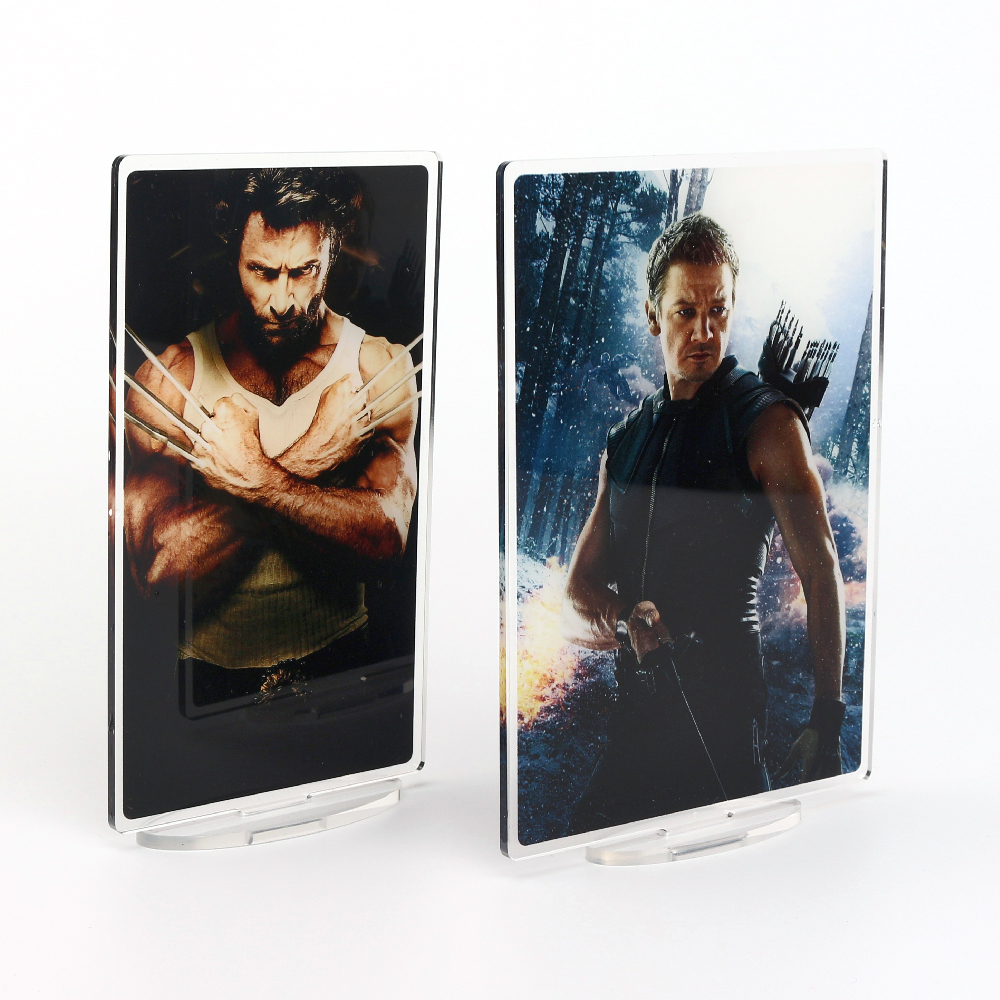
Two layout variants are visible across the pair set, and both are orderable: print inset with a clear margin (frame effect, and it hides corner handling marks), or edge-to-edge face print where the artwork runs to the cut line. The second studio view shows the same two characters printed to the trim, with the clear board catching light at top and side.
Print Route: Full-Colour Artwork Straight onto Clear Board
The face you see is a direct full-colour print on the acrylic — photographic greys, skin tones, dark backgrounds, and the brights of a forest scene all reproduced without a paper insert or a laminated film in between. That matters at the 100-500 piece tier because there is no second component to source, no insert that shifts in transit, and no colour drift between two supplier lines: one file, one printed face, one cut contour.
Files that survive this process best are high-resolution portrait crops — the sample art is film-still grade. If your upload is a phone snapshot of a printed photo, the free digital mock-up is where we flag softness before the plate runs, not after. Colour-managed proofing comes with every design; send the artwork at its intended print size and the prepress team returns scale, DPI, and bleed notes on the same proof, marking anything that will fall inside the slot line once the panel is seated in its foot.
Two colour-behaviour notes that change how a print reads on clear board. Dark artwork holds saturation well because the pigment sits dense against the transparent body, but a mostly-white or pale-pastel design loses its edges where bare acrylic meets a bright counter surface — resellers running light portrait crops usually ask for the backed variant so the print keeps contrast under shop lighting. And because there is no white paper layer underneath, any area of your file left transparent will print as nothing: the board shows through, which is a design tool for window zones but a defect for a file that assumed a white page background. Flatten to opaque artwork before upload, or mark the transparent areas on purpose.
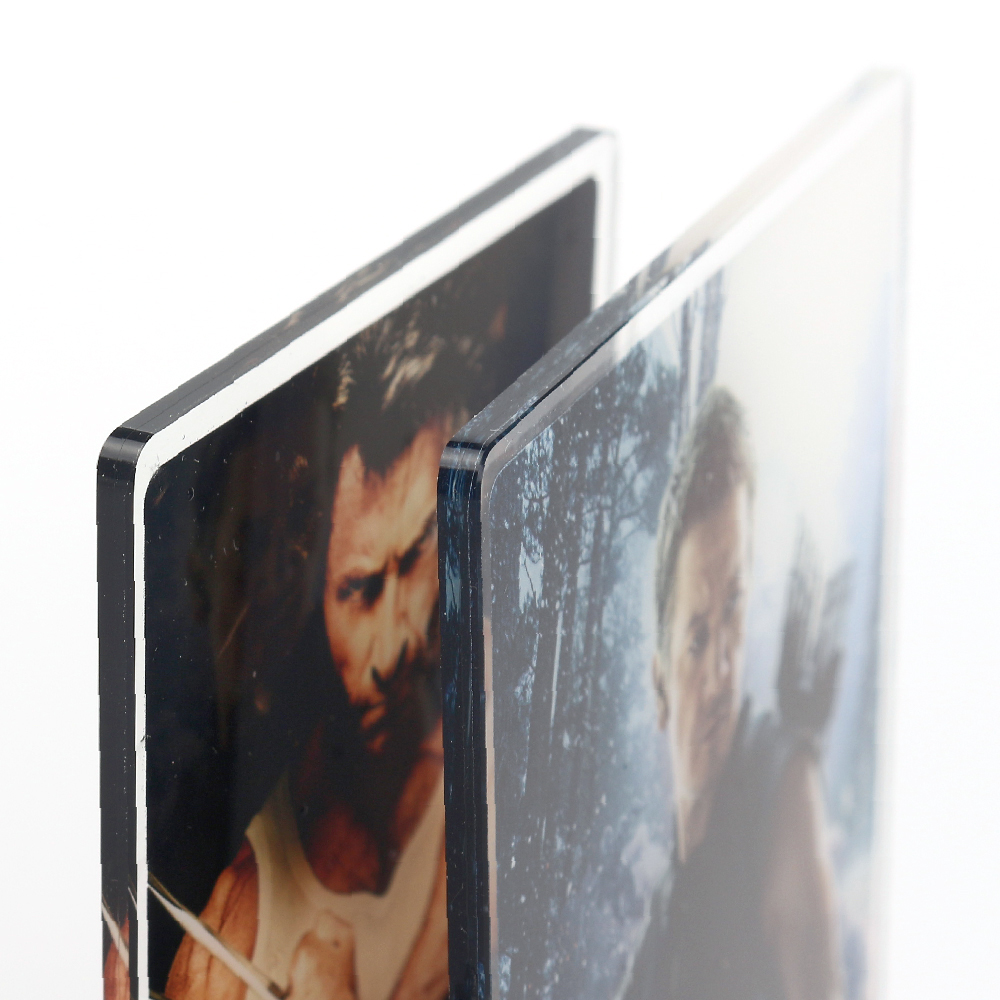
The dark perimeter on the third studio view is a rim finish on the sample set — an edge treatment or backing band that frames the print with a hard outline instead of leaving the edge crystal. If you want the opposite look, polished clear edges on all four sides are the default. Both are quoted together with the board gauge, since rim choices affect which thickness hides handling best.
How the Panel Stands: Base Geometry Worth Copying
Nothing in the photos is glued, screwed, or hinged. The panel bottom edge drops into a milled slot in a separate clear foot, which is why one shipment of thirty pieces packs flat and sets up at the venue in seconds. The foot footprint on the sample pair is compact — sized for the panel’s width, with rounded outer corners and polished faces — so it disappears visually under the print.
Two decisions to make at quote stage. First, whether the slot foot ships paired to each panel (the default for retail units) or in bulk sheets for event crews to assemble on site. Second, whether the panel gets a printed reverse face or stays clear at the back; back-face options are confirmed with the gauge on your target height, because a taller panel wants a heavier foot and the back treatment affects how the piece reads from queue lines behind it.
Slot tolerance is the detail buyers ask about last and regret most. The foot slot on the studio pair holds the panel with light friction fit — enough that a display survives being bumped at a busy counter, not so tight that crews assembling forty units at a venue start hairline-marking the polished edges. If your use case is single-piece gifting rather than venue assembly, ask for the snug variant and say so at proofing; the sample leaves with the fit you tested, and the same tooling reference carries into bulk. None of this is glued at the factory, which is the point: a replacement foot for a shipped-order damage claim costs less than replacing an assembled panel, and your customer can source a spare base from us without reordering printed stock.
Who Reorders These, and on What Calendar
The repeat buyers on this line are not one-off gift customers. They are fan-gift shops restocking a new photo drop, party-supply resellers running a birthday seasonal pack, event decorators who spec one portrait per table setting, and club or studio merchandisers building an anniversary giveaway. All of them share the same math: the design changes, the product body does not.
That split is why the MOQ is written as 100 pcs per design. A fan-gift vendor launching six likeness designs needs six qualifying quantities — or a mix-to-threshold plan we can quote in one line item when the design count is agreed up front. Launch calendars compress hard in this category: birthday season and holiday retail restocks both land inside the same window where courier rates spike, so artwork files for the drop should be locked before the bulk 7-15 days after artwork approval clock starts, not after.
One scheduling detail separates this line from paper printing: the panel footprint does not scale linearly with press time. A run of three hundred tabletop pieces and a run of eighty taller display panels can occupy the same cutting window, because the nesting layout on the board sheet — not the piece count — decides how much material and machine time the order eats. When your quote names two heights in one shipment, expect the desk to split the board into separate nesting jobs and say so on the confirmation, with each job keeping its own proof reference. That is also where the reference figure on the page stops being useful on its own: the displayed price anchors the 100-piece tier of one design at the standard footprint, and anything beyond that gets a fresh line on the quote sheet.
Seasonal timing runs both ways here. Summer convention circuits order likeness pieces in April so the booth stock lands before the first show weekend; birthday and holiday retail restock orders peak in the weeks where air freight tightens. If your drop calendar touches either window, reserve production slots at proof stage rather than at purchase-order stage — the 3-5 days sample lane is short enough to fit inside a compressed schedule, but only if the file review happens while the queue is still open.
The Customisation List Before You Send a File
Every variable below is quoted from the same request, so one email covers the build. Note what is deliberately absent from the list: no metal hardware, no printed backing card, no adhesive step. The value of this format is that a likeness product ships as two plastic parts and one print file, which keeps landed weight low for courier reorders and keeps the assembly step simple enough that a gift recipient does it wrong zero times. When a buyer asks for additions — a logo strip under the photo, a message band in the clear margin, a QR zone for a fan page — those are artwork edits handled on the same proof, at the same tier, not new tooling charges.
- Panel width and height, portrait or landscape crop, corner radius, print-to-edge or inset clear margin
- Board gauge for the target height — thickness options are quoted on request against a physical sample once we know panel scale
- Face print: full-colour photographic artwork, single-sided or mirrored double-sided reverse
- Edge finish: polished clear as default; dark rim or backed framing as the sample variant
- Optional clear zones inside the artwork (see-through windows or unfilled panel areas) where the design calls for bare acrylic
- Slot-foot base size to match panel width; paired-packed or bulk-packed assembly
- Individual poly bag per finished piece, with printed face protected before cartons close
- Your own carton labelling and FBA prep when the order ships into Amazon network flow
Specification Summary
The table below is the short form the sales desk quotes against; numbers inside it follow the standing business terms for this line and nothing else. Read it as a build sheet, not a catalogue card: every row is a decision the mock-up already settled for your design, and anything still open in it (gauge, foot weight, rim treatment) is exactly what the proof comes back asking.
| Row | What we build to |
|---|---|
| Item | Custom acrylic photo standee: printed clear panel with separate slot-in display foot |
| Size | Built to your artwork crop and target display height; panel dimensions come back on the digital mock-up sheet |
| Board & Thickness | Colourless cast acrylic, polished edges, rounded corners; thickness options quoted on request against a physical sample once panel scale is fixed |
| Decoration | Full-colour direct print on the face; single-sided or double-sided reverse; optional clear window zones; dark rim or backed framing variant |
| Assembly or Mounting | Panel bottom seats into a milled slot in an unprinted clear foot; no tools, no adhesive, no frame |
| Packing | Finished pieces individually poly bagged, foam interleaves, rigid export cartons; pallet patterns on the order confirmation |
| MOQ | 100 pcs per design |
| Sample time | 3-5 days |
| Lead time | 7-15 days after artwork approval for bulk |
| Capacity | 1,000,000 pcs per month across our gift lines |
Sampling, Proofing, and the Route to Bulk
Order flow on this listing is deliberately linear. You send the portrait files at print resolution plus the target height; the desk returns a free digital mock-up showing placement, margins, and corner treatment on the exact panel ratio you picked. Approve the artwork and a physical sample leaves in 3-5 days, printed on the board and gauge named on the proof, so the piece in your hand is the contract spec, not a generic stand-in.
Bulk production runs 7-15 days after artwork approval. The reference price displayed on this listing anchors the 100-piece tier for one design; quantities above that, mixed design splits, and courier upgrades are re-anchored on the quote sheet, never guessed from the page figure. For likeness products, one practical warning from the production side: prepress checks portrait crops for head placement against the slot line, because artwork bleeding toward the panel bottom disappears into the foot once assembled. The mock-up catches that before cartons are printed.
What the sample carton contains is worth stating exactly, because buyers compare proofs against it: a finished panel in the agreed gauge, printed on the approved file, seated in the foot you specified, bagged the way bulk will be bagged. Not a blank off the shelf with your JPEG emailed beside it. If a physical step beyond the digital mock-up is required by your own QC process — colour draw-down against a previous order, edge-radius check with a calliper photo — that is what the sample lane in these 3-5 days exists to absorb. The desk keeps the sample on file with your account reference so a later dispute about “what was approved” has a physical anchor, not only a PDF.
Reorders of an approved design skip the proof cycle entirely — files stay on the account and the same spec re-enters the queue directly. That is where the monthly 1,000,000 pcs per month across our gift lines capacity shows up in practice: a restock of five approved likeness designs lands inside a single production week, and the seasonal drops behind it are not competing for the same press slots.
Two paperwork items close the loop once purchase orders are cut. First, the proof archive: every approved mock-up, gauge note, and foot-fit decision stays attached to the design reference, so a reorder six months later does not reopen a conversation three people have forgotten. Second, the carton mark: your SKU scheme, not our internal job number, prints on the outside at the packing line, which is what makes a mixed-height shipment sortable when it arrives split across a dozen boxes. Neither costs a setup fee, and both exist because likeness catalogues grow fast — the vendor who launches six designs in spring is running twenty by autumn, and the account should scale by file, not by meeting.
Packed for Fragile Freight, Not for a Photo Shoot

Acrylic panels ship as flat glass-adjacent goods in behaviour: they tolerate stacking compression but hate point strikes on a corner during the last mile of a courier network. Standard export build for this line — every finished panel poly bagged with a face protector, foam interleaves between rows, rigid double-wall cartons, palletised patterns on request — exists to stop exactly that. Sea, air, or courier (DHL, UPS, FedEx, TNT) all quote from the same packed cartons, so landed-cost comparisons are honest. FBA sellers get label-and-bag prep handled inside the packing line, one carton spec from factory to inbound shelf.
What file resolution does a likeness print need on this standee line?
Can six different portrait designs share one order?
Is the panel printed on both sides?
What does the base on these samples hold, and can it be changed?
How fast can a birthday-season restock arrive?
Where This Page Sits in the Acrylic Range
The full acrylic items catalogue covers every board-based line we cut and print. Inside it, the standee category holds the printed relatives of this page: the illustrated-character blocks for creator and collab drops, and the spring-mounted cutouts when a design needs a moving element instead of a static portrait. Recognition programmes pull from a different branch — disc awards on sculpted stands, faceted tournament plaques, and clear medals on gradient ribbon — and mixed baskets across these lines consolidate into one shipment. Ready to price your likeness drop? The request desk answers with the mock-up, the gauge, and the tier sheet in the same reply.
Start the Mock-Up on Your Own File
Attach the portrait, state the height, name the design count, and the desk returns the proof. Everything above — construction, calendar, packing — applies unchanged to the first sample carton.