Custom Acrylic Bracket Display Stands with Risers | Alice
$3.00
The elevation library for counters and planograms: three-step staircase risers with retaining lips on every tier, inverted-U bridge blocks that stagger into ascending rows, bonded two-tier channel stands, and tilted easel holders with triangular side braces and slot ledges – plus a thirteen-shape montage from one-slot hooks to five-step towers. All clear, all blank, all polished-edge bonded construction delivered built up; step heights, gauge and branding are set from your cells, never assumed. MOQ 100 pcs per design, samples 3-5 days, bulk 7-15 days after artwork approval, capacity 1,000,000 pcs per month across our gift lines, freight by sea, air or courier.
The Custom Acrylic Display Stand With Bracket That Fixes Your Planogram Flatness
A custom acrylic display stand with bracket exists for one commercial reason: shelf space that reads flat sells nothing. Counter and gondola real estate only produces movement when product gets stepped, tilted and lip-caught, and acrylic is the material that does it invisibly – walls and risers that vanish into the display while the merchandise keeps the attention. The five photographs on this page cover the geometry library we cut for shopfitting programs: a three-step staircase riser with retaining lips on every level, four inverted-U bridge blocks that step from short to tall, a single bonded two-tier channel stand, a tilted easel holder with a triangular side brace, and a catalog montage running thirteen shapes from one-slot hooks to five-step towers. Blank, clear, polished edges on all of them – no print, no hardware, no feet – which is exactly the state your planogram files should spec against.
Elevation Economics: Why Steps Beat Flat Trays
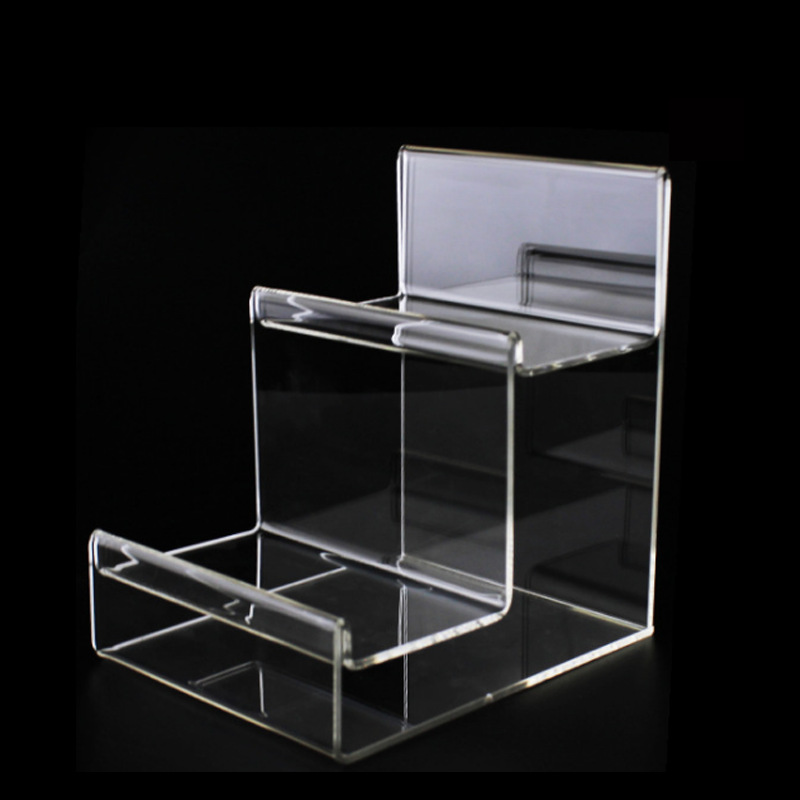
The staircase photographed first makes the planogram argument physically. A base slab carries a rear vertical panel and forward of it two stepped platforms, each finished with its own retaining lip – a small turned edge that stops facings from sliding at a touch or during customer handling. Three horizontal planes become three visible facings rows in the same shelf depth, and because each tier steps up and back, the front of one row never occludes the label of another. The bonded ninety-degree joints visible as fine bright lines are the construction that holds those steps square under continuous handling, delivered built-up so store staff never assemble geometry.
Category by category, the same stand does different work. Cosmetics counters step lipsticks so the shade rail reads under fixture lighting without a demonstrator flipping each tube. Collectible and figure retail lip-caught the front row against convention-table knocks. Tobacco counters use the rear panel to hold price rails while the tiers keep single sticks visible. Confectionery end-caps stack gift sizes by price band. The hardware stays identical; the planogram cell decides the step heights – which is why our drawings start from your facings list, not from a standard catalogue size, and why lip style (downward, upturned rounded, or none, all visible in the photo) gets matched to product depth rather than chosen by default.
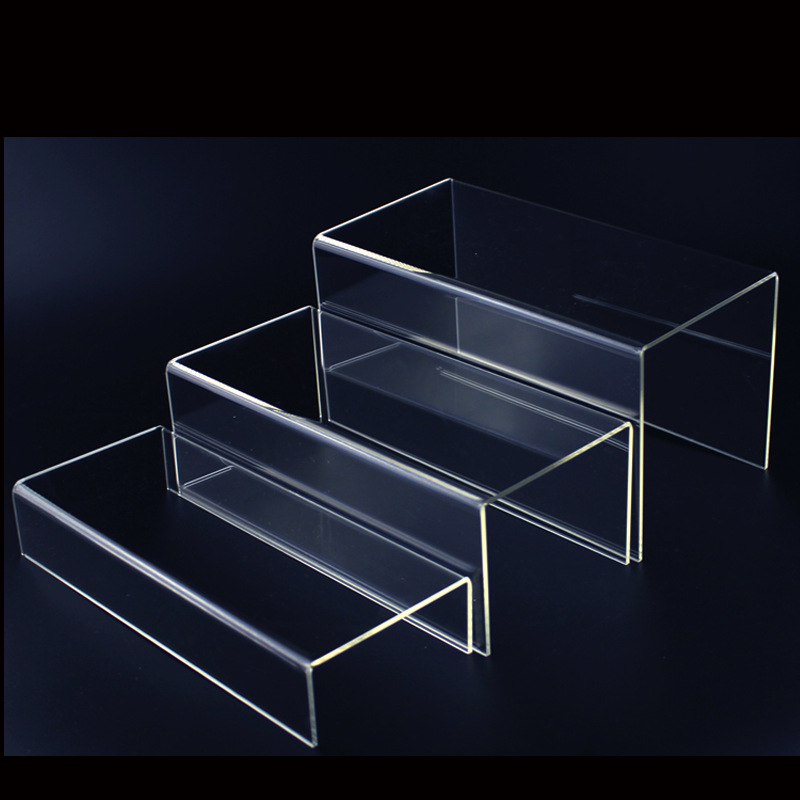
Bridge blocks solve the neighbouring problem: you already have flat shelf sections that need elevation zones, not full staircases. The four inverted-U pieces in the next photograph are open-bottom channel risers – flat top panel, two vertical legs, nothing more – that drop onto a shelf and instantly give a rear row a second plane. Stagger four of them at ascending heights and a planogram tier appears without any permanent fixture change; they slide out for resets, and being single bonded forms, one person moves ten of them in a stockroom pass.
Bridge blocks are also the answer to lease-cycle retail. Chain buyers who cannot drill or glue into landlord shelving need elevation that leaves no trace, and a leg-standing riser clears that bar: no adhesive, no clips, no fixture-approval paperwork with the property manager. Height ladders order themselves too – specify short, medium, tall and extra-tall sets against your shelf depth and the merchandising guide collapses into one back-block-highest diagram for the store team. Because each piece is a single bonded form, a break replaces one block instead of one fixture.
Two-Tier Channel Steps and the See-Through Test
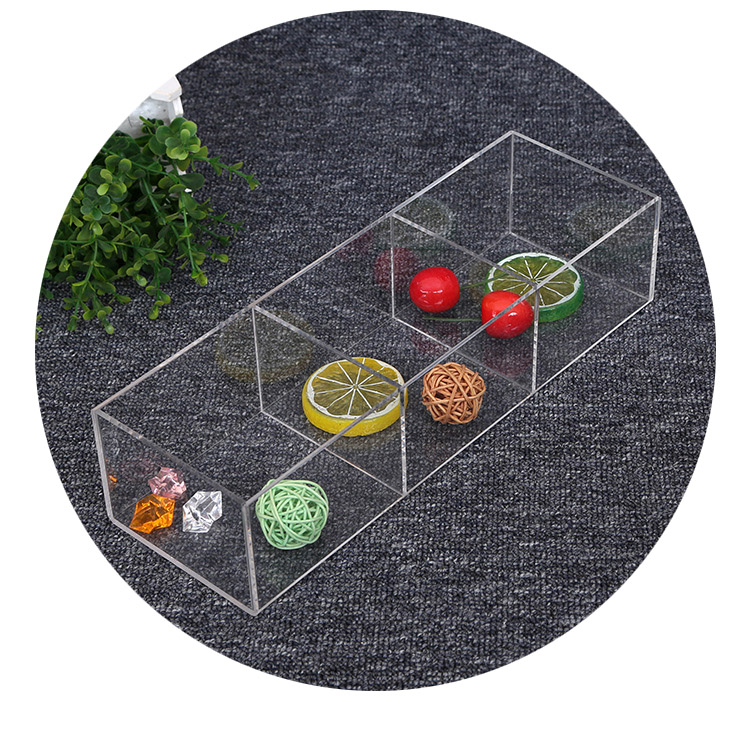
The channel stand photographed next is one continuous bonded form: a lower open platform stepping ninety degrees up into a taller one, open-ended so products load from the side and the rear face stays see-through clear. Look at the upper tier’s front wall in the photo and you will notice a crisp inner rectangle – that is refraction of the back wall’s edges through the clear face, not a printed graphic, and the image doubles as proof of how transparent these panels run. In a planogram, that quality is the reason channel steps replace opaque riser boxes: the product keeps its own background while the shelf gets its second level.
Channel steps earn their place exactly where an opaque riser box would steal light. Tobacco counters run single-stick rows along the lower shelf while the taller tier holds the premium band facing the queue; cosmetics present testers on the low plane and full-price product above it; electronics end-caps angle cables and cases at a hand-friendly reach. The open ends matter for replenishment – staff slide product in from the side without lifting the fixture – and the see-through walls keep shelf-edge labels behind the riser legible through it.
Store-ops language for the manual: channel stands wipe with the same neutral cleaner as the rest of the acrylic set, spare units keep their protective film in the fixture crate between resets, and a corner that took a hard knock gets re-polished at the shop instead of scrapped. Because step heights vary while the side geometry stays identical, mixed sizes nest end-for-end in one carton – the packing note further down covers how they travel to the store. Because step heights vary while the side geometry stays identical, mixed sizes nest end-for-end in one carton, which is how a chain order ships five planogram formats without five separate pack lines.
Tobacco counters are the unglamorous customer for this shape: price rails mount on the rear edge, the lower channel holds single sticks at hand height, and the upper tier keeps the box-format product facing the queue. Because the stand is one bonded footprint with open sides, restock slides in from either end without lifting the fixture off the shelf, and the transparent front wall means the planogram photo sent by head office matches what the store actually built. Store staff also read the geometry without training: a two-tier channel has one obvious loading direction and one obvious facing side, so reset crews build it correctly on the first pass and the visual audit photos come back consistent between stores.
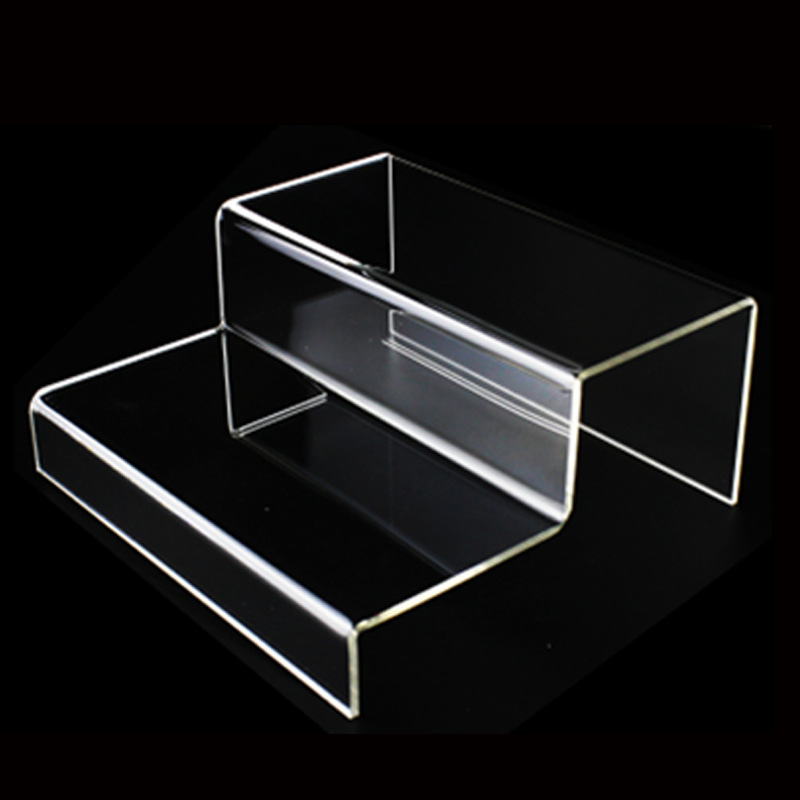
Two words on the refraction detail, because procurement teams mistake it for a spec: that inner rectangle in the photograph is the back wall’s polished edge seen through the front wall, and it is the clearest proof of panel flatness available in a catalog shot. Warped or thin injection-molded stands bend that image; a bonded optical sheet keeps it crisp. Judge your other suppliers’ samples by the same look before anyone signs a planogram fixture order.
The Easel Bracket: Angled Reading for Cards and Boxes
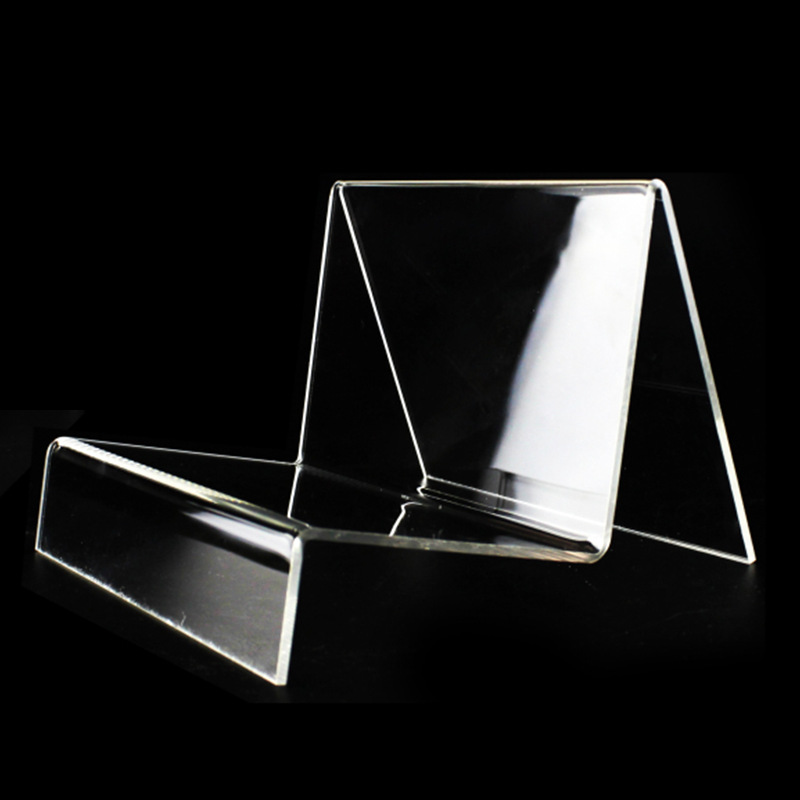
Tilted holders do the job lips and steps cannot. The easel photographed here sets a back panel leaning roughly seventy to eighty degrees – the angle a sales associate uses when they prop a card for eye-level reading – braced by triangular side panels that double as the support feet. Along the front, a slot ledge with an upturned rectangular lip registers whatever slides in: signage, price narrative, photo-format collateral, or a slim boxed good standing upright. Because the brace is integral, nothing tips when a customer lifts the card out, and the base stays a single bonded footprint that clears the shelf edge without hardware.
Easel holders cover the collateral job the risers cannot. A signage card is structurally just a lean angle, and this geometry keeps that lean honest under daily handling: slot lip depth follows your thickest insert, tilt adjusts per card format at drawing stage, and a mirrored-back option bounces overhead light across the print instead of shadowing it – useful under glass shelf strips where the fixtures miss the counter face entirely. Chain programs print the card centrally and ship the holders, so a price update becomes a paper swap rather than a fixture reorder. Pop-up retail favors this format for one reason beyond optics: the holder is the cheapest fixture in the crate, so collateral gets updated weekly while the risers stay in service untouched.
Read the easel photograph against the two risers above it and the fixture logic closes: steps and bridges handle product depth, the easel handles message height, and all three share the same clear sheet, the same polished edge, the same decoration zones. A counter program that specs only one of them merchandises half its sightlines. The same clarity sells the format internally: one line in the merchandising guide – ‘easel for messaging, risers for product’ – keeps collateral and merchandise from competing for the same sightline.
Set the easel beside a staircase and the division of labor is obvious on-site: risers carry volume, the holder carries the message, and nothing in either needs a fastener, a bracket or a battery.
The Thirteen-Shape Family and How to Read the Montage
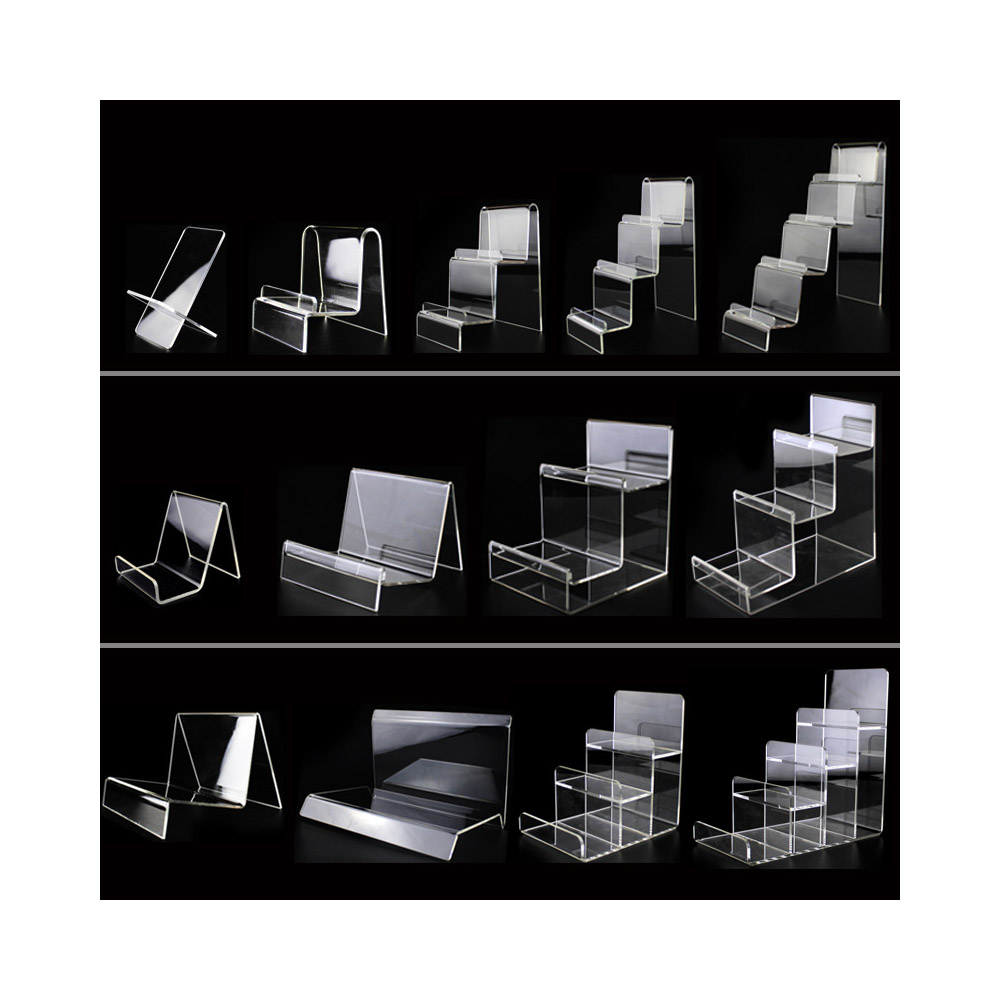
The catalog photograph is the purchasing document, so read it properly. Its top row shows thermoformed-style holders whose back panel curves over the top into a rounded hook – single-foot through five-step staircase, five sizes of one idea, the hooked back letting cards and tags hang past the apex. Middle and bottom rows show the folded-or-glued flat-top school instead: easel holders in small and wide formats, broad single-slot trays, and two-, three- and four-step towers, every unit blank clear stock with polished edges catching the studio light as white glow lines.
Two forming routes, one sheet list: the rounded hook backs are heat-formed while the flat-top series is cut-and-bonded, and the montage exists so a buyer can point at rows instead of writing paragraphs. There are no dimension callouts printed on it, and none are invented here – footprint, step heights and sheet gauge come from your planogram cells and are fixed on the drawing you approve. Order logic across the family is per-design: pick the five shapes your chain actually resets, each carrying its own 100 pcs per design step, and the whole fixture pack lands on one production schedule.
Reading the montage as a purchasing document has one trap to avoid: those thirteen silhouettes are geometry families, not stock-keeping units. The order is cut from the family – the hook-back that fits your card depth, the staircase whose step height matches your facings, the easel whose slot takes your collateral thickness – which is why the free digital mock-up redraws the row you pointed at instead of shipping whatever the photograph happened to show.
What Is Customizable on Every Bracket Stand
- Step count and step height per planogram cell, from single platform to five-tier towers as in the montage
- Lip style: downward, upturned rounded or absent, chosen per product depth
- Bridge riser height ladders so staggered rows stay visually even
- Easel tilt angle and slot lip depth for card thickness or boxed goods
- Sheet gauge fixed per load and size; specified at sample, never assumed
- Faces: clear standard, with tinted, frosted or mirrored back panels quoted on request
- Branding on rear panels or base bands by screen print, UV print or laser engraving
- Retail extras: hang-hole drilling, shelf-rail notching, numbered batch marking
Before the montage goes into your sourcing file, one discipline applies to every shape in it: acrylic risers live or die on flat seating. A store team that sets a staircase on a warped shelf strip sees every wobble as a fixture defect, so the drawing should note the shelf tolerance your stores can actually hold, and sample review should happen on a real counter rather than a bench. It is a five-minute check that saves a chain-wide replacement conversation after rollout.
Spec Table for Fixture Sourcing Files
| Item | Clear acrylic display riser, bracket stand, bridge block and easel holder family for retail counters |
| Size | Footprints, step heights and tilt angles built from your planogram; montage covers single-step through five-step formats |
| Board & Thickness | Clear acrylic sheet; gauge set per stand size and product load, confirmed at sample |
| Decoration | Screen print, UV print, laser engraving on back panels and base zones; frosted mask options |
| Assembly or Mounting | Bonded ninety-degree construction with retaining lips, bridge legs or triangular easel braces, delivered built-up |
| Packing | Filmed faces, guarded edges, cavity-foam export cartons that rack into fixture crates; FBA prep on request |
| MOQ | 100 pcs per design |
| Sample time | 3-5 days |
| Lead time | 7-15 days after artwork approval |
| Capacity | 1,000,000 pcs per month across our gift lines |
Sampling, Production and Reset-Window Lead Times
Retail resets are scheduled like flights, so the supplier clock has to match. Drop the planogram cells and shelf dimensions into a brief; a free digital mock-up answers with geometry first – step heights, lip positions, brace angles – before decoration is discussed. Physical samples in 3-5 days let your visual-merchandising team seat the actual product and judge whether a tier height is right, which no render settles. Bulk follows 7-15 days after artwork approval against month capacity of 1,000,000 pcs per month across our gift lines; chain rollouts get split by store cluster inside that window. Reference cost is built at the hundred-piece tier, moving with gauge, step count and finishing – never a posted unit price.
Cluster rollouts split packing inside the same production window: store-A cartons and store-B cartons build from one approved drawing, labelled per destination at pack-out, so regional distribution centers never break down fixture crates to redistribute hardware between themselves. The unit count that matters for a chain quote is the design count – five shapes across forty stores is five designs, and the hundred-piece tier applies to each.
Protecting Edge Glow From Factory to Fixture
A riser’s polished edges are its selling feature and its injury point: chipped corner lines and swirl scratches are what make acrylic fixtures look cheap. Every stand ships face-filmed with edge guards on lips and brace tips, packed cavity-to-cavity in foam inside double-wall cartons that stack into fixture crates without panel pressure. Freight goes sea, air or express (DHL, UPS, FedEx, TNT) on the same packing standard, and FBA prep builds labelled cartons when fixtures route through fulfillment. The packing chart below shows the layout your receiving dock should expect.

Planogram and Procurement FAQ
Can I mix five different step heights in one order?
Do the bridge blocks need glue to hold the row together?
How steep is the easel angle and can it change?
Will UV print survive counter cleaning with alcohol wipes?
Can the staircase carry heavy boxed product without shelf sag?
Are rounded-hook holders and flat-top holders the same price?
Adjacent Hardware Pages and the Category Path
When a fixture program needs enclosures, not just elevation, our map is deliberate: lidded keep-case cubes for small premium goods are specced on the display cube page, closure-hardware humidor cases for tobacco counters argue their case on the humidor listing, open gift trays for jewelry presentation live on the gift box page, and event-side pyramid dessert stands are built on the cake stand page. Award and recognition formats sit in the acrylic awards category, cut-out retail presences in acrylic standees, and the full format list stays under acrylic items.
Send the planogram cell or a shelf photo; the riser gets drawn to it, mocked free, and quoted per design at the hundred-piece tier before your next reset window closes – or use the request-quote desk.