Custom Playing Cards with Logo – Themed Tuck Box Decks
$1.20
Custom playing cards with logo programs built as full illustrated decks: artwork across the tuck box front, spine and end panels, full-bleed design on every card back, and a clean face system with corner indices the fan photo proves legible from king down to ace. The sample deck shows matte printed board under a shrink-sleeved cream carton, detective-genre pictogram art used purely to demonstrate print range, not a line we sell. Bars, breweries, Kickstarter studios and promo buyers order 54-surface brand systems from one vector file. MOQ 100 pcs per design, free digital mock-up, sample decks in 3-5 days, production 7-15 days after approval, FBA labeling handled in-carton.
A logo on a tuck box is a small billboard that sits in a coat pocket for years. Custom playing cards with logo programs work because a 54-card surface gives a brand far more print real estate than any flyer: front face, card back, box panels, even the joker slot. This page is written for bar programs, brewery taprooms, board-game Kickstarter add-ons and promotional deck buyers, and it walks through exactly what the photographed sample deck proves about our production.
What the Sample Deck Proves About Our Print Range
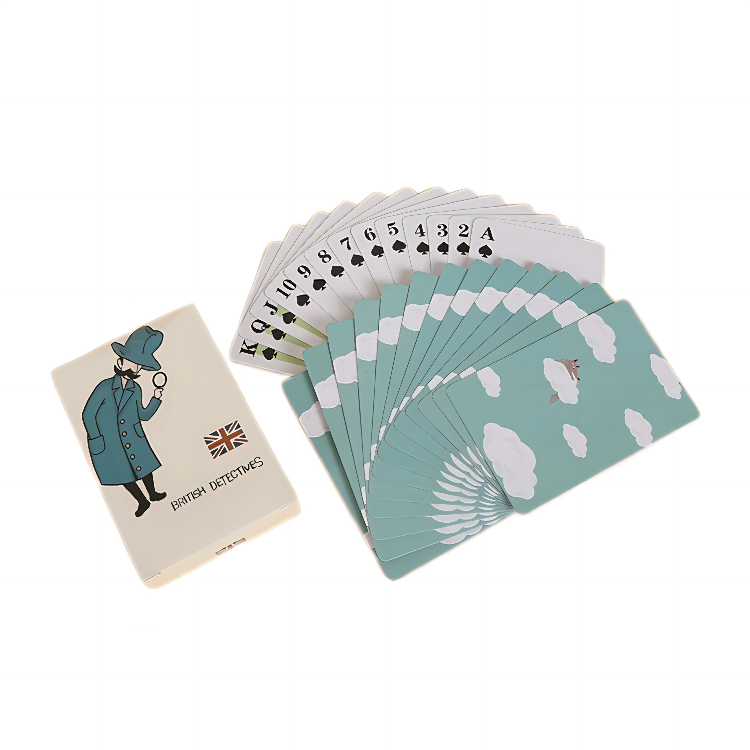
The first photograph lays the deck out the way a purchasing manager should inspect it: box on one side, two fanned arcs on the other. One fan shows faces, the other shows backs, so a single image answers both halves of a spec sheet. The faces are white cards with black spade indices stacked rank-over-pip in the corners, running K, Q, J, 10 down to A, a complete thirteen-card suit run with deliberately minimal central artwork. The backs carry a full-bleed teal field with white cloud shapes, a scalloped cloud row along one edge and a small bird-and-wing motif. Everything reads flat and matte with no metallic and no relief, consistent with coated paper stock rather than a high-gloss sheet, and the box body is cream folding carton.
Reading a Deck Photo Like a Buyer
When a purchasing team reviews sample deck photos, three questions decide the vendor short list, and each is answerable from the fan layout above. Question one: does the index survive overlap? Fanned cards expose only corner ranks, and here every rank from king down to ace reads cleanly in black on white, which is the legibility standard for dim bar lighting. Question two: is the back art edge-to-edge? The teal cloud field bleeds to all four edges of the visible backs with no white border, meaning your pattern artwork will not be judged against a mis-registered margin. Question three: what finish is actually on the sheet? No glare lines the faces, so the print is matte and photos of your artwork will preview close to the delivered tone rather than brighter.
That third point carries cost logic. Matte coated paper decks run cheaper per unit than gloss-laminated variants, shuffle noticeably softer out of the box, and break in over weeks of play. A bar buying two hundred decks a quarter usually values deck-turnover price over lifetime durability; a museum shop selling a keepsake deck values the opposite. Both are legitimate specs. Decide which buyer you are before asking for a quote, because the stock choice moves price faster than box decoration does.
Reading the Sealed Box: Panels, Shrink and Shelf Presence
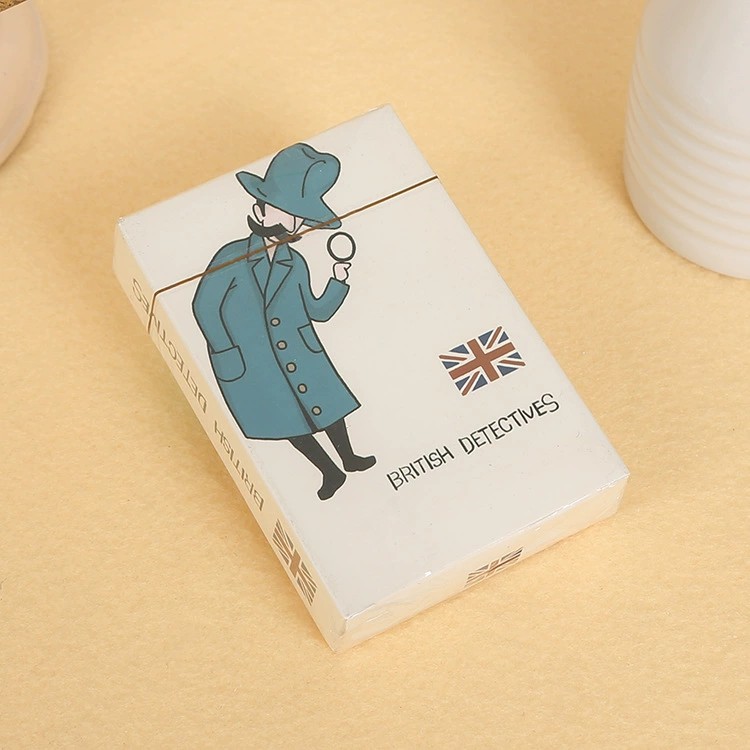
The second photograph shows a sealed deck: the carton stands on a warm-toned surface inside a clear shrink sleeve whose glossy seams belong to the overwrap, not the box. Three printed panels are visible and each does a different job. The front carries the theme illustration: a flat pictogram of a trench-coated, hatted figure raising a magnifier, drawn in solid teal fills with clean dark outlines, beside a muted red-white-and-blue national-flag emblem, with the deck title set beneath in condensed caps. The long side panel repeats the title vertically with a smaller flag near its foot, so a deck lying in a shelf channel still identifies itself. The short end panel carries only a centered flag emblem. No manufacturer name, URL or contact string appears anywhere on the carton, which is exactly how a private-label deck should arrive: your artwork is the only identity on the box.
Retail buyers should note one more thing the sealed photo proves: the cellophane overwrap sits flat with a single diagonal seam, which is the difference between a deck that reads new on a peg and one that shoplifters have already opened. We apply sleeves per your retail spec rather than as an invisible default, so decide during the proofing call whether your channel needs the seal and price it in from the start instead of retrofitting it at a third-party prep center for a surcharge per unit.
For your own programs, those same four real estate zones take your logo on the front, your handle or website on the side spine, a mark on the end tuck flap, and a full illustration across the back of every card. The sample’s detective genre with a flag motif is third-party themed artwork used to show illustration range, not a product we sell as-is.
Fifty-Two Surfaces, One Brand System
A standard deck is thirteen cards per suit plus court treatments, aces, jokers and a back design printed on all fifty-four. That structure creates a natural hierarchy for logo placement. The card back does the heavy lifting since it is the only face visible during play, so a strong back pattern, like the cloud field photographed here, pays out every time the deck hits a table. Corner indices stay functional and black for legibility; your mark sits best in the tuck box art, a joker illustration, or an ad strip on the ace of spades, the traditional showcase card. Breweries commonly run the label as the box front and let the taproom’s founding year ride the side spine. Kickstarter teams use the box to signal the game’s genre and reserve card backs for the world’s map texture. Board-gamers who need custom suits can replace pips entirely, with face counts and index layouts agreed before imposition.
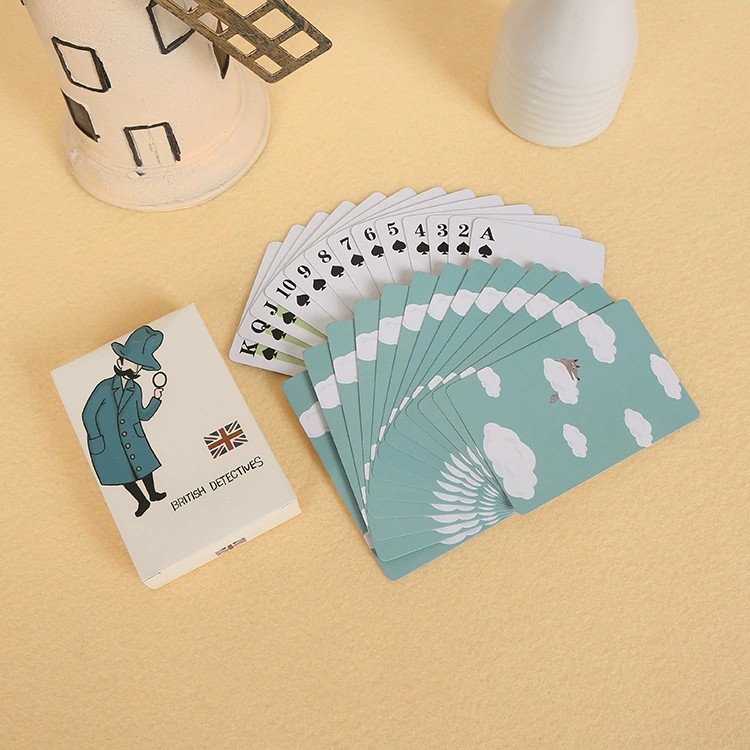
One planning detail trips up first-time deck buyers: the print surface count, not the logo size, drives the quote. A design where all four suits share one template costs less to proof than a deck illustrating fifty-two unique faces, because each custom-drawn face is its own layout to place, crop-check and color-match. Studios commissioning artist-illustrated tarot-adjacent decks budget for that per-face work; promo buyers usually want one strong back, one clean face system and a showcase ace, and land far lower per unit. The third photograph pairs both fans in one frame: the minimalist numbered face system on one arc, the repeating full-bleed back on the other, one deck demonstrating the range between those two pricing poles.
Paper as Photographed, Stock Choices by Quote
Read the evidence straight: every surface in these photos shows a flat matte print with no specular sheen or water-beading, so the photographed deck is treated here as coated paper card stock. We describe the photographed deck only as the images support: flat matte printed board. Heavier or coated sheet options are quoted on request with their own sample run, so you weigh, shuffle and wipe-test before committing quantity. The smooth coated paper in the photographs stays the default cost-per-deck champion, and matte varnish over it keeps proof tones honest. Ask for two sample stacks if your channel splits between turnover pricing and keepsake pricing: one in the photographed board, one in an upgraded sheet, both carrying the same artwork so the comparison is stock, not design.
Finish and Format Choices per Design
- Card size: poker and bridge proportions are the standard pockets; confirm the exact dimension against your box die
- Faces: classic French suits or fully custom pips; index style, court artwork and ace treatments each open for revision
- Backs: full-bleed artwork on every card, edge-to-edge, as the cloud pattern demonstrates
- Box: tuck-carton with tuck-flap, art across front, spine and end panels; shrink sleeve added on request
- Coating: matte as photographed; gloss, linen texture or metallic upgrades quoted against a proof, not a guess
- Jokers and ace of spades: showcase slots for logo, founder mark or campaign line
- Extras: rule cards, sealing stickers, numbered-edition foil stamps discussed as add-ons with the carton spec
Specifications Table
| Item | Custom playing-card decks with illustrated tuck box |
| Size | Poker or bridge pocket proportions; exact dimensions confirmed with your box die (no printed size visible in photos) |
| Stock & Finish | Coated paper card stock, matte as photographed; upgraded sheet and coating options quoted on request |
| Printing & Artwork | Full-color faces, full-bleed back art, box panels printed edge-to-edge; free digital mock-up before platemaking |
| Envelope or Extras | Not applicable; shrink sleeve, rule card or seal sticker offered as deck extras |
| Packing | Individually sleeved or loose decks in fitted inner cartons, export master cartons per freight chart |
| MOQ | 100 pcs per design |
| Sample time | 3-5 days |
| Lead time | 7-15 days after artwork approval |
| Capacity | 1,000,000 pcs per month across our gift lines |
From Logo File to Deck on the Bar Shelf
The order path is short because decks are one SKU. Send vector artwork, a can label or a game’s cover illustration, and we return a free digital mock-up mapped across box front, spine and card back within days. Physical sample decks follow in 3-5 days so you can shuffle the paper, check index legibility at table light and verify the tuck flap opens cleanly before bulk releases. Production then runs 7-15 days after artwork approval. Kickstarter teams usually schedule two waves: a proofing tranche against the campaign launch date and a refill tranche once backer counts settle, and the 100 pcs per design floor makes both waves cheap to plan. Taproom accounts reorder seasonally with new label art while the card back stays constant, which keeps plates mostly reusable. Pricing displayed online anchors to the 100-piece tier as a reference, with volume decks quoted from your actual count.
Packing, Freight and FBA Prep for Decks
Decks ship dense and square: fitted inner cartons that stop corner dinging, export masters with weight declared per your lane, and shrink sleeves applied at line if retail demands them. Sea, air, DHL, UPS, FedEx and TNT are all quotable, and Amazon sellers get FBA labeling plus consolidation with companion inserts in the same carton so inbound appointments stay clean. Gift-set accounts often pair a deck with flat print items in one master, so a holiday bundle arrives pre-sorted.

Deck Questions Procurement Teams Ask First
What does a custom deck minimum order look like?
Can we get a physical deck before approving bulk artwork?
What sheet are the photographed cards made from?
Who owns the artwork we commission for the deck?
How do kickstarter refill waves affect lead time?
Can decks ship with rule cards, sleeves or a numbered seal?
Print Lines That Share Your Freight Container
See the cards category for flat print that bundles with decks, and the broader printed items catalog for carton-mates. Seasonal accounts often consolidate decks with holiday mail cards for one December landing, while retail gift programs pair single-deck SKU volume against festival gift set builds. Ring-bound learning decks for the same shelf live at custom flash cards for kids learning. Ready for a number? Request a quote or write [email protected], phone +86-15967739086.
Send the logo file, name the count and name the ship-by date. Mock-up back within days, sample deck in 3-5, and a shelf-ready tuck box on your bar schedule after that.