Custom Kraft Paper Bags with Logo | Rope & Die-Cut Handles
$0.20
Custom kraft paper bags with your logo, built as working retail carriers: matte brown stock that resists tear propagation, a glued square base that stands open on the counter, and two arched loops of twisted paper cord so the load sits on the wrist. Choose one-colour marks printed straight on tan fibre, white-underprinted colour for brand accuracy, or coated coloured faces over a kraft interior. Handle menu covers twisted cord, ribbon thread-through and die-cut punches on the same size shells.
Order floor: 100 pcs per design | Sample: 3-5 days | Bulk: 7-15 days after artwork approval, on lines running to 1,000,000 pcs per month across our gift lines. Free digital mock-up; sizes, gsm and cord specs quoted on request since none are printed on our photos. Cartoned flat and nested; sea, air or express by DHL, UPS, FedEx or TNT; FBA labelling supported. Message [email protected] or +86-15967739086 with artwork and target in-hands date.
Custom kraft paper bags with your logo, built for boutiques, concept stores, grocery counters and grab-and-go retail where packaging has to survive the walk from the till to the car. Alice Gifts runs this line on printed paper rather than textile: matte tan fibre bodies, glued square bases that let an empty bag stand open on the counter while a clerk packs it, vertical side pleats, and arched twisted cord loops as the default carry hardware. Print decisions on brown stock — one-colour marks, white underprinting, coated coloured faces — take up the second half of this page, together with the handle line-up and the load logic. Order floor 100 pcs per design, free digital mock-up, physical samples in 3-5 days, and full production completed 7-15 days after artwork approval.
Where a Carrier Bag Actually Gives Up
Carriers rarely fail in the middle of a panel. They fail at the bottom glue line, where the folded square base meets the sidewall. They fail at the handle anchors, where the cord threads through the rim and the paper takes a direct peel load every single time the bag is lifted. And they fail wherever a fold wants to run: a small nick at a gusset crease on a coated sheet can open into a slit across the whole face, while the same nick on kraft tends to stop on its own. That third behaviour is the real reason retail keeps specifying uncoated tan stock even when a cheaper alternative exists on the price list. The long, minimally processed fibres in kraft resist tear propagation instead of hiding from it, and the bag behaves honestly about it — it creases, it softens, but it does not unzip down the side panel with a bottle hanging in it.
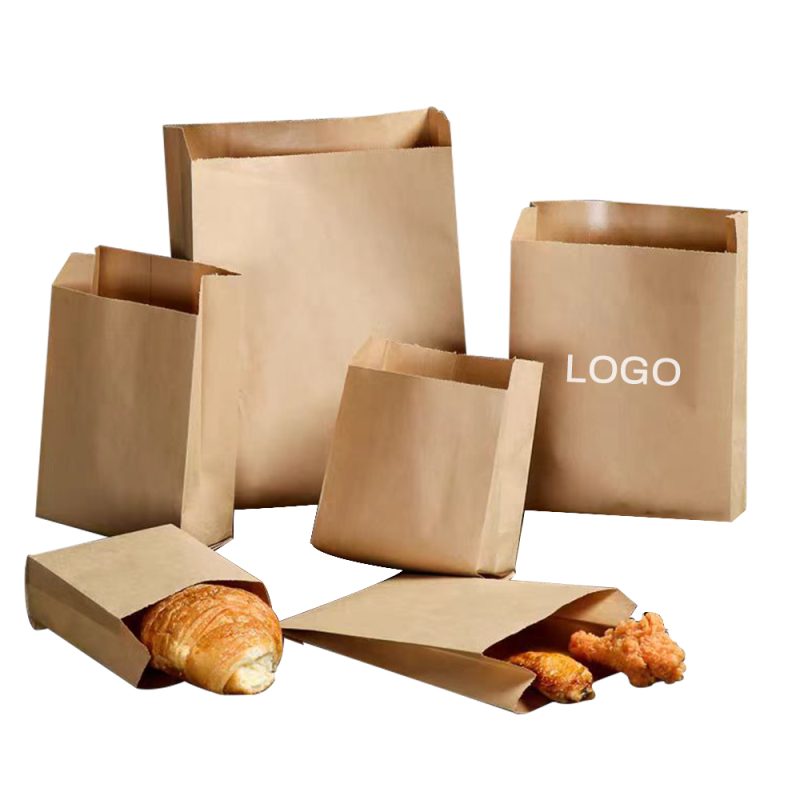
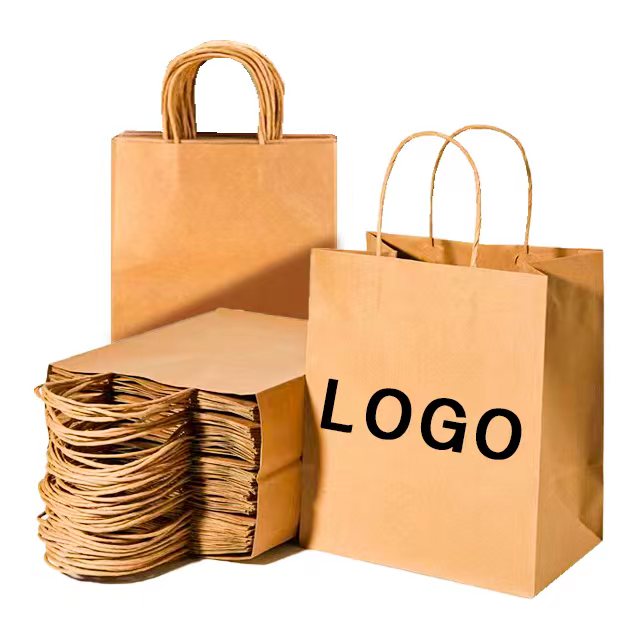
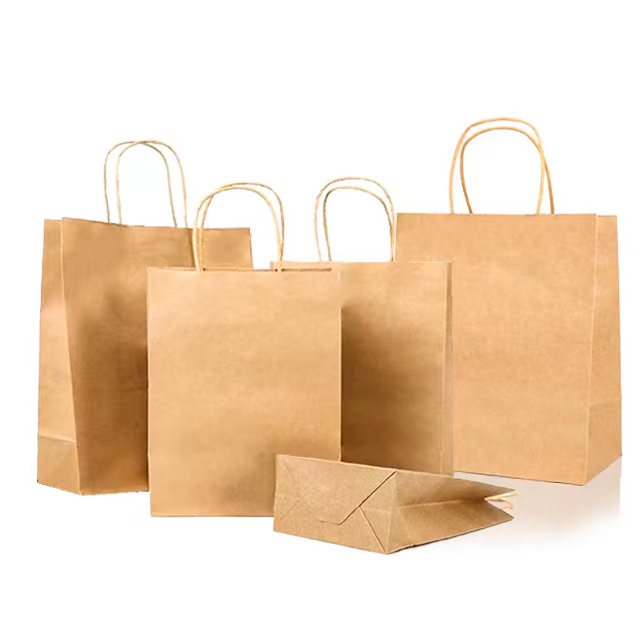
The first photograph shows the family in three states at once: one bag standing blank, one standing with a placeholder print so you can judge mark size against body area, and one nested bundle lying flat with cord loops collapsed into the stack. Those three states are the whole lifecycle you are buying — flat in storage, sprung open at the counter, printed at the till. Nothing in that shot is decorative. The vertical pleats, the folded rim band and the square footprint are exactly the features your staff will work with every shift, and the way the bundle nests is exactly how the carton will arrive.
Handle Line-Up: Twisted Cord, Ribbon, Die-Cut Punch
Every standing bag photographed here wears the same hardware: two arched loops of twisted paper cord, one set into the front edge of the rim and one into the back, anchored inside the bag where the doubled paper gives the adhesive something honest to hold. The helical twist adds grip so the loop does not slide off a smooth sleeve, and the plain paper core keeps the arch soft against a wrist. Cord in natural tan is the stock default; dyed cord in black, red or a Pantone-matched tone is a colour decision, not a tooling decision, and it prices like one.
The full handle menu on this body shape runs to three families:
- Twisted paper cord — the arched loops visible in every photo on this page. Natural or dyed, matched to the body or set in deliberate contrast.
- Ribbon handles — flat woven ribbon threaded through the rim. Sits wider on the hand, drapes better on a gift bag, and takes a hang-tag or bow without a separate accessory.
- Die-cut handles — a grip punched directly through the folded top rim. No extra component, no hand-threading at assembly, lowest unit cost of the three; the standard answer for high-volume counter bags a clerk packs in seconds.
None of these options changes the size shell. The blanking die, the creasing pattern and the bottom former stay exactly where they are while only the handle station moves, which is why one store can run die-cut carriers for checkout volume and cord-handle versions of the same printed artwork for gift-with-purchase — on one file, one delivery, one vendor conversation.
Carry Time, Not Flat-Lay Looks, Decides the Hardware
A cord loop rests on the wrist and spreads load across the joint; a die-cut hole hangs from the fingers and starts biting after ten minutes of walking. If your customer crosses a shopping district with two boxes in the bag, cord or ribbon is the specification, full stop. If a clerk hands a light purchase over a counter and the buyer walks thirty metres to a parking bay, die-cut saves real money at volume and nobody complains about ergonomics they never actually experienced.
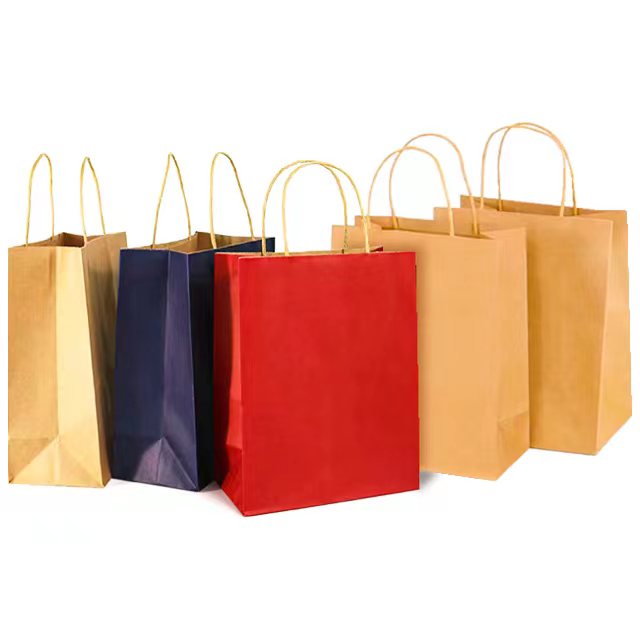
The fanned row in the second photograph makes the second point. Five coated faces — champagne, navy, bright red, two golds — each carrying the same twin cord arches, the pleats visible where the bags overlap. Colour and finish decorate the decision; carry distance decides the hardware. When you send artwork, state the carry scenario in one line and we will put the recommendation plus the price delta between all three handle types on the same mock-up sheet, so the choice costs one email instead of one extra sample round.
Ink Behaviour on Uncoated Tan Fibre
Kraft paper drinks ink. A black or white mark printed straight onto tan fibre reads slightly softer at the stroke edges than the identical artwork on white coated stock, and the sheet’s natural mottling shows faintly through large solid areas. Designers who proof only on a laptop are usually surprised once; after that surprise they either stop specifying hairline serifs for brown paper, or they pay for the fix. We would rather tell you before the sample than after the container lands.
Three control options, listed in cost order:
One — design for the substrate. Bold strokes, open counters, generous clear space around the mark. One colour, one big graphic, lots of bare tan left around it. This is the cheapest pass on press and, honestly, the most recognisable look kraft can produce: heritage grocery brands, bakery logos and coffee roasters built their entire bag identity on exactly this constraint, not around it.
Two — lay white under the colour. A flood-coated white base beneath your brand colour restores saturation against the brown fibre. It adds one press pass and a price step. Choose it when the logo must sit true beside the same mark printed on cards, signage and tape, or when brand colour is the whole shelf presence. It appears as an explicit priced line on your quote sheet, never as a surprise after approval.
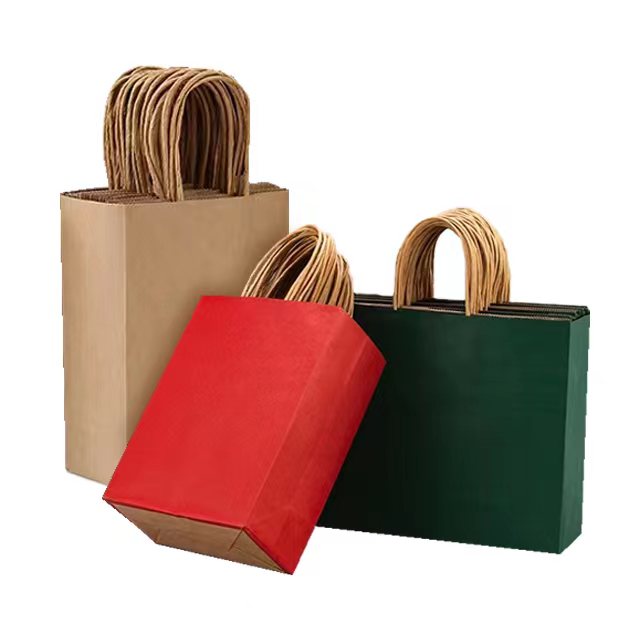
Three — move to a coated face. The red and the deep-toned bags in the last photograph are smooth printed outer faces over a kraft interior and base: cleaner ink behaviour for colour-critical artwork, same paper structure doing the load-bearing underneath. The pearl row above shows the same principle pushed further, where the paper itself carries the finish and the print stays to a single mark.
One more practical note before you commit an artwork file to tan stock. Solid background blocks printed edge-to-edge on uncoated kraft show the sheet’s fibre direction under raking light — this is normal, it is on every brown paper bag in your supermarket, and buyers who know it do not file complaints about it. If a design cannot tolerate any texture showing through, that is the moment to switch to a coated face or to leave the field bare and let the kraft be the field. We flag which option a given file needs on the mock-up sheet; the check costs nothing before plates are made and everything after.
Placement is the last print decision most buyers forget to make. A mark centred on the front face is the default, and the placeholder in the first photograph sits exactly there for reference. But the vertical pleat panels are printable zones on this construction — every bag on this page shows them as a distinct flat facing when the bag stands open — and rim-band printing repeats a wordmark around the top edge where the bag is held. Aisles notice those zones when the bag stands on a shelf, not when it hangs on an arm. If your store displays bags stacked face-out, ask us to mock the pleat panel; it is one extra zone on one extra pass, priced per surface, and it turns a carrier into shelf media without a second product.
Colour Families Beyond Plain Tan
Natural tan is the family default — the four standing bags in the middle photograph are one model shown at different depths, side pleats and gusset shadows visible on each. Past tan, this line covers solid-dyed bodies (the compact red and the deep bottle-toned example at the end of the page, both with contrasting cord tones), and pearl or metallic coated faces for gift, wedding and event counts, where the paper carries the decoration and the print stays minimal. Interior and base stay kraft on every dyed option shown here, which is part of the honest look: the colour sits on the face, the structure stays in the fibre.
Choose the cord against the face deliberately. A matched tan-on-tan arch disappears into the body and reads quiet; a dark arch on a champagne face reads designed; a contrast loop on a red bag becomes a second brand element whether you planned it or not. State “cord matches body” or “cord contrasts to tone X” on the artwork handoff, because that line changes nothing on press but everything in the photo catalogue you shoot afterwards.
Flat-Pack Storage Belongs on the Cost Sheet
The nested bundle at the left of the first photograph is the shipping format: bags collapse flat, cord loops fold into the stack, and a hundred pieces travel in a fraction of the cube an assembled carrier would ever take. Two line items follow from that fact. Freight: fewer cartons per pallet, lower landed cost per bag, more designs fitting under one shipment. Back of house: retail floor space, market stalls and pop-up sellers pay for storage by the shelf, and an empty kraft carrier returns to a carton in seconds while a rigid gift box never does. When buyers ask us to price a kraft carrier against a rigid box for the same gift programme, we quote both flat-pack consequences before either party discovers them after the first delivery — that comparison usually decides the spec without us arguing for it.
Load, Size and What We Will Not Guess for You
Paper weight in gsm, cord diameter and exact bag dimensions are printed nowhere in our photographs, so we refuse to invent them inside a listing paragraph. Send the load target instead — a two-kilo grocery run, a boxed pastry set, a folded garment, a wine bottle with a divider insert — and we specify sheet and handle against it, then put every figure in writing on the mock-up sheet before you approve anything. Our standard size ladder ships on request; custom width × height × gusset drawings are routine for chain buyers matching an under-counter slot or a fixed shelf bay.
Two planning notes that prevent reorders. Gusset depth matters more than height when the product is rigid: a boxed item needs footprint, and a wide pleat converts a tall narrow carrier into a square-bottomed one without extra paper. And always order one step above the measured product: customers fold a second purchase into a retail carrier, and a bag that fits exactly on day one becomes a bag quietly replaced at the till by month three.
Specification Points You Control
- Face stock: uncoated tan kraft, solid-dyed paper, pearl or metallic coated face over kraft core
- Carry hardware: twisted cord (photographed default), ribbon thread-through, die-cut rim punch
- Print zones: front, back, side pleats and rim band; single colour through full colour, white underprint optional
- Structure: vertical side pleats, glued square flat base, clean-cut folded rim
- Sizes: standard ladder on request, or your width × height × gusset drawing
- Extras: bottom board inserts, inner-tape printing, matched or contrast cord tone on the same quote line
- Logo reproduction: vector file (AI/PDF/EPS) or a clear photo of a sketch; free digital mock-up before payment
Reference Sheet for This Carrier Line
| Attribute | As produced and photographed here |
|---|---|
| Faces in these photos | Matte uncoated tan kraft, single wall, no visible film lamination |
| Dyed and coated variants | Smooth coloured outer faces and pearl metallic faces over kraft interiors |
| Base | Glued square bottom, diagonal crease pattern exposed on the tipped bag |
| Sides | Vertical pleats that collapse flat and spring open when the bag is lifted by the rim |
| Top rim | Clean cut folded inward; cord arches anchored inside the doubled band |
| Carry options | Twisted cord (default), woven ribbon, or punched die-cut grip |
| Press options | 1-colour to full-colour; white underprint where brand colour must match |
| Order floor | 100 pcs per design |
| Physical sample | 3-5 days |
| Bulk completion | 7-15 days after artwork approval |
| Group output | 1,000,000 pcs per month across our gift lines |
From Artwork File to Approved Carton
The flow is short because the product is standard. Choose size and carry hardware → free digital mock-up with print zones, cord tone and base option marked up → physical sample in 3-5 days if you want paper in hand before committing → deposit → bulk finished 7-15 days after artwork approval. Reference pricing anchors at the 100-piece tier and steps down as quantity grows; we publish no fixed unit price because gsm, press passes and handle type move it, and a dead number in an advert is a dead conversation at the quote desk. Send artwork as a vector file or a clear photograph of a sketch — the mock-up process turns napkin versions into production files without a design retainer.
Reorders reuse the same plates and the same machine slots, so a season-two run moves faster than season one, and multi-store buyers typically lock one medium carrier first, then widen the ladder once real carry behaviour is proven at the till. Event and launch buyers should work backwards from the in-hands date, subtract the sample cycle, then subtract one freight buffer; that arithmetic, not the design file, is what usually decides whether the programme ships with the ribbon upgrade or the die-cut cost saving.
Packing Cartons and Shipping Lanes
Bags ship flat, nested and interleaved in export cartons so printed faces do not abrade in transit; the chart below is our reference sheet for how cartons are sized, marked and staged before a pallet forms. Per-carton quantities follow the selected bag size and appear on the proforma before production starts. Freight moves by sea, air, or express — DHL, UPS, FedEx, TNT — picked against your in-hands date rather than habit, and FBA-labelled cartons with pick-pack-label prep are supported when Amazon is the channel. Orders running into the tens of thousands palletise at the factory instead of leaving loose cartons to be broken down at destination: on paper bags, a crushed carton corner is the difference between sellable stock and a credit note.

Frequently Asked Questions
What is the minimum order for custom kraft paper bags with a logo?
Can the same bag size use rope handles on one order and die-cut grips on another?
Will a coloured logo look correct when printed on brown kraft?
Do your product photos show paper weight or bag dimensions?
How fast can printed carrier bags arrive in my store?
Pages Worth Comparing Before You Lock the Spec
Three neighbours in the catalogue answer questions this carrier page deliberately does not. Counter work where an oil barrier matters more than a carry arch — pastry, fry, deli tray packing — belongs to our white greaseproof counter bags at custom greaseproof counter bags, which ship handle-less for packing speed behind the glass. Merchandise that must sell itself before anyone opens the packaging lives on the windowed page at custom paper bags with window, where a clear film panel does the merchandising and the print frames it. Multi-year carry use — market, gym, campaign totes — is indexed separately under textile bags, and the wider paper family sits in the paper bags category, with the parent printed items index one level above it.
Send sizes, artwork, handle preference and your target in-hands date through the quote desk, or reach the same team at [email protected] / +86-15967739086. You will get a mock-up sheet with every spec in writing — not a brochure.