Custom Acrylic Character Standee | Illustrated Blocks 100+
$3.00
This custom acrylic character standee is a solid block, not a panel in a foot: thick colourless cast acrylic with your illustration printed edge-to-edge across the face, polished side depths that refract the artwork’s palette, and enough mass to stand on its own bottom edge with no base hardware to lose at retail. Built for creators, café collab teams, and convention merch desks running numbered series — each colourway counts as its own design against the MOQ of 100 pcs per design. The free digital mock-up flags file issues before tooling: fine line work, gradient falloffs, and transparent layers that will read as bare board instead of white. Samples ship in 3-5 days, bulk runs 7-15 days after artwork approval, and blocks pack face-bagged with foam interleaves in rigid export cartons for sea, air, or courier legs, FBA prep included. Face ratio, corner radius, single or mirrored print, and slab depth all quote from one request sheet.
A custom acrylic character standee on this line is a different object from a photo panel in a slot foot: it is a solid block. Thick clear board, illustration printed straight across the front face, polished sides that carry the artwork’s colour through the depth of the material, and no base hardware because the block’s own mass holds it upright on a counter, a shelf, or a café display rail. That construction is what the three studio shots show, block after block, with the print doing all the visual work.
The buyers this format serves are illustrators turning a character into merchandise, café and shop collab teams that need a counter piece that reads at arm’s length, content creators dropping numbered series, and merch desks at conventions where a solid block out-performs a flat cutout on perceived value. MOQ 100 pcs per design, samples in 3-5 days, bulk in 7-15 days after artwork approval — same spine as every board line we run, applied to a heavier object.
There is a commercial reason the block format keeps growing in collab programmes rather than shrinking. Shelf behaviour is the whole pitch: a flat print in a frame gets glanced at, a solid object with a colour-carrying edge gets picked up, and pick-up rate is what a café owner or a convention booth operator actually negotiates on at restock time. The samples below were shot the way our own line reads them — face on a white sweep for catalogue use, rotated for edge proof — and every claim in this page is anchored to what those three frames show. Where a photo cannot prove something (exact depth, weight, pack count per carton), the page says quoted on request instead of inventing a number.
The Block, Read From the Photos
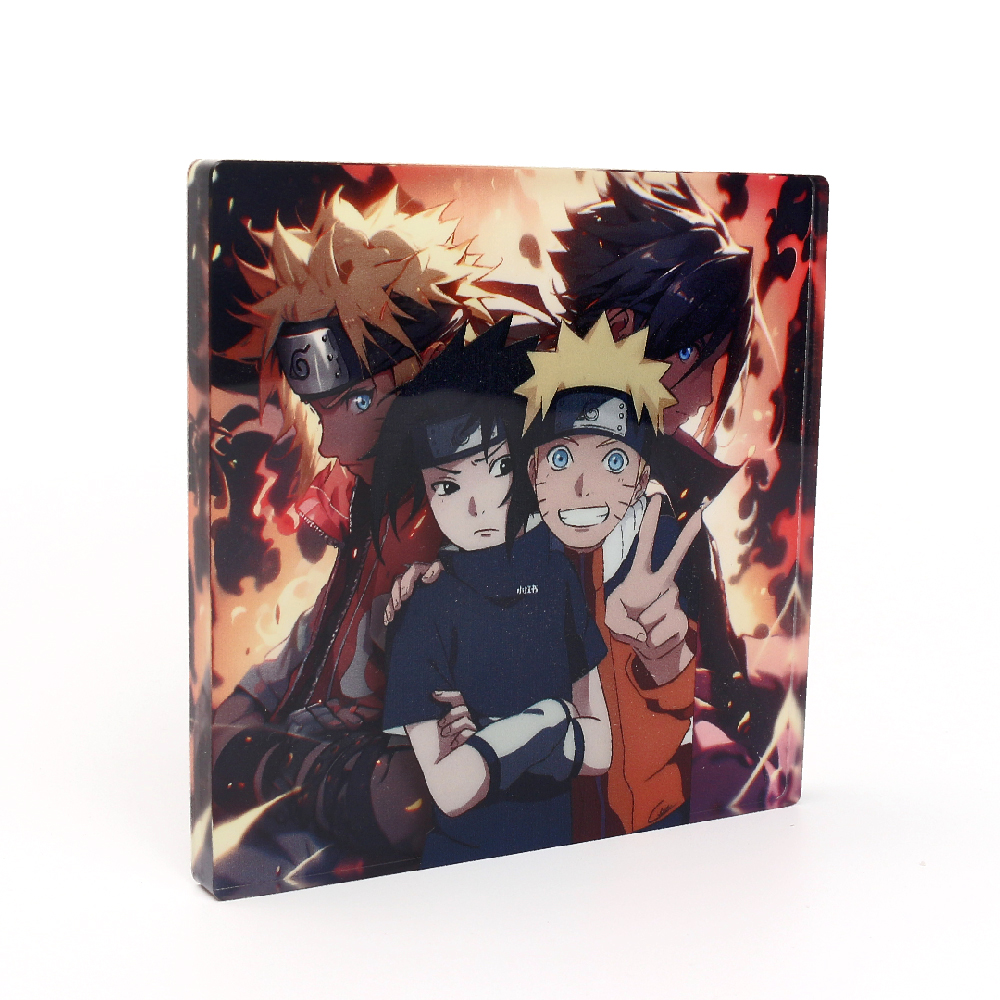
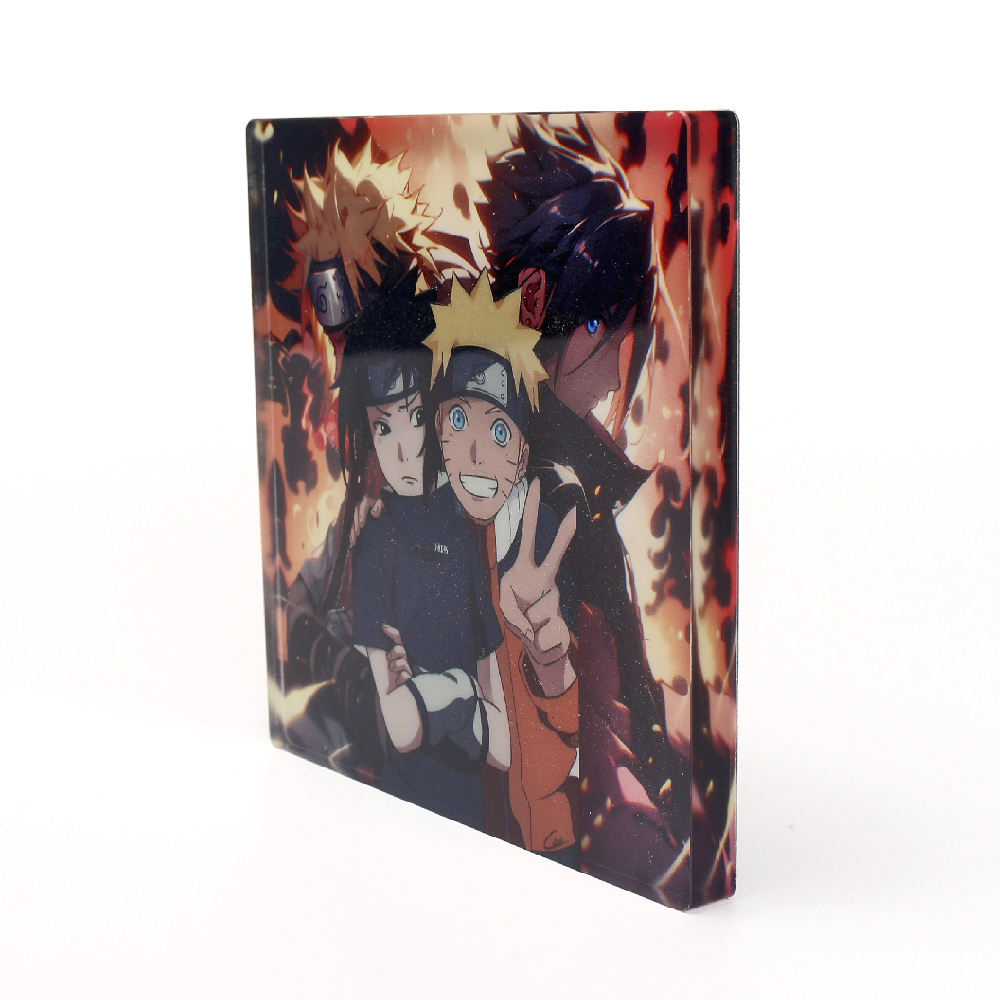
First sample: a square-format slab standing on its own bottom edge, rotated off-axis so the face and one side both read. The illustration covers the entire front, edge to edge, with no clear margin — four figures in a layered composition over a fiery background, cel-shaded line work holding sharp at print scale. The visible side is where this format earns its price point: the slab is thick enough that the artwork’s palette refracts through it, warm tones running down the clear edge like a tinted spine. The corners sit close to square with the smallest radius, so the silhouette stays architectural rather than soft.
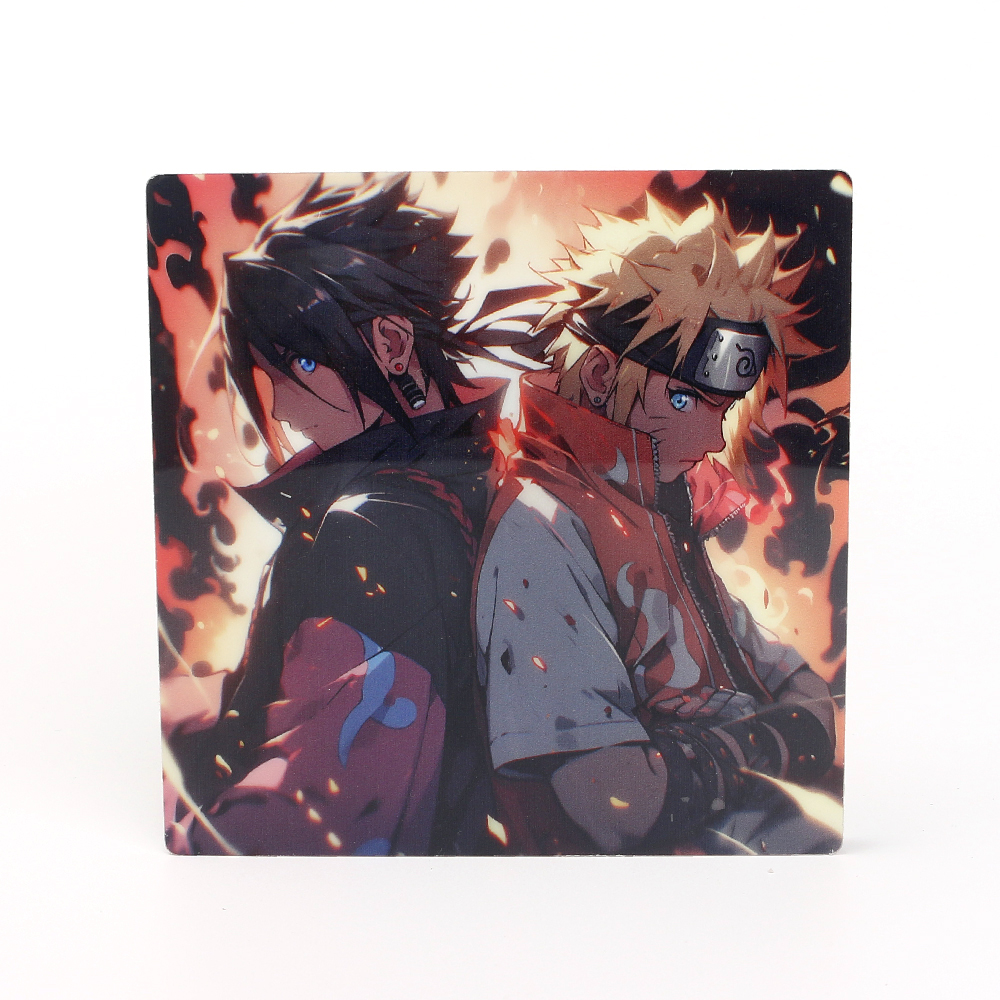
Second sample, face-on: the same block geometry in a two-figure composition, flames and embers across the field, rounded corners now clearly visible at each quadrant. There is no engraving anywhere on either piece, no separate plaque, no metal or wooden footing — the printed face is the product. Nothing props them up because nothing needs to: depth into the board is what keeps a square of this size standing on a smooth tabletop without a lean.
Why Solid Board Instead of a Thin Panel
Two reasons, both visible in the third photo. First, optical weight. A thin sheet prints a picture; a thick block prints a picture and then repeats it — the polished side faces catch the artwork’s colour range and bend it along the slab’s depth, so the piece reads as an object from across a room, not as a flyer in a stand. For collector-priced merch and collab limited runs, that edge refraction is the difference customers touch before they decide the piece is worth the shelf price.
Second, stability without parts. No foot to slot, no lean angle to set, no separate component that goes missing in a retail back room. One SKU arrives, stands, and restocks. The trade-off is material: a solid block uses more board per piece than a panel-plus-foot, and that lands in the unit tier rather than hidden in a moulding charge. Thickness options quoted on request against a physical sample once your face dimensions are fixed — the studio pieces read substantial at their ratio, but nothing in a photo is a gauge sheet, and we will not mail you a number we cannot prove.
A third consequence shows up only after the first restock: print alignment on a block is permanent. There is no sleeve to swap and no panel to re-seat, so the proof stage carries more weight here than on any other standee format. The mock-up places your artwork against the block’s cut outline, marks where a highlight will run across a figure’s face under shop lighting, and states whether the second face mirrors, clears, or carries a different pose. Get that decision wrong on a thin panel and the fix costs a reprint; on a solid slab, the depth that makes the format desirable is also the depth that makes a bad placement expensive — which is precisely why we push sample-first on every series order.
Buying signals worth reading into the format: the sample blocks are shot standing, not lying, because the merch buyers specifying them display them standing on rails, register counters, and checkout acrylic risers. A café collab piece competes for the same sightlines as dessert signage, so face ratio matters more than raw size — a portrait block at modest height clears a queue line better than a wide square buried behind a card reader. Send the display location with your file and the desk will cut the mock-up at the ratio that earns that shelf, not the one that flatters the artwork on a screen.
Art Files: What an Illustrated Design Needs Before It Prints
Character art is not portrait art, and the file rules differ. A clean flat or cel-shaded illustration with defined outlines survives the process beautifully — line edges stay crisp at block scale, and saturated colour fields fill edge-to-edge without banding. The failure modes are the ones artists do not expect from a screen file: fine crosshatch that closes up when the print dots merge, glow effects that print as solid blocks of one tone, and background gradients darker at the corners than the board’s own light path can carry. The free digital mock-up returns your composition mounted on the exact block ratio, with these flagged on the proof, before any slab is cut.
Colour space follows the print route: full-colour direct print on clear board means anything left transparent in your layer stack becomes see-through acrylic, not white. On an illustrated character piece this is a real design decision — a flame background that fades to nothing at the bottom will fade to bare board instead, and the block’s edge will read clear rather than tinted in that zone. Flatten with intent, or send the layered file with notes on which transparent zones are deliberate.
Series Drops, Collabs, and the Design-Count Math
The order pattern on this line is series-shaped. A creator releasing one character in four colourways counts as four designs against the MOQ of 100 pcs per design; a café collab with one artwork is one qualifying run. Mixed baskets are normal and quoted as one shipment with split design lines, and the sales desk prices the tier per design, never blended — a three-design series is not a 300-piece order of one item, and any quote that treats it that way is reading the wrong sheet.
Collab timing deserves a plain warning: café and pop-up windows are set by the venue, not by freight. A launch pegged to a month-end opening should have artwork approved and the sample signed while the fit-out is still on paper, because the bulk 7-15 days after artwork approval is production only — sea or air legs sit on top of that calendar, and courier rescue of a missed launch weekend reprices the whole drop. Send the series calendar with the first file and the desk schedules proofs against it.
The Customisable Variables
Confirm each of these in the quote request and the mock-up comes back complete:
- Face dimensions and format — square as sampled, or portrait/landscape ratio on the same solid-block build
- Board depth for the face size, so the block self-stands at your scale; thickness quoted on request against a sample
- Corner treatment: near-square with light radius as sampled, or a softer rounded profile
- Print face: edge-to-edge full-colour illustration; single face or mirrored second face
- Deliberate clear zones in the artwork left unprinted, and whether edges should carry colour or run clear
- Individual poly bag per block with face protection; no assembly parts exist to bag separately
- Carton markings to your SKU scheme for shelf-ready restock; FBA prep on the same line
- Series documentation: one proof reference stored per design so colourway reorders skip re-approval
Specification Summary
One table, standing terms only — the rows match what the studio blocks actually show and nothing beyond them.
| Field | Build standard |
|---|---|
| Item | Solid-block acrylic character standee: illustrated face print on a thick clear slab, self-standing |
| Size | Square face as sampled; other face ratios cut to your artwork’s frame on request |
| Board & Thickness | Colourless cast acrylic, substantial slab depth; exact gauge quoted on request against a physical sample once face size is set |
| Decoration | Edge-to-edge full-colour direct print, one face or mirrored both faces; no engraving on this format |
| Assembly or Mounting | None — the block stands on its own bottom edge; no foot, frame, or fixing shipped |
| Packing | Each block poly bagged with face protection, foam layers between rows, rigid export cartons, pallet patterns available |
| MOQ | 100 pcs per design |
| Sample time | 3-5 days |
| Lead time | Bulk 7-15 days after artwork approval |
| Capacity | 1,000,000 pcs per month across our gift lines |
From Proof to Pallet
Route a sample first — in 3-5 days a single block prints on your approved file at the agreed gauge, and holding it is how most buyers confirm the edge-refraction effect photographs badly but shelves beautifully. Approve artwork, bulk runs 7-15 days after artwork approval, and the displayed figure on this page anchors only the 100-pc tier of one design; colourway splits and larger depths re-tier on the quote sheet with your dimensions named.
Two quality checkpoints sit between the sample and your pallet, and they exist because illustrated prints fail differently from photographs. The first is a line-crispness check under raking light: fine ink detail that reads sharp on screen can carry a faint print-direction shimmer on board, and a series artist should see that on the sample before signing the run, not after five hundred units arrive at a convention hall. The second is carton shake: a block that survived its bag but shifted in transit scuffs its own polished bottom edge, so the packing spec locks orientation per row and the interleave weight is set to your face size, confirmed on the sample carton’s paperwork. Neither step adds days to the calendar — both happen inside the standard bulk window and are written into the proof reference so reorders inherit them automatically.
Cost structure, stated plainly because series budgets depend on it: on this format the print is one master file scaled per block face, so a second colourway of the same artwork is not a new print setup — it is a new tier line. What actually separates one design line from the next is a changed composition, and the desk codes it that way on the quote sheet. That is how a creator with three poses and two background swaps gets six orderable designs from a single art session while each colourway still counts separately against the 100 pcs per design floor. Ask for the split-table on your first quote if you plan to launch all six at one event; the production calendar fits them side by side more often than buyers assume.
Handling Blocks as Fragile Stock

A solid slab survives shelf life that would wreck a thin panel, but its weakness is the same as any acrylic edge: a corner strike during the courier’s last kilometre. The standard export build — face-bagged units, foam interleaves, double-wall cartons — is what sits between our pallet and your restock door, and sea, air, and courier legs (DHL, UPS, FedEx, TNT) all quote from those packed cartons so freight comparisons stay clean. Retail and FBA sellers get carton labelling and prep done at the same packing line, one spec end to end.
Does this block ship with a stand or base like the panel standees?
Can I order four colourways of one character in a single order?
Will my transparent PNG layers show as clear acrylic on the block?
How thick is the sample block, and can I choose the depth?
What holds engraved text on this format?
Pages Worth Opening Before You Quote
Range context, in one place: the full acrylic items index, and inside it the standee category where this block sits beside its siblings — the photo-print panel with slot foot for likeness uploads, and the spring-mounted figure cutout when a character needs to move. Recognition programmes sourcing alongside merch pull from disc plaques on sculpted stands, faceted tournament boards, and clear medals with ribbon. Print-adjacent categories live at printed items. Submit artwork and dates through the quote request desk and one reply covers mock-up, gauge, and tier.
Send the Artwork, Keep the Dates
A block series is merchandise with a calendar attached. File in hand, launch date named, design count stated — that is the entire brief the desk needs to return your proof.