Custom Acrylic Medal with Ribbon | Race Finisher Supply
$1.50
A custom acrylic medal with ribbon is finish-line hardware engineered for fields of thousands: a thick clear disc with frosted etched zones — edge branches, centre emblem, inscription band, lower seal — or a full-colour printed gradient face, hung from a decorative metal bail with a woven jacquard or satin ribbon threaded as a closed loop before bagging. The studio samples prove three builds: bare clear with white etching and multicolor ribbon, a seven-piece family mixing coloured metal rims with solid tinted acrylic bodies, and one printed hero disc on a blue-to-red satin loop. Personalisation runs from a single data sheet, so distance bands or finisher names merge against one locked master. MOQ 100 pcs per design, samples in 3-5 days, bulk 7-15 days after artwork approval, cartons divided per distance or session for expo-day distribution, FBA prep available.
A custom acrylic medal with ribbon solves the specific problem a road-race supply planner carries: several thousand people cross a finish line in one morning, and every one of them should walk out with the same object. The build on this page is a thick clear disc with an attached metal bail and a woven ribbon loop — printed or etched artwork on the face, colour-matched ribbon, and an engraving data pass when finisher names replace a generic message. The three studio frames show the format held in hand, in a seven-piece finish family, and as a single printed hero piece, and every claim below stays inside what those photos prove.
Order terms for race programmes: MOQ 100 pcs per design, samples in 3-5 days, bulk 7-15 days after artwork approval — sized against registration reality, where a 3,000-person spring field is the norm and a full-marathon weekend stacks three medal designs into one delivery window.
Anatomy From the Hand-Held Shot
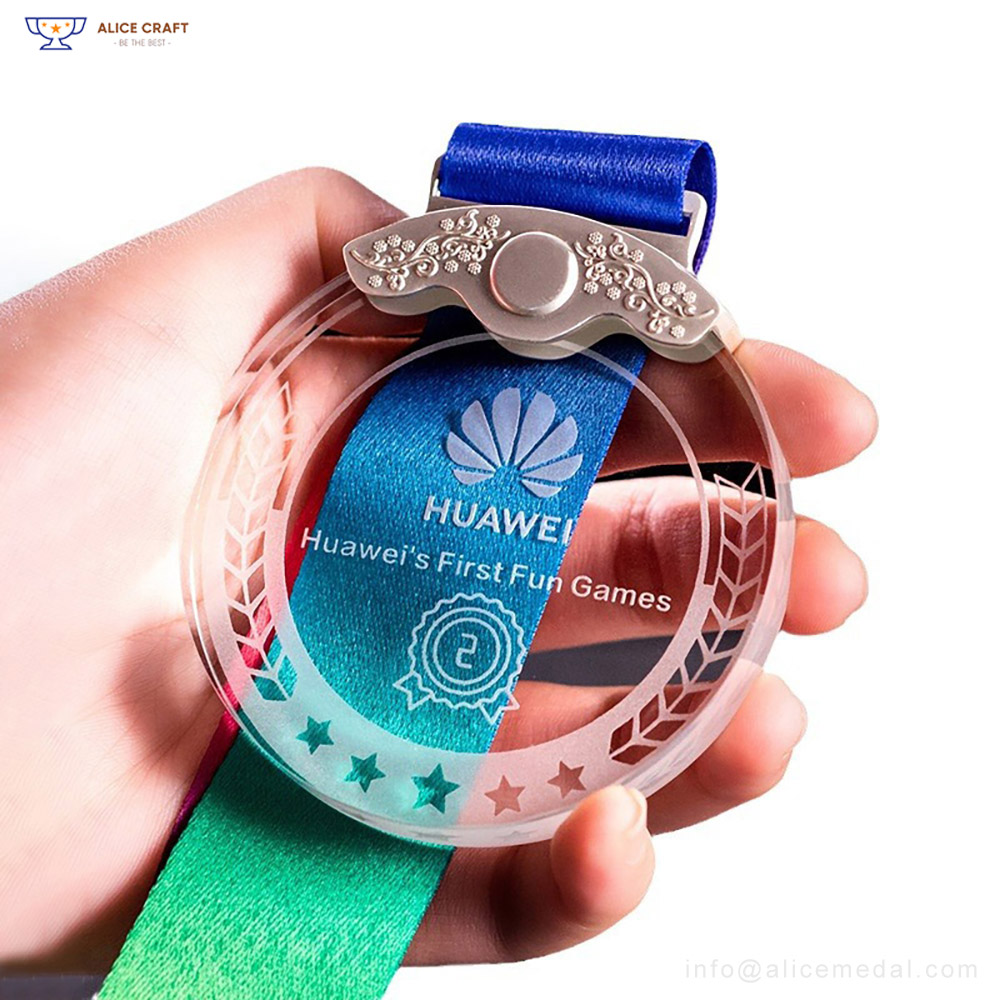
One palm, one medal, the scale cue every race buyer needs before speculating about size: the disc reads as a broad flat circle, some millimetres through, its rim smooth and polished with no metal ring around the circumference. The body is see-through — the ribbon shows directly through the lower half of the disc, which is the effect solid colour metal cannot copy: the fabric’s blue and green blocks glow through clear acrylic, and the etched marks stay white-frosted against them. Decoration zones map cleanly: laurel-style branches climb the inner left and right edges, a star row traces the bottom arc, an emblem cluster sits upper-centre, a horizontal inscription band crosses the middle, and a small round seal holds a place in the lower-centre. Each of those is a customisable zone on your proof; what they currently carry on the sample is demonstration content and nothing more.
At twelve o’clock, a silver-toned metal topper wraps the disc edge — a curved bar with embossed scrollwork halves and a raised dome at its centre — and its rectangular rear slot is where the ribbon threads through, looping up over the fitting and down behind the disc. The ribbon itself is jacquard-style woven fabric, colour-blocked deep blue above and green below with a red accent edge, and there is no separate chain or cord: the loop is the ribbon, exactly as it arrives on the finisher’s neck.
Two construction lessons hide in that one photo, and both change your spec sheet. First, the topper is a separate component fixed at the rim, not moulded into the disc — which means the bail hardware is a shared part across diameters and artwork families, so a series can run three disc sizes on one anchor spec and one ribbon stock. Second, the hand behind the disc is doing scale work no caption can: the medal sits palm-sized with the ribbon loop rising well above the fitting, and that loop height is part of your spec conversation, not an assumption. Runners wearing race bibs want clearance over the shirt collar; podium photography wants the disc centred on chest, not buried at sternum. State the neck-drop you want and the desk cuts the loop length to it before bulk threading starts.
The order-page version of that lesson: the bail population on this line is shared across diameters and artwork families — silver top bar, gold ornate clasp, or rim-integrated tab — while the disc and ribbon are where your event identity lives. A series with a 500-piece youth leg, a 2,000-piece main road race, and a 100-piece VIP ceremony is one anchor hardware spec, three face builds, and one ribbon programme, not three separate supplier conversations. That is the actual reason family photos like these get taken: proof that the parts interlock before anyone commits a season’s budget to a drawing.
The Family Shot: Two Mounting Styles in One Frame
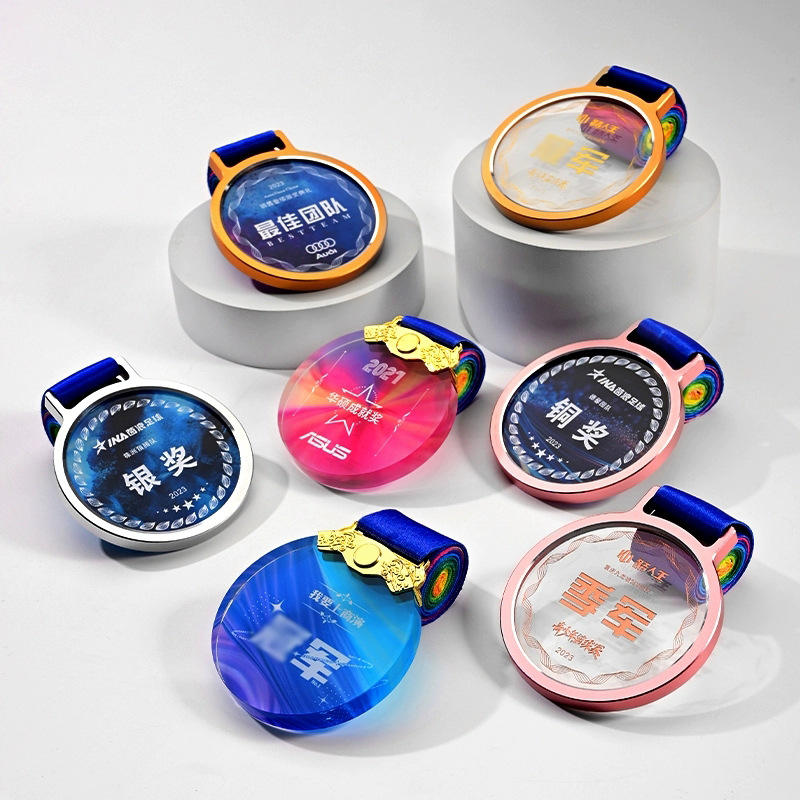
Seven pieces, one product family, and the frame quietly documents two different hardware routes. Five of them are rim-framed: a coloured metal ring — copper, silver, or rose-gold finishes — with the disc face recessed inside it and the top tab punched as part of the ring itself, the blue ribbon sliding through that integrated loop. Two of them are the opposite build: the entire body is one thick tinted acrylic disc (one magenta burst, one deep blue swirl), glossy and beveled all around with no surrounding metal, carrying a separate gold-toned ornamental clasp at the top edge as the ribbon anchor. The matte white cylinders two pieces rest on are display props; nothing ships standing that way.
Why that split matters to a race planner: the rim-framed style is the tier-flexible workhorse — swap the centre face or the ring colour and the silhouette keeps reading as the same programme — while the full-acrylic style is the premium single-build where light travels through the whole body. Both accept the same ribbon treatment, and the ribbon detail worth noticing is the inner fold: several loops show a rainbow-striped edge revealed where the fabric doubles back, blue facing out. Multi-band ribbon is a stock-adjacent option, colour-matching to your event palette is the standard request, and both are answered from the same quote line.
Count the centres in that frame and the artwork logic falls out: some faces are opaque printed discs, some carry tinted solid colour with light marking over the middle, and at least two leave the centre clear so the etched or printed block sits on bare transparency. That is three decoration routes inside one hardware family, and a race organiser can assign them to programme tiers without reopening tooling — sponsor-facing VIPs on the printed opaque face, age-group winners on tinted bodies, the general field on etched clear, all on one ribbon spec, all hanging from the same bail geometry. The frame proves the mix-and-match works because every piece was assembled from the same part vocabulary; your quote picks which vocabulary applies to which wave of the start list.
Assembly economics sit in the same frame. Rim-framed pieces arrive as ring plus face — two components the line pairs before the bag — while a solid tinted disc is one cut, one print pass, one clasp fix. For fields over a thousand, that difference moves the packing-line minute count, and the minute count moves your tier price more predictably than any artwork choice. Organisers comparing a rimmed VIP variant against solid-body field medals on the same order sheet are really comparing assembly passes dressed in the same ribbon, which is precisely why the desk quotes both shapes side by side instead of guessing which one you meant.
The Hero Build: Full-Colour Print on a Thick Clear Disc
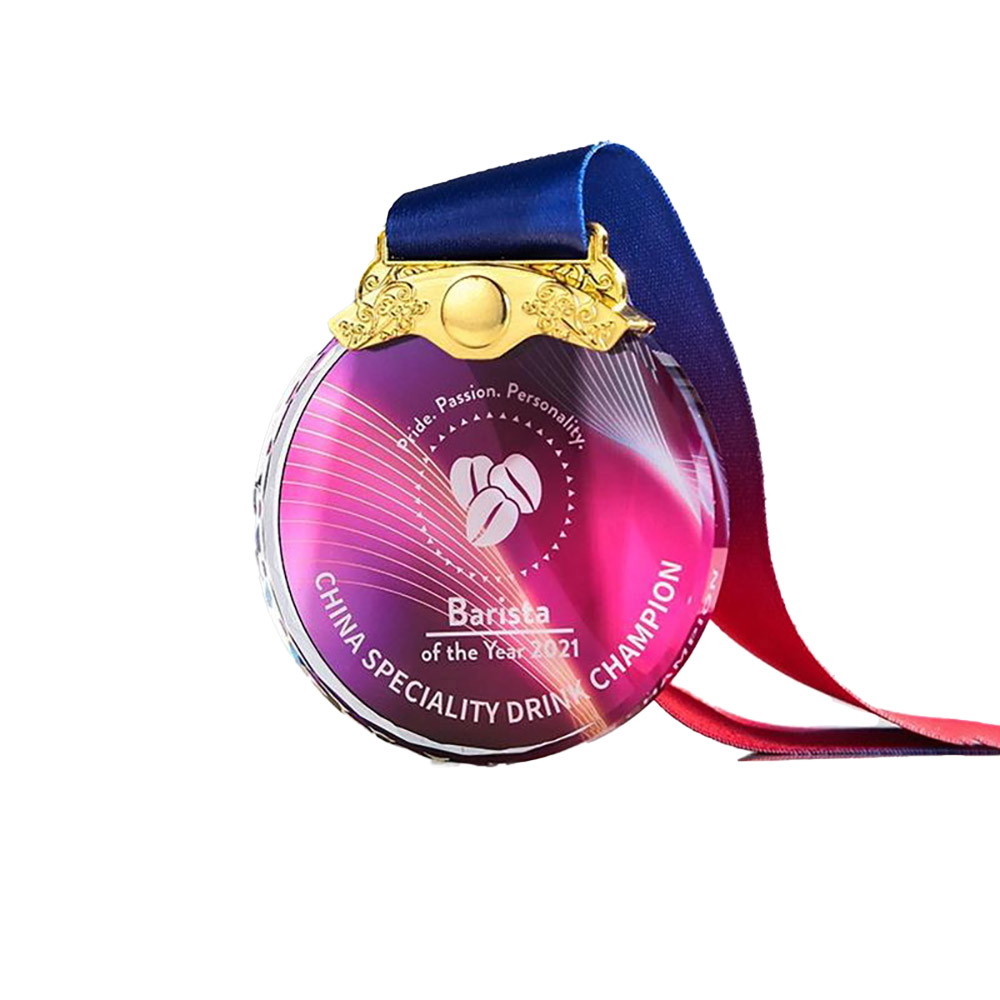
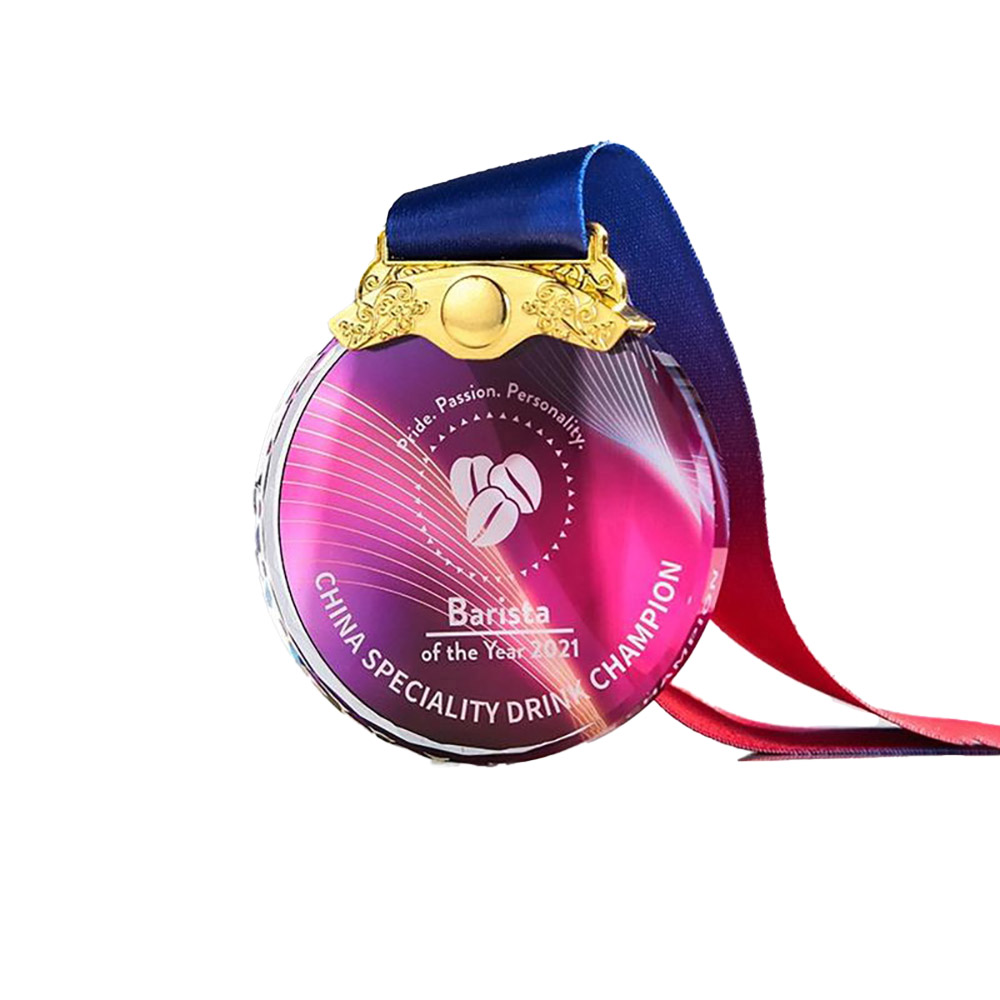
The third frame isolates the printed route at product-hero scale: a substantial disc whose face carries a saturated magenta-to-violet gradient crossed by thin radiating white lines, a centred emblem inside a dotted ring, and lettering laid along two arcs top and bottom plus one straight block under the centre mark. The rim is the detail a race photographer notices first — beveled and faceted, throwing light like a cut lens while the printed field stays vivid — and the gold-tone bail with its domed centre and scroll wings finishes the piece against a satin ribbon that shifts from royal blue at the loop into red down the tails.
Read the zones as your design canvas, because that arc-and-band geometry is why event artwork fits medals at all. Curved text follows the inner circle; the centre emblem holds the event mark; the straight mid-band carries distance or category wording; and nothing has to be one colour or one route — the etched white-on-clear style from the hand-held shot and the printed gradient style here are two decoration answers to the same disc. What an organiser chooses decides the tier price, the ribbon pairing decides the podium photo, and the data pass decides whether finisher names print before bulk starts.
One more thing the hero shot proves that spec sheets forget: thickness is a hang-quality decision, not just a feel decision. A deep disc with faceted edges keeps its face vertical on a ribbon because its mass hangs below the bail’s pivot; a thin disc of the same diameter curls toward the chest and shows its edge to the camera. The sampled piece is visibly a chunky slab by medal standards, which is exactly why it photographs standing proud in a studio and behaves the same way on a tired runner at mile twenty-six. When you fix your diameter, fix the drop behaviour at the same moment — the sample lane is where both get settled before ten thousand units inherit the mistake.
Race-Week Logistics: From Registration Count to Medals on Neck
Supplying a field is arithmetic with weather attached. Finish-line ceremonies happen outdoors, in dawn light, over picnic tables, with volunteers who have never seen the product before — which means the packing, the ribbon pre-threading, and the carton division all exist so that a table of four hundred medals distributes itself without a single person opening a bag and finding a knot. Everything below assumes that reality rather than a warehouse one.
Event supply lives and dies on quantities that move. A spring 5K series plans per-leg counts and repeats one master across the legs — one design line, several delivery points — while a marathon weekend stacks a finisher medal, a 10K companion, and a VIP or volunteer variant into a single programme window. Because design counting follows masters rather than distances, distance wording rides the merge pass instead of multiplying MOQ: three events sharing one artwork with three distance lines is one qualifying design family quoted three ways on the sheet.
The calendar discipline is strict for a reason. Bulk production needs 7-15 days after artwork approval; ribbon colour matching, bail attachment, and per-medal bagging happen inside that window, not after it; and expo-weekend deadlines do not flex for slow freight. The desk books race supply backwards from event day — files to us at least a month clear, sample signed at the two-week-plus-freight mark — and when a spring field sells out faster than forecast, a follow-on run on the stored master schedules without a fresh proof cycle, which is the only rescue that ever fits between registration close and bib pickup.
Decision List Before Quoting a Field
- Disc diameter and route: etched white marks on clear, full-colour printed face, or tinted solid acrylic body
- Hardware style from the sampled families: silver decorative top bar, gold ornate bail clasp, rim-framed tab, or ring-and-clasp pairings
- Ribbon: woven jacquard or satin, solid or gradient colourway, edge stripes matched to event palette, loop length for neck fit
- Personalisation pass: finisher names, distance bands, or edition marks from one data sheet; reverse stays clear or prints on quote
- Gauge for your diameter so the disc hangs flat instead of tilting on the ribbon; thickness quoted on request against a physical sample
- Per-medal assembly check: bail, ribbon threading, and face protection done on the line, not in your volunteer tent
- Carton division by distance or session so expo-day distribution tables sort themselves
- Storage plan for post-race mail-outs when a field includes deferred finishers
Specification Sheet
| Field | Standard build |
|---|---|
| Item | Acrylic award medal: clear, tinted, or printed disc with metal bail and woven ribbon loop |
| Size | Race-standard diameters set at quote; disc scales to your artwork’s arc geometry |
| Board & Thickness | Clear cast acrylic with polished beveled rim, or solid tinted disc body; thickness quoted on request against a physical sample |
| Decoration | Frosted etched zones (edge branches, emblem, inscription band, seal) or full-colour face print; data-driven name or distance pass from one sheet |
| Assembly or Mounting | Metal topper or clasp fixed at twelve o’clock; ribbon threaded through its slot as a closed loop; rim-tab variant on framed styles |
| Packing | Medals bagged individually with ribbons laid flat, foam rows, double-wall export cartons divided per distance or session |
| MOQ | 100 pcs per design |
| Sample time | 3-5 days |
| Lead time | Bulk 7-15 days after artwork approval |
| Capacity | 1,000,000 pcs per month across our gift lines |
What a Signed Medal Sample Actually Settles
A ribbon reads different against skin than against a white studio sweep, and a disc hangs different once gravity finds its weak axis. The 3-5 day sample answers four questions no PDF can: whether your diameter tilts forward on the loop length you planned, whether the etch depth on your logo survives a phone camera at arm’s length, whether the gradient ribbon you picked photographs as the event palette or as mud under expo lighting, and whether the bail-to-disc connection — bar, clasp, or rim tab — takes a hundred neckings without working loose. Race supply buyers who skip this step reorder once with the fixes and once without the budget; the buyers who route the sample build one clean field after another on a locked spec, and the stored proof reference carries every one of those decisions into the next season automatically.
Packed and Divided for Expo-Day Reality

Finish-line packing is distribution engineering: thousands of identical units that volunteers must grab fast without tangling ribbons or scratching faces. Each medal leaves bagged with the ribbon laid flat in its own sleeve, rows separate by foam so loops never knot across units, and cartons divide by distance or session — the packing list arriving as the distribution map. The printed or etched face rides protected against the bag, never against a neighbouring bail, because the metal hardware is the one component that can mark an artwork in transit. Sea, air, or express (DHL, UPS, FedEx, TNT) all quote from these cartons, and FBA prep on the same line suits organisers stocking mail-out inventory for deferred finishers. Gift-box upgrades for VIP tiers are a quoted add-on; nothing on the standard race build arrives boxed unless your order says so.
Can finisher names be printed on every medal in a bulk field?
Is the ribbon attached or do volunteers thread it on site?
What distinguishes the metal-rim medals from the all-acrylic ones?
Can two events in one season share one medal design?
How much slack does the bulk window leave for late registrations?
Pages That Complete a Race Programme
Podium tiers and crowd finishers usually order together: this medal line sits in the acrylic awards index beside faceted tournament boards for first-three hardware and the round disc plaque on a peak stand for officials and volunteers, all under the acrylic items catalogue. Event merch reaches the standee branch — photo panels, character blocks, spring-mount figures — and registration collateral lives in printed items. One container can carry all of it. Race dates, field counts, and artwork go to the request-quote desk; the reply comes back with a ribbon match and a merge plan.
Lock the Loop Before the Start Line
Diameter, hardware style, ribbon colourway, data fields — four decisions, one sample run, then a signed spec your whole season reorders against without conversation.