Custom Acrylic Cigar Humidor Display Boxes | Alice
$15.00
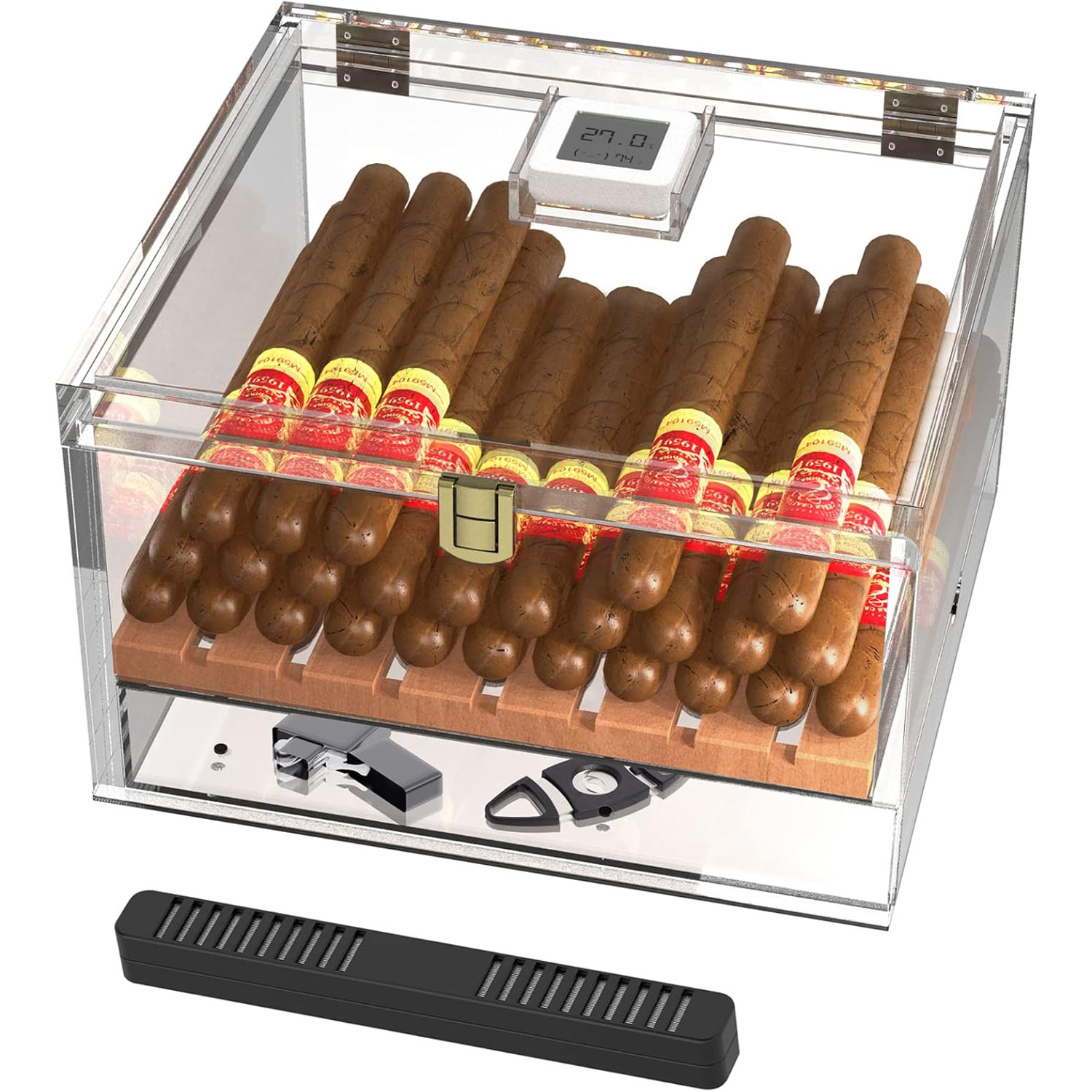
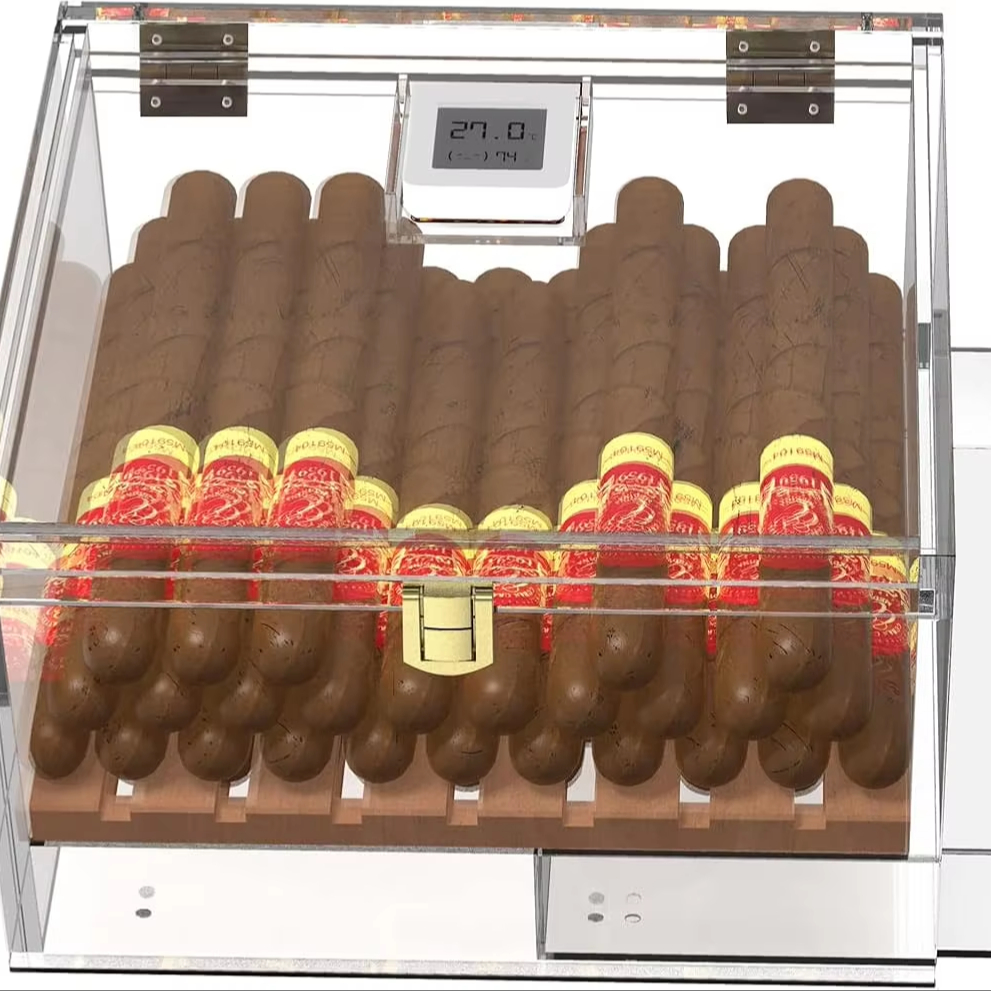
The clear counter case for tobacco retail, opened panel by panel: twin metal hinge plates at the rear, a brass toggle latch on the front, a slatted wood tray over an under-shelf accessory bay, and hygrometer mounts built into the lid – digital module inset in a bezel, or analogue dial in a polished block. The photographed format is annotated at 8.3 by 9.0 by 5.9 inches holding roughly two dozen sticks; larger capacities are quoted from your count target, and gasket or seal specs are confirmed on request rather than assumed. Samples in 3-5 days, bulk 7-15 days after artwork approval, MOQ 100 pcs per design.
The Custom Acrylic Cigar Humidor Display Box, Opened Up Panel by Panel
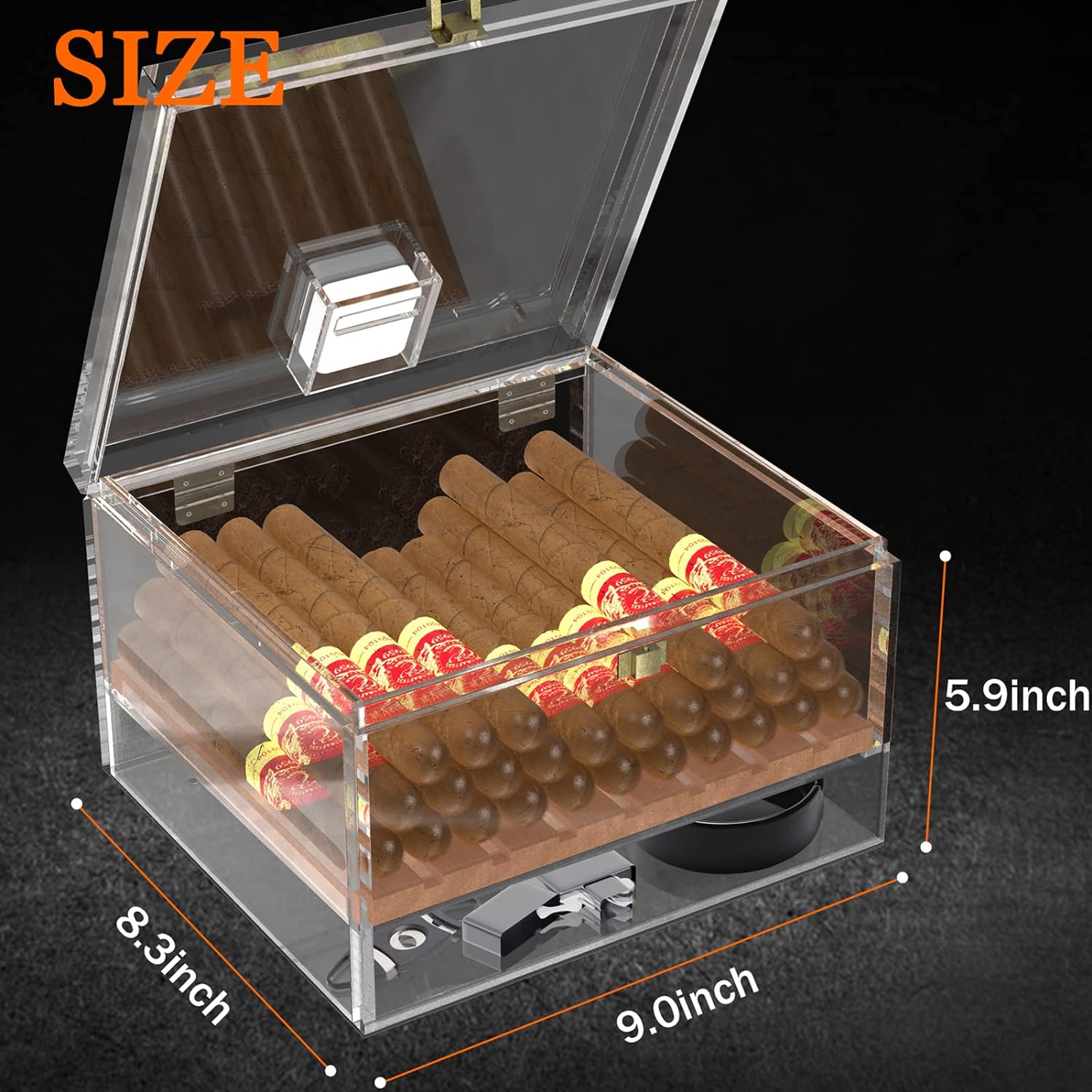
A custom acrylic cigar humidor display box has one job no opaque wood cabinet can do: let the counter sell the stick without the customer opening anything. The photographed build here is a fully clear rectangular case – four polished walls, a clear floor, and a hinged lid that swings up on two screw-fixed metal hinge plates, held shut at the front by a brass-toned toggle latch. The dimension graphic printed on one photo measures the format at 8.3 by 9.0 by 5.9 inches, and inside that shell sits a slatted wood tray over a lower bay that swallows a cutter, a punch and a small tool. Hygrometer mounting is engineered into the lid itself: the overhead shot shows a white digital unit inset flush into a clear acrylic bezel, while the open-lid shot presents a second route – an analogue dial suspended in a thick polished block on the lid’s inner face. Everything below is keyed to what those three photographs actually prove.
Why Smoke Shops and Bar Tops Choose Clear Walls
Merchandising tobacco in glass cases costs sightlines: reflections kill the row, and staff unlock the front for every question. Acrylic solves both. The case floor to rim is optically transparent with no green body cast, so a full tray of torpedos reads at eye level from three sides, and the polished edges channel shop light into thin bright outlines that make the box look built rather than bought. Retail staff handling twenty units a day get practical wins too: the lid stays captive on its rear hinges, the front latch is a single swing motion, and the whole footprint shrinks from the 8.3-inch depth back, which fits a bar-top rail where a wooden humidor would block the register. For point-of-sale upgrades, counter cases at this scale routinely carry single-stick pricing decisions, and the clear format lets the band artwork do that selling.
Hinges, Latch and the Honest Talk About Sealing
This page is the only place in our acrylic range where closure hardware gets the deep dive, so here is exactly what the photographs show – and what they do not. At the rear top corners, two flat metal hinge plates sit countersunk-screwed through the wall and lid, one at each corner; the open-lid shot also exposes a gold-toned latch hook at the lid’s front centre, meeting its keeper on the front wall. What is not visible in any photograph is a compression gasket line, and we will not pretend otherwise: lid closure here is hardware compression, and if your program requires a gasketed or seal-strip spec, that detail is confirmed on request at sample stage rather than claimed from a picture. The same discipline applies to humidity: we mount instruments that show conditions, we do not publish performance numbers this product has not earned in your store’s environment.
Theft and shrink logic belongs in the same conversation. A latched clear case keeps premium sticks in sight lines instead of locked in a back drawer where they never get recommended, and the lid hardware means every open decision involves a deliberate staff swing-latch motion rather than a grab-and-run lift. Convenience-store formats that moved single sticks out of sealed sleeves onto counter glass consistently report the same trade: a little more handling time per sale, a lot more impulse conversion, because the band artwork finally gets read from three angles instead of one. For a category priced by the unit and sold by the eye, that sightline argument is the entire case for a transparent box with hardware on it.
Interior Geography: Slat Tray, Second Bay, Instrument Mounts
The lid’s engineering story continues inside. On the open photo, an internal acrylic shelf runs across the mid-height of the box, supported so the wooden slat tray sits above it as the display level while the floor beneath becomes a quiet accessory bay – the photographs stage it with a double-blade guillotine cutter, a black punch and a slim tool, and the external humidification bar demonstrates how a stick-on accessory lives beside the case rather than inside the sightline. Two instrument architectures are proven by the shots: a digital hygrometer-thermometer inset into a bezel cut in the lid front zone, reading out through the clear face, and an analogue dial sunk into a thick polished acrylic cube mounted on the lid interior with a spring clip, which keeps the dial above the stick tips without touching them. Choose one at drawing stage; both keep the tray volume clean. Demo load in the photos is roughly two dozen figure-shaped cigars in two rows – your count target drives the footprint we quote.
- Case footprint: 8.3 x 9.0 x 5.9 inch format as graphic-annotated, scaled to your count target
- Sheet gauges: wall, lid and shelf set per size; specified on request rather than assumed
- Closure hardware: twin rear metal hinge plates plus front brass toggle; gasket spec quoted on request
- Liner options: slatted wood tray as photographed, all-acrylic tray and liner variants on request
- Instrument mounts: digital bezel-in-lid or analogue dial in polished block
- Accessory bay: internal shelf creating under-tray storage for cutters and small tools
- Decoration: logo screen print, UV print or laser engraving on lid, front wall or base band
Instrument readability is the second interior decision. The bezel-in-lid digital module reads out through the clear face with the case closed, positioned for a customer standing at the counter, its two-line display showing temperature and humidity at a glance; the polished-block analogue dial instead lives on the lid interior, staying in view while the cap is open for a sale. Neither mount intrudes on the tray volume, which keeps loading and rotation unobstructed. Both positions are drawn from your lid geometry before the first sample, and the honest test is physical: stand at customer height, then at staff height, and decide which dial earns the counter. A mount chosen from a spec sheet gets moved once; one chosen from the sample usually does not. One more field detail the photographs settle: the hygrometer bezel sits in the lid’s clear face, so a store that swaps the retail unit for a different module is a lid replacement, not a new case – keeping spare lids on the same drawing is the cheapest way to protect the display investment over a three-year fixture life.
Specifications Table for the Vendor Comparison Sheet
| Item | Hinged clear acrylic cigar display humidor box with slat tray and lid-mounted hygrometer |
| Size | Photographed format annotated at 8.3 x 9.0 x 5.9 inches; other footprints quoted from your count target |
| Board & Thickness | Clear acrylic sheet for walls, lid and internal shelf; gauges fixed per size at sample approval |
| Decoration | Screen print, UV print or laser engraving on lid, front wall or base band |
| Assembly or Mounting | Solvent-bonded case; two rear metal hinge plates; front brass toggle latch; digital-in-bezel or block-mounted analogue hygrometer; wood slat tray over lower accessory bay |
| Packing | Filmed panels, hardware protected, foam-lined export carton; FBA prep available |
| MOQ | 100 pcs per design |
| Sample time | 3-5 days |
| Lead time | 7-15 days after artwork approval |
| Capacity | 1,000,000 pcs per month across our gift lines |
Ladder logic for the buying desk: the 8.3 x 9.0 x 5.9 shell is the reference point, and larger capacities scale wall and tray geometry, not hardware count alone. Mixed-line buyers typically split one order between a single-store flagship format and a lighter bar-top SKU; each format carries its own 100 pcs per design step, and the sample stage exists to let you compare latch tension and dial mounting between them before either goes to bulk.
Sampling and Production Cadence
Send the case target – stick count, display level, instrument choice – and the drawing comes back as a free digital mock-up with hinge, latch and bezel positions called out. A physical sample ships in 3-5 days: that is where you judge latch swing, lid hold and dial readability from customer height, not where we promise it. After artwork approval the production window is 7-15 days, and month capacity of 1,000,000 pcs per month across our gift lines keeps reorders for chain accounts inside one quarter’s plan. Reference pricing starts from the hundred-piece tier, moving with size tier and decoration; the actual unit number always comes from your quote sheet.
Shipping Fragile Clear Stock Without Edge Damage
A humidor that chips a corner in transit loses the whole display value, so each case travels film-wrapped with hinge and latch zones guarded, nested in foam-cut export cartons rated for stacking. Freight runs sea, air or courier – DHL, UPS, FedEx, TNT – and FBA-ready labelling and pallet builds follow the same internal packing layout. Chain buyers ordering one flagship format plus a bar-top SKU get both on one schedule because the case is a bonded build with fixed hardware, not a bespoke fabrication, and repeat reorders run against the locked drawing rather than a fresh conversation. The graphic below maps the packing standard your inbound team will receive.

Purchase Desk Questions, Answered Without Brochure Language
Does the case come with the hygrometer included?
Can the latch be replaced with a lock?
Is a cedar liner required for the display function?
What changes when I move to a fifty-count format?
Do you print the store brand on the lid?
How do you keep edges from chipping in ocean freight?
Sibling Formats and the Category Map
For buyers assembling a whole counter program, our range lines up neatly: keep-cases with lift-off or hinged caps live on the display cube page, open gift-presentation formats are built for unboxing moments on the jewelry gift box page, tiered event hardware sits in the dessert-table stands listing, and shelf elevation is solved with bracket riser stands. Browse the full acrylic items category for formats between these poles.
Send your stick count and counter geometry; the mock-up, hardware list and hundred-tier reference pricing come back the same business day.