Custom Christmas Bingo Cards – Nativity Game Decks
$0.60
Shuffled Christmas and Nativity bingo decks printed for real holiday programs: 5×5 picture grids with captioned cells, a dark free-space centre, numbered corners, and a full set of printed calling chips on guttered cut sheets – or dauber-ready faces for single-night play. Deck counts from 24 to 100 sheets per master pool, church, school and retail pack formats on the same plate session, and the grid architecture re-skins for any season without touching geometry. Samples in 3-5 days, MOQ 100 pcs per design, bulk 7-15 days after artwork approval, with a September sea-freight cutoff that keeps December programs out of the courier lane.
These custom christmas bingo cards are holiday program inventory, not novelties: a 5×5 picture grid per player, a printed sheet of calling chips, a free space engineered into the centre, and a deck count sized to the room that will actually play – church hall, Sunday school, office party, or family living room. The photographs below are sample decks of exactly that construction, and we quote them as production files rather than downloadables because a December program lives or dies on physical arrival before the twelfth of the month, not on a PDF the week before. Publishers buy the mechanic; our job is the grid geometry, the chip sheet, and getting forty to a hundred identical nights of play into one carton.
Grid Anatomy: The Mechanics The Samples Actually Show
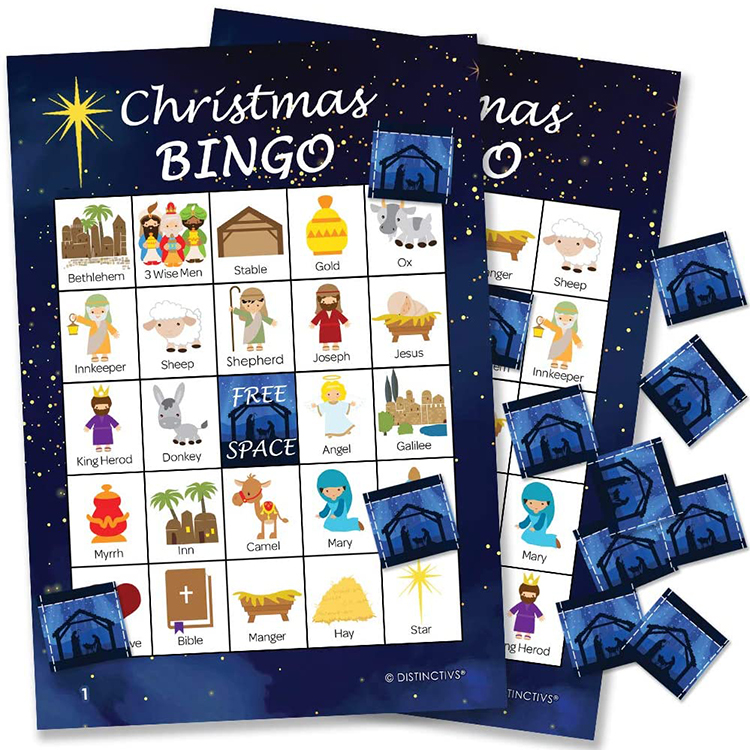
Front and centre sheet: a deep navy night-sky field speckled with gold dots, a yellow multi-point star with a long tail tucked top-left, and a two-line title block in white above the playing area – a script holiday word over a bold BINGO headline. The grid itself is twenty-five white squares with thin black rules, five across and five down, each cell holding one flat cartoon Nativity picture with a small caption underneath; the centre cell breaks the rhythm deliberately – a solid blue square reading FREE over SPACE with a small stable outline, the only dark cell in a field of light. A corner numeral marks the sheet number in the deck, which matters more than it looks: with duplicate grids in a hundred-person hall, the number is how a caller settles a disputed line at the mic.
The specimen stack shows a second identical sheet behind the first, three loose chips laid on the grid over marked cells, and a translucent red dauber blot on one square – two marking methods in one photograph, which is exactly the specification question we ask every buyer before quoting. Cards plus chips is the reusable program route; cards plus daubers is the single-night event route, faster to clear away and cheaper per seat because the chips sheet drops out of the pack. Either way the art vocabulary stays generic seasonal imagery – figures, animals, gifts, places, the star – and your own licensed or original artwork replaces the sample’s picture set at plate stage, one caption per cell, twenty-four playable cells per face, never fewer.
Caption typography carries a hard accessibility brief we enforce at layout stage: minimum type size measured for six-year-old eyes at the back of a parish hall, black on white cells, never reversed out onto the art. The caption sits in the lower third of each square with the picture in the upper two-thirds – a fixed two-zone cell grammar repeated twenty-four times with the centre broken out – and that grammar is what lets a mixed-age table play the same sheet. When buyers send us artwork that crowds the caption band, we return the mock-up with the text zone protected and the art trimmed, because a bingo cell is a label with decoration, not decoration with a label.
The Chip Sheet: Every Game Needs A Caller, And The Caller Needs Hardware
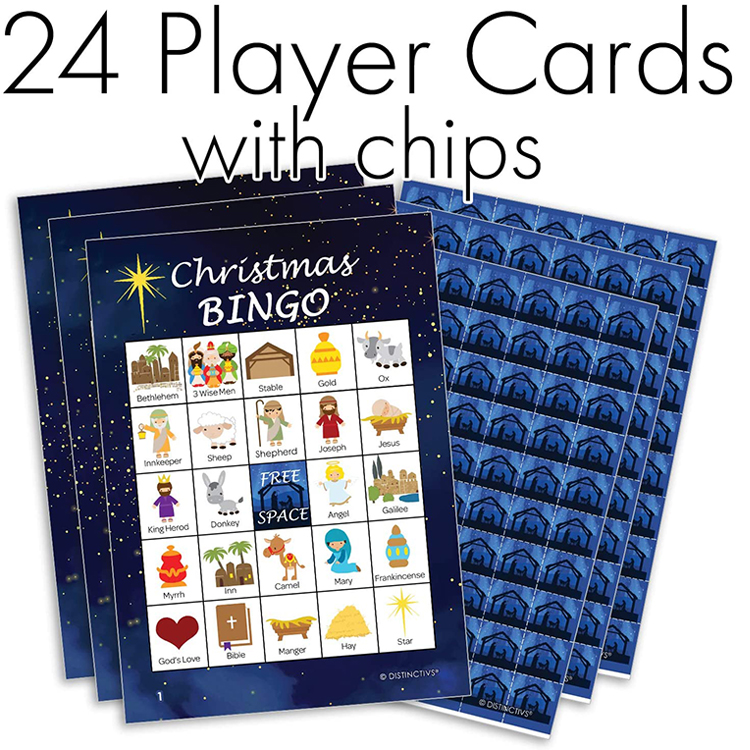
A bingo deck is half player cards and half calling apparatus, and the second photograph is the apparatus. On the right, a fan of backing sheets carries the marker side: a repeating grid of small squares – the same night-sky ground, the same stable silhouette motif – printed four across, six down, guttered with cut lines so one scissors pass turns a sheet into twenty-four chips. On the left, the player face stacked over two or three identical siblings, the navy borders stepping out to whisper deck depth. The marketing headline floating above the mockup states the pack promise in the only two numbers a program buyer reads: player-card count and the fact that chips come with them. That pairing is the whole product. A church committee that forgets the calling set runs the night with folded paper scraps; a retailer who sells cards without chips earns the return they deserve.
Chip count is the spec buyers routinely under-buy. Twenty-four squares per backing sheet means a twenty-four-sheet deck is one caller set, and rooms playing three rounds need three sets unless chips get collected between rounds – which never happens with children present. Our boarding default is one set per deck plus a caller spare sheet, printed in the same plate session for the cost of one gutter. Retail repackers standardise on one chip sheet per box because shelf maths reads cleaner than room maths, and both routes run off the identical master artwork, so the disagreement about how many chips a night needs costs nobody a design fee.
Production-wise the chip sheet is the cheap hero of this SKU: it shares the player cards’ plate session, the same stock, the same varnish-free matte face, and its own simple die line is just the gutter grid. Deck size is where the real engineering hides. True randomised bingo decks guarantee that no two visible sheets in a pack play the same sequence; our multi-card imposition builds every face from one master picture pool with shuffling rules applied at layout, so forty sheets means forty orderings, not forty printings. The card-number corner, the free-space cell, and the caption sizes all hold across the deck from a single approved master file – which is why a restock of a proven deck is a quantity conversation, never a design one, and why the sample’s printed look stays flat ink on card: a holiday night with forty sticky fingers and one box of daubers has no appetite for foil it will smear by round two.
Program Maths: Church Halls, Classrooms, And The December Cliff
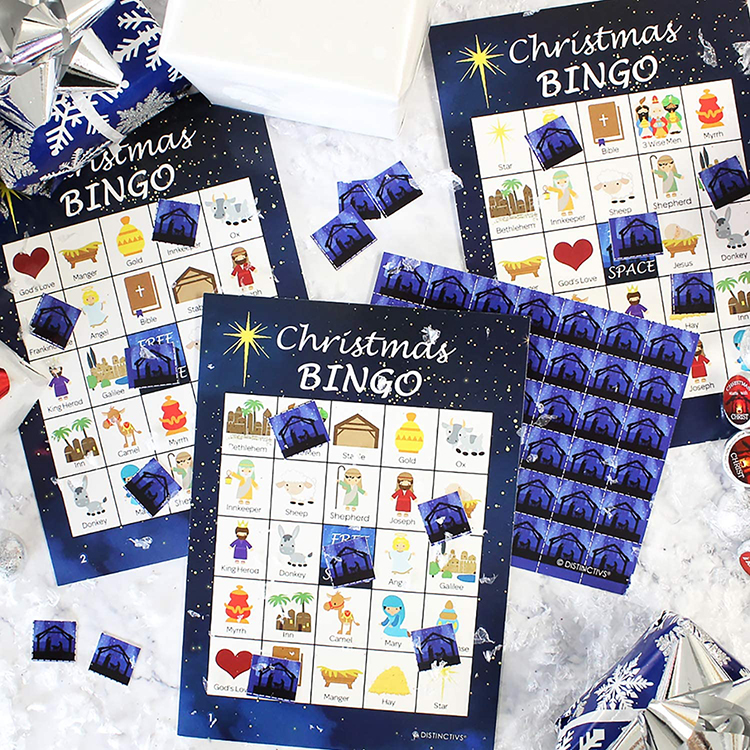
The third specimen is the scene the product disappears into: three cards fanned on white faux snow, free-space chips parked on their centre cells, wrapped boxes with silver star bows closing the corners – a Christmas-morning family table in a still photo. Between that scene and our press sits an event calendar more unforgiving than graduation season, because the date is fixed by liturgy and commerce alike: Sunday-school programs run the Advent weeks, office parties cluster in the final working fortnight, and family-game-night retail sells through November. Deck count follows the room. A parish running one night for a hundred parishioners buys one hundred sheets of one shuffled deck; a school department stocking six classrooms buys six smaller packs and reuses the die all term; a gift shop stocks the twenty-four-sheet pod because that number fits a party of four tables without dead cards.
Lead times read against that cliff, not against the file: samples in 3-5 days so a committee can approve caption legibility at six-year-old reading distance before December hardens, and bulk on the 7-15 days after artwork approval window with the last sea cut-off announced every September because nobody wants a Christmas program arriving in January. The figure on this listing anchors the 100-piece tier; contact us for pricing on other quantities, and the 100 pcs per design rule applies deck-side – each shuffled deck variant that carries different sheet numbering counts within one design line, while a second artwork family under the same theme is its own line. That distinction is how a church program and a toy retailer get honest quotes off identical machinery.
Storage reality shapes one more detail. Program decks live on a shelf between Decembers, and stacked sheets in a humid hall curl at the corners; the chip sheet’s cut squares are the first casualty, losing their crisp edges long before the cards do. We run both at the same board so curl matches across components, and committees that plan to reuse a deck for three years should order cards at the program count and chips at double, because replacement chips without the original plate are a re-quote while replacement chips printed from a retained file are a one-line reorder at the 100-piece minimum.
Committee approvals also move faster on physical proofs: caption legibility across a hall is a six-year-old argument, not a projector one.
Budget holders comparing deck quotes should read the gutter count as carefully as the price: sheets per master pool, chips per backing sheet, and spare caller sheets per deck are three separate numbers, and two decks priced identically can differ by twenty percent on night-one playability simply because one of the three quietly dropped out at artwork lock.
One Grid, Every Season: The Print-And-Play Family This Deck Belongs To
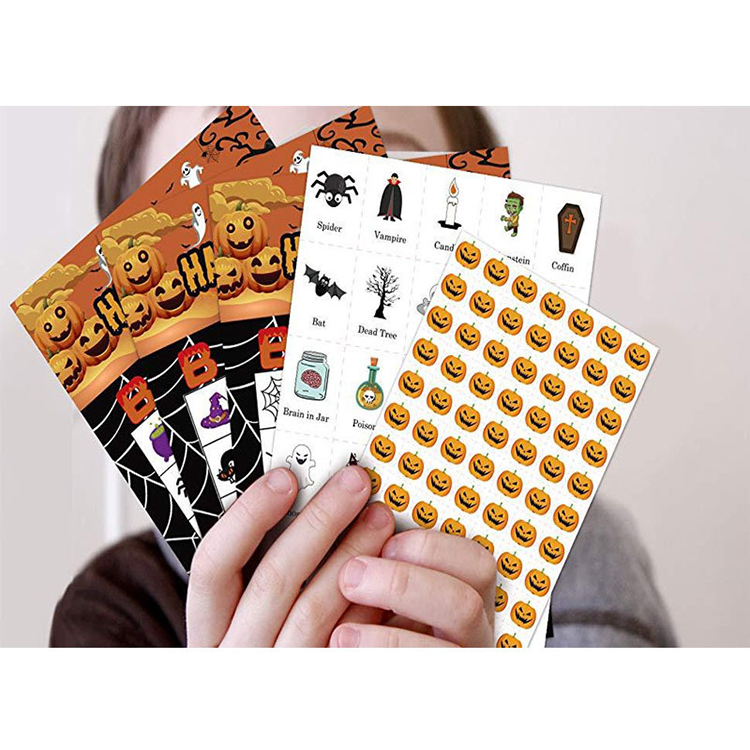
The fourth sample swaps the snow for a hand-held fan of sheets and quietly proves the reusability argument. Held up against a plain wall: a labelled icon-key grid – squares of cartoon art each captioned in small print – a dense repeating pattern sheet of carved pumpkin faces, black web-patterned sheets with hanging charms and oversized banner letters, orange scene bands behind them. Halloween skin, Christmas engine. The component logic is line-for-line the one the nativity deck uses: a grid whose cells pair picture with caption, a companion sheet that repeats a single motif in cut-ready squares, and extra face variants that share the same plate session. Which is the actual sales argument for a party channel or a school shop: the deck you commission for December is a caption-and-artwork swap away from February, October, or a reading-labeled classroom version, all on the same die, the same gutter grid, the same imposition rules.
What does change between seasons is only the picture pool and the free-space treatment – a stable outline for Advent, a carved lantern for Halloween, a school crest for a literacy night. Our pre-press keeps those zones separate from the grid mechanics in the master file precisely so that seasonal restocks never touch geometry: cell size stays finger-sized, caption type stays readable across a hall, the centre cell stays dark so a dauber blot or a chip cannot be mistaken for a marked square. Retail buyers get the shelf-ready version of that argument: header-carded poly packs of a fixed sheet count with a small caller-instruction panel printed on the reverse of the top card, quoted as an option because a church program wants none of that packaging cost and a toy aisle wants nothing else.
A practical dauber note for planners who specify the marking route: ink behaviour on the matte face is predictable, but the cell art sits under every blot, so callers running multi-round nights on one card set should brief tables to mark once per game and deal fresh sheets each round. The deck architecture supports either style, but the photographs of the finished evening come out cleaner one way than the other.
Retail pods and program bundles share the press but not the pallet: an event order can ride as loose banded stacks counted to the seating plan, while a shelf pod arrives header-carded and shrink-banded with the count printed on the card itself. Both configurations come off one production week, which is exactly how a December seller keeps a game-night listing live between program seasons without holding two stocks.
What You Can Specify On This Deck
- Deck count: 24, 48 or 100 shuffled sheets per master pool, numbered corners included
- Grid artwork: your licensed or original picture set, captioned cells, twenty-four playable squares plus free space
- Marking system: printed calling chips on guttered cut sheets, dauber-ready cards, or both quoted as variants of one run
- Free space: theme mark in a solid-colour centre cell, locked across the whole deck
- Seasonal skins: one grid architecture, holiday artwork swapped at plate level without touching geometry
- Pack format: loose program bundles or retail header-carded poly packs with reverse instruction panels
- Caller kit: optional master calling card and winner-check sheet printed on the same plate session
Specification Summary
| Item | Christmas/Nativity bingo game decks: player sheets, calling-chip sheets, optional dauber-ready run |
| Size | Common pocket sizes quoted on request; full-sheet format for program play per your room plan |
| Stock & Finish | Matte cardstock, flat full-colour print; uncoated face so chips grip and daubers dry |
| Printing & Artwork | Shuffled multi-sheet imposition from one picture pool; caption and free-space zones plated separately; free digital mock-up before tooling |
| Envelope or Extras | No envelope component; extras are cut chips, caller sheets, and retail header cards |
| Packing | Decks banded per program count, components individually poly bagged for retail, master export cartons |
| MOQ | 100 pcs per design |
| Sample time | 3-5 days |
| Lead time | 7-15 days after artwork approval |
| Capacity | 1,000,000 pcs per month across our gift lines |
Booking A December Program Without A December Panic
The order path compresses to three decisions: caption set, deck size, marking system. From an approved master file we return a digital mock-up free – one player sheet, its chip backing, the centre-cell treatment – then physical samples in 3-5 days so the committee can test legibility at hall distance rather than on a laptop. Approval before end of September keeps sea freight viable; October approval moves the program to the air-freight plan; anything later is a courier conversation priced accordingly, and we would rather have it in September than argue it in December. Restocking a proven deck is the easy half of the season: same plates, same shuffle pool, 7-15 days after artwork approval becomes 7-15 days, period – the reason event channels front-load their artwork fees once and then survive seasons on reorders. Mixed-theme buyers splitting one order between Advent and Halloween skins should count each artwork family against the per-design minimum before artwork opens, because that is the line where two decks stop sharing a quote.
Packing And Getting Decks Into Halls Before The Program
Program bundles ride as banded decks inside master export cartons sized to your sheet count; retail pods are individually poly bagged under header cards so a shelf brick survives forty customer hands before the first December sale. Full sheets and cut chips pack in separate inner sleeves during the same run – loose chips in the same bag as cards arrive as confetti at a parish hall. Freight options cover the whole cliff edge: by sea, air, or express with DHL, UPS, FedEx and TNT, and Amazon channels get FBA prep including co-packing bingo decks with other game or gift SKUs in one inbound, which is how a holiday seller turns a single Prime listing into a full party shelf instead of three half-empty shipments.

Questions From Event Committees And Holiday Sellers
How many cards do we need for a hundred-person church program night?
Do the calling chips come pre-cut or do our volunteers cut them?
Can we replace the religious caption set with a secular holiday one on the same order?
Daubers or chips – which marking method lasts across a multi-year program?
What stops two players in our hall getting the identical card?
The Rest Of Our Game And Event Line
The shower-season cousin of this mechanic – fill-in party cards kept as memories rather than discarded at last call – lives on our prediction game cards page, and the invitation that fills the room around them is the shower invitation suite. Ceremony programs buy the graduation advice keepsake, gift-packaged holiday bundles draw from the gift sets tree, and everything above sits under the general cards range in printed products. Deck counts, caption files and hall dates go to the quote desk, [email protected], or +86-15967739086 – before September, if you value the word “program” more than the word “postponed.”
Send the picture pool and the seating plan; the shuffled mock-up comes back free, and December arrives already packed.