Custom Baby Shower Invitation Cards With Matching Suites
$0.60
Square and portrait baby shower invitations built as fill-in platforms: an illustrated animal-and-foliage border frames a centred field stack with rules for the honouree, date, time, a two-line place, host, RSVP, and registry rows. Buy the same file blank for write-on retail stock or pre-printed with variable details from your order data, and extend one artwork into a full suite – game cards, thank-you notes, pattern-lined envelopes – so the season sells as one basket instead of five separate designs. Samples in 3-5 days, MOQ 100 pcs per design, bulk 7-15 days after artwork approval, with FBA prep and mixed-carton suite packing available.
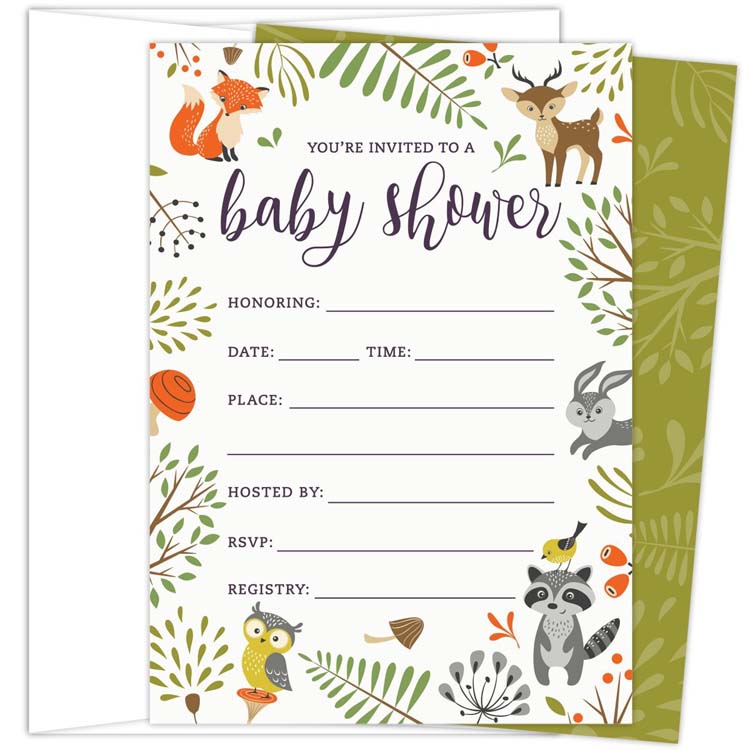
These are custom baby shower invitation cards planned the way event season actually buys them: one illustrated face, one fill-in field stack, and a whole matching program – game sheets, thank-you notes, backing envelopes – built from the same artwork file. The card pictured is a square forest-creature layout: fox, fawn, owl, raccoon, hare, bird, mushrooms, acorns and berry sprigs run around all four edges while the middle stays clear for type and writing lines. Party-supply resellers, registry-driven gift shops and print-on-demand sellers reorder this exact architecture every spring; the art swaps, the field list stays. What buyers usually get wrong is treating the invitation as a single SKU instead of the anchor of a suite, and that is where the margin leaks out of the season.
Legibility at thumbnail size is a second engineering reason the layout survives reprint after reprint. Every field label in the stack sits in serif caps with full letter spacing, not condensed sans – small type on a phone screen at two inches wide lives or dies by x-height and tracking, and a template that reads on a shop wall but fails on a marketplace listing loses half its channel. The picture band carries the same constraint: the animals are drawn chunky with high-contrast flat fills, because fine-etched woodland art muddies into a green smear at print-ready reduction and nobody buys a muddle for a party.
The Border-And-Center Layout, Read As a Production File
Start from the specimen and work backward through the press. The ground is a clean cream card, four-colour printed flat – no foil, no emboss, nothing tactile that would push the unit price up on a product parents buy by the dozen for a single afternoon. Around the edges sits the illustration band: an orange fox with a cream chest at the top left, a fern frond brushing the top edge, an antlered fawn at the top right, a grey hare peeking along the right margin, an owl perched on a mushroom at the bottom left, a raccoon with a small bird above it at the bottom right, and berries, seed pods and leaf sprigs closing every corner gap. The artwork is deliberately a frame, not a scene – the four corners carry the density so the centre column can breathe. That is the trick every illustrated invite layout steals from stationery: the border does the mood, the centre does the information, and neither fights the other at small thumbnail size on a shop shelf or a phone screen.
In the centre, a small serif caps line introduces the event, a large script word names it, and below that the field stack runs in a strict left-aligned column: HONORING, then DATE and TIME sharing one row, PLACE on its own rule with a second blank line directly beneath for addresses that run long, then HOSTED BY, RSVP, and REGISTRY – each label in caps with a thin horizontal writing rule after it. On the blank specimen every rule is empty, which is exactly what a wholesale buyer wants: the card ships as a write-on platform, and the details get filled in pen, or printed over by an on-demand vendor, or left open for a chalk-marker finish at the register counter.
Same File, Two Business Models: Write-On Stock and Printed Variable Runs
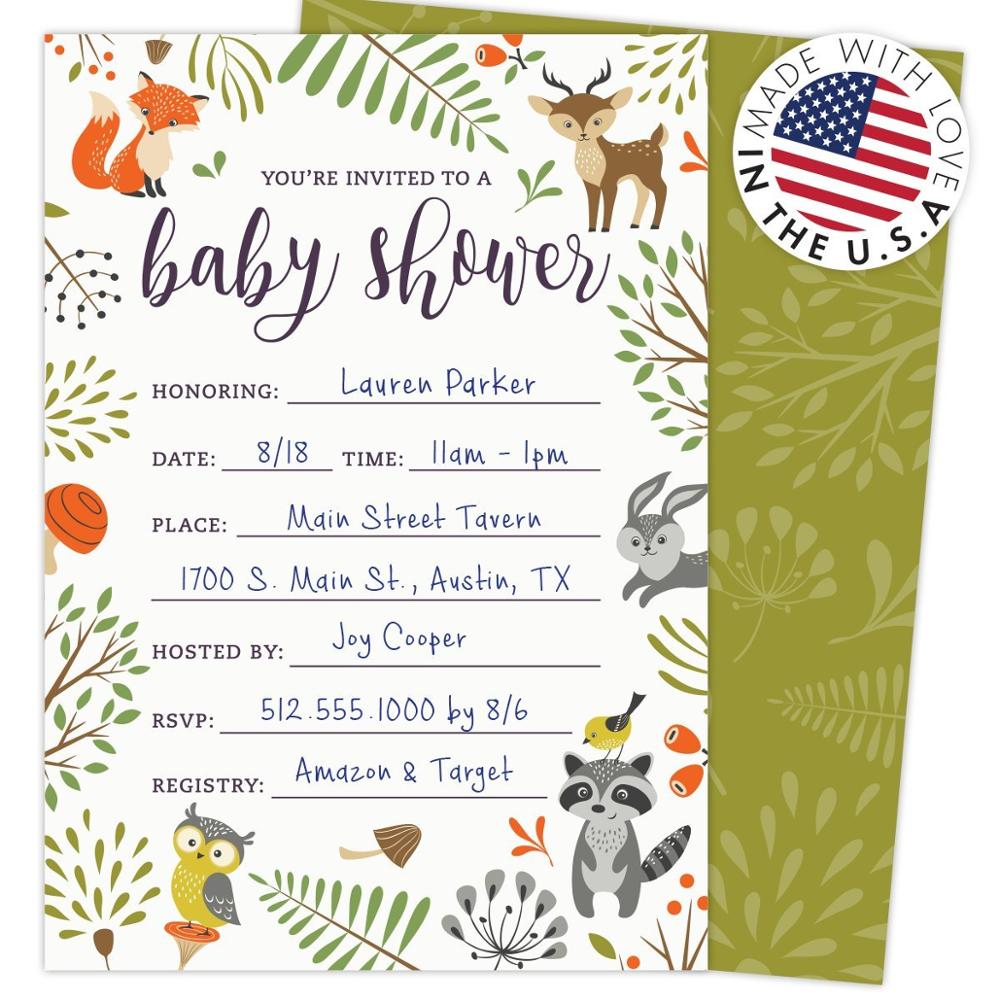
The second specimen shows the identical card with the rules populated – demo entries in a handwriting-style print across every field: who the shower honours, a date and time window, a venue and street line, a host name, an RSVP number with a reply deadline, and a registry line naming mass retailers. Read it as a proof of the layout’s capacity, not as content: those lines are the designer’s mock, filled here purely to show how much text each rule swallows before the border starts to crowd. The address row is the honest stress test; PLACE got two rules on the artwork precisely because venue lines are the field that blows up a beautiful template in real life.
Read the demo entries as capacity, not style: each rule absorbs a full venue name plus an address, a host with a surname, a phone number with an area code, a reply-by date, and a two-store registry line, and none of them collides with the border art. That headroom is why personalised reprints from customer order forms work without redrawing – the text zones were measured before the illustration was finalised, in reverse order from most template design, and it is the single question to ask any supplier whose artwork looks prettier than this: show me the longest real address that fits your rule.
That single proof image also splits the product into two business models, and both run off one artwork file. Model one: buy the blank write-on version in bulk – 100 pcs per design gets you on the floor of a party store, where the host fills it at the counter and the shop never touches pre-press. Model two: sell or send pre-printed personalised runs, where each buyer’s details go onto the rules from their own order form. For that second model we run the artwork as a fixed background with a variable text zone, one master file, one print plate, and a data file per order – the on-demand sellers we supply treat the two-line PLACE field as mandatory because shipping-address-length complaints land on them, not on the customer with the pen. Both models share dies, both share your colour setup, and the digital mock-up we return before tooling costs nothing either way.
One more production consequence of the blank-versus-personalised split: write-on stock wants a pen-friendly surface, personalised runs want a color-managed one. Same card stock, different inspection notes – the blank version is checked for tooth and ink-set on the rules, the variable version is checked for registration between the printed data and the artwork, because a handwriting font printed two millimetres high turns a demo into a disaster when a real address arrives longer than the mock. We proof both routes physically before a channel commits to either, and the reference for both is the second photograph on this page rather than a promise in a spreadsheet.
Suite Continuity: The Pattern Does the Matching, Not the Logo
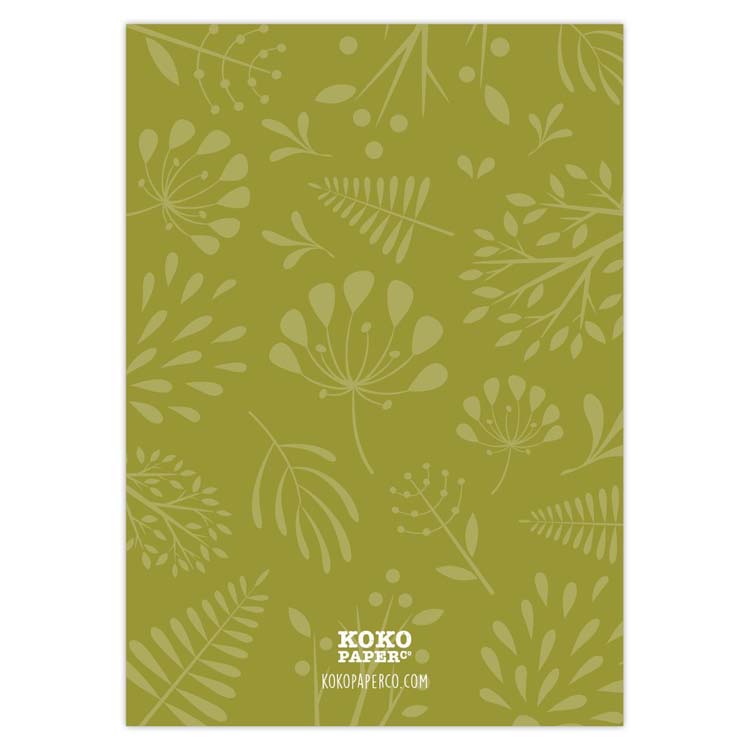
Here is the part most shower programs get cheap. The invitation’s border motifs – fronds, sprigs, berry clusters, twigs, scattered seed heads – are lifted, recoloured to a tone-on-tone duotone, and pushed to full bleed, and suddenly the same artwork earns you four more SKUs. The reverse-side sheet shown below is that move in practice: an olive ground carrying the identical botanical vocabulary in a paler sage, all-over, bleeding off every edge, sized to sit behind the card in a photograph and behind the invitation in real life as the envelope liner, the backing board, or the reverse of the game cards. Nobody in the guest list reads a logo to know this suite came from one shower; they read the pattern. Which is why the pattern needs to be developed as a repeat at artwork stage, not cropped out of the corner of the border art after the fact.
On a production quote this reads as: one master illustration file, exported as border version, centre version and all-over repeat version. Game sheets take the repeat as a full-bleed back so the prediction faces and the invitations stack on one display table looking deliberate. Thank-you cards take the border treatment shrunk to the same rule weight. The envelope, unprinted or lined with the duotone, closes the set. When a reseller asks what makes their shelf different from the marketplace’s $3 digital downloads, the answer is that the download is a JPEG and the shelf is a suite of physical pieces on matched stock – same file, four formats, one artwork fee. Registry season rewards whoever can sell all four in one basket, and the pattern is what lets one file do that honestly.
One stock and carton detail before the pattern section: write-on stock ships flat-counted in export cartons with interleaved stiffeners, because unprinted rules are exactly the surface that scuffs in transit – the pen test a buyer runs on a sample happens in a shop with a display copy, not on a customer card. Personalised runs ship sealed against order data, and both routes use the same cream card so a store keeps one family with two fill methods rather than two families a guest could visually tell apart.
Retail buyers running seasonal endcaps tend to keep one physical proof face permanently on the counter, because the repeat pattern reads very differently at true scale than on a screen, and that proof sheet is the cheapest closing argument available to a shop assistant who never draws – order it from the sample run, not the bulk carton, so its corners stay clean through a full season of handling.
Season Math: Buying the Invitation Before The Bump Picture Exists
Baby events do not wait for a quarter, but they do follow a curve. Showers cluster around late spring and early autumn in most Northern Hemisphere retail markets, gender-reveal purchases run hotter and flatter year-round, and the invitation is always the first domino: it locks the guest list, so it ships four to six weeks ahead of everything else in the set. That ordering is why we develop the suite file first and print the components in waves against your sell-through, instead of dumping one giant equal split across five SKUs. A reseller who tested this design in March can restock invitation stock in week two and game sheets in week five off the same tooling, because nothing about the artwork changes between runs – only the quantity mix does.
On the calendar side, remember the press itself has a rush hour. The weeks before each shower season get tight for illustrated four-colour runs, and the 7-15 days after artwork approval production window moves faster when it is not competing with six other seasonal jobs in the queue. Samples run 3-5 days from a clean file so you can check border colour against your actual gift-shop wall before committing, and the minimum stays at 100 pcs per design because a pattern repeat is only economically yours once it prints more than once.
What You Can Specify on This Program
- Card format: square or portrait invitation layouts with border-frame artwork and a centred fill-in column
- Field list: event line, honouree, date/time row, two-line place field, host, RSVP, registry – reorder or drop rows at artwork stage
- Print: flat four-colour on matte cream card; no tactile upgrades needed for the write-on version, which is why it holds a shelf price
- Versatility: blank write-on stock, or variable-text personalised runs from one master file with a per-order data sheet
- Suite formats: invitation, game card, thank-you card, backing sheet, envelope – one border artwork exported to four placements
- Pattern: tone-on-tone duotone repeat developed from the border motifs for reverses, liners and backing boards
- Envelopes: plain or lined; lining uses the suite repeat, options quoted on request against a physical sample
Specification Summary
| Item | Baby shower invitation cards with matching suite components (invitation, game card, thank-you card, backing sheet, envelope) |
| Size | Common pocket sizes quoted on request; square and portrait formats per artwork |
| Stock & Finish | Matte cream or white cardstock, flat printed; envelope stock matched per format |
| Printing & Artwork | Four-colour offset or digital; fixed background plus variable field zone; vector artwork preferred, free digital mock-up before tooling |
| Envelope or Extras | Plain or suite-pattern-lined envelopes; backing boards; game-card reverses on the same repeat |
| Packing | Components individually poly bagged, master export cartons, suite sets assembled per your pick list |
| MOQ | 100 pcs per design |
| Sample time | 3-5 days |
| Lead time | 7-15 days after artwork approval |
| Capacity | 1,000,000 pcs per month across our gift lines |
Ordering, Proofing, and Getting Your Text Onto the Rules
Send the illustration you own, or send a brief and take ours. Either way the file comes back as a digital mock-up before anything is cut: border on one side, field stack on the other, colour pinned against the repeat you will see in the photograph above. Personalised programs add one step – your per-order data list, matched against the variable zone, proofed once as a batch sample so the demo-handwriting stage is over before the print run starts, and the sample lead stays 3-5 days from the moment that list is final. The price figure listed on this product anchors the 100-piece tier; contact us for pricing on other quantities, and mixed-suite orders are quoted design-line by design-line because every extra artwork counts as its own 100 pcs per design, not a fraction of the invitation’s. If a buyer wants the game mechanic that this suite’s pattern feeds into, it lives on our baby shower prediction cards page – same season, different SKU, different conversation at the register.
Packing For Retail Shelves and Amazon Inbounds
Invitation stock ships loose-counted in master export cartons or face-out ready for shelf hooks, depending on whether your channel is a party store or a marketplace pod; game sheets interleave with invitations in the same carton when the suite sells as one basket, and every component is individually poly bagged before boxing so corner bruising never meets a gift-wrap station. Freight moves by sea, air, or express with DHL, UPS, FedEx and TNT all on the table, and the usual rhythm is sea for the seasonal base order, air or express for the mid-season restock when one design suddenly out-converts its wall. FBA prep is routine on this line – pick, pack, label, and combine-in-carton with matching thank-you or game SKUs, so a reveal-season inbound shows up as one shipment instead of three.

Buying Questions, Answered Plainly
Can we buy the invitation blank and run the personalised printing ourselves?
Does adding a game card and thank-you card to the order mean paying for new artwork?
What happens to the price when a season is mid-run and one SKU sells through early?
Are the illustrated borders reprintable in a different colour family for a second season?
How should a shop display the suite without buying five sample sets?
The Rest Of The Paper Program
All of these formats live in our broader cards catalogue under the general printed products tree. The event-goods shelf here is deliberately cross-linked: prediction game cards own the party-floor moment, the keepsake advice-card line shows how a fill-in card ages into a memory object, and when a client wants the premium wedding-grade press treatment, the embossed and foil suite page is that argument in full. Holiday-party event planners pull the same game-pack skill set from our bingo card decks, and box-and-set buyers start at the gift sets category. Ready to price your season? Use the quote desk, or write [email protected], or ring +86-15967739086 – artwork in hand or not.
Send the field list and the season date; the mock-up comes back free, and the sample comes back printed.