

Custom Printed Oversized Beach Towels | Bulk 100pcs
$2.10
Full-bleed novelty printing on oversized towels for gift shops, resort boutiques, tour merch tables and rental programs. The photographed sample footprint is 140 cm by 70 cm, printed edge to edge from your artwork file on a smooth sublimation face or a plush velour-terry build with an overlocked seam, exactly as the construction close-up shows. MOQ runs 100 pcs per design, digital mock-ups are free, physical samples ship in 3-5 days, and bulk closes 7-15 days after artwork approval inside a 1,000,000 pcs monthly capacity across our gift lines. Retail-ready poly bag and header-card packing, FBA labels, sea or courier freight. Send the file and the shelf date; we return the mock-up and a quoted price at the 100-piece tier before you commit anything.
Gift-shop buyers do not stock textiles; they stock shelf presence. Our oversized printed beach towels are built for that job: a full-coverage graphic that reads from three feet away, a footprint large enough to double as a sofa throw or a poolside wrap, and a print lane that runs straight off your artwork file. The sample photos on this page are novelty graphic print demos of one buyer’s artwork – they load your art, not ours, and sit on the replacement list awaiting on-brand shots of client-approved designs.
Why large-format novelty prints reorder
Impulse-priced soft goods sell on graphic impact before they sell on fibre. Tour merch tables, resort boutiques, museum stores, car-dealer promos and rental lockers all run the same math: a big, legible image on a big cloth moves units at a visible margin, while a plain piece with a small chest-size logo zone never earns a second look. Full-bleed printing turns the entire rectangle into shelf space – edge to edge, no dead border, nothing for the customer’s eye to slide past on the way to the next hook.
Because the footprint is oversized, one SKU works four ways: cover-up at the pool, throw on a cold stadium night, blanket in the bleachers, wall hanging after the season ends. That second life explains the reorder pattern we see constantly – buyers come back to restock a sold-out graphic, not to replace worn fabric. The artwork is the product; the cloth is its delivery vehicle. Print shops that treat the graphic as decoration on a towel have the hierarchy backwards, and their clearance racks show it.
Tour merch proves the model every summer. A city-exclusive design printed in a 100-piece drop per venue sells through before the bus leaves town, and the fan who buys one becomes a walking advertisement for the next city’s table – media the promoter didn’t have to buy. Nobody restocks a plain towel mid-tour. They restock a graphic, and whoever ordered one venue’s file becomes a customer for the whole run of dates. The same logic covers car-dealer giveaways, festival camping bundles and the resort shop that sells the pool’s logo back to guests as luggage.
There is also a margin structure hidden in the format. A mid-size printed piece competes on price with whatever the customer finds online that week; an oversized one competes on presence, and presence is harder to comparison-shop. Venues that tested both report the same result: the big graphic sells at a multiple of commodity pricing while the small one gets haggled. That is why our merch-channel repeat customers standardise on the oversized footprint even for designs that would technically fit smaller – once the shelf math is proven, the size decision stops being about fabric and starts being about price points per square metre of artwork.
Which brings us to the actual buying question for this page: not what the cloth costs, but whether your graphic survives being the product. Everything below is what our photography and our production path can demonstrate about that survival – with the claims kept strictly inside what the samples show.
That discipline is also how we protect you downstream. Listings that inherit our spec sheet verbatim stay defensible when a marketplace audits them, because every published number traces to a file, a mock-up or a photograph – and every number we deliberately refuse to publish arrives instead as a quote you own and can verify before it ever reaches a customer.
What the sample photographs actually prove
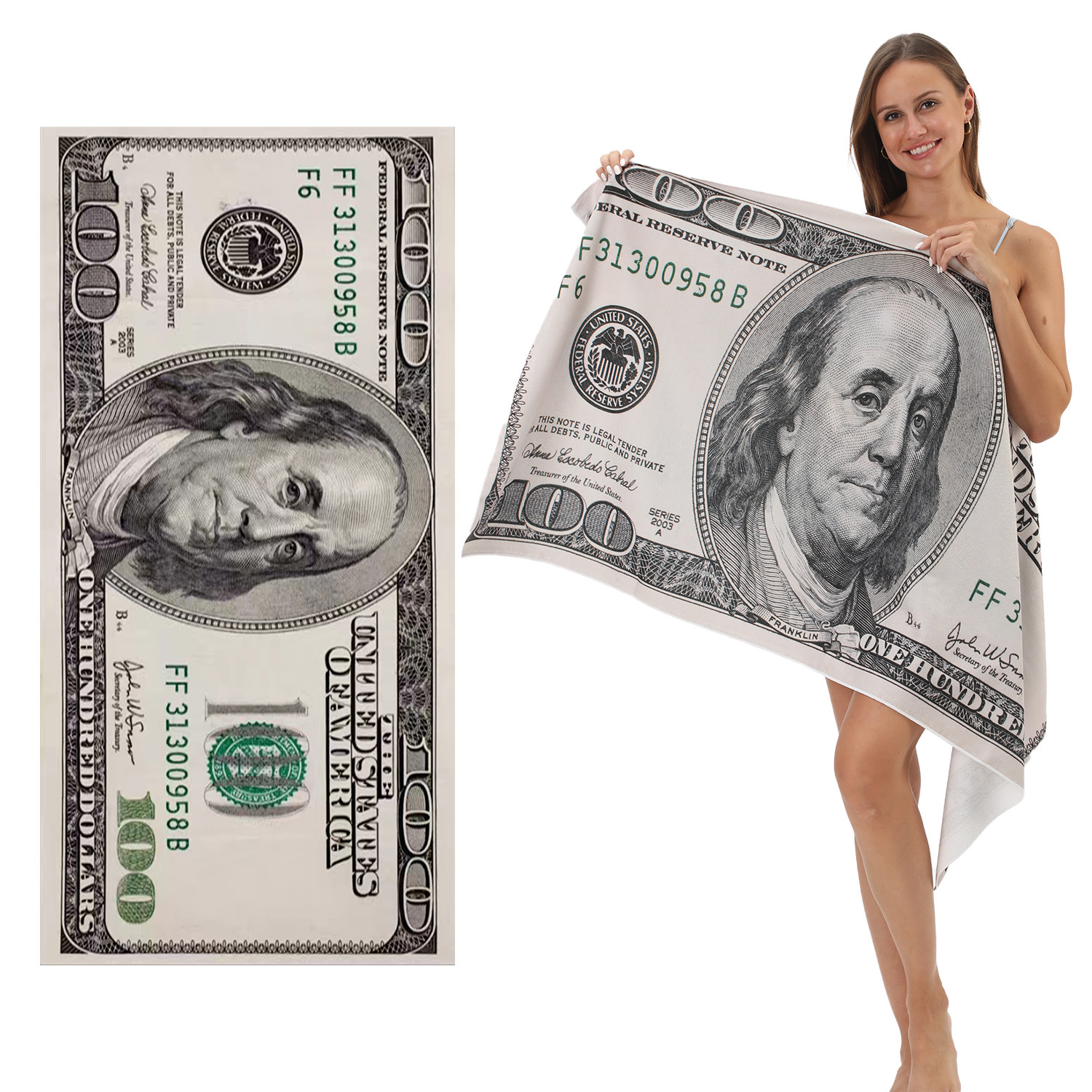
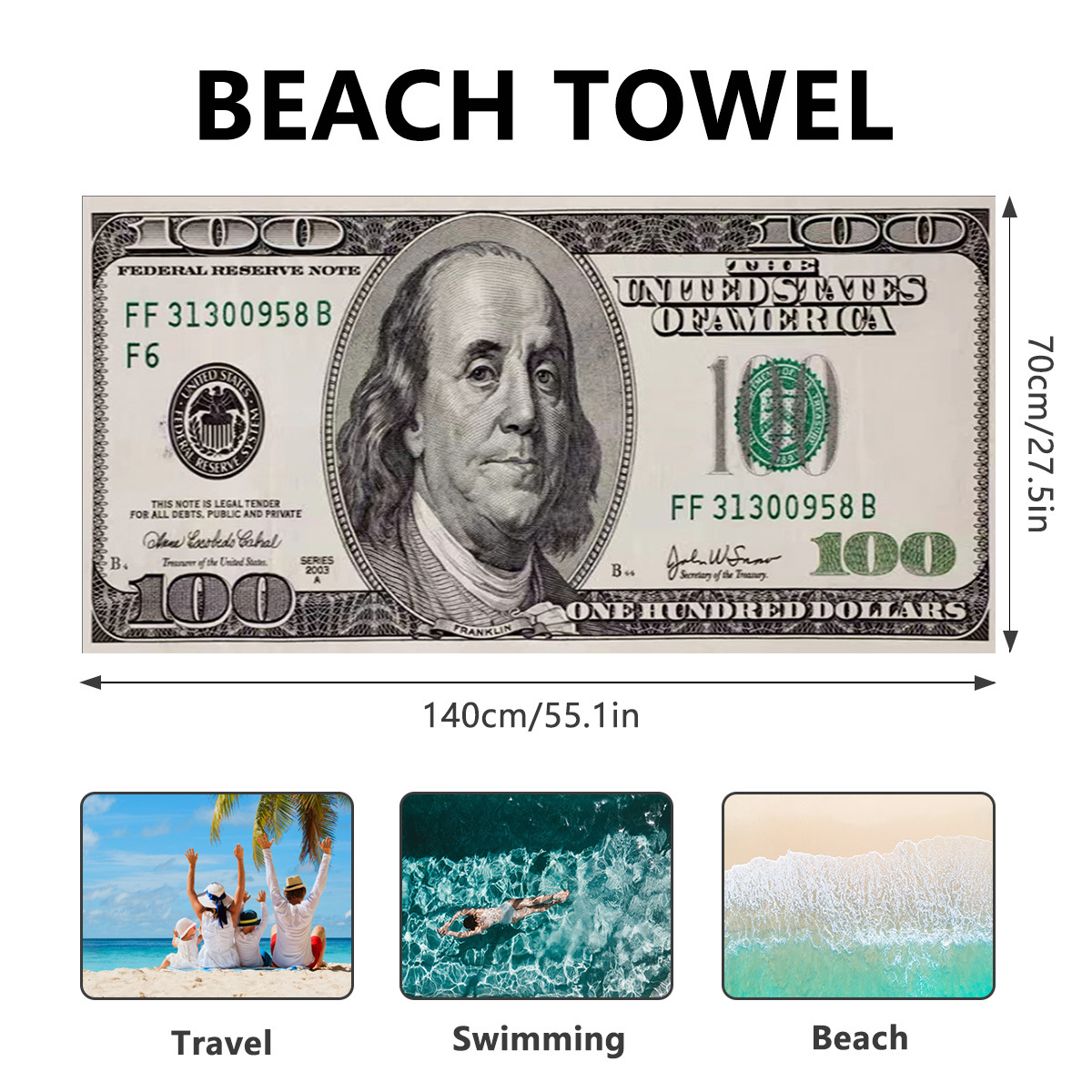
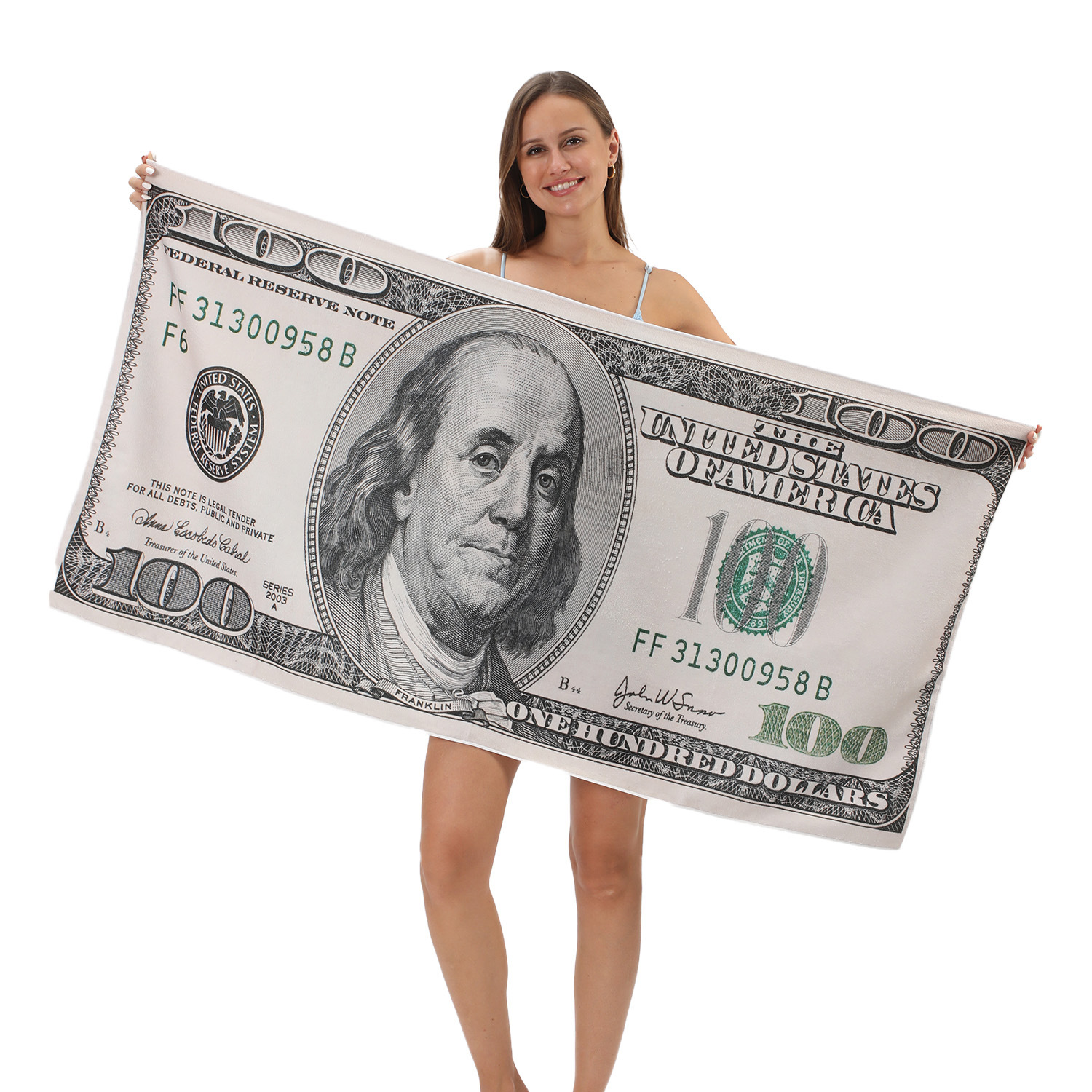
We keep claims to what the pictures show. The flat panel in the first photo proves a dense, fine-detail graphic reproduces cleanly from hem to hem with no registration gaps or banding across the full field. The held sample proves the cloth drapes soft and fluid rather than board-stiff, and that the print stays aligned when the fabric hangs diagonally across a body – fold lines move the image without breaking it, the way a wear piece should. The dimension mockup annotates the sample footprint at 140 cm by 70 cm (55.1 in by 27.5 in) with arrows drawn on the art; treat that as the photographed reference size, not a promised spec across every fabric option.
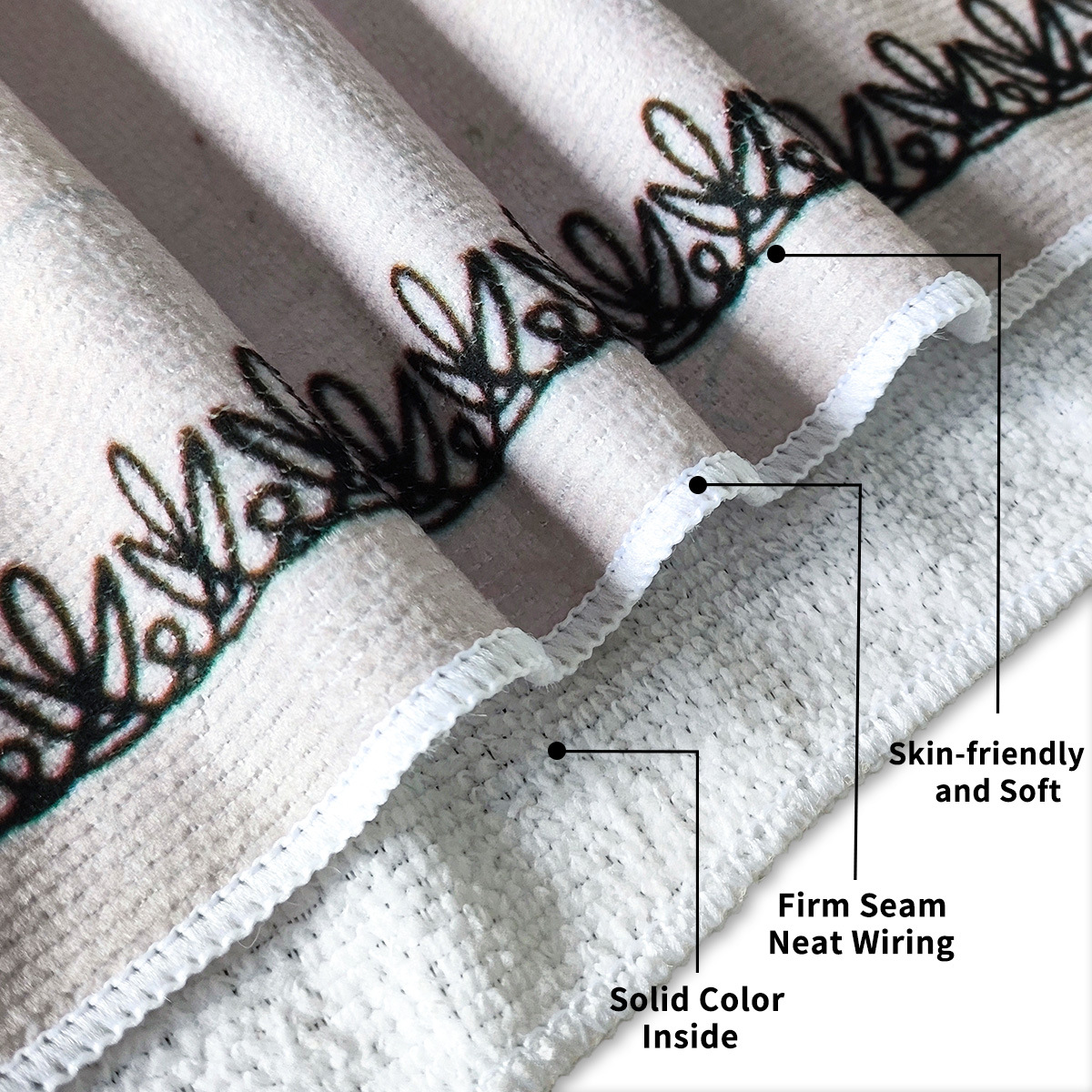
We publish no GSM figure on this page. Cloth weight comes back quoted against your chosen construction, so the number you print on your own listing is one you chose and tested. What the photography does establish is the production ceiling: complex line-work, tonal gradients and edge-to-edge coverage all land without artefacts. The construction close-up further down the page carries the physical-build proof – a smooth print face, a white loop-pile reverse, and an overlocked edge that stays straight under fold tension. Layout fidelity plus drape plus edge work is the shortlist criterion novelty buyers check before they ever ask about weight.
Print method and fabric faces
Full-coverage graphics run by dye-sublimation onto a smooth synthetic face: the ink bonds into the fibre, so fine linework, halftone shadows and gradient tones survive folding and laundering with no surface layer to crack. Cotton velour and terry bases take rotary or flat print instead, with a softer hand and a plush light-play across the image; expect slightly muted micro-detail versus a subbed face, and check your artwork against a physical strike-off before committing a run. Smaller badge zones can be done by DTG or screen print where a full-bleed field is not needed.
Laundering-cycle and fastness figures are not asserted here; they go out quoted per construction on request, with lab data where the fabric class carries it. If your artwork carries hairline elements – small type, thin contours, engraved-style textures – say so in the RFQ. The studio will recommend the face and method that hold detail at your print size, then prove it on the sample that ships before bulk starts. Choosing the face is a two-way decision: the graphic decides how much detail must survive, the channel decides how much hand-feel the shelf price can lean on.
Size program beyond the annotated sample
Buyers scale this lane in two directions from the photographed 140 x 70 cm footprint. Shorter lap formats, roughly sarong-to-throw, hit a lower checkout price point without losing graphic area – useful for venue tables where the ticket has to stay under a psychological line. King footprints cover a lounger head to toe and photograph well on a resort website, which is itself the sales channel for the boutique stocking them. Any rectangle between those poles is cut and sewn to order; the print file simply re-flows to the new aspect, so one artwork purchase can cover a full size ladder on a single hang card.
Send finished dimensions in millimetres or inches with bleed marked. The studio checks proportions against your art before the digital mock-up goes out and flags anything that would fall into a fold, hem or corner at the requested format. Cropped text and amputated design elements are artwork-prep problems, not production problems, and catching them in pre-flight saves an entire sample cycle. If your file was drawn for a different aspect, the fix is a guided re-layout, quoted once, not a re-buy.
Customisation spec sheet
| Print lane | Full-bleed novelty graphics from customer artwork files |
| Face options | Smooth sublimation-grade synthetic face; cotton velour/terry with printed face and white loop-pile back |
| Annotated sample footprint | 140 cm x 70 cm (55.1 in x 27.5 in), per dimension arrows in the mockup photo |
| Edge finish | Overlocked perimeter seam as photographed; narrow unprinted margin optional |
| Colour approach | Process-colour artwork supported; spot matching against your Pantone reference quoted on request |
| Artwork inputs | Vector (AI/EPS/PDF) or high-resolution raster; bleed marked; studio pre-flight included |
| Capacity | 1,000,000 pcs per month across our gift lines |
| Bulk window | 7-15 days after artwork approval |
| Sample time | 3-5 days |
| Minimum order | 100 pcs per design |
| Mock-up | Free digital mock-up before sampling |
Artwork-to-order flow and buying signals
One file, one PO, one lane. You send the artwork and target size; we return a free digital mock-up showing the graphic at full bleed on the chosen face; you approve; a physical sample leaves in 3-5 days; bulk production closes in 7-15 days after artwork approval. The MOQ is 100 pcs per design, so a tour or a resort can run several graphics as parallel small drops instead of one giant buy, and reorders of an approved file skip re-approval and go back into production without a new sign-off. Our gift lines run at 1,000,000 pcs of monthly output – the reason merch-table deadlines that smaller print shops decline fit our queue without heroics.
Read three signals before you commit budget: how long the graphic stays interesting, whether the size feels generous on the shelf, and whether restock can land while the season still runs. Full-bleed artwork ages visibly because customers photograph it. The oversized footprint carries a premium ticket on the same production pass a mid-size run would use, since the cloth decision happens once in the marker. And a 7-15 day reorder clock off an already-approved file lets you split a season into small lots instead of betting the whole shelf on one forecast.
Reference pricing anchors at the 100-pc tier and steps down with volume, so the first order of a new graphic is a test buy, not a warehouse decision. Designers inside our studio can also work from sketches or mood boards where a venue has a concept but no file; that pre-press path is quoted separately and still lands on the same approval-to-sample track as supplied artwork.
Packing, freight and season timing
Retail-ready packing is the default: each towel folds into an individual poly bag, and hang-tag or header-card packaging turns the unit into hook-wall stock straight off the carton, no back-room repack. Cartons are lined and pressed so the printed face stays flat-sided, with marks to your SKU scheme and mixed-design splits inside one shipment. FBA labelling is covered, and freight moves by sea, air, or DHL/UPS/FedEx/TNT courier depending on the calendar. The packing graphic below documents the standard export stack; pre-production samples ship in plain courier boxes so review happens at your desk before any carton is sealed.
Freight is quoted FOB or CIF as your incoterms team prefers, and carton cubes go back with the invoice so you can pre-book shelf space before the pallets clear. Reverse the calendar from the shelf date. Festival and tour graphics want bulk landed four to six weeks before the first show; northern-hemisphere resort boutiques restock in the gap between spring break and summer peak; gift-season prints should be artwork-approved before late summer so production, freight and customs all fit without courier escalation. Because approval-to-door on air closes inside three weeks, a late drop is a freight decision, not a production miracle – we price both lanes so you choose knowingly rather than praying at a loading dock.
Winter is not a dead quarter for this lane; it is its booking season. Tour routing sheets, resort purchasing meetings and gift-set deadlines all land between November and February, which is when spring artwork should enter approval. Programs that start RFQs in March are buying a compressed freight rate; programs that start in January are buying sea rates and first-weekend shelf position. The production window stays identical either way – the difference is only which leg of the journey gets rushed.
Two logistics notes that save buyers surprise costs. First, printed panels ship flat rather than fluffed: carton dimensions assume folded product, so recube the freight quote if you switch to rolled or gift-tube presentation, which is available at quoted cost. Second, header-card artwork and poly-bag warning text are your files, not ours – supply print-ready card art with the same PO that carries the towel art and both go into production together, instead of the common pattern where product finishes first and waits one week for a slow-approval hang tag. Third, if your venue sells at multiple gates or kiosks, we can inner-pack cartons by location so each stand opens one box instead of splitting a shared case in a stockroom.

The sheet shows the folded-and-lined stack with printed faces separated before boxing, which is why our delivered samples rarely arrive with crease-set marks across the artwork.
How this lane divides the towel program
Four product pages, four jobs – mixing them up wastes RFQs. This one owns large-format graphic art at big footprints for merch and boutique retail. If the assortment also needs a pack-down swim-and-gym format, custom microfiber travel towels is the functional sibling; character-style family programs run on the marine motif page, and hotel-amenity buyers are served by bamboo-viscose towel sets. The towel category indexes the whole soft-goods range when one buyer needs several lanes in a single season plan.
Frequently asked questions
What is the minimum order for a custom oversized printed towel?
How fast can we see a physical sample?
What is the production window after artwork approval?
Can the print match our brand colours exactly?
Is the 140 x 70 cm size fixed?
Send us the artwork file
Tell us the graphic, the size and the shelf date. Reference pricing starts at the 100-pc tier: mail [email protected] or ring +86-15967739086, and the studio replies with your mock-up.


