Custom Microfiber Printed Towels | Gym & Travel 100pc
$2.10
Printed microfiber towels for gym chains, swim schools, tour expo kits and travel retail: a flat synthetic face that sublimates edge-to-edge, folds to a paperback block and re-joins the program quickly. The photographed sample panel measures 140 x 40 cm with six annotated use scenes from yoga to picnic; formats cut from pocket squares up to lounger sizes, with GSM and fastness data quoted per fabric rather than guessed. MOQ 100 pcs per design, free digital mock-up, samples in 3-5 days, bulk 7-15 days after artwork approval inside 1,000,000 pcs monthly capacity. Individual poly bags, optional pouch or snap-loop accessories, FBA labelling, sea, air and courier freight. Tell us the artwork and the program date and we quote from the 100-piece tier.
Gym bags and carry-ons punish thick terry. A printed microfiber panel does the same wipe-down job at a fraction of the bulk: a thin, flat, loop-free face that takes a full-colour sublimation print, folds into a backpack sleeve, and rejoins the kit while bulkier cotton options are still wet. This is the functional lane of our custom towel program – swim schools, gyms, tour operators, marathon expo kits, hotel add-on retail – where the buyer needs pack size, print area and a reorder clock rather than a plush hand-feel story.
What the photographs on this page prove
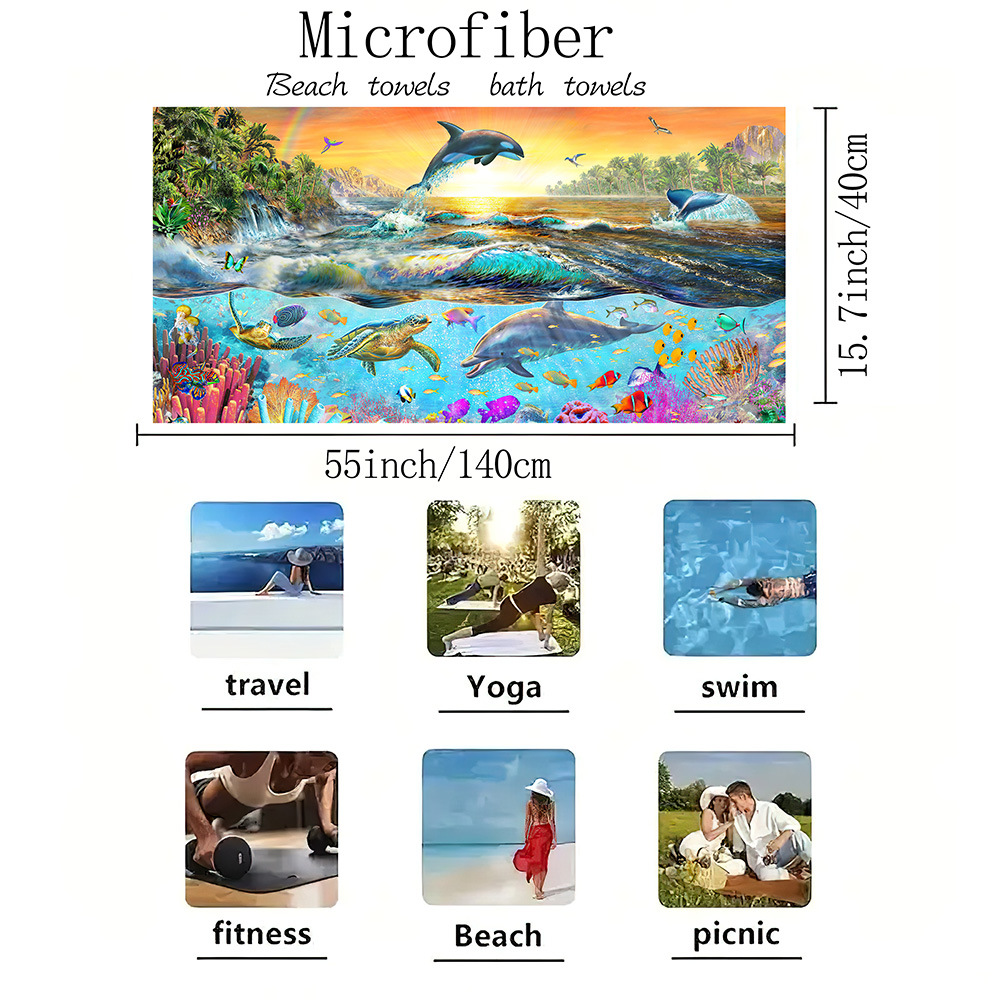
We hold every claim to the pixel. The dimension graphic annotates the sample panel at 140 cm by 40 cm (55 in by 15.7 in) – a lap-and-shoulders footprint that lies across a lounge chair yet rolls smaller than a folded cotton hand towel. The header text printed over that graphic calls the cloth microfiber and lists it for beach and bath use; we log those words exactly as photographed annotation, the fabric-class label being the one thing the picture legitimately settles for us. Beneath the panel, six captioned thumbnails place the product at travel, yoga, swim, fitness, beach and picnic scenes – marketing staging, admittedly, but each scene maps to a real program category that reorders this format season after season.
Read the thumbnails as a channel list, because that is how purchasing teams actually arrive here, each one searching a different word. A yoga studio buys the fitness scene: neutral colours, one centred logo, bulk mats-and-towel kits. A swim school buys the swim scene: sizing by age band and chlorine-tolerant laundering notes quoted per fabric. A tour company buys the travel scene: something that survives a backpack for three weeks and still photographs clean on a sales page. Each of those buyers is ordering the same base panel with a different decision layered on top, which is why we quote construction-by-construction instead of one generic listing with every promise crammed into it.
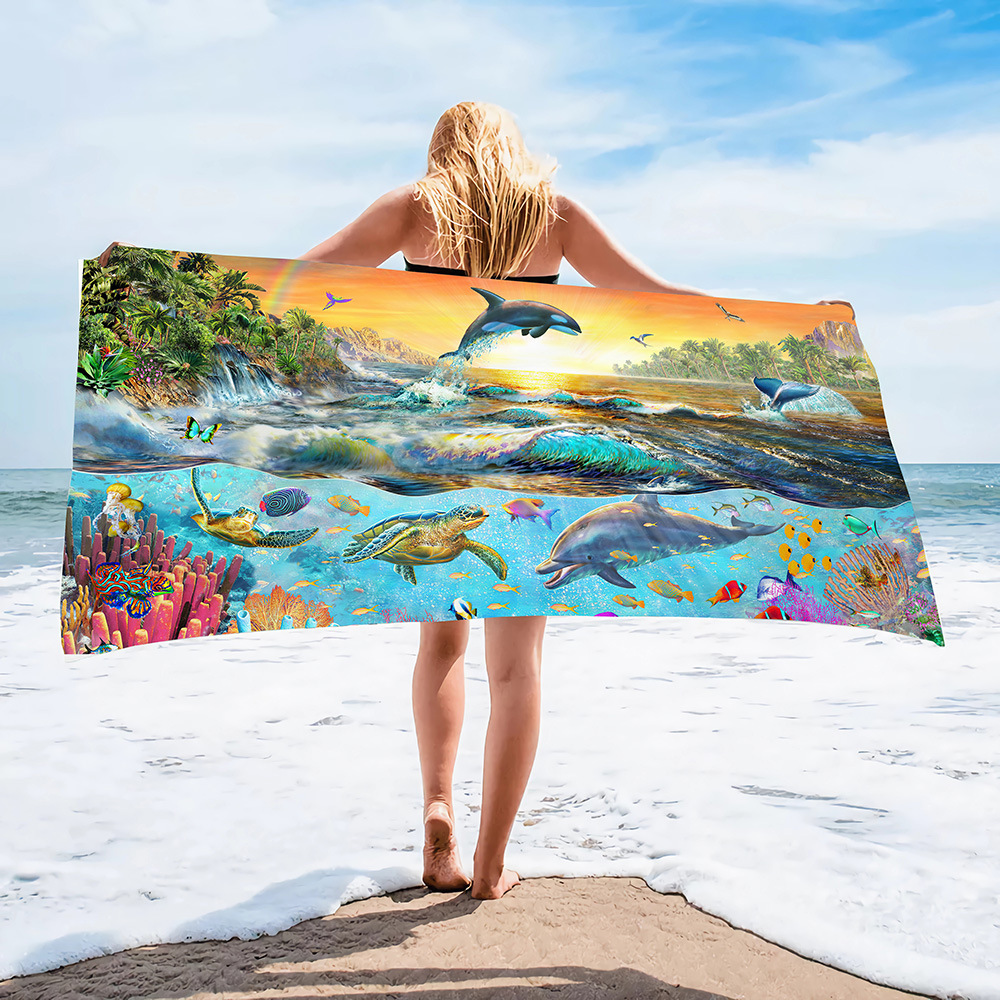
The taut-fabric beach shot earns one more paragraph because it answers a question spec sheets usually dodge: what does the print do under real tension and sunlight? The artwork stretches with the cloth instead of cracking or turning pale at the pull lines, and the saturated reef palette reads clearly against blown-out beach light – which is the visual test an expo buyer runs mentally when they picture their kit on a sunny finish line. It is also the cheapest sample request you can make of us: one printed panel, held outside, photographed on your own phone, before you approve a program. The drape you see here is what arrives, fold for fold.
The honest limits: none of the thumbnails prove drying speed, absorbency or wash cycles – they prove positioning and intent. Anything you plan to print on your own listing beyond the fabric-class word comes from a quote sheet and a sample you tested, never from a picture on our page. We would rather lose a conversion to that sentence than win it with a number we cannot defend on your audit day.
Construction: the weight-versus-pack-size dial
Microfiber prints sit on a family of knit and woven synthetic faces, and the dial buyers actually turn is cloth mass against folded volume. Lighter faces win the pocket-size argument – the 140 x 40 cm panel disappearing into a handlebar bag – and print with the sharpest line definition, because ink lands on a suede-smooth surface with nothing for it to blur into. Heavier faces add coverage and a softer hand but eat pack volume fast; somewhere between those poles sits the standard issue for hotel gyms, where the towel has to survive commercial laundering more than it has to vanish into a pocket.
The beach photograph above is the best field evidence on this page. It shows a print face held taut in open surf: a smooth, low-reflectance surface with no visible loop pile, no edge curl and no border band – a single continuous full-bleed image from hem to hem, with artwork detail intact across the stretch. The most important negative evidence hides in the same frame: no snaps, no corner loops, no clips, no grommets, no attached pouch. Hardware on our samples is exactly zero, so any carry accessory we later quote is separate tooling and separate cost – stated plainly now so nobody approves a mock-up assuming a loop came free with the print.
We do not publish a GSM figure on this page. Weight is quoted per construction against your use case with physical strike-offs, so the number on your own listing is one you selected and tested. Drying and wash-cycle behaviour follow the identical discipline: comparative statements about the fabric class are fair – at the same footprint there is simply far less cloth holding water than a cotton terry build – while numeric claims get quoted per fabric with lab data where the class carries it. Nothing here promises a dry-down you cannot verify on your own schedule sample.
Print durability for hard-use programs
Sublimation bonds colour into the synthetic fibre instead of laying ink on top of it. That is why the photographed reef panel keeps its saturation across fold lines, tension stretches and the corner pinch of a hand gripping fabric on a windy beach. For programs that launder weekly – swim schools, gyms, rental lockers – the graphic fails last, after hems or logistics give out first. Colourfastness percentages, cycle counts and bleach tolerance are quoted on request against the exact face you select rather than asserted generically.
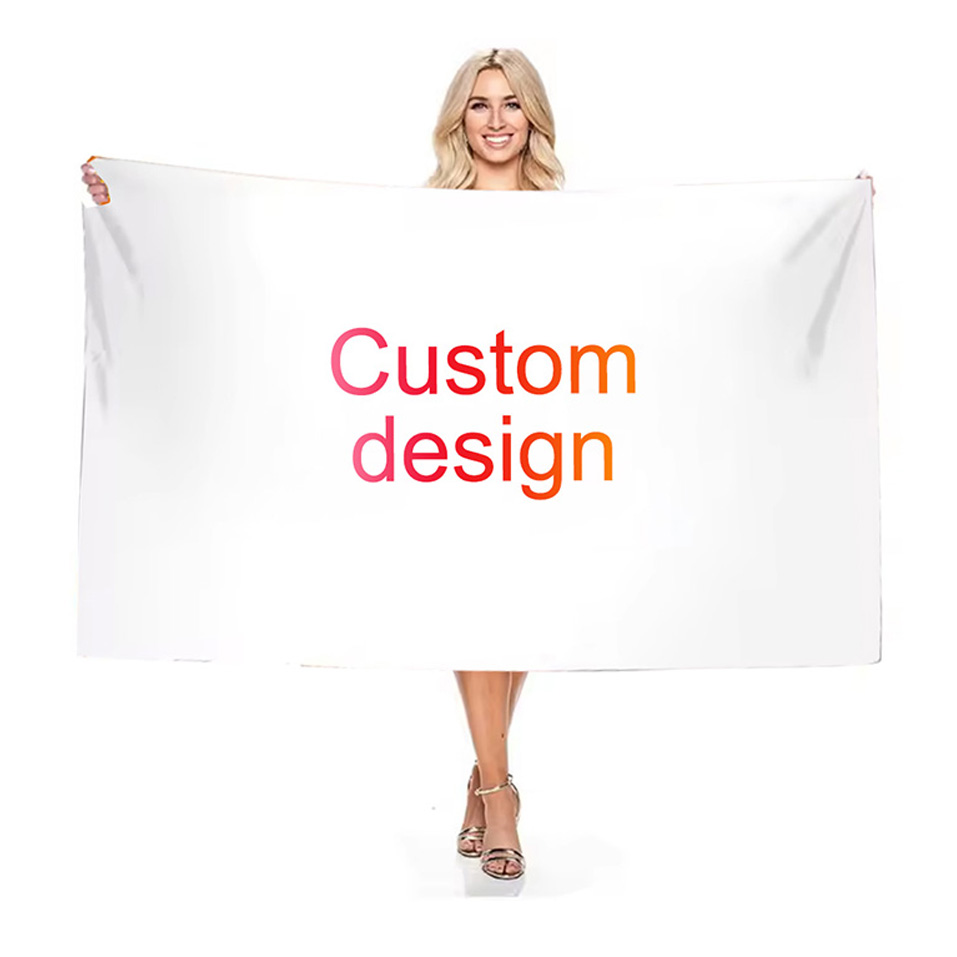
Artwork handling splits into two configurations, both photographed on this page. Full-bleed programs flood colour to every hem: resort graphics, tour artwork, event photography, the reef scene you can see above. Identity programs run the opposite way – a mostly white cloth with one centred artwork block, exactly as the model-held sample in the next section shows – which is the corporate-logo configuration gym chains and conference kits order most. Spot colour matching to your brand system is a quoted option; process-colour files reproduce as supplied and get verified on the free digital mock-up before the sample builds.
One practical warning from repeat programs: full-bleed artwork on a long narrow panel needs its focal zone checked against how the item folds in actual use. A logo centred on a 140 x 40 cm file sits perfectly when hung, and disappears when draped. The studio flags composition risks during pre-flight so event kits photograph correctly on the day, not just on the spec sheet.
Size ladder and the three-step workflow
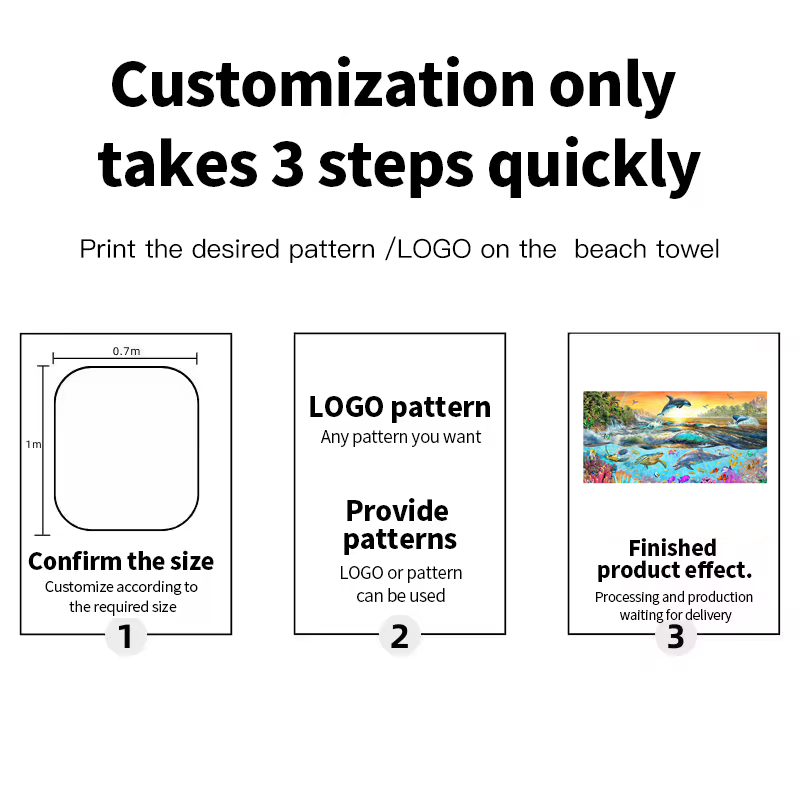
Beyond the annotated 140 x 40 cm panel, this lane cuts to order from pocket formats – handkerchief-size promo inserts in the 30 x 30 cm class – through yoga-and-gym rectangles, up to the 70 x 100 cm class sketched as the size template in our workflow drawing and lounger footprints at the big end. Thin fabric makes oversized panels genuinely carryable: a 180 x 90 cm sheet still rolls smaller than a rolled cotton hand towel, so oversized does not have to mean heavy. Send finished dimensions with bleed marked and the file re-flows to the new aspect at no design charge.
Size choice for programs follows one rule we learned from swim-school repeat orders: buy the smallest panel the activity can use, not the largest the artwork can fill. A 140 x 40 cm lap panel wipes an adult swimmer from shoulders to knees and dries on the bus ride; a lounger sheet prints beautifully but gets left behind at the motel because it doesn’t fit the bag. The merch instinct and the functional answer often disagree, and for this fabric class the functional answer keeps reorders flowing. Our studio mocks your artwork at every candidate size on the same sheet, so the assortment decision happens with the whole ladder visible at once.
The workflow infographic compressed at the bottom of this section photographs our actual process in three numbered steps: confirm the size on a template drawing, supply any logo or pattern file, receive the finished production output. The real sequence around those steps: you send artwork and target dimensions; we answer with a free digital mock-up on the selected face; you approve; a physical sample ships in 3-5 days; bulk completes 7-15 days after artwork approval.
The MOQ is 100 pcs per design – one file, one drop – which lets a gym chain pilot a single club before rolling a program, and lets a tour operator run city-exclusive graphics as parallel 100-piece lots instead of one risky pallet buy. Reorders of approved files skip re-approval and go straight back into production. Our gift lines hold 1,000,000 pcs of monthly capacity, so a program expansion – three new clubs, five new venues – lands without renegotiating your calendar. Quoting starts at the 100-pc tier and steps down as volume grows; artwork pre-flight, mock-ups and dimension checks are included at every tier rather than sold as services. One detail that keeps program paperwork simple: every quote references your artwork filename and revision, so six months later a requote is one line, not a renegotiation.
Functional spec sheet
| Fabric class | Printed microfiber synthetic face, flat and loop-free as photographed |
| Cloth weight | Not published on page – GSM quoted per construction with strike-offs |
| Annotated sample footprint | 140 x 40 cm (55 in x 15.7 in) per dimension graphic; 70 x 100 cm class outlined in workflow drawing |
| Print configurations | Full-bleed sublimation or centred logo block – both photographed on this page |
| Hardware on samples | None shown – zero snaps, loops, clips, grommets or pouches in photography |
| Optional carry accessories | Snap loop, corner clip, mesh or zip pouch: quoted and tooled separately |
| Fastness and drying data | Quoted per selected fabric, with lab reports where the class carries them |
| Capacity | 1,000,000 pcs per month across our gift lines |
| Bulk lead | 7-15 days after artwork approval |
| Sample time | 3-5 days |
| MOQ | 100 pcs per design |
| Reference pricing | Quoted from the 100-piece tier |
| Mock-up | Free digital mock-up before sampling |
Kitting, packing and program calendars
Program buyers rarely receive loose cartons. Standard export packing folds each panel into an individual poly bag; gym and expo kits can be bagged with your event card, and single towels can roll into pouches as a quoted add-on rather than a built-in assumption. The packing graphic at the end of this section documents the carton configuration with marks to your SKU scheme; mixed-design splits inside one shipment are standard, and FBA prep is available for Amazon-channel kit sellers who need label-and-bag compliance before a listing goes live. Freight moves by sea for program stock, air for restock gaps, or DHL/UPS/FedEx/TNT courier when a venue date is inside three weeks.
Calendar math runs backward from registration dates. New-year gym sign-up waves want approved artwork by late autumn, because approval-to-production plus sea freight lands inside the January window. Summer swim schools should lock kits before spring break, when their marketing teams finalise enrolment tiers. Marathon and triathlon expo kits run on a hard venue date, which is where air and courier lanes earn their price: bulk closes 7-15 days after artwork approval, so a late venue addition comes down to buying freight, not buying manufacturing time – we price both routes and let the kit manager choose knowingly. Conference buyers adding a sponsor logo mid-program are the same story: the bottleneck is never our line, it is the artwork approval signature.

Where this lane stops and the others start
Four product pages divide our towel program, and correct routing saves RFQ cycles. This page owns performance microfiber intent: thin, packable, sublimated, hardware-free by default. If the assortment needs plush graphic art at big footprints for a merch table, the oversized novelty print page runs that lane. Family character programs live on the marine motif page, and spa or hotel presentation is engineered on the bamboo-viscose set page. The complete towel category lists every format before you spec a season.
Frequently asked questions
How small does a printed microfiber panel pack?
What is the MOQ for a custom gym or swim kit?
Can you add a carrying pouch or a snap loop?
Will sublimation print survive commercial laundering?
How quickly can an expo order land?
Do you support FBA prep for kit sellers?
Request the fabric card
Send the artwork, the format and the program date. Email [email protected] or call +86-15967739086, and we return a mock-up, a strike-off list and reference pricing from the 100-pc tier.