Custom Dolphin Family Beach Towels | Marine Print 100pc
$2.10
Themed marine prints sized for the whole family: dense mandala-style dolphin line-work over colour-banded plush faces, with a looped-terry reverse as the sample corner macro shows. One artwork file fans into a ten-colour swatch grid and a full kid-to-adult size ladder – camp programs, aquarium and zoo shops, resort retail. MOQ 100 pcs per design, free mock-ups per colourway, samples in 3-5 days, bulk 7-15 days after artwork approval. Fabric composition and GSM are quoted against physical strike-offs instead of copied from banner text, and retail-ready poly bags, header cards and FBA labelling ship with every carton plan. Send your motif and season date.
Dolphin prints sell through a specific retail math: a kid spots the animal, a parent checks whether the piece still covers them at fourteen, and the shopkeeper restocks whatever size ladder actually moved. This page is our themed family-print lane – character-style marine motifs printed across plush faces, sized so one hang card can carry summer-camp, aquarium-shop and beach-resort assortments from a single artwork purchase. The dolphin graphics shown are sample artwork from our themed library; your original or licensed motif flows through the identical process, on the identical faces.
What the marine sample artwork proves
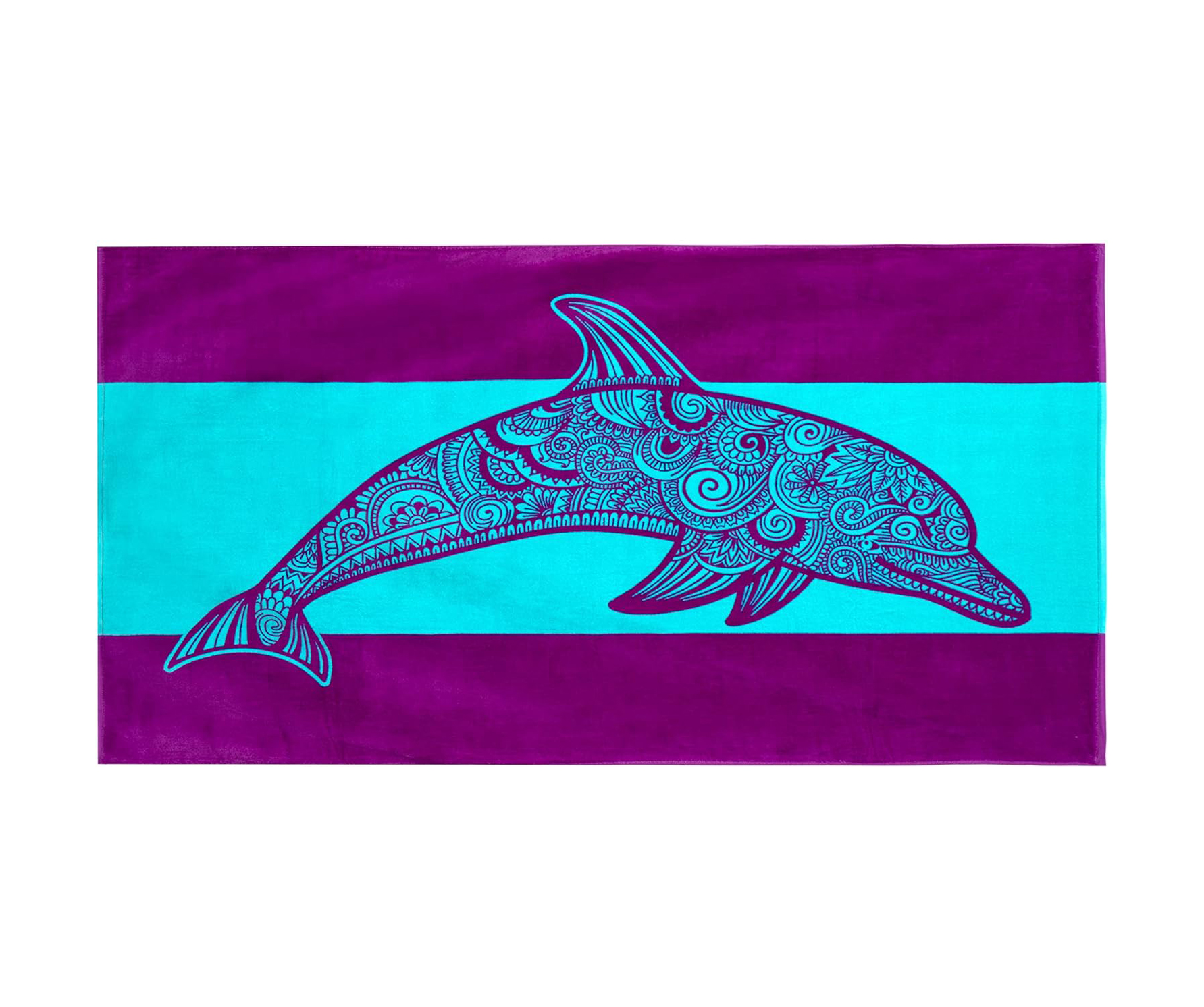
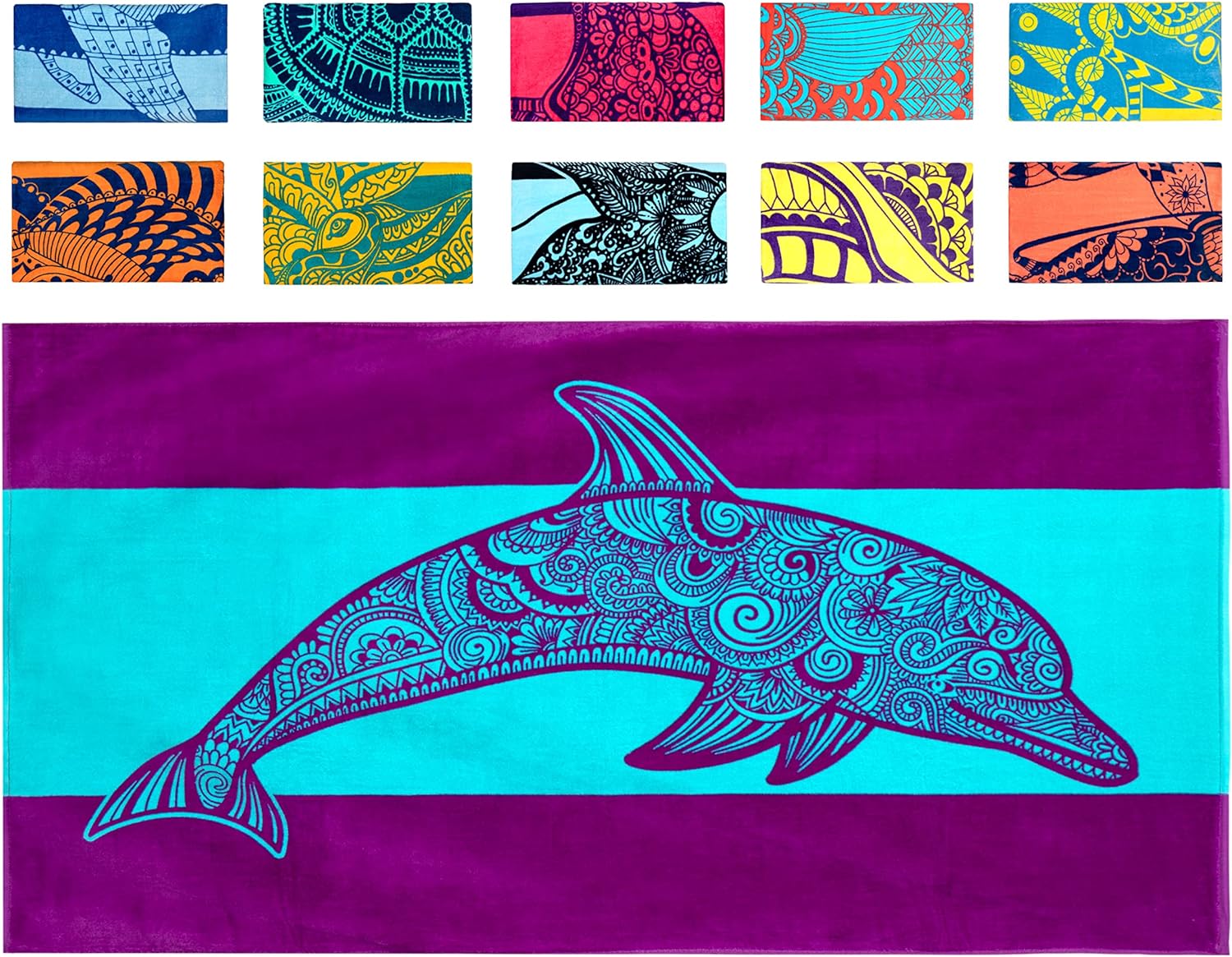
The hero flat-lay is the argument for dense line-work printing. A single leaping dolphin is built from spirals, scalloped fans, leaf shapes and dot rows, printed across three horizontal bands, with the ink colour deliberately flipping where the motif crosses a band: turquoise linework over the purple fields, purple linework over the cyan centre. That inversion survives on press only when registration is tight – a half-millimetre drift turns the flip into a smudge – so the flat-lay is quietly a capability proof, not just a picture of one design.
At retail distance the towel reads as one bold animal on colour blocks; up close it rewards inspection, which is exactly the shelf behaviour family purchases need, because the adult checking quality and the kid checking for a cool dolphin look at the same object differently and both have to be satisfied. The surface in the photograph shows the soft directional sheen of a low-pile plush face rather than looped terry – light plays across it in the patchy way cut-pile cloth always does – and the four edges finish straight and narrow with no fringe and no border tape. One artwork file, one colour-flip rule, one clean hem: that is the entire production spec the picture has to support, and it supports all of it.
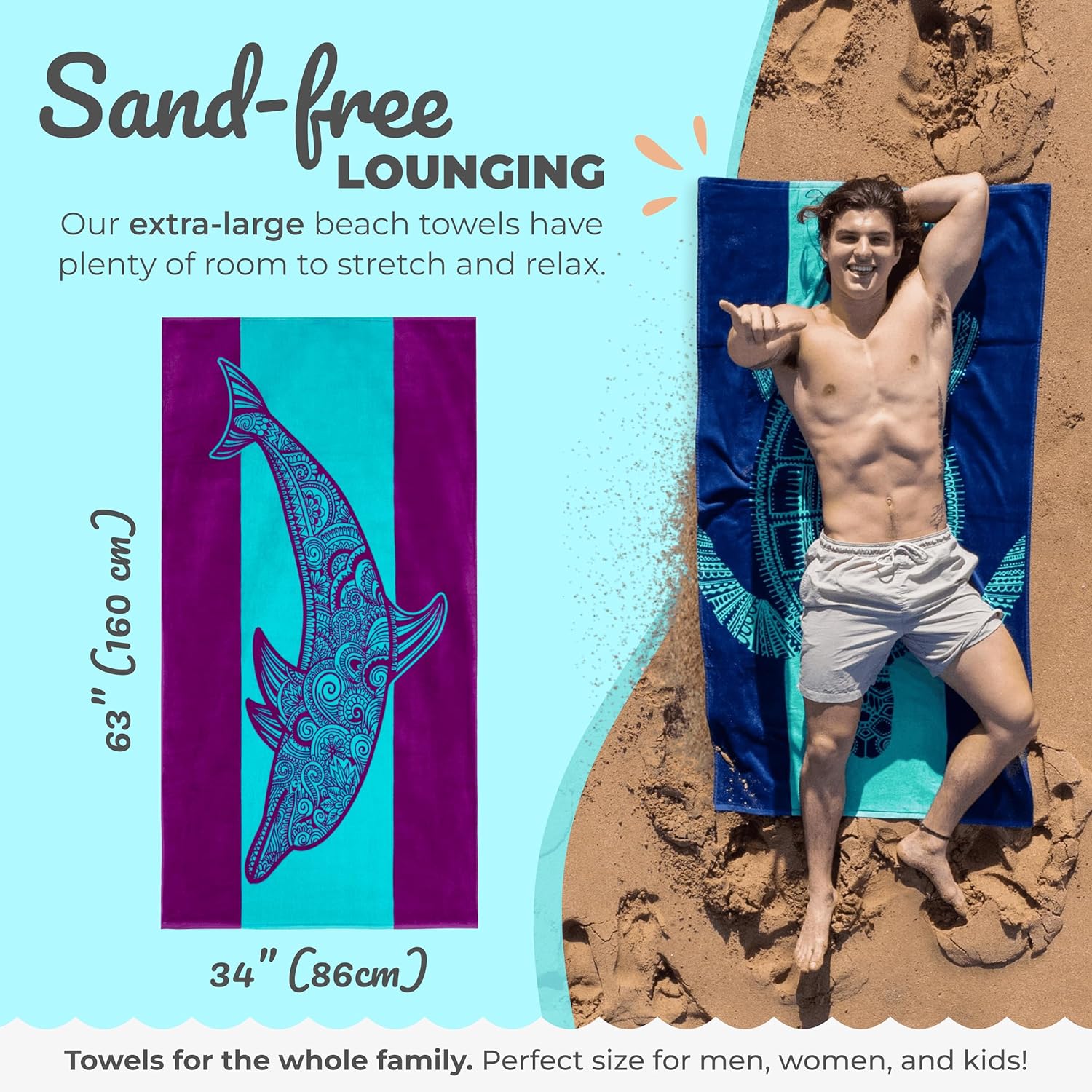
The second sample photo, coming up, carries the same print in a different staging: the flat product beside a model stretched out on the identical design in a navy colourway, which is how the range’s family-size argument gets made visually rather than in a spec table. We read it the same disciplined way – the layout and the size callouts are what the frame proves; every adjective painted over it by the original supplier belongs to their listing, not to our claims.
Sized so one print covers the whole family
The lifestyle product graphic annotates a vertical format at 63 in (160 cm) by 34 in (86 cm) and shows the design twice in one frame: flat on the left against a cyan panel, and occupied on the right by an adult model lying full-length on the same composition in a navy-and-teal colourway, one hand behind his head, feet clear of the hem. That pairing is the family-set pitch settled with pixels – the same artwork scaled across kid, teen and adult footprints, colourways varied so siblings can claim their own at camp without anybody accepting a smaller piece. The annotation also carries a supplier sand-shake phrase and a stretch-out comfort line over the lifestyle panel; we log both as third-party listing text photographed onto the sample sheet, not our promise. Sand behaviour and drape are fabric-by-fabric answers, and you get them from a physical sample in your hands, not from repeating someone else’s banner.
Colourway program and swatch logic
A themed print lives or dies on colour range, because family retail sells the second piece as a matching pair – the purple one for the parents’ bag, the coral one because somebody insists. The swatch-grid photograph makes that argument structurally: ten cropped detail tiles stacked above the full purple-and-turquoise hero, each tile the same mandala dolphin re-inked in a different combination – indigo flukes on denim blue, teal lacework on near-black, maroon spirals on magenta-red, yellow mandala on royal blue, navy feathers on orange, black-and-white detail on pale cyan, purple on yellow, coral field with dark-navy fin. Every tile zooms a different zone of the animal: the tail, a fin, the circular eye motif, a band of body pattern.
For buyers, that grid encodes a cost rule. One artwork file fans into a six-to-twelve SKU colour program with zero new design spend: re-ink the line-work, keep the layout, and the assortment reads as a collection instead of six unrelated prints competing for shelf attention. Your camp might need cabin colours; your aquarium shop might need the reef palette; your resort might only ever order two combos a year. The file is the constant, the ink schedule is the variable, and the mock-up we return shows every colourway against the band layout before anything is cut.
Face options: plush print side, absorbent reverse
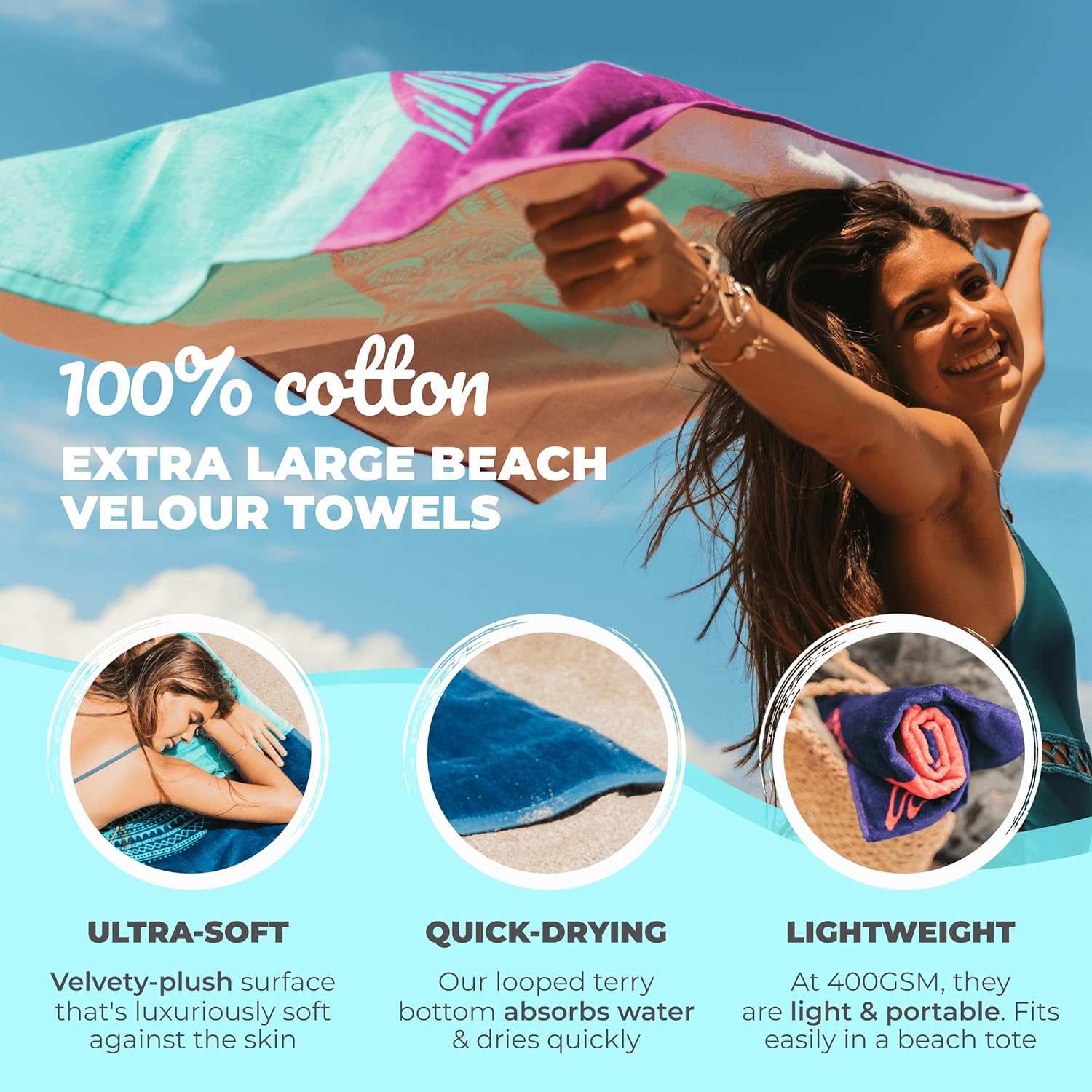
The construction sheet photographs both faces of the themed cloth. The hero image shows the piece billowing overhead – printed plush face out, and where the corner folds back, a paler secondary pattern is visible on the reverse. Three circular vignettes under the banner do the detailed work: one shows the smooth turquoise face under a reclining model, one is a macro of the turned hem proving the two-sided build – flat plush face above, looped terry beneath the roll, a few sand grains sitting on the loops – and one shows the piece rolled tight into a straw tote so the packing volume is visible.
That two-face construction – graphic clarity on one side, water-holding loops on the other – is the standard themed spec we quote against. The supplier banner over the sheet lists its own cotton content and GSM figures; we treat those as third-party text from the source artwork, not our claim, because our photography proves structure (plush face, terry back, bound hem) and not composition. Our own process states both numbers for the exact cloth you choose, on paper, before approval. Care labelling to your market’s rules, hang-tag design and retail folding are quoted add-ons on the same PO.
Themed print spec sheet
| Motif library | Marine themes: dolphin, turtle, reef and wave compositions; original or licensed artwork accepted |
| Annotated sample size | 63 in x 34 in (160 x 86 cm) vertical family format, per dimension callouts in the lifestyle graphic |
| Face build as photographed | Printed plush low-pile front; looped-terry reverse visible at the turned hem in the corner macro |
| Colourway depth | Ten-tile swatch grid demonstrated from one file; spot colours matched to your reference, quoted on request |
| Kid/tween/adult scaling | Same artwork re-flowed across the size ladder; send finished dimensions with bleed marked |
| Weight and composition | Not asserted from banner text – quoted per selected fabric with strike-off samples |
| Monthly capacity | 1,000,000 pcs per month across our gift lines |
| Mock-up | Free digital mock-up on every requested colourway before sampling |
| MOQ | 100 pcs per design |
| Bulk window | 7-15 days after artwork approval |
| Sample time | 3-5 days |
Where themed prints get restocked, and how the order clock works
Four channels reorder this format predictably. Summer day camps buy name-and-motif kits where the artwork stays fixed and only a small print zone changes per cabin. Aquarium shops, science centres and zoo stores run marine motifs as the soft-goods anchor beside plush toys, and they restock per exhibit rotation – a new tank opening means a new towel file, and our artwork-to-sample path handles that inside a week. Beach resorts and waterpark lockers take the family size ladder as one PO so the rental program isn’t managing three SKUs per age band. Museum shops do the same with exhibit-linked art, swapping the centred motif seasonally.
What separates these four from ordinary towel retail is restock cadence, and it is why the family format’s MOQ math matters. Camps reorder per cabin block as rosters change; aquariums reorder per exhibit lease, which can be as short as a season; resorts reorder per storm season and guest loss; museum shops reorder per show. None of those calendars can absorb a six-month buy, which is exactly the constraint a 100-pcs-per-design minimum was built for: the artwork stays constant while the money leaves the account in season-sized bites, and the approved-file reorder path means each bite lands inside the same 7-15 day production window as the last.
The order clock for all four: send the illustration – vector preferred, high-resolution raster accepted – plus the size ladder and colour count. The studio returns free mock-ups showing line-work over the band layout in each requested colourway; approve, and samples ship 3-5 days later; bulk closes 7-15 days after artwork approval. The MOQ of 100 pcs per design applies per changed artwork file, but simple re-inks of one approved layout roll under the same approval – which is how a ten-SKU collection starts as a single 1,000-piece buy instead of ten nervous minimums. Capacity across our gift lines is 1,000,000 pcs per month, so a camp chain’s expansion order and an aquarium’s exhibit drop queue in the same machinery. Camp and resort calendars run backward from opening day: approve by early spring and bulk, freight and hang-tagging all land before Memorial Day traffic.
Packing for hook walls and cabin lockers
Family prints ship retail-ready. Each towel folds into an individual poly bag; header cards or hang tags turn the fold into hook-wall inventory straight off the carton, and camp programs can instead receive undecorated bags their front desk tags on arrival, keeping one supplier spec and zero pre-season labelling work at your warehouse. Carton marks follow your SKU scheme, mixed-carton colourway splits are standard so one shipment covers six designs without six shipments, and FBA prep is available for marketplace sellers running the same print on Amazon listings. Freight runs sea for season stock, air for mid-season gaps, or DHL/UPS/FedEx/TNT courier for exhibit-driven restocks with a hard opening date. The packing sheet below documents the standard export stack; sample programs receive single units in plain courier boxes before the first PO so the plush face can be judged against your own shelf light.
A note on the retail fold itself: family prints ship folded to a standard card size rather than rolled, because rolled plush holds a curl that fights header-card bags on a hook wall. If your store merchandises flat stacks instead – gift tables and resort boutiques usually do – say so at quote stage; the fold geometry changes and the poly-bag size with it, both without re-approving the artwork.
One presentation trick repeats across the family channel: bag the set with the motif edge up. The mandala line-work lives in the middle bands of the layout, and camps and museum shops that fold with the animal showing sell through faster than stores displaying the plain border stripe – a shelf test we get reports of from three separate aquarium programs. Bag direction costs nothing at our end; specify it on the packing list and every unit ships with the face your fixture wants.
Carton sizing deserves a line for buyers planning container economics. Family-format towels at the 160 x 86 cm footprint press flat into standard export cartons at retail-fold; a carton of these weighs what your freight quote assumes, not what a loose-load estimate guesses. When you mix formats – say kid sizes with adult ones in one shipment – we provide a packing matrix before production so your receiving team can pre-assign shelf counts instead of sorting at the dock. Retail-fold counts per carton are confirmed with the quote, so fixture planning happens against real numbers rather than a carton guess. Camp buyers shipping lockers by cabin can also request carton labels printed with cabin names instead of SKU codes – a no-cost change to the mark file if it arrives before production starts.

How this lane divides the program
Four product pages split our soft-goods intents, and mixing them up costs everyone time. This page owns themed family motifs on plush faces: characters, animals, collections, size ladders. If the program is abstract oversized graphic art for merch tables, the novelty big-print page runs that lane; pack-down gym and swim kit belongs on the printed microfiber page; hotel-amenity gift boxes are engineered on the bamboo-viscose set page. The towel category index lists all four when a camp store needs swim soft-goods and spa presentation in the same budget year.
Frequently asked questions
Can we put our own dolphin or marine character on the towel?
Does one print file cover kids and adult sizes?
How many colourways can one artwork produce?
What is the minimum order and lead time?
Is the fabric 100% cotton at a fixed weight?
Can camp programs get mixed size-cartons per colourway?
Start a themed print run
Send the motif, the size ladder and the season date. Mail [email protected], call +86-15967739086, and mock-ups across your colourways come back free before any sample is cut.
Two file notes speed the first reply. If your motif came from a raster source – an old print scan, a mascot JPEG – send the largest version you own even if it looks soft; our studio checks whether lines can be rebuilt vector-side before asking you to redraw anything. And if the artwork carries licensed characters, attach or reference the licence scope (territory, channel, term) in the same message. Print capability is never the question on marine programs – licensing paperwork is, and it is the one step that cannot be compressed after approval.
For camp and rental operations, one more planning detail: order a 3-5% overage in plain undecorated towels of the same face, and store them as swap stock. Motif towels get lost, claimed as souvenirs, or fade in a locker that sees four seasons of sun; the overage lets you quietly replace units without opening a new production run, because a top-up reorder only makes sense once you have five or ten pieces genuinely gone. The plain swap stock carries the same dimensions and wash behaviour as the printed ones, so nothing looks mismatched on a rack mid-summer.