

Custom Knitted Beanies With Label for Retail Drops
$0.95
Custom knitted beanies with label branding for band merch, brewery drops, gym member tiers and Q4 corporate gifting. The photographed base is a fine-gauge machine knit with a single turned-up rib cuff — rib-profile and smooth-crown grids plus a two-dozen-shade colour wheel mean a three-colour capsule picks stock shades instead of new dye lots. Every sampled hat ships bare, so woven cuff labels, faux-leather patches, rubber badges and cuff embroidery arrive as quoted applications proven on your 3-5 day sample; fibre content, gauge and graded sizing are quoted against a lab card rather than guessed from pixels. MOQ 100 pcs per design across mixed colours, bulk 7-15 days after artwork approval, 1,000,000 pcs per month capacity. Poly-bagged per hat, FBA-ready cartons, sea, air and courier lanes from one carton plan.
Bare Hats, Loud Branding: The Beanie Drop Equation
Custom knitted beanies with label branding sell merch because the hat does two jobs at once: it keeps a head warm and it wears the mark where a thousand faces will see it. The photograph set on this page is deliberately honest about where the line sits between those jobs. Every hat in every frame arrives bare — clean rib-knit crowns, single turned-up cuffs, no pom-poms, no woven labels, no patches, no embroidery stitching anywhere visible. That is not an omission; it is the canvas. Your drop’s identity — woven label, faux-leather patch, rubber badge, cuff embroidery — is decided at quotation and proven on a physical sample before a thousand units exist.
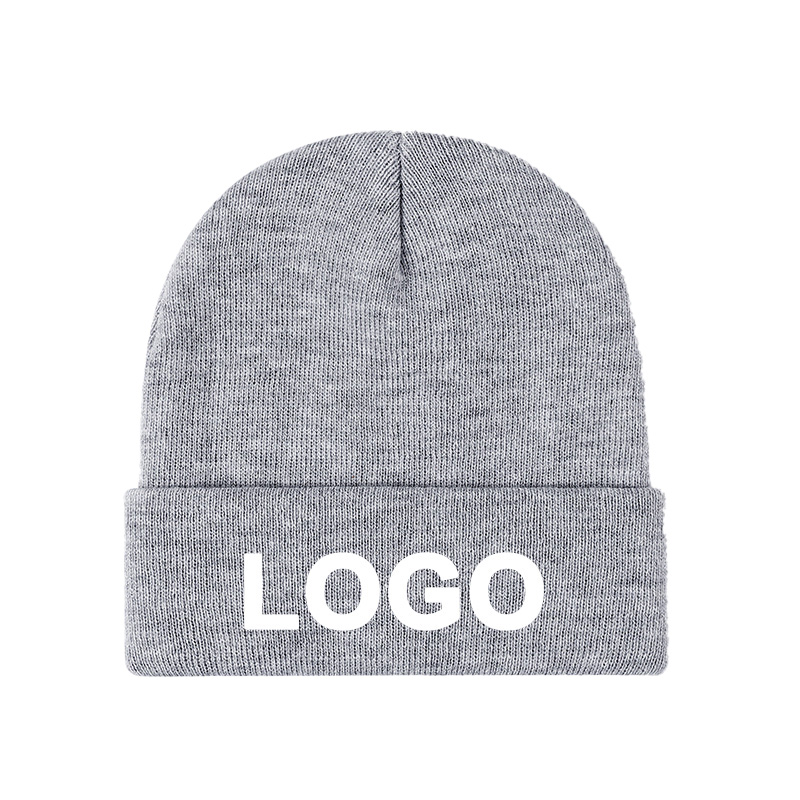
Read the frames as a colour system plus a blank. The branding zone the mock-up marks on the grey heather cuff is the same zone every retail beanie program uses, and the wall of solid colour behind it means your capsule can run black-heavy, pastel-heavy or neon-accent without a re-tooling conversation. Fit, yarn composition and gauge counts are quoted on request against a lab card, because no photograph on this page shows a printed content label — the honesty costs one sentence and buys the whole spec.
What the Frames Actually Prove About the Knit
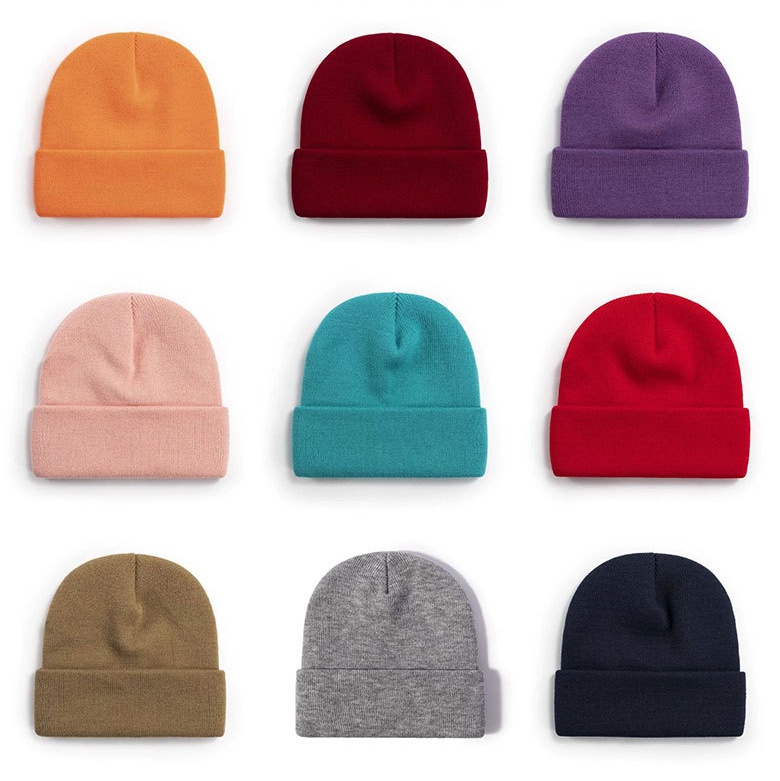
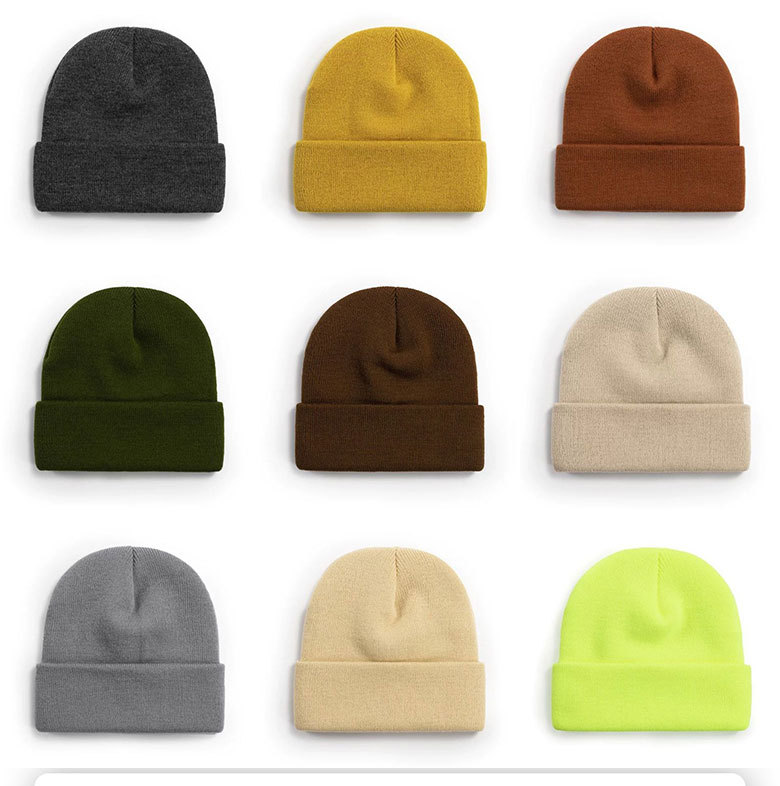
Start with construction, because the camera supports all of it. The hats are fine-gauge machine knits with a soft matte halo on the yarn — the surface reads like the smooth acrylic and acrylic-blend spins that stock this price tier, though fibre content gets confirmed against a lab card on the quotation, not guessed from pixels. Two knit profiles repeat across the frames. The first is an all-over vertical rib: narrow wales run from cuff up through the crown and gather at the top into a small closed point, visible on the nine-hat grid in orange, maroon, purple, salmon, teal, red, olive, heather grey and black. The second is a smoother stockinette-style crown with a centre seam running down to a pinched apex, paired with a fine rib cuff band — the second grid’s charcoal, mustard, rust, olive, chocolate, oatmeal, heather grey, cream and lime hats.
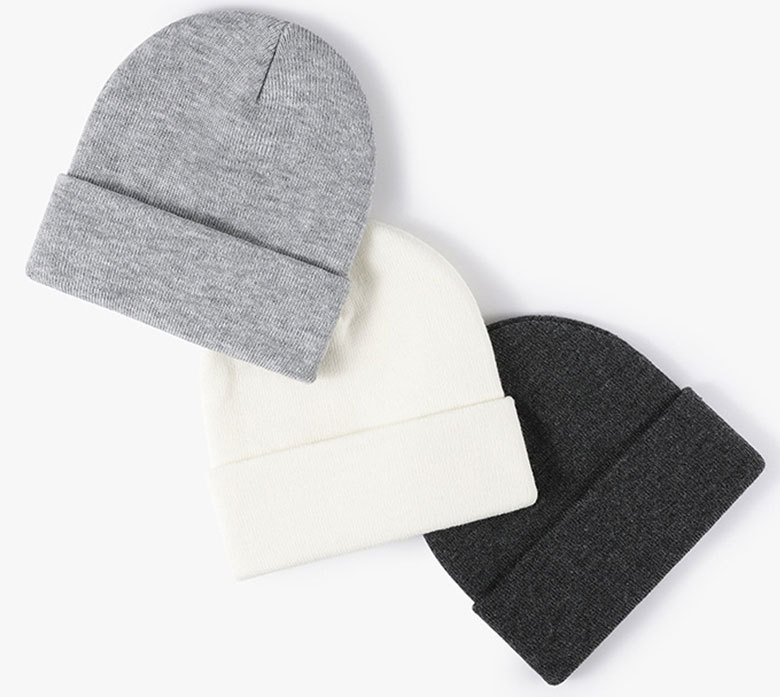
The cuff is the one structural decision every frame shares: a single turned-up band, folded once, not a rolled tube and not a thick double cuff. Fold width sits in the classic retail range that frames the eyebrow without swallowing the logo zone. Heather greys — the charcoal and mid-grey hats — show the marl spin where light and dark fibres are blended before spinning, which is why “grey” on a beanie hangtag photographs as texture rather than flat dye; solid colours run through the rest of the spectrum. All sampled units are one-size blocks; no sizing tag or measurement marking appears on a single photographed hat, so head-circumference grading and stretch-range data come to the sample stage on request.
The Colour Program Is the Merch Program
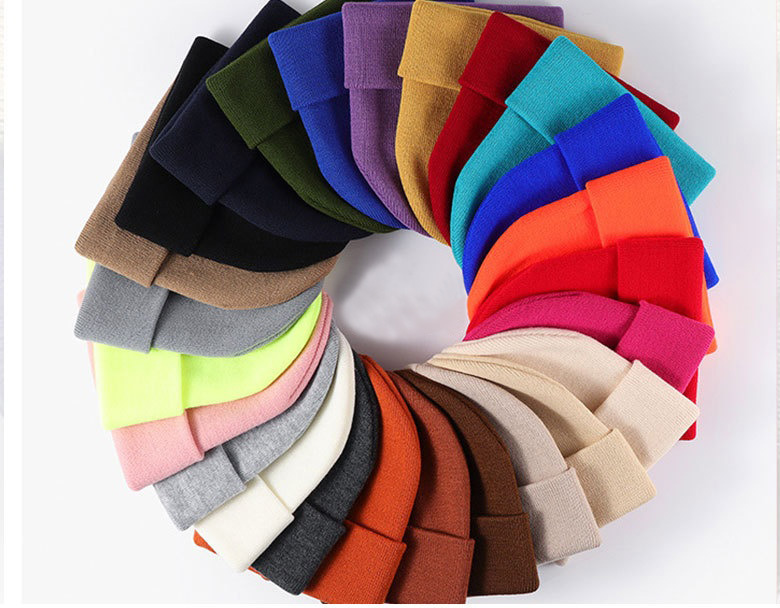
Bands, breweries, gyms and street labels rarely drop one colour. The radial wheel frame exists to show what an actual colour program looks like from the stock side: roughly two dozen solid shades curled into one ring — purples, royal and deep blues, teal, forest and olive greens, scarlets, rusts, oranges, hot pink, mustard, camel, tans, oatmeal, cream, heather greys, charcoal and black — each hat identical in build, differing only in dye lot. When a capsule needs three colourways against that shelf, you pick from stock; when it needs a custom-matched shade, colour-matching is quoted against a PMS reference and a dyed lab dip.
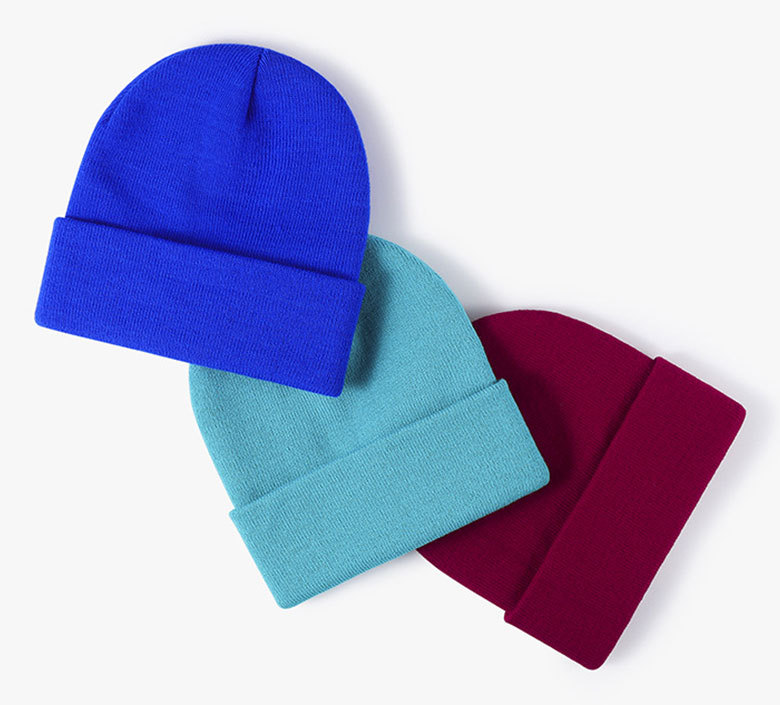
The diagonal trio frames reinforce the repeat logic: royal blue, cyan and maroon in one shot; light grey, cream and charcoal in another. That is the visual rhythm of a real retail drop — a core neutral pair plus one statement colour, photographed as a set so the shelf reads as a family. Two nine-hat grids close the argument: colour is inventory, and inventory is the reason a restock in month three matches month one. Nothing on this page promises a Pantone match from memory; every shade ships from the photographed wheel or a confirmed lab dip, and your order’s colour mix is locked at the mock-up stage.
There is a quiet merchandising lesson in how the grids are shot, too. The rib-profile nine-hat frame puts its heather grey bottom-centre — the marl always reads as the “honest” colour on a hangwall, and the solid black at the opposite corner reads as the safe seller. The smooth-crown grid runs charcoal first and lime last, warm neutrals through the middle, which is exactly how a stock allocation gets cut when a brand orders twelve shades for a season: two statement colours for the lookbook, six working neutrals for volume, and black carrying the reorder tail. Your mix-and-match against the photographed wheel happens on the quotation as percentages, not anecdotes — and the same block knits in every shade, so fold width and cuff stretch never change between the lime and the navy.
Your Label, Patch or Cuff Embroidery: The Branding Menu
Here is the honest framing. The photographs show blank hats because that is what ships as the base SKU; the branding arrives as a chosen application, and each option has different economics at beanie scale.
Woven labels are the retail default: a tightly jacquard-woven edge label stitched onto the cuff fold, readable at arm’s length, cheap per unit at volume, and removable if the program ever wants a bare-hat resale version. Faux-leather patches sit one tier up in perceived value — die-cut, debossed or printed, stitched at two or four corners so the cuff keeps its stretch. Rubber and silicone badges give the moulded, light-catching mark that streetwear drops favour. Cuff embroidery puts the mark directly into the rib, working best on small wordmarks because the vertical wales drag under wide satin fields. Pom-pom toppers exist as a modification — none of the photographed hats carries one — quoted with pom diameter, attachment knot and colour match specified on the sample.
The decision matrix at drop scale is boring in the best way. Woven label wins on unit cost above three hundred pieces and on shelf presentation, because a hangtag-adjacent label reads retail rather than promotional. Patch wins on perceived gift value inside corporate boxes, where fingers touch the debossed edge before the recipient reads the mark. Rubber badges survive cold, salt and snow better than thread-heavy embroidery on a cuff that gets stuffed into a coat pocket weekly. Embroidery wins when the mark is four words or fewer and the program refuses any stitched-in extra that could peel. Mixed builds exist too: woven label at the side seam plus a small cuff embroidery, quoted as two line items on one mock-up so the placement maths happens before tooling instead of after complaints.
Every one of these is a mock-up decision, not a mystery: your mark gets laid out on the exact cuff zone the placeholder occupies on the grey heather hat, sized to real fold width, and the application that survives your price point wins. Patches and labels are sourced with blank stock or made from your artwork; stitch-out samples in 3-5 days let the merch team touch the badge before the drop quantity is committed.
One placement warning earns its paragraph: a cuff mark is a stretch-zone mark. The rib gives when the hat goes on, and a rigid element — a large rubber badge, a wide patch with squared corners — either gathers around itself or flattens the wales under constant tension. Programs with full-width wordmarks get them stitched into the rib so the knit flexes with the lettering, or the patch goes slightly above the fold line on the crown. Both options show up on the same mock-up for the same artwork, which is where that decision actually belongs — before a thousand hats exist, not on a complaint thread after.
Who Buys Beanies in Runs of a Hundred
The reorder file splits into four recognisable buyers, and each writes the spec sheet differently.
Music and event merch teams top the list: tour-capable quantities, one artwork, two or three colourways, delivered before the first date. For them the cuff is a second poster space, and the woven label — cheap, quick, removable for bare-hat resale — usually wins. breweries and distilleries run the same play around release calendars, favouring oatmeal, charcoal and forest neutrals so the logo patch carries the colour instead of the dye. Fitness studios, climbing gyms and run clubs order member-tier and coach-tier hats with embroidered marks on greys and blacks, then restock in hundred-piece pulses as membership turns over.
Corporate gifting reaches across differently: a branded beanie lands in a Q4 gift box next to a printed towel from the textiles range, and because the artwork registry from the structured cap program can be digitised again for knit, the brand mark stays identical head to counter. School alumni and camp stores are the sleeper lane — end-of-year sales and reunion drops that lean on the cream-and-charcoal neutrals photographed here plus one school colour.
Fit, Comfort and the Things Photos Cannot Promise
What the frames prove about fit: fine-gauge rib knits stretch, single cuffs fold crisp, and the crowns close without seams poking through a lining. What they cannot prove is stated plainly. There is no fibre content printed on any photographed hat, so “acrylic” in the old title is treated as the stock yarn family for this price tier — exact composition, gauge count, weight in grams and any blend percentage go on the quotation against a lab card, and a physical sample confirms the hand-feel before bulk. No care instruction, wash test or shrinkage data is claimed from a photograph either; those specs travel with your approved sample.
Fit sizing follows the same discipline. The one-size rib block covers the adult head range on stretch alone, which is why single-SKU drops work at merch tables. If a program genuinely needs graded sizes — kids for a youth camp line, small-crown builds for a children’s program — sizing is quoted per run, and the kids-apparel lane already has its own artwork workflow on the children’s apron page, which proves the same print zone logic on smaller panels. If your staff program pairs hats with woven work aprons for a coffee brand, the adult apron line carries the matching chest-zone mock-up.
Comfort claims get the same photo-audit treatment as construction ones. The fine-gauge rib reads soft against skin because the wales flex instead of binding — but “itch-free” is a fibre-content statement, and the content card only arrives with your quoted sample, so nobody on the merch desk should promise sensitive-skin comfort from a stock photograph. What the frames do support: light weight that layers under a hood without helmet pressure points, a cuff band tall enough to cover ears when pulled down, and enough stretch that one carton size chart survives the whole floor staff. Linings, fold-double cuff variants and windproof membranes are modification conversations priced per run, listed on the quotation the same way the yarn spec is.
Q4 Calendar Math for Merch and Gifting
Beanies are a seasonal machine, and the only way to beat the machine is to plan backward. The drop calendar has three hard windows. First, back-to-school and early-fall retail set: artwork should be locked by mid-summer so shelf stock lands before temperature drops turn demand vertical. Second, the holiday gift peak: corporate boxes, band merch for December runs, and brewery release gifts all converge on the same six weeks, which is why quotation freezes arrive early — a hundred-piece gift order approved in October sails; the same file arriving in December queues behind the ocean bookings. Third, ski, festival and resort-season reorders in January, where the profitable orders are the ones restocking a proven drop, not launching a new one. One scheduling detail trips first-time buyers in every season: approval, not shipping, is the deadline. The 7-15 day bulk clock only starts the moment your artwork is signed, so an unreturned mock-up email — not a slow factory — is what actually misses the window.
Against those windows, production is the small number: bulk completes 7-15 days after artwork approval within 1,000,000 pcs per month across our gift lines, so a 2,000-unit tour restock is a scheduling question, not a capacity question. Freight is the large number: sea needs the early slot, air buys back weeks, DHL/UPS/FedEx courier consolidation covers hundred-piece emergency top-ups between tranches. The free digital mock-up, the 3-5 day sample and the artwork-approval clock are the three levers a merch manager actually controls — use them, and the December shelf gets its hats in September.
The weather flip is the other clock worth respecting. Retail beanies sell on temperature, and the demand curve bends hard the first cold week — which means the hats have to already be in the building when it happens, not in transit when it does. Programs selling from a physical shop should target shelf presence six weeks before their latitude’s average first frost; online sellers can run one to two weeks tighter, but the same rule applies in reverse — a drop announced for the first cold snap arriving Tuesday cannot ship approval to production on Monday and expect the ad spend to land. Brewery release gifts ride festival and launch dates instead of weather, which is the least forgiving calendar of the four: the date is fixed, the artwork is the label, and the only movable part of the schedule is how early the artwork file was finished. Every one of those plans uses the same arithmetic — subtract 7-15 days of production from the on-head or on-shelf date, add the freight window, then hold yourself to the written cut-off the quotation states on the proforma.
Specification Table
| Item on this page | Fine-gauge cuffed knit beanie, bare as photographed, retail-drop branding applied per spec |
| Knit profiles shown | All-over vertical rib with gathered crown; smooth stockinette crown with centre seam + rib cuff |
| Cuff | Single turned-up fold on every photographed hat; double-cuff and slouch profiles quoted on request |
| Yarn | Smooth matte acrylic-family spin as photographed; composition, gauge and GSM quoted against a lab card |
| Colour program | ~24-stock-shade wheel plus two nine-hat grids photo-charted; PMS matching via dyed lab dip |
| Heather note | Marl greys spun from blended light/dark fibre; solid dyes across the rest of the wheel |
| Branding options | Woven cuff label, faux-leather patch, rubber badge, cuff embroidery — none visible on samples, all quoted + sampled |
| Pom / extras | Not on any photographed hat; pom diameter and knot quoted as modification |
| Fit | One-size rib block on stretch; graded sizes quoted per run (no size tags visible in photos) |
| MOQ | 100 pcs per design (colour splits inside one artwork) |
| Sample time | 3-5 days |
| Lead time | 7-15 days after artwork approval |
| Capacity | 1,000,000 pcs per month across our gift lines |
Reading the Mock-Up Zone Before You Commit Art
One frame on this page exists specifically as the artwork target. The heather-grey single hat — a marl-spun rib knit with the same fine vertical wales and single folded cuff as the bare samples — carries a centred white placeholder block across the front of the cuff. That block is not decoration; it is the scale reference your designer needs before drawing anything. When the mock-up comes back, your mark is composited onto that exact rectangle, on that exact fold width, on the exact colourway you are considering.
Use the zone intelligently and the drop photographs well for social. Keep the primary mark inside the placeholder’s footprint: a woven label that overruns the cuff fold loses its stitch line on one side and puckers when the hat stretches over a head. Short wordmarks sit centred for retail shelves; crest-style marks read better shifted a finger’s width toward the wearer’s left, because that is the side that faces the camera in the standard street portrait. Secondary marks — a small date, a tour city, a brewery founding year — belong on the cuff’s opposite flank or the side seam, never stacked on the primary zone. The mock-up returns showing all of it on a real block, and the sample that follows in 3-5 days proves the thread, badge or patch against the actual knit before your drop quantity is set in stone.
Sampling, MOQ and the Hundred-Piece Drop
Samples return in 3-5 days with the branding decision settled at the same stop: you approve a bare hat or a labelled one, a rib or a smooth crown, the cuff fold width and the patch placement, all in hand before the PO moves. The MOQ is 100 pcs per design, counted against the artwork file, not against the dye lot — a three-colour capsule sharing one woven label sits inside a single minimum, split at packing with per-carton colour counts so a web store or merch table can receive and go live carton by carton. Above the floor, brackets step down; the displayed price anchors the 100-piece tier, and a 5,000-unit release reprice is one line on the quotation rather than a renegotiation. Reorders of an approved design skip mock-up entirely and run straight from the file on record.
Two ordering habits save merch desks real money. First, batch the small tests: rather than sampling label, patch and embroidery separately, request one triple-build sample set on a single hat run — the 3-5 day window covers all three applications side by side, and your team argues over one parcel instead of three weeks of email. Second, split the drop across two approval gates: the hero colour at full quantity once the badge is signed, then statement colours at hundred-piece lots released month by month against the same artwork. The 7-15 day production window after each artwork-approval makes the drip-feed plan mechanical, and unsold statement colours never exist in bulk because they were never committed in bulk. Tour and festival crews run exactly this pattern: core black boxed and shipped by sea, venue-exclusive colours air-freighted one show at a time.
Packing and Global Delivery
Beanies compress, which is their packing advantage and their presentation risk. The standard build is one poly bag per hat, retail-ready with hangtag slots where the program wants shelf presence, stacked to count in export cartons with per-carton breakdowns printed on the packing list. FBA prep — barcode labelling, poly compliance, carton marking — is routine for the D2C brands running marketplaces alongside their storefront. Sea, air, DHL, UPS, FedEx and TNT all quote from the same carton plan; mixed-carton colour splits, hangtag inserts and sticker sets ship on the same booking without touching MOQ. A program that also runs uniform headwear in summer can keep one artwork registry across the hat category pairings and add apparel from the clothes range to a consolidated Q4 gift carton — one invoice, one receiving event, zero colour drift between the knit and the print.

Merch-Desk Questions, Answered Honestly
The photos show blank hats — where is the label actually attached?
Is the yarn real acrylic or a blend?
Can we add a pom-pom to the drop?
How many colours can one 100-piece design mix?
Will a restock in March match the October drop?
Can the beanie arrive gift-boxed for a corporate set?
Where This Page Sits in the Textiles Range
The hats category divides by silhouette and season: this page owns the knit-beanie retail drop — bare cuff, your badge, Q4 timing — while the structured cap page owns year-round uniform programs on twill and mesh. Venue staffwear that pairs a hat with chest-zone print continues on the trade apron page, younger-program artwork lives on the kids apron page, and gift-carton partners across the towel range quote onto the same booking. Every spec row above is written from this listing’s own six photographs.
Send the Mark, Get the Mock-Up
Email your logo and target quantity to the request-a-quote desk, [email protected] or +86-15967739086. The free digital mock-up places your mark on the chosen colourway’s cuff — label, patch, badge or embroidery — and 100-piece-per-design production starts on approval.


