Custom Baseball Caps With Logo for Uniform Programs
$1.25
Custom baseball caps with logo embroidery for corporate, worksite and event uniform programs: structured six-panel twill crowns with fabric buttons, pre-curved visors and embroidered tonal eyelets, plus mesh-back trucker builds with the plastic snap adjuster shown on camera. An eighteen-colour twill wheel and captioned second chart mean mid-year top-ups reorder off stock shades instead of chasing new dye lots. Front-zone marks run flat embroidery as photographed, with 3D puff, chenille or woven patches digitised on your free digital mock-up — and artwork intake only accepts marks you own. MOQ 100 pcs per design across mixed colours and styles, samples in 3-5 days, bulk in 7-15 days after artwork approval, 1,000,000 pcs per month across our gift lines. Tissue-stuffed shaped cartons, FBA prep, sea/air/courier.
The Headwear Decision Is Three Questions, Not One
Custom baseball caps with logo artwork look simple until a uniform program actually places one. Then procurement discovers three separate decisions hiding inside the order: what shape the crown holds, how the back closes, and how the mark sits on the front. The photographs on this page answer all three for the two silhouettes we run in volume — a structured twill six-panel and a mesh-back trucker — and every line below is pinned to what those frames show rather than to catalogue folklore.
One structural note before anything else: on a structured crown, the front panels carry an interlining that keeps the dome self-supporting out of the box. That is the single biggest cost-and-look lever in corporate headwear, and it is exactly what distinguishes the photographed work-and-uniform caps from soft unstructured teardrop shapes. It is also the reason a worksite cap photographed on month one still photographs right at month six.
Structured Twill Six-Panel: The House Build
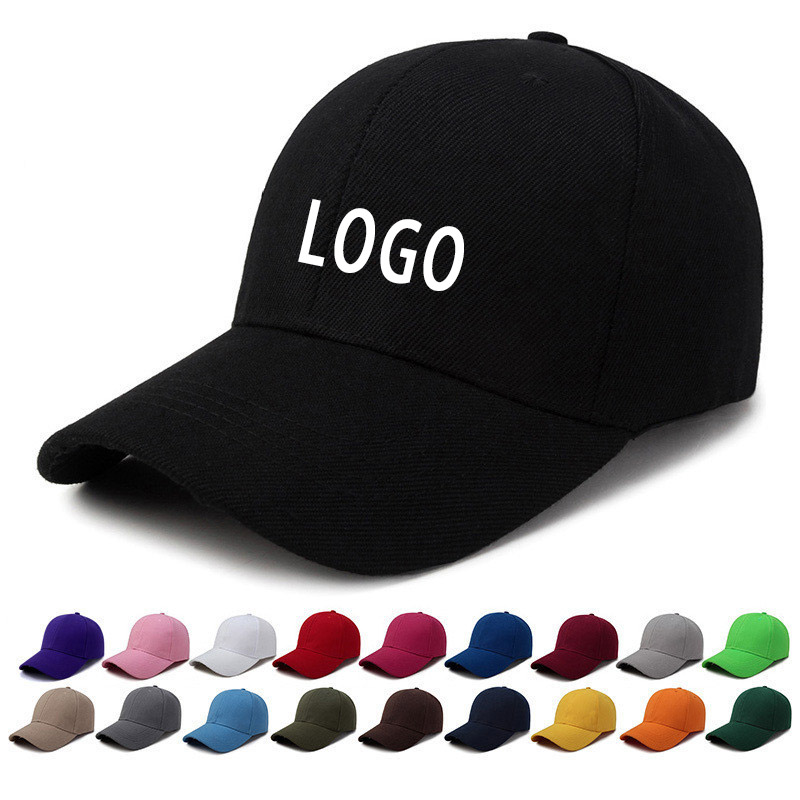
The hero cap is black cotton-type twill with the diagonal rib visible across crown and brim. Count the seams: six panels converging on a fabric-covered button at the apex, tonal topstitching running in concentric rows along a pre-curved visor. The same build repeats across eighteen blank colour thumbnails — purple, light pink, white, red, berry, royal blue, maroon, light grey, bright green, khaki, charcoal, sky blue, olive, brown, navy, mustard, orange and forest green — one tooling set, one crown block, eighteen dye lots.
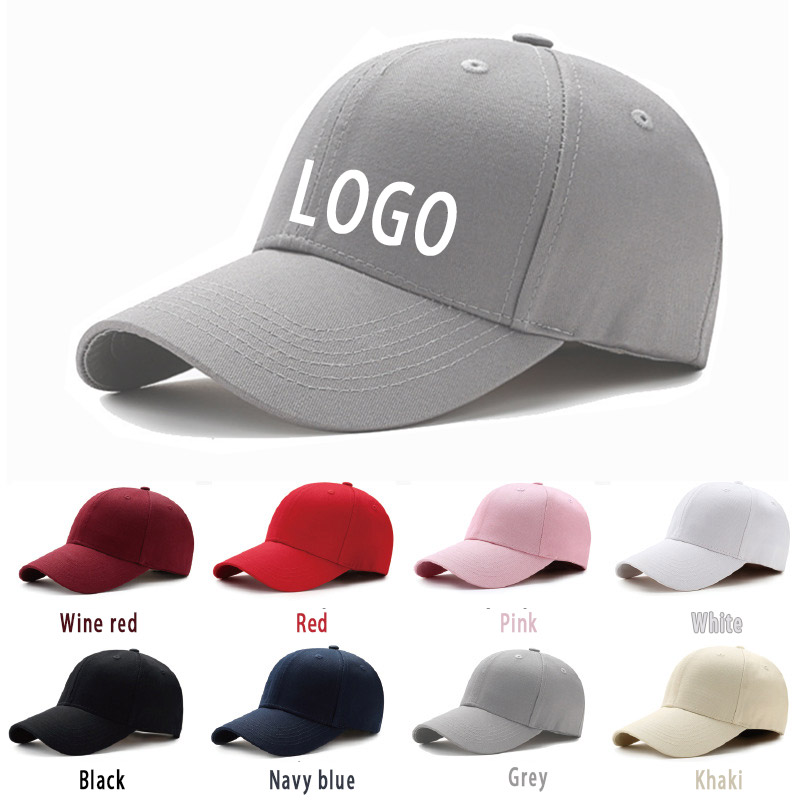
A second colour chart shows the same profile from a three-quarter angle in grey, with eight captioned blanks — wine red, red, pink, white, black, navy blue, grey and khaki — and embroidered tonal eyelets clearly worked into the side panels for ventilation. That eyelet detail matters for the worksite buyer: ventilation on a full-panel cap is stitched, not punched, which keeps the interlining edge clean behind the logo zone. Fabric weight, crown depth and thread-count per panel are quoted on request against a physical blank, because no weight marking is printed on any photographed cap.
Why does the colour wheel matter commercially? Because uniform programs are colour-coded: navy for supervisors, charcoal for yard crew, red for the promo team that tours. Holding eighteen stock shades means a mid-year top-up never asks a new dye lot to match an old one — you reorder off the photographed chart, and the tone you approved last spring is still on the shelf this autumn. The three-quarter grey hero adds a quieter second signal: crown height sits at the standard mid profile rather than a tall fashion block, the visor sweep arcs enough to shade eyes on a loading dock without clipping a safety-visor hinge, and every stitch line is tonal — no contrast thread to break a brand board’s “clean cap” rule. None of that needs a spec sheet to see; what the camera cannot show, millimetre-by-millimetre, is exactly what the blank sample is for.
Mesh-Back Trucker: The High-Vis and Event Lane
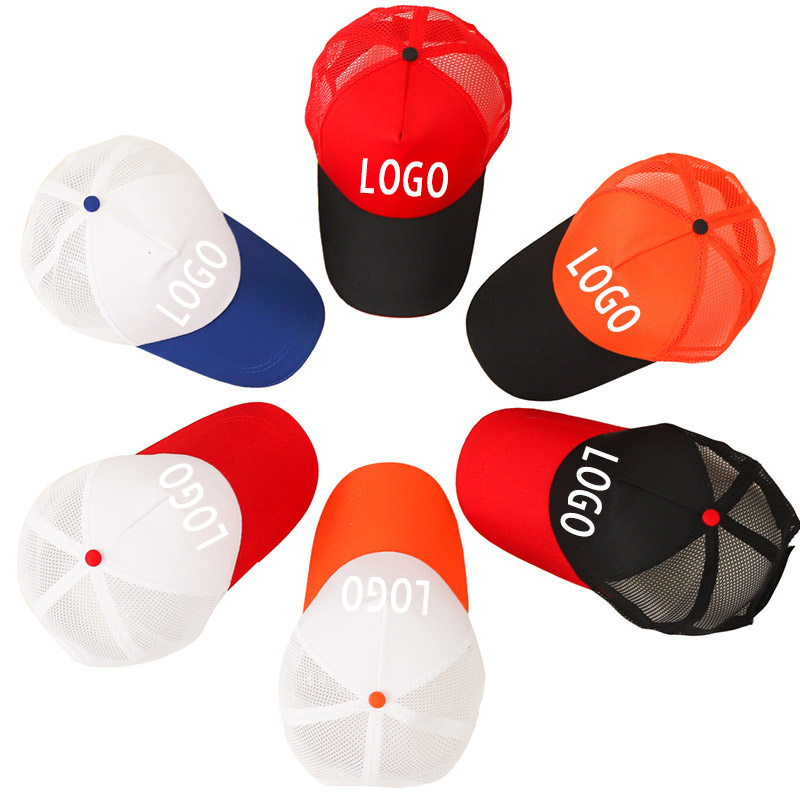
The circular colour-wheel frame shows the second silhouette from six angles at once: a solid matte front panel and brim married to an open diamond-net mesh back, structured front over an unstructured rear, fabric button at the crown, pre-curved brim, and no punched eyelets at all — the mesh is the ventilation. The colour splits run red-front/black-brim, orange-front/black-brim, red-front/white-mesh, orange-front/white-mesh, white-front/blue-brim.
This is also the one rear closure we can actually photograph: the bottom-right angle shows the plastic snapback adjuster band along the rim, prong rows intact. Everything else about closures stays honest — the front-angle heroes hide their backs, so strapback, hook-and-loop and elastic-trainer options are quoted per blank, not promised from pixels. Trucker economics suit the same programs that buy hi-vis: brand launches, race crews, farm-brand merch and construction-site giveaways, where two-tone foam-and-mesh reads louder than solid twill at equal print cost.
Where the Logo Goes and How It Sits
All front artwork in the photographs lands on the same real estate: the two front panels, centred above the visor seam, in the block the placeholder word marks on every sample cap. Exact working dimensions in millimetres come back on your mock-up, measured on the actual blank. Secondary territory exists too: side panels for small marks, rear strap zone for a serial or team number, brim underside for the playful builds. What you can see on camera is a flat application — the placeholder letters lie level with the twill, no dimensional shadow — which is the standard flat-embroidery profile.
The step up in perceived value is 3D puff embroidery, where the stabiliser core lifts the stitch off the panel; we run it routinely on structured crowns, and the digitising difference between flat and puff shows on your free digital mock-up before stitch-out. Printed sublimation applies to polyester-shell builds, and woven or chenille patches stitch onto the same zone when the program changes logos every season. Thread counts under 9,000 per mark are the quote comfort zone; finer script and half-tones get digitised, flagged and re-quoted rather than quietly attempted — a 2 mm serif is where an honest cap house says no and redesigns, instead of discovering the problem after three thousand units exist.
Artwork intake is unglamorous and decisive: vector preferred, one master file, and every zone — front, side, rear — positions off that same file so a franchise store opening and the regional crew order match seam to seam. The mock-up returns on the actual blank you chose, not a generic template, which is how closure, colour and stitch decisions collapse into one approval email instead of five. Programs that rebrand mid-flight get the old file archived rather than deleted: a top-up run in the legacy mark is a five-minute retrieval, priced at the same tier, which keeps a store rollout from bleeding stock value when marketing finally signs the new logo.
Program Math: Blanks, Caps and Reorder Windows
Uniform headwear lives or dies on reorder behaviour, and the blank-versus-custom split is the lever. A corporate program can stock dyed blanks from the eighteen-colour wheel and hold embroidery in-house, but the honest number is that per-unit custom runs at our MOQ of 100 pcs per design often land cheaper than a stock-then-mark plan once labour is counted. The photographed line’s real strength is repeat fidelity: one approved stitch file, one crown block, the same cap re-manufactured in month nine across mixed colourways on a single purchase order.
Buyer lanes sort cleanly. Worksite and trade contractors take the structured twill in navy, charcoal or black with a puff wordmark. Event and promo teams take the trucker in red/white splits for race weeks and product launches. Venue and security staffwear pairs the black cap with the woven work apron line so the uniform reads as one program. Cold-season continuation rides the acrylic beanie page, and school or camp programs that dress the small ones pull the kids craft aprons onto the same consolidated booking.
Fit, Sizing and the Adjustable Question
Here is the sizing truth the photographs enforce: the trucker frame shows a snap-adjusted band; the twill heroes show nothing at the rear because they are front-lit three-quarter shots. So this page sells adjustable as the default posture — snapback on truckers, closure choice on twills quoted per blank — and states graded fitted sizes as a quotation option against sample caps, not as a promise from pixels.
One-size-adjustable is why corporate orders survive HR turnover: a single carton mix covers every head on the floor, and the snap row simply resets per wearer. For teams that want a fitted profile, size curves are quoted with a physical sample, since no size marking appears on any cap in the photographs. Sweatband grades, buckle materials and hook-and-loop quality come to the sample stage with the rest of the spec sheet.
One distribution habit quietly saves uniform programs money: pre-set the snap before caps go into the locker or the welcome packet. A cap issued already adjusted to the wearer’s position gets worn on day one instead of sitting in a drawer for a week, and the adjustment rows on the photographed snapband are designed for exactly that kind of one-handed reset — press, lift, reseat. The same logic drives colour-coded programs: supervisors on mixed sites can spot their crew’s caps across a yard faster than they can read any logo, which is why the colour charts above get used as a hierarchy tool as much as a branding one.
What Dimensional Embroidery Can Carry — and Where We Draw the Line
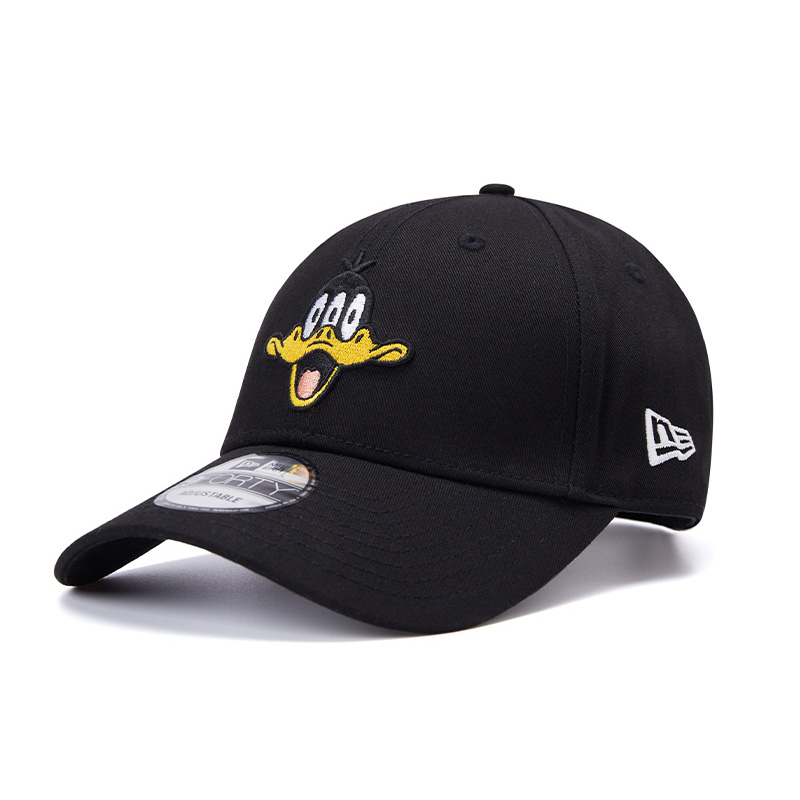
The fourth frame on this page shows a retail sample cap outside our own production: a black twill crown carrying a raised novelty character face stitched in dimensional thread, a small side-panel maker mark, and a paper sticker across the brim. It earns its place as a capability reference and a boundary line at the same time. On the capability side, the photograph proves the stitch relief programs like this produce — multi-colour thread fields, raised edges throwing their own shadow, colour changes every few hundred stitches across a single face. That is the same machinery that embroiders your crest, only aimed at artwork you own.
On the boundary side, that sample’s character, maker mark and model sticker all belong to third parties, and the copy on this page deliberately quotes none of them. We stitch your mark, or art your client can prove they own; licensed characters and borrowed mascots get refused at the intake stage, not after 3,000 units exist. Bring a wordmark, a crest or an original mascot and it digitises to the same dimensional standard — the mock-up and sample stage exist precisely so a program never learns about rights exposure from a customs letter.
Specification Table
| Item on this page | Structured 6-panel twill cap + mesh-back trucker cap, front-zone custom logo |
| Crown | Six panels, fabric-covered apex button, structured front on both silhouettes |
| Brim | Pre-curved, concentric tonal stitch rows as photographed |
| Ventilation | Embroidered tonal eyelets (twill, photographed); open diamond mesh (trucker) |
| Twill colour wheel | 18 blanks photo-charted; 8 more captioned charted; further dyed lots quoted |
| Trucker splits shown | Red, orange or white fronts with black/white mesh and contrast brims |
| Closures | Plastic snapback visible on trucker rear view; strapback/hook-loop/elastic/fitted quoted per blank against samples |
| Logo zones | Front two-panel centred block; side, rear and brim zones as add-on placements |
| Logo methods | Flat embroidery as photographed; 3D puff, patch, print methods specified on mock-up |
| Weight / sizing marks | None printed on photographed units — GSM and fitted size curves quoted on request |
| MOQ | 100 pcs per design |
| Sample time | 3-5 days |
| Lead time | 7-15 days after artwork approval |
| Capacity | 1,000,000 pcs per month across our gift lines |
Sampling and Bulk Runs
Blank and stitch-out samples return in 3-5 days; you approve a cap with the real interlining under the real thread before the run starts. MOQ is 100 pcs per design — one logo file can split across the colour wheel inside the same floor, so three site colours stay one artwork. Bulk ships 7-15 days after artwork approval, within 1,000,000 pcs per month across our gift lines; a 4,000-cap conference order is a scheduled slot, not a negotiation. The displayed price anchors the 100-piece tier and volume brackets step down on the quotation. Seasonal calendar math: worksite and retail programs lock artwork by early autumn so branded caps and the matching hat category builds land ahead of the Q4 gift window and holiday drop cycles.
Packing and Global Delivery
Caps ship shaped, not crushed: individually polybagged with tissue-stuffed crowns, stacked in export cartons to a per-carton count printed on the packing list so warehouse receiving ties out per SKU. FBA labelling, carton marking and prep are standard. Mixed-carton colour splits happen at packing without touching MOQ. Sea, air, DHL, UPS, FedEx and TNT all quote from the same artwork plan; courier consolidation covers a two-carton top-up between ocean tranches, and a uniform bundle — caps plus aprons plus counter towels — can ride one booking under a single commercial invoice.

Uniform-Program Questions, Answered Plainly
Is the crown structured or unstructured on the black hero cap?
What closure does my cap get — snap, strap or fitted?
Flat embroidery or 3D puff — which should our logo use?
Can a uniform order mix cap styles under one minimum?
Do you reprint or restitch a cap that fails at inspection?
How early must artwork sign off for a spring event?
Where This Page Sits in the Textiles Range
The hats category splits by silhouette and buyer: this page owns the structured-cap uniform lane, the knit beanie line owns the cold-season retail drop, staff bodies pair with the trade aprons, classroom kits with the kids aprons, and towel add-ons for counter and hospitality programs sit in the textiles range. Every spec row above is written from this page’s own photographs.
Send the Logo, Get the Mock-Up
Email artwork and quantities to the request-a-quote desk, [email protected] or +86-15967739086. You get a free digital mock-up naming blank, closure and stitch profile — approve it and the 100-piece-per-design clock starts.