Custom Mini Waving Flags – Desk and Tabletop Print
$0.65
Custom mini waving flags built for table height: conference desk pairs, dealer counter sets, reception colour rows, race-day checker kits. Small-format polyester cloth on short sticks, printed by dye sublimation when the artwork carries fine devices and by screen when flat spot colour runs deep – both routes photographed on this page, including the honest detail that single-layer cloth reads faintly translucent, so flags facing two sides of a table get quoted with a denser face or a two-panel build. Units ship rolled around their stick in individual heat-sealed poly bags, crease-free for close desk lighting, or flat-folded for dense sea cartons. Stand options do not appear in our gallery photos and are therefore quoted on request against your layout, never sold as photographed hardware; artwork stays your-design – protected national or state flags and official seals stay out of production. MOQ 100 pcs per design, free digital mock-up, proofs in 3-5 days, bulk in 7-15 days after artwork approval inside 1,000,000 pcs per month across our gift lines. Sea, air or DHL / UPS / FedEx / TNT, FBA labelling supported.
A mini waving flag earns its place by staying in frame at table height: the delegate’s desk in a conference hall, the corner of a dealership counter, the head table at an awards dinner, the shelf beside the till. These custom mini waving flags are the small-format lane of our flag line – printed polyester cloth on short sticks, sized so the graphic reads at half a metre instead of fifty, and packed so a hundred units can be set out or handed over without a staging crew. The buying logic differs from crowd flags: nobody waves these at scale; they are placed, grouped, photographed and collected, and the order gets planned around table counts instead of attendance.
What arrives at the table is smaller than it sounds. The cloth is pocket-handkerchief territory on a short shaft, light enough that a single stack of five hundred bagged units rides in one carton a store clerk can carry, cheap enough that the unit cost hides inside a registration fee or a menu price rather than standing out as line item. None of that is visible in a product sheet, so the four photographs on this page do the talking: what the print edge looks like at reading distance, how a unit arrives sealed, which grip goes in the hand, and what a plain field actually costs you in artwork preparation – nothing.
The Format: Small Cloth, Exact Print, Table-Height Reading Distance
At desk distance, the rules of flag legibility flip. A large parade flag survives a thin wordmark because the crowd never reads fine type anyway – they read colour and motion. A mini flag gets looked at directly, from across a table, by one person at a time, for as long as the meeting lasts. That changes what the artwork should be: bold field colours, a tight device, type heavy enough to survive being printed at cloth scale. It also changes how the print runs. At this format, dye sublimation does most of the work: the dye floods the polyester face edge to edge, so thin strokes stay sharp, points and serifs do not bleed into the weave, and the colours that read on your screen read on the table because the pigment sits inside the fibre instead of cracking on top of it. Screen printing still earns its place when the design is flat spot colours and the quantity is deep – one wordmark across ten thousand bagged units prices better on screens than on sublimation paper.
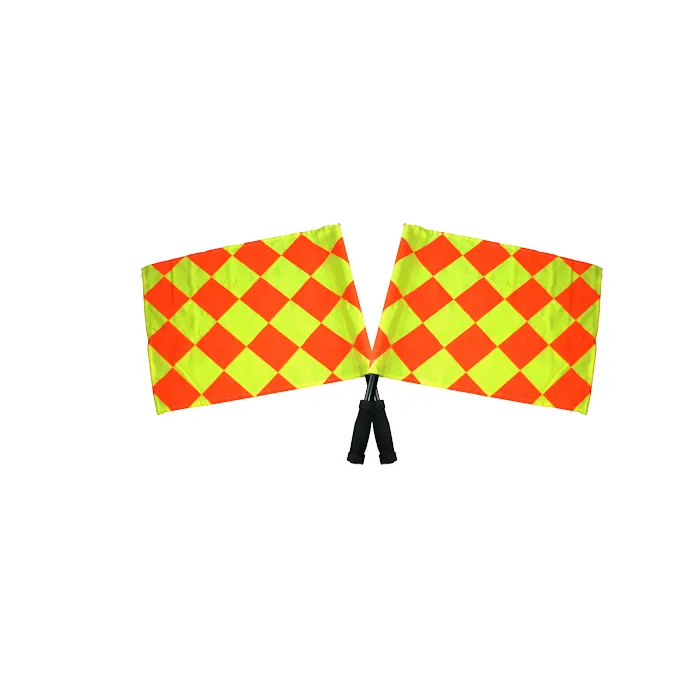
The first photographed pair shows what the small format looks like when it skips the logo entirely. Two short flags, fluorescent orange-red and high-vis lime in a diamond checker, printed sharp from edge to edge, hoist sides sewn into narrow sleeves over slim sticks that end in moulded black grips. The panels bow the way light synthetic cloth bows when nothing stretches it taut – a soft wave along the top and bottom edges rather than a rigid board. No fringe, no grommets, no tassel, no printed size, no text of any kind. This is the signalling end of the mini lane: start-line and finish-line pairs, marshal desks at kart days and cycling events, safety-course stations, or two-tone house colours for a table set at a team-building day. The crossed-handle presentation is the product – both flags share one pattern and one grip, sold as a matched kit.
Four Rolled Units, Each in Its Own Bag
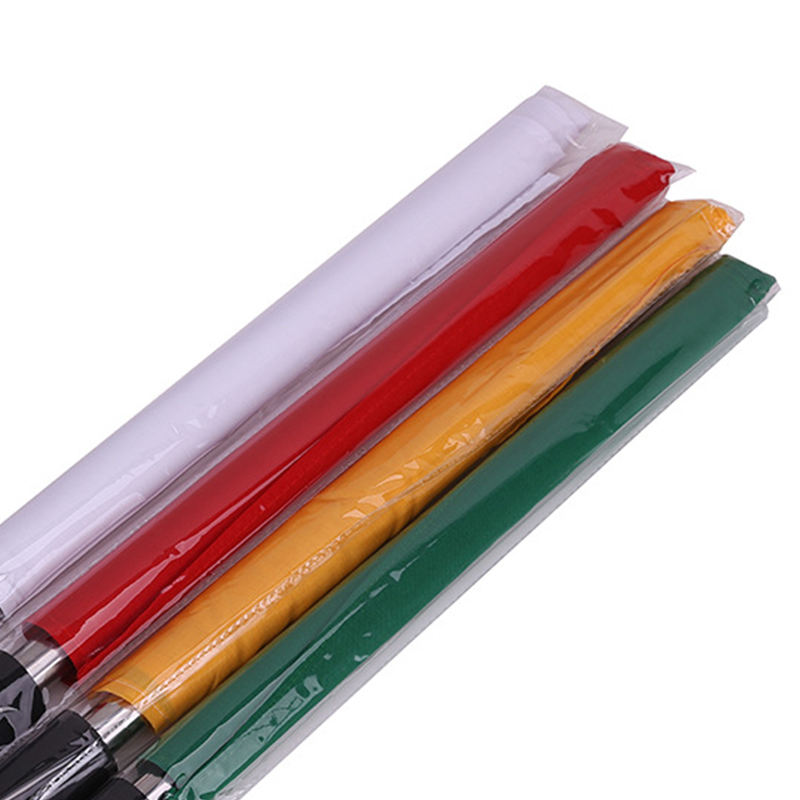
The second photograph is the one procurement people misread, so read it with them. Four sticks lie in a diagonal stack, each sealed in a clear polybag heat-closed at the top into a small pointed flap. The cloth on every unit is rolled tight around its internal pole rather than folded flat, so what shows is four solid columns of colour – white, red, yellow, green – and nothing else: no hem, no print, no emblem, no label, no marking. At the free ends, black grips with polished silver ferrules peek out from the open bottom of each bag.
Why a mini flag ships rolled and bagged instead of flat in a sleeve: the rolled build keeps the cloth crease-free, which matters far more at desk height than at parade height – a conference delegate sits forty centimetres from your print, and a fold line caught in raking hotel lighting reads as a defect even when the artwork is perfect. Rolling around the pole means the cloth never gets a hard set line, the stick and flag stay one unit so nothing separates in a carton, and the individual bag keeps units clean through packing, palletising and a delegate’s hands. For hygienic-event buyers – medical congresses, food trade floors – the bag is also the story you can tell on the floor: nobody between our packing bench and the conference table has touched the cloth.
Four solid colours with zero print is also a product decision worth noting. Plain-field mini flags in your two house colours are the cheapest way to buy table identity: one fabric, one hem, one grip, no artwork gate, and the colour separation does the brand work across a long banquet row. When a buyer needs three hundred place settings to carry sponsor colour without printing three hundred logos, solid fields are the answer and they quote fast because there is nothing to proof beyond a colour match.
There is a second reason the plain-field program keeps selling, and it shows up in how the four bagged units in the photo get used after the session ends. A printed flag is campaign furniture – the agenda changes and the cloth becomes obsolete stock. A solid colour is inventory: next quarter’s event re-uses the same panels under a different table plan, the bagged stack sits in a drawer for months without fading into an unfunded message, and the only spend at reorder is replacement cloth, not new artwork rounds. For buyers running twelve or more events a year across one brand palette, that recycling logic changes the annual number more than any unit-price negotiation on a single order would, and it starts from the same four-colour picture this photograph shows you buying.
Checker Up Close: Thin Cloth, Folded Hems, Honest Translucency
The third photo rests two printed minis on a white surface, and they are the most useful construction evidence this page has. Both are rectangular panels of thin, lightly glossy synthetic cloth laid flat, gently folding where they settled, with a checkerboard of orange-red and lemon-yellow blocks across roughly three squares by two – a square-grid take on the same racing motif as the fluorescent diamond pair above, and proof that the mini lane prints both geometries cleanly. Edges finish in narrow folded stitching; the hoist edge is captured along the pole, a slim silver metal rod that terminates in a black foam grip with a small metal collar at the junction. No text, no emblem, no size marking anywhere in the frame. Note what the pose itself is doing: a studio shot laid flat, creases and all, instead of a rigged wave – the honest way to show a printed panel is the way your quality inspector will actually look at it, folded on a bench, not flying.
One honest observation from this shot matters more than it looks: where the light comes through a yellow square on the rear flag, the cloth reads slightly translucent. At mini scale that is normal for lightweight single-layer polyester, and it tells you exactly when to pay for more build. A desk flag that faces one direction – a moderator panel, a name-and-flag place setting – is fine as printed. A flag two sides of a table will look at across the same meeting wants a denser face or a two-panel sewn build so the reverse shows a controlled second design instead of a mirrored ghost of the first. The photo is the cheapest way to understand that trade before a quotation call covers it.
Scale reasoning applies to the checker itself as artwork planning. A three-by-two grid on a desk panel is not a finish-line flag shrunk down – it is a pattern that has to survive being cropped by a sleeve on one edge and read from a seated position on the other. Squares that small on a large banner blur into stripes at ten metres; at forty centimetres they carry their edges, and that inversion is why small formats get designed, not resized. Send the studio a layout built for reading distance and the free mock-up returns it composited at true scale on your grip choice, before the proof run costs anything. Every file that reaches the press on this lane passed through that desk-distance sanity check first – it is the difference between a logo that survived the shrink and a graphic rebuilt to earn its table.

The Solid-Colour Row: Four Fields, One Grip Design
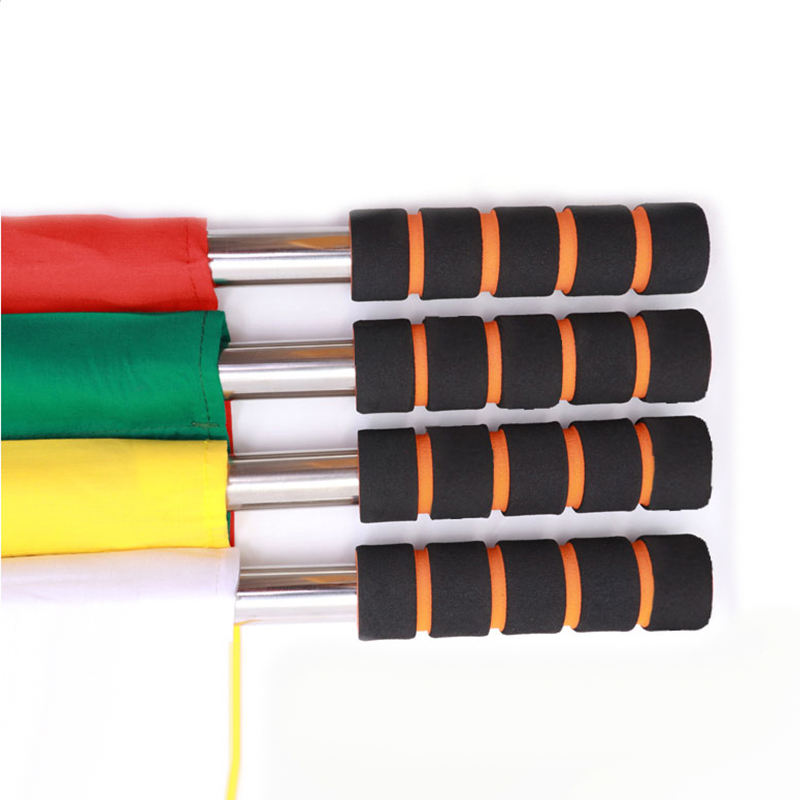
The fourth photograph lines up the plain-field program as built, not as bagged. Four mini flags stacked flat – solid red, solid green, solid yellow, solid white – each hoist edge turned into a sleeve over its pole, the stitched seam reading clearest on the green panel, the cloth gathered in soft folds where it wraps the shaft. Below each sleeve, a polished silver rod runs into a black foam grip moulded with four evenly spaced orange ridges, five black segments alternating with four grooves, rounded at the end cap. A thin yellow tie cord dangles from the lower edge of the white unit, packaging detail left in frame. Every surface is a flat single colour with no print at all: no emblem, no canton, no stripes, no device.
Read the set the way a merchandiser does and you get three products in one photo. The colour row itself – a four-panel lineup on one tray at a reception desk, a race village or an international school dinner – where the message is palette, not artwork. The grip spec as a SKU decision: the ridged two-tone foam handle is a purchase-counter object as much as a flag part, giving a kid’s party pack or a track-day souvenir something to hold that a bare dowel does not. And the sleeve gather at the hoist, which is the small-format version of a real construction point – the folded, stitched sleeve takes every bit of load the cloth collects, and on all four units it sits straight.
One thing the photographs deliberately do not claim: no display stand, base, socket or finial appears anywhere in this gallery. Conference desk sets and multi-socket tabletop stands exist as an accessory request, but because they are not in these shots, they are quoted on request against your layout rather than sold as photographed hardware – the flags themselves, bagged or sleeved on sticks, are what this page proves. Send your table layout with the enquiry and the mock-up places your print at desk height on your surface before anything ships.
Colour discipline is the last thing this row quietly teaches. Four solid dyed panels photographed side by side is also a swatch request in disguise – buyers re-ordering a banquet palette six months later discover that screen values drift between dye batches, and the only reference that holds is the physical unit kept from the first event. Keep one bagged sample per colourway at your office and colour matching on the next tranche becomes a comparison against your own stock, not an argument against a monitor profile. That habit costs one flag out of three hundred and saves the entire palette.
Three Buying Calendars, One Production Window
Conference season concentrates the desk-flag trade. Congresses and summits publish their dates months ahead and order to their own procurement calendar, which almost always lands a delivery deadline measured in weeks, not months – so the useful trick is to lock artwork against the call for papers, not the agenda. A sponsor package promising delegate bag inserts needs the bagged-unit picture above, quantity near attendee count, and courier timing; the same cloth on a different stick goes to stage tables at a fraction of that count.
Dealership and showroom programs run quarter to quarter: a launch weekend wants table sets on the counter the day the model goes on sale, and the mini flag’s role there is small – marking the new colour, carrying the offer number, standing beside the spec card. Because units are individually bagged, a dealer-network order can ship store by store from our warehouse without anyone re-packing, and each store’s table count becomes one line on a single master order.
Party and gifting demand spikes at fixed dates – national-holiday table sets, international dinners, club and school events – and behaves like every short-window buy: the reorder for the winner is faster than the first buy, because the artwork is already approved and a top-up tranche clears the same 7-15 day bulk window and flies. The 100 pcs per design minimum keeps all three calendars sane: one event is one design, one sponsor wall is one design per sponsor, and each colourway counts separately. If your brief ever needs official emblems rather than your own artwork – national or state flags, government seals – that reproduction stays out of our production, the same policy across every flag page in this category; what this lane prints is your logo, your colours, your pattern.
Specifications
| Item | Custom Polyester Mini Waving Flag – small printed flag on short stick, tabletop and desk build |
| Field size | 30 * 34 cm per the listing sheet (or your own cut) – no photo in this set carries a printed dimension |
| Fabric | Polyester, thin synthetic face with light sheen as photographed; rolled or folded per packing spec |
| Print routes | Dye sublimation for fine devices and full-bleed artwork; silk screen for flat spot colours at depth |
| Hoist finish | Sewn sleeve capturing the stick, visible on every sample in this gallery |
| Stick options | Black moulded grip with silver ferrule; silver shaft with black foam grip; orange-ridged two-tone foam grip – all photographed |
| Display hardware | Desk stands and multi-socket tabletop sets: not shown in this photo gallery – quoted on request against your layout |
| Artwork rule | Files you own, printed as you send them – official-flag and seal copying sits outside production on every page of this category |
| MOQ | 100 pcs per design |
| Sample time | 3-5 days from file sign-off |
| Lead time | 7-15 days after artwork approval |
| Capacity | 1,000,000 pcs per month across our gift lines |
| Packing | Individual poly bag per unit; rolled around the stick or flat-folded; inner carton and export master per quote |
| Shipping | By sea, by air or by express courier – DHL, UPS, FedEx, TNT; FBA labelling supported |
Reference pricing follows the quantity tier, not a fixed number on screen: the displayed figure on this listing anchors the 100-piece tier, and volume rates come back with your quantity, grip spec and destination on the quote. Detail questions – colour standards, bag gauge, grip batch – are settled against a real proof piece, not datasheet prose.
Where This Sits in the Flag Line
Three flag formats share our textiles catalogue, split by where the cloth lives during the event. Cloth in thousands of hands on a route belongs to the festival lane – the hand-held event flag page covers crowd quantities with sticks and eyelet headers. Cloth placed at counter and table height is this page. Cloth flying from a vertical system outside a shop is the large advertising flag build, quoted with pole and hardware against site conditions. All three sit in the flags category of the home textiles line, and event buyers commonly run desk minis and crowd hand flags off one artwork file – the same design scaled per surface – ordered through the quote request desk as one bundle.
Packing, Transit and the Collection Problem
The packing stage for mini flags has one job the crowd format never faces: collection. Desk flags leave conferences in delegate pockets, and a programme that expects its table flags back after the keynote is a programme that needs a retrieval plan – which usually means the bagged-unit picture works twice, as a hygiene seal before the session and as a re-bagging kit after it, so units return to storage clean and paired with their sticks. For shipping maths, rolled-and-bagged units count into inner cartons by a per-carton figure confirmed on your quote, and cartons stack into masters sized for pallet or parcel.
Freight lanes are the usual set – by sea, by air or by express courier DHL, UPS, FedEx, TNT – and FBA-style inbound labelling is supported when the destination is a marketplace warehouse rather than a venue. A single purchase order can split: base volume on water timed to next quarter’s calendar, a courier tranche for the event with the fixed date, store-by-store drops for a dealer program. The diagram below is the reference picture from the packing bench through to the freight mode.

Mini Flag Questions, Answered
What is a mini waving flag used for?
Do the photos include a display stand?
Is sublimation or screen printing better at this size?
Can the reverse side show a second design?
What is the minimum order and the timeline?
How do units ship – rolled or flat?
Send the Table Plan
Table counts, delegate quantities, event dates and grip preferences go on one sheet and into the form below; tick the quote request list too if the same campaign needs hand flags or mast lines. The desk that proofs your cloth replies with the mock-up, landed costs and a dated production calendar. WhatsApp / Tel: +86-15967739086 | Email: [email protected]