Custom Heavy Duty Work Aprons for Staff & Trades
$1.60
Custom heavy duty work aprons for workshops, smoker pits, garden centres and roastery counters: woven bib shells with tonal twin-needle stitching, fixed-loop, webbed-slider or three-snap neck systems, and pocket architectures from split kangaroo bays to a riveted three-compartment utility panel. Four photographed colourways — black, khaki, chocolate brown, burnt orange — carry chest-block and pocket-zone screen print from one approved master file. The photos show an uncoated woven face, so weather-side performance is quoted per chosen production shell, never assumed. MOQ 100 pcs per design, samples in 3-5 days, bulk in 7-15 days after artwork approval, 1,000,000 pcs per month across our gift lines. Mixed colourway splits, FBA prep and per-carton packing lists are standard.
Workwear Aprons Ranked by What Survives the Shift
A staff apron is a tool, not a costume. Buyers of custom heavy duty work aprons judge three things before price: whether the neck system holds after a hundred tie-offs, whether the pocket layout matches the actual hand tools of the trade, and whether the cloth stands up to weekly laundering without shredding at the corners. This page covers the woven bib-apron line built for exactly that — workshops, smoker pits, garden centres, roastery counters and garment-industry benches — and every claim below is pinned to what the four product photographs on this page actually show.
The line runs in smooth matte woven cloth with tonal topstitching, twin-needle seams at the pocket joins, and a knee-dropping bib skirt. Two distinct neck systems appear across the photographs, three pocket architectures are visible, and four solid colourways are on the table: black, khaki, chocolate brown and burnt orange. Sizing charts, fabric weight and any weather-side performance are quoted per production shell; nothing is promised that the camera cannot back up.
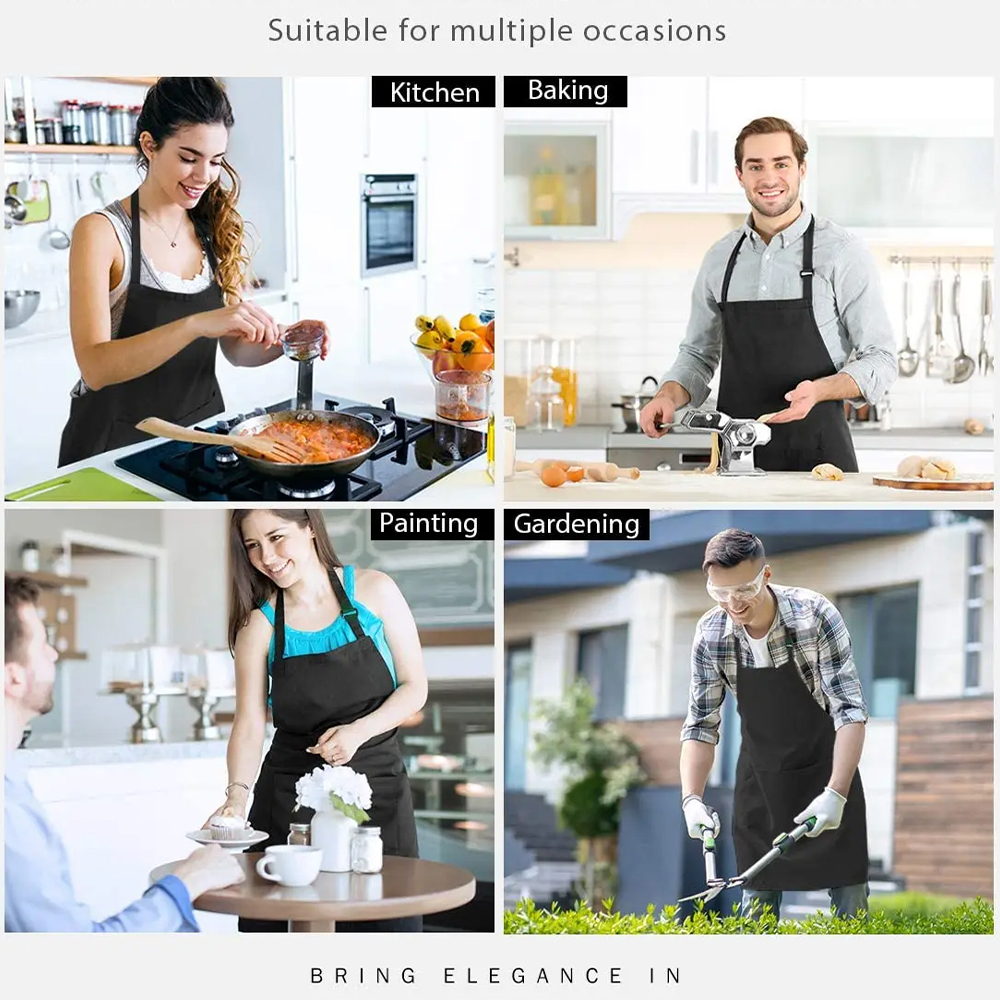
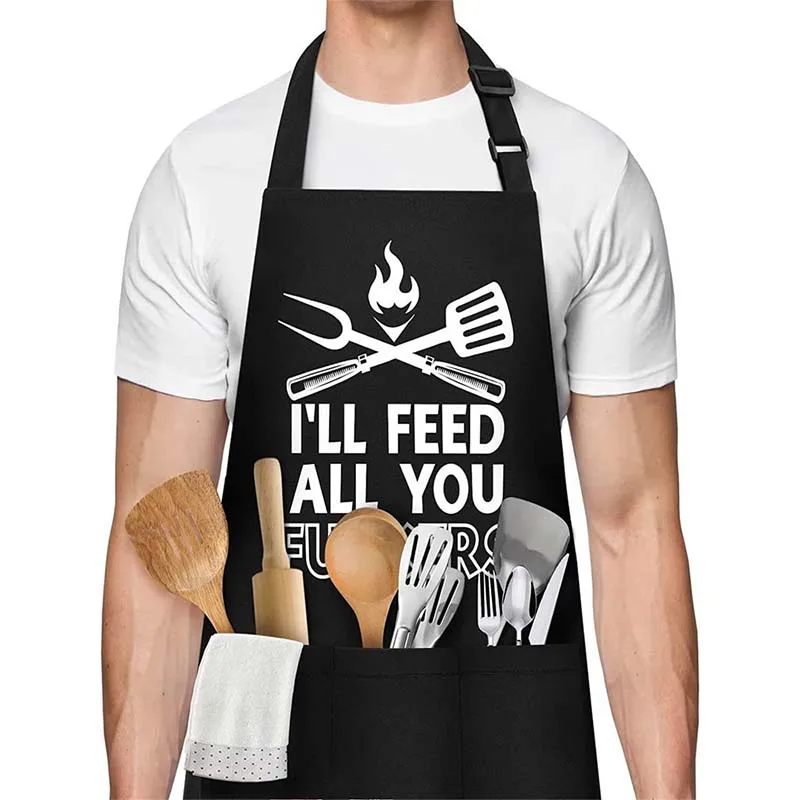
The photograph set is small and specific: a four-scene lifestyle grid, a two-colour studio mock-up with marked print zones, a single printed sample wearing an opaque white emblem with its pocket loaded full of kitchen steel, and a three-model staff frame in black, brown and orange. Nothing else hangs on this page. Every fastening family, pocket divider, rivet point and stitch line quoted below maps to a visible detail inside those four frames, and anything the frames do not show — coating behaviour, GSM numbers, graded size runs — is written as a quotation-stage question with a physical sample behind it. That discipline is also why this listing no longer leads with the water claim its old title carried: four photographs of matte woven cloth simply do not say that word anymore.
Two Neck Systems You Can Actually See
The photographs split the line into two fastening families, and the difference matters when aprons circulate across a shared staff pool.
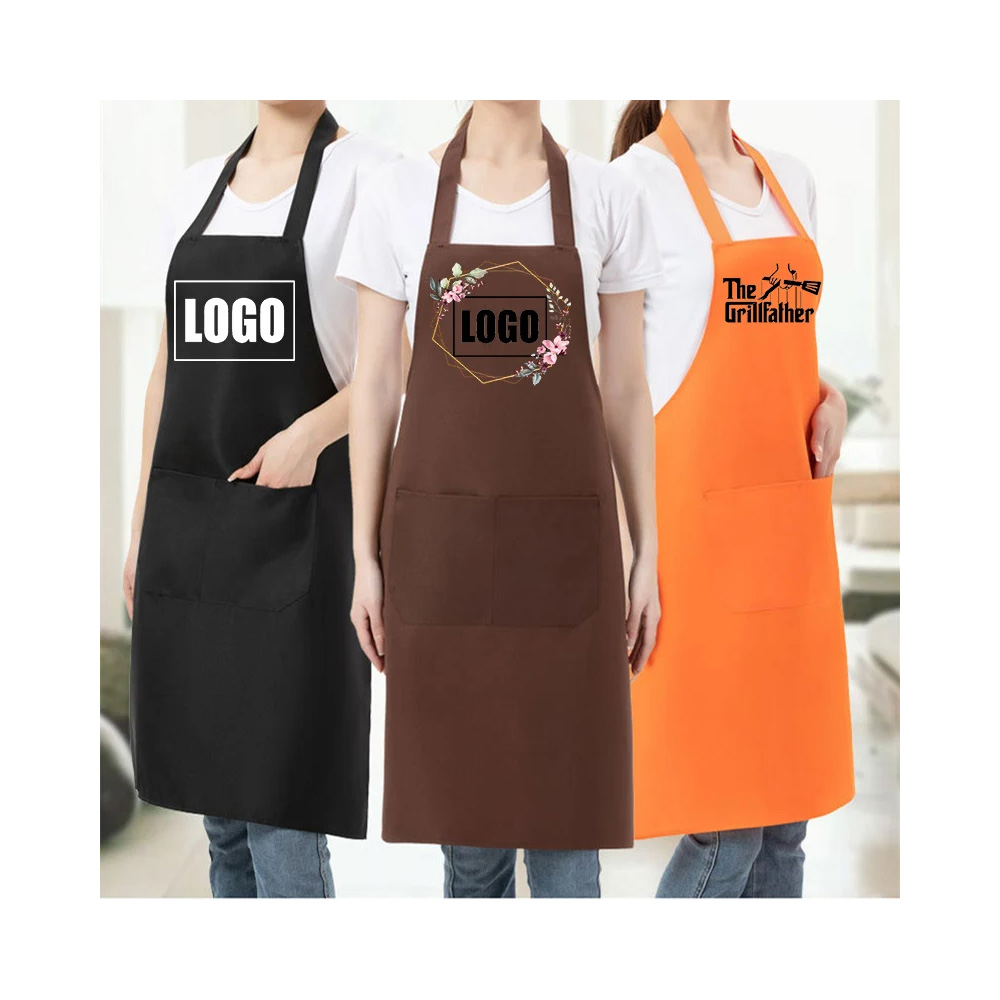
First family: the fixed fabric loop. On the three-staff photo, the black, brown and orange aprons carry a simple cut-and-folded strap sewn to the bib — no metal at the neck at all. Head goes through, done. It is the cheapest system to produce, has nothing to lose, and suits high-turnover teams where aprons swap wearers all day. Waist closure there is self-fabric tie strings drawn behind the back.
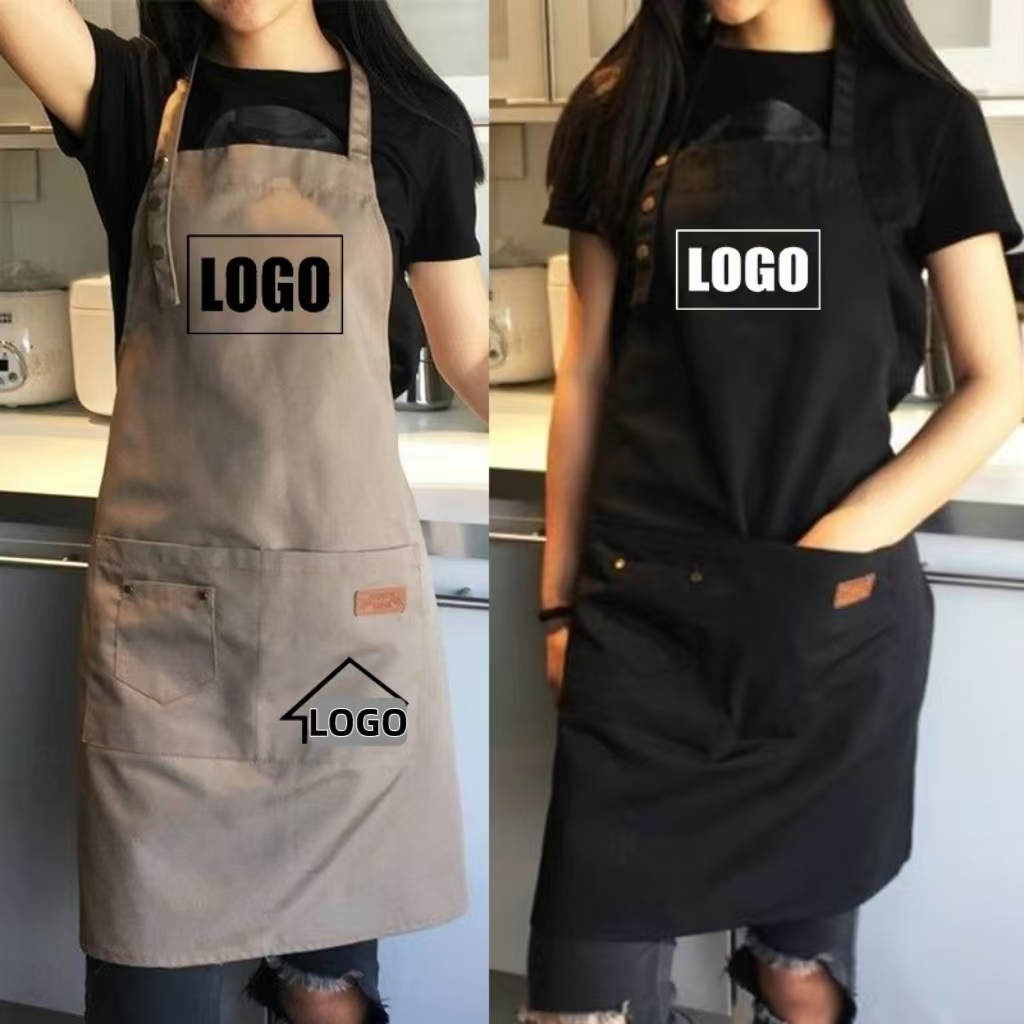
Second family: adjustable hardware. The printed black sample runs a woven webbing strap through a rectangular metal slider and ring, so one size covers small to large frames on the same stock. The two-colour studio photo shows a third variation: a vertical row of three round snaps down the side of the bib, letting the wearer dial neck height without sliding hardware that migrates under a towel or lanyard. Every visible metal part on the photographed units is a plain silver-tone or dark gunmetal finish; decorative rivets appear only at pocket corners where load lives.
Which neck system ships is a spec-sheet decision, not a mystery: you pick loop, slider or snap on the mock-up stage, and the approved system repeats through the run. Buckle-side durability beyond these photographed styles is quoted on request against a physical sample.
Three Pocket Layouts, Each for a Different Hand
Pocket architecture is where a work apron earns its keep, and the photos show three distinct builds.
- Split kangaroo: one waist-level patch pocket divided by a single vertical seam into two hands-free compartments — the layout on the black apron in the four-scene photo. Thermometers left, phone right, nothing migrates across the divider.
- Three-compartment utility panel: the khaki and black studio aprons carry a full-width pocket panel with a pointed-bottom pentagon pouch riveted at its corner, a large open compartment for a hand or a folding rule, and a third bay on the patch side. Two corner rivets plus a centre-top stud reinforce the tear points where pens and pruners lever the cloth.
- Deep single bay: the printed sample’s pocket is stuffed with a dish towel, wooden spatulas, a rolling pin and steel turners in the same shot — proof of raw volume, with a near-centre vertical seam splitting it into at least two bays.
No chest pockets, flaps or zip closures appear on any photographed unit; if your brief needs them, they are add-on tooling and land on the quotation as line items.
What the Fabric Photos Prove — and What They Do Not
Here is the honest part. Every apron on this page is photographed in a matte, tightly woven cloth: plain-weave canvas and duck on the studio units, smooth poly-cotton webbing on the straps. Light falls flat across the bibs. No beading, no sheen, no laminated face shows in any frame.
That means this page will not repeat the word the old listing led with. The photographed line is an uncoated woven workwear shell, and uncoated woven cloth is not a rain claim. If your program needs a weather side — coated or film-backed panels — we source it, test it against your use case and quote performance numbers with a physical sample in hand; nothing about water behaviour is stated here beyond what the camera supports.
What the cloth does prove: tonal twin-needle topstitching around bib edges, pocket openings and hems; bar-tack style reinforcement where neck-strap tabs meet the bib; double-stitched seams at pocket joins; and a surface that takes screen print and heat transfer cleanly — the printed black sample is the evidence, holding an opaque white emblem after being photographed loaded with kitchen steel.
Print Zones, Your Artwork, and One Sample to Judge
Logo placement across the photographed units follows two zones. Zone one is the upper bib — a centred chest block, roughly the footprint of a fold of A4, where the studio mock-ups mark the print position and the three-staff photo shows a hexagonal line frame, a boxed mark and a turner-and-flame emblem side by side. Zone two is the pocket panel or the lower-right field, used for small secondary marks like the house-shaped icon on the studio mock-up.
Screen print and heat-transfer vinyl cover the white emblem on the printed sample — dense opaque coverage, no stitch relief, sitting flat on the webbed cloth. One-off colours and PMS-matched inks are available; thread-count and mesh for your artwork size are set at pre-production and shown on the free digital mock-up before anything is tooled. Placement across every zone runs from one approved master file, so a 500-piece staff run and a 50-piece top-up match seam to seam.
Two practical artwork rules come out of the print zone geometry. First, keep line weights above roughly 1.5 mm inside the chest block — the woven face has enough tooth that hairline serifs fill in with ink on the first wash cycle, and the mock-up stage is where that gets flagged before it costs a carton. Second, expect the vertical bib seam on some colourways to run behind the mark: programs that cannot tolerate any seam interruption get the print shifted a centimetre left or moved to the pocket-panel zone, which is a quotation-stage decision, not a press-stage surprise. Emblem-plus-wordmark lockups photograph cleanly because the bib holds flat against the torso from chest to waist — the wrinkle lines that distort shop-front signage on a hanging banner simply do not appear once the apron is worn.
Colourways on the Table
Four solid colourways are photographed and stocked in the current sample set. Black dominates the lifestyle frames and reads best under soot and grease-lighting. Khaki sits as a warm taupe-grey that hides flour and ash between washes. Chocolate brown shows as a rich mid-dark tone in the three-staff frame — the favourite of roastery and coffee-bar programs. Burnt orange runs bright enough to function as hi-vis-adjacent staffwear on a garden-centre floor without tripping any safety-colour rules.
Additional shades and colourfastness data are quoted on request; the four above are what this page will stand behind from the photographs. Mixed-colour splits inside one design reorder cleanly — the MOQ counts the artwork, not the dye lots, so a brown-and-black pair of store teams sits on one purchase order.
Laundering behaviour belongs in the colour conversation because dye choice is really a maintenance choice. Black woven bibs tolerate hot wash cycles best and stay looking new longest under weekly industrial laundering, which is why pit crews and butchers default to it. Khaki hides flour, ash and coffee grounds between washes but shows grease shadows earlier than black does. Chocolate brown holds its tone beautifully under UV-heavy storefront lighting, where black can fade visibly toward grey within a season of sun-facing window storage. Burnt orange is the loudest at order and the first to read tired on a collar-adjacent zone, so garden-centre programs that machine-wash at high temperatures tend to order orange in shorter rotation cycles with a larger per-head allocation. Wash-temperature ceilings and shrinkage numbers depend on the production cloth chosen for your run; the spec sheet that travels with your sample carries them, not this page.
Who Reorders This Line
The repeat buyers cluster into five lanes. Barbecue and smoking businesses outfit pit crews and competition teams — the flame-and-utensils sample was printed for exactly that trade. Garden centres and nurseries run orange or brown bibs as counter and greenhouse staffwear, where the riveted utility pocket holds pruners and label markers. Roasteries and cafés use the split-kangaroo layout to park towel and dosing scale. Manufacturing and garment workshops issue fixed-loop black aprons to bench staff because there is no hardware to snag fabric bolts. And farm-to-table venues order the khaki snap-side version as the front-of-house uniform piece that reads crafted rather than corporate.
Whoever wears the apron all day decides which lane reorders, and the pattern is predictable from the first quote. Pit crews and competition barbecue teams reorder around event seasons — spring ticket shows, summer circuit dates — which makes the free mock-up stage the real deadline, not production. Garden centres and nurseries order at season open and top up at half-season when staff count grows; they are the buyers who care most about the riveted utility pocket because pruners, label pens and a coil of twine live in it all day. Roasteries and cafés replace aprons on a sanitation schedule rather than a wear-out schedule, so their repeat orders are calendar events with a fixed artwork, which is exactly what a per-design MOQ of 100 pieces and a stitch-file-on-record program handles cleanly. Garment and manufacturing workshops run the longest single-cycle orders — one black loop-style spec, issued to every bench, re-cut only when the fit block changes — and are the lane most likely to add chest-zone ID numbers or employee-first-name prints, which quote as variable-data add-ons against the same plate.
For adult sizes, the fixed-loop units run generously off a standard one-size block; graded charts and XS-XXL availability are quoted per production run, since no size marking is printed on any photographed sample. If your team spans small to XL wearers, the webbing-slider style is the low-friction answer before any grading conversation.
Specification Table
| Item on this page | Woven bib work apron, adult trade & workshop staffwear (uncoated face as photographed) |
| Visible colourways | Black, khaki, chocolate brown, burnt orange; further shades quoted on request |
| Neck systems shown | Fixed sewn loop; woven webbing with rectangular metal slider; three-snap bib side — choose one per order |
| Waist closure | Self-fabric tie strings routed behind the back on all photographed units |
| Pocket architectures shown | Split kangaroo (2 bay); full-width panel with riveted pointed utility pouch (3 bay); deep loaded bay with centre divider |
| Reinforcement | Twin-needle tonal topstitch; bar-tack strap anchors; pocket-corner rivets on the utility-panel style |
| Print zones | Upper bib chest block; secondary mark on pocket panel — screen print or heat transfer, free digital mock-up first |
| Weather performance | Not shown in photos; coated shells sourced and quoted on request against a physical sample |
| Sizing | One-size block as photographed; graded charts quoted per run |
| MOQ | 100 pcs per design |
| Sample time | 3-5 days |
| Lead time | 7-15 days after artwork approval |
| Capacity | 1,000,000 pcs per month across our gift lines |
Sampling, Bulk Runs and the 100-Piece Door
Sample turnaround is 3-5 days: you hold a stitched unit with your chosen neck hardware and pocket build before committing. The MOQ sits at 100 pcs per design, which lets a single store’s staff refresh and a multi-site uniform rollout share one artwork file. Production lands 7-15 days after artwork approval, backed by 1,000,000 pcs per month across our gift lines, so even a 3,000-apron franchise order clears inside one lead-time window without a second queue.
The displayed reference price anchors the 100-piece tier; larger brackets reprice downward on the quotation. Free digital mock-ups show chest and pocket-zone placement against the actual block, and a physical apron ships for sign-off when colour or hand-feel decides the PO. Uniform programs layer nicely with headwear — the structured caps page carries the matching embroidery-zone logic, and staff kits combining apron, cap and branded bar or counter towels quote as one carton plan.
Packing and Global Delivery
Aprons fold flat, individually polybagged, then into export cartons with counts printed per box so receiving departments reconcile by the packing list, not by hand. FBA labelling and prep are standard. Sea, air, DHL, UPS, FedEx and TNT all quote from the same artwork and carton plan; mixed-carton builds — brown bibs with orange bibs, sizes split at packing — are routine. For the children’s end of an all-family venue program, classroom sets ship from the kids craft aprons page on the same freight consolidation, and seasonal knit beanie drops can ride the same booking window.

Questions Procurement Teams Ask Before the First PO
Do these aprons shed water as sold?
Which neck system is most durable for shared staff pools?
Can one order mix colours and pocket layouts?
Will the white chest print survive hot-wash cycles?
Do you hold graded adult sizes?
How fast can a uniform refresh land across stores?
Where This Page Sits in the Textiles Range
Within the aprons category, this page owns the adult workwear lane: woven staff bibs, trade pockets and chest-print programs. Painting-and-baking family sets live on the kids aprons page; the same purchase order can pull the structured cap line or beanie drops for seasonal headwear, and broader textile add-ons sit under the clothes category. Every spec row on this table is built from this listing’s own photographs, not reused from sister pages.
Send the Logo, Get the Mock-Up
Send artwork and your target quantity to the request-a-quote desk or to [email protected] / +86-15967739086. A digital mock-up on the chosen neck system and pocket architecture returns free — approve it, and 100-piece-per-design production starts.