Custom Logo Leather Dated Planner and Agenda Notebook
$1.98
Q4 executive agenda shell: matte charcoal or black PU leather hardcover with rounded corners, copper-gilded or plain fore-edge, elastic closure and pen loop, sewn 180-degree lay-flat opening, and 100 gsm pages per the photographed spec. Interiors print YEARLY PLAN, MONTHLY PLAN, and WEEKLY PLAN formats plus ruled and grid notes, open-dated as standard with pre-printed 2027 or fiscal-year dating quoted on request. Your wordmark lands as foil, deboss, or belly-band print. MOQ 100 pcs per design, free mock-up, samples in 3-5 days, bulk in 7-15 days after artwork approval, FBA prep available.
A custom leather planner notebook bought in Q4 is a logistics problem wearing a stationery costume: agendas dated for the coming January must clear artwork approval while executives are still traveling in the fall. This page documents the photographed planner shell and its calendar interiors, then maps the order windows that get units deskside before New Year. The build family shown here pairs a matte faux-leather hardcover with elastic closure and gilded fore-edge, a 100 gsm paper spec on the weight shot, lay-flat opening per the 180-degree photograph, and four interior formats printed as a set.
The listing photographs carry their own spec text, so every claim below is anchored to it: layout names read off the sample grid, paper weight off the printed overlay, opening angle off the arc drawn across the gutter. Where a photograph leaves a question open, the copy says so instead of guessing.
Four Interior Formats, Straight Off the Layout Grid
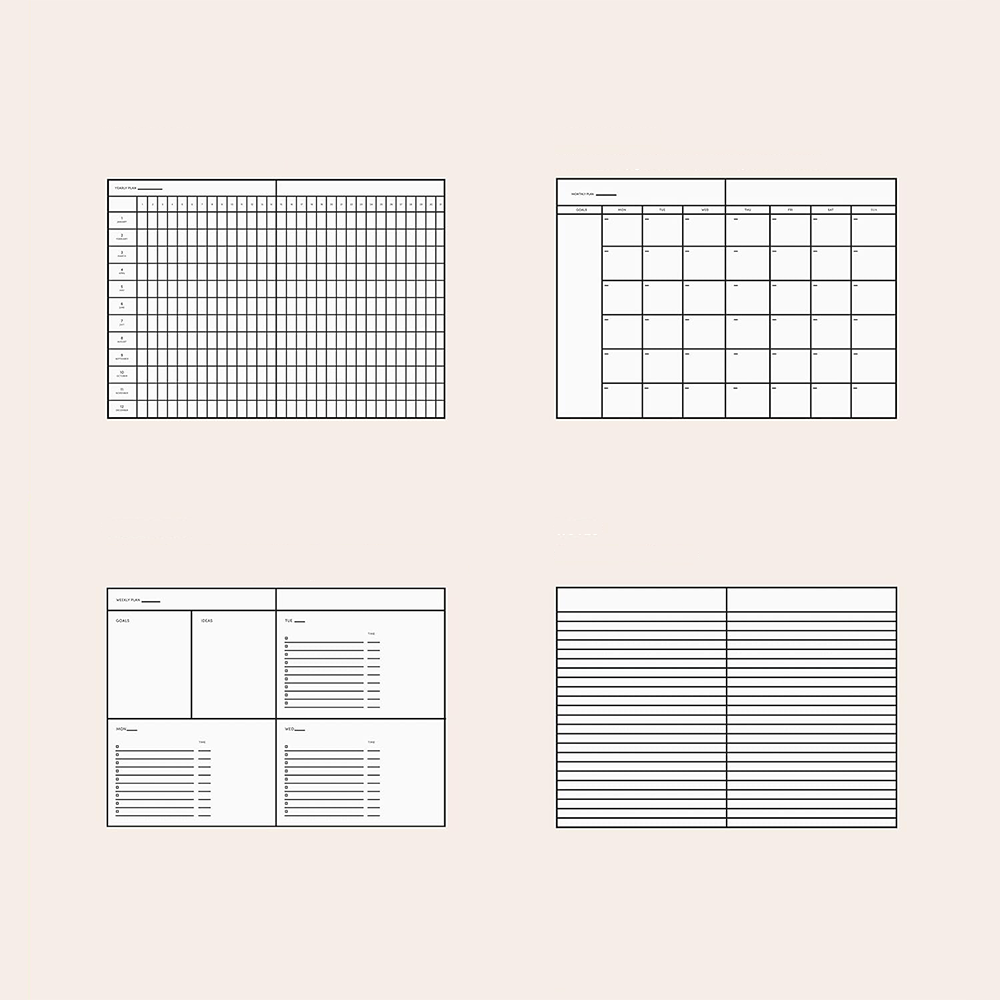
The interior photograph on this listing shows four two-page samples in one frame, each titled in printed caps. YEARLY PLAN is a 12-month by 31-day tracking grid with month names down the left and day numbers across the top: the whole year scannable in one spread for leave plans and deadline sweeps. MONTHLY PLAN is a seven-day by six-week calendar block with weekday headers and a full-height GOALS rail. WEEKLY PLAN stacks a GOALS / IDEAS / TODO band over two day-columns with circle checkboxes and TIME sub-rails. The fourth sample is a clean two-column ruled note page for meeting minutes.
One nuance this photograph settles: every plan header carries a short blank rule instead of a printed year or date. That makes the default stock open-dated: usable for fiscal years, school calendars, or odd start dates without reprinting, which is why it never dies on shelves in February. Pre-printed January-to-December 2027 dating, or a custom fiscal start like April, is a print-file change rather than a new tool, quoted on request against your layout proof, with artwork locked earlier because date grids cannot be edited after imposition.
The weekly spread deserves a closer read because it is where buyer opinions harden. The printed sample pairs a three-rail band for GOALS, IDEAS, and TODO over two day-columns, each with a vertical list of circle checkboxes and its own TIME sub-rail of short rules. Programs that plan by half-day want the checkbox density doubled and the day-columns widened; programs that journal rather than schedule ask for the opposite, trading rails for open rule space. All of that is layout-file work at proofing: your week-start convention, the number of checkbox rows, and whether the TO-DO rail even prints get fixed once, on one proof, before the run begins.
Page architecture across the set follows a sane planning rhythm: the yearly grid opens the book for horizon viewing, monthly spreads carry the operating calendar, weekly pages run the working week, and the two-column ruled notes absorb meeting minutes and overflow. Executive buyers ask for the ratio of planning pages to note pages more often than designers expect, and that ratio is a signature choice per design, priced the same as any layout swap. Ribbon marker, elastic closure, and pen loop travel with the build sheet rather than the layout, so a dated agenda and its open-dated twin can share hardware specs exactly and differ only on printed pages.
Cover and Hardware Built for a Wordmark
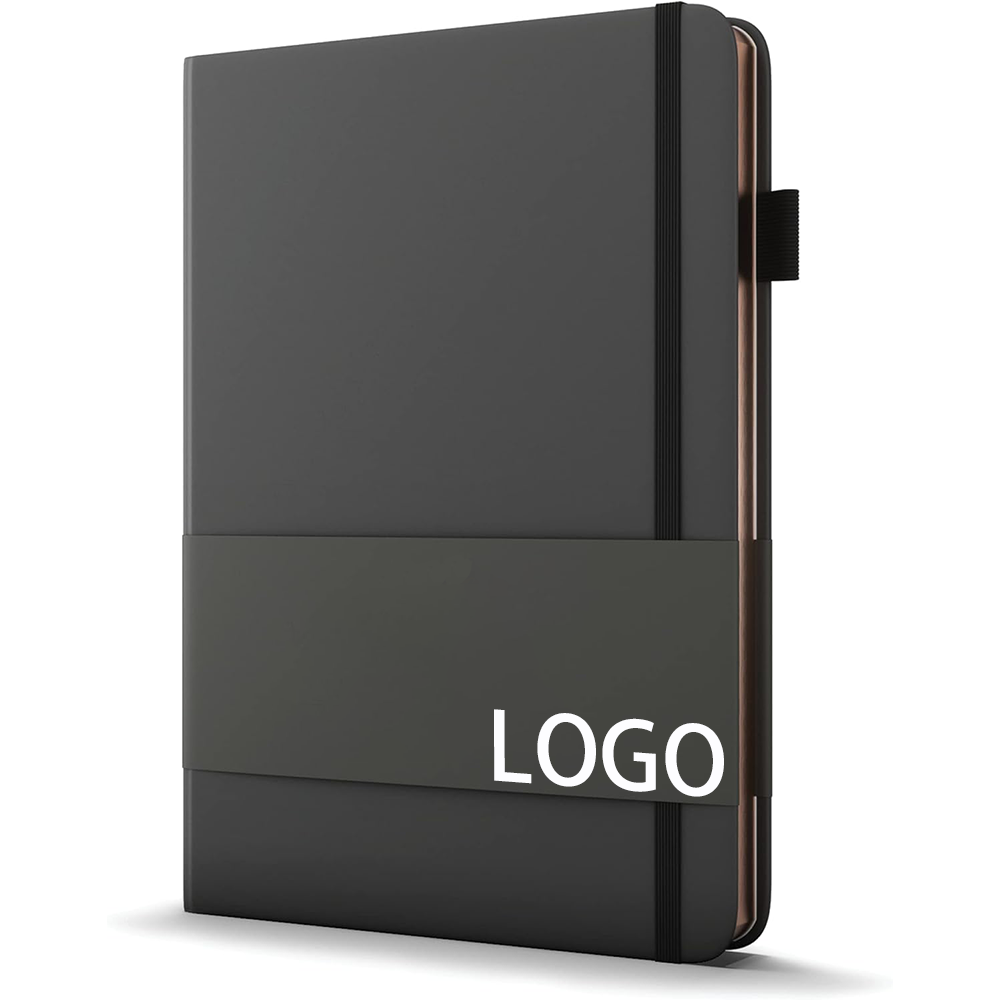
The cover shot shows a planner rendered as a branding canvas: matte charcoal hardcover with rounded corners, a black elastic band stretched vertically near the fore-edge, a second short elastic tab at the upper edge for a pen, and a copper-toned gilded fore-edge that catches light on a reception desk. The gray belly band reads only LOGO, a placeholder print zone, which is the honest way to photograph a product whose cover is yours to specify. Foil stamping or blind deboss replaces that band and the blank front in production; gold, silver, and matte-tone foils all hold well on fine-grain PU.
Two edge treatments are worth pricing separately: page-edge gilding as photographed reads luxury in board rooms and gift bags, while a plain fore-edge keeps unit cost down for bulk onboarding runs. Cover colors include the photographed charcoal with black hardware, a black variant shown in the lay-flat shot, and Pantone-matched PU quoted on request for corporate palette programs.
Calendar typography gets one proofing pass that journal text never needs. Month abbreviations, weekday headers, and printed date numerals must clear a legibility check at 100 percent size on the physical sample, because a 6-point header that reads on a screen becomes a squint across an executive desk in year two. If the agenda stock is for senior readers, ask for the next type size up in the header band; the grid geometry holds either way, and the fix costs nothing before imposition and everything after, when reprinting a date grid is not an option anyone wants to price.
Paper and Opening Geometry
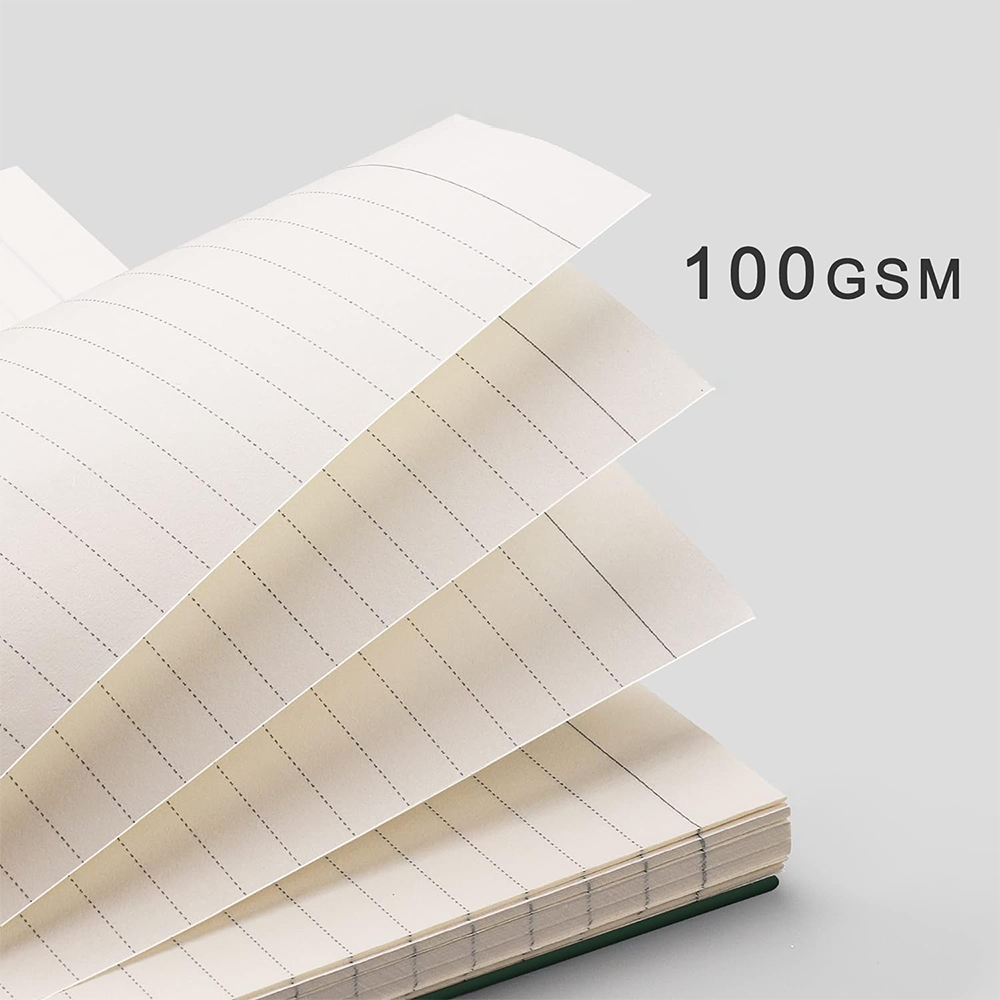
The paper photograph carries a printed 100GSM overlay over fanned cream sheets, ruling visible as an even dashed-line pattern, no margin rule, a warm matte surface, and a green cover strip under the sewn edge. That overlay is the only weight figure this page commits to for this build; alternate weights inside the standard 80-120 gsm band are quoted on request against a physical sheet, because agenda paper choices are really ink choices: gel and rollerball programs want the heavier end, pencil-and-ballpoint desk stock does fine lighter.
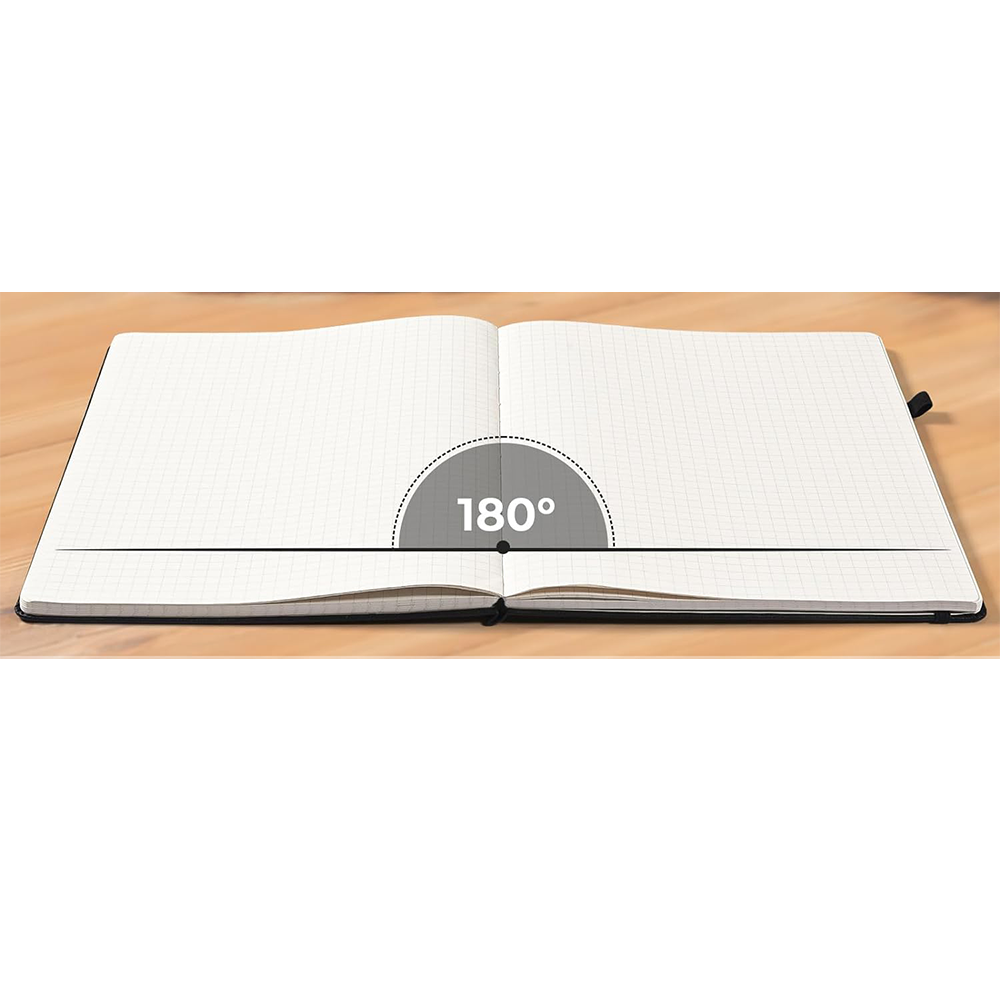
Opening geometry is the second engineered claim. The lay-flat photograph shows the book pressed completely open on a timber table with a 180-degree arc printed across the spine gutter, and the pages in that shot run a fine square-grid ruling with a black elastic loop at the fore-edge. Sewn section binding is what makes that angle possible: a planner that fights back closes itself mid-meeting, and executives notice within a week. Grid, ruled, and calendar formats all coexist in this family, so ruling per section is fixed at proofing, not assumed from a single image.
What You Can Specify
Before the checklist, one commercial framing note. Every line below is a print-file or component swap against the same cover tool, which is why the 100-piece floor per design stays believable for a mid-year executive run of three hundred books. The choices that genuinely move unit price are paper weight above the photographed 100 gsm, fore-edge gilding versus plain, foil versus deboss versus band print, and the step from banded units to individual gift boxes. A program that standardizes one charcoal cover, one layout file, and deboss-only marks sits on the lowest tier at any quantity; the moment January gifting wants gold foil, copper edges and two ribbon colors, the same floor applies per design and each design quotes separately. Lock all of it on one proof: cover, hardware, layout and box share a single sign-off so the ceremony calendar never waits on a second approval chain.
- Cover: matte PU leather in charcoal or black as photographed; Pantone matches on request; rounded corners
- Logo: foil stamp, blind deboss, or printed belly band replacing the LOGO placeholder shown
- Fore-edge: copper gilding as photographed, or plain edge for volume runs
- Interior formats: yearly grid, monthly calendar, weekly checklist spread, ruled notes, grid pages, in one book or as chosen singles
- Dating: open-dated fill-in headers as photographed; printed 2027 or custom fiscal-year dates quoted on request
- Paper: 100 gsm per the photographed overlay; 80-120 gsm alternates against sample
- Hardware: elastic closure band, pen loop, ribbon marker per build sheet
- Trim: planner-class hardcover formats with alternate sizes quoted on request
- Packaging: individual band or box; belly-band copy printed per program
Grid pages in that lay-flat photograph are a deliberate statement, not an accident of styling: the same shell family prints calendar, ruled, and graph interiors, so the 180-degree opening proof applies to whichever ruling your program chooses. A weekly planning spread that fights its own gutter is unusable in a conference room regardless of paper quality, which is why the arc in this image is quoted against the spread rather than treated as decoration.
Weight selection for agenda stock works backward from the pen drawer, not the paper catalog. Ballpoint executives and pencil planners write comfortably on the photographed 100 gsm sheet with margin to spare; gel-heavy teams want the same layout printed one step heavier because gel pools on lighter stock and the checkbox rails in a weekly spread turn into mud; fountain-pen cohorts need the sample tested in their exact ink before anyone signs. A five-minute decision at proofing saves a calendar-wide reprint argument in November, and the 3-5 day sample window is sized precisely for that five minutes.
Note-page ratio is the quiet customization in this family. The layout photograph pairs planning grids with a two-column ruled spread, and executive programs routinely ask for more note volume between months, or a dedicated project-notes block after the final quarter; both are imposition choices fixed on the layout proof. Contact pages, holiday lists, and habit trackers round out the optional section set, each printed in the same single-color rule as the core calendar so the book reads as one system rather than a patchwork.
Agenda Specification Summary
The table below restates the page’s confirmed figures in the one format procurement teams forward internally. Anything the photographs do not settle, trim variants and alternate sheet counts among them, stays marked quoted on request instead of inheriting a number from a neighboring listing.
| Item | Custom logo leather planner and agenda notebook, calendar-interior corporate gifting |
| Size | Planner-class hardcover trim per chosen shell; alternate sizes quoted on request |
| Paper & Ruling | 100 gsm per photographed spec overlay; layouts as printed: YEARLY PLAN, MONTHLY PLAN, WEEKLY PLAN, ruled and grid note pages; open-dated headers standard, pre-printed dates optional |
| Cover | Matte charcoal or black PU leather hardcover, rounded corners, LOGO print zone on belly band as placeholder |
| Binding | Sewn, 180-degree lay-flat opening per photographed arc; elastic closure and pen loop hardware |
| Logo & Finish | Foil stamp, blind deboss, or band print; copper-gilded or plain fore-edge |
| Packing | Individual band or gift box, inner packs, five-layer export cartons; FBA labeling available |
| MOQ | 100 pcs per design |
| Sample time | 3-5 days |
| Lead time | 7-15 days after artwork approval |
| Capacity | 1,000,000 pcs per month across our gift lines |
Counting Backwards from January First
Dated stock is the only stationery category where the calendar genuinely owns you. Work the chain: freight from port to deskside, then 7-15 days of production after artwork approval, then 3-5 days for the signed physical sample, then internal logo approvals nobody budgets for. A December 15 delivery target means artwork approval by mid-November at the latest on air, and by late October on sea. Open-dated interiors relax that chain because they stay sellable all year, which is why many programs split: a small dated executive run, a larger open-dated field-force run off the same cover tool.
Fiscal-year buyers get the mirror of the same logic: an April-start planning cycle ships best in Q1, a September academic agenda in Q2, and none of those dates change the production terms, only the proof deadline. Capacity across our gift lines is 1,000,000 pcs per month, so Q4 surge orders slot into the same lines that run journal programs all year without a re-qualification meeting.
Packing, Freight, and FBA
Agendas ship individually banded or boxed, into inner cartons at fixed counts per SKU, then five-layer export cases built for holiday-season transshipment. Freight moves by sea for program volume, by air or courier (DHL, UPS, FedEx, TNT) for award deadlines and top-ups. FBA prep with barcode labels and carton compliance is done in-house for resellers whose Q4 replenishment windows cannot absorb a third-party touch.

Questions Executive-Gift and Program Buyers Ask
Does this planner ship with 2027 dates already printed?
Which weekly layout does this build use? I need Thursday starts.
Will the cover foil survive being carried daily for a year?
Can one PO mix dated and open-dated quantities?
How thick is the paper, and does fountain-pen ink ghost through?
What does 1,000 units cost for a January program?
Neighboring Pages for One Gift File
Programs that land here usually need the undated sibling next: the faux leather journal notebook carries the ruled, non-calendar anatomy for onboarding kits. Field and hospitality runs pair with the PU leather travel folio, and ceremony awards move to the boxed journal-and-pen gift set. Browse the wider notebook category, then file specs at the quote desk.
Lock the Logo, Then the Calendar
Send the wordmark file, cover color, and layout selection to [email protected] or +86-15967739086. The digital mock-up is free, the physical sample follows in 3-5 days, and the Q4 calendar stops being a crisis when the proof cycle is this short.