

Custom Photo Booth Props Sets | Bulk Curated Kit Boards
$1.20
Curated prop boards built from one artwork system: novelty eyewear, skewered speech bubbles, hats, masks, costume silhouettes and a decorated selfie frame in black-and-gold, holographic or pastel foil. Boards are quoted around your guest count and room behavior – which pieces get worn, held, framed or posed – instead of catalog SKUs, so a single approval, sample round and carton plan cover the whole kit. Year strings on our photographed boards are past sample artwork, not promised seasons. Every distinct shape carries its own 100 pcs per design floor, spares ratios can be built into rental crates, and sets ship assembled or flat-packed. Samples in 3-5 days, bulk in 7-15 days after artwork approval, kit boxes or bulk cartons with FBA prep available.
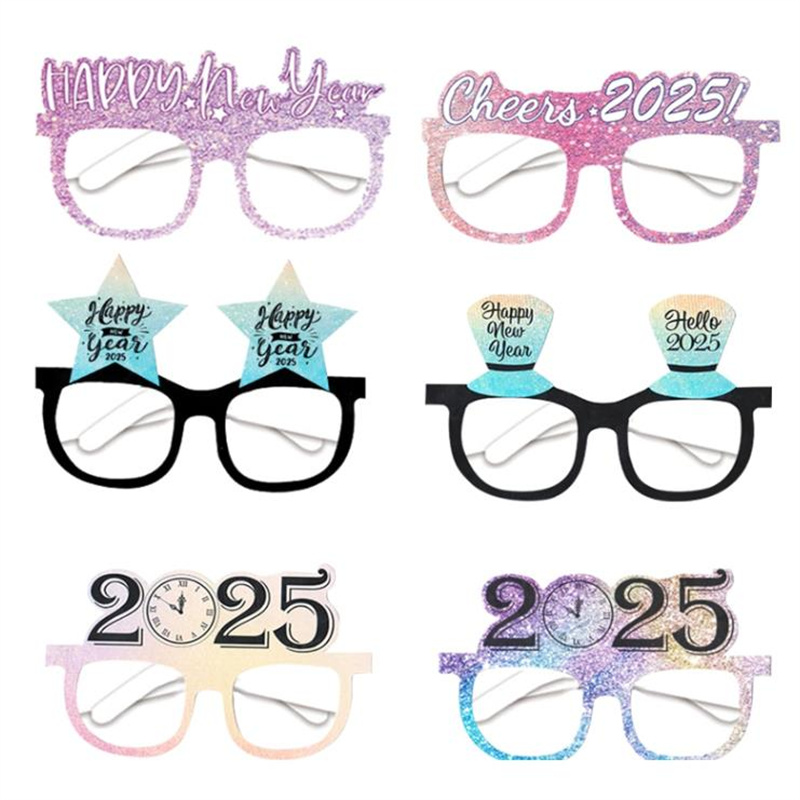
Buying custom photo booth props sets in bulk makes sense when one artwork system can put eyewear, speech bubbles, hats and masks on the same table without four separate proofs and four separate minimums. That is the logic of this line: boards are curated for guest counts, not for individual SKUs. The sample below fans novelty glasses across a printed greeting – flat die-cut fronts with script wordmarks, star and top-hat toppers, clock-face numerals where the zero shows a dial at midnight. Years visible on every photographed board are artwork from past sample runs; the set you approve carries your wording, your palette and your count.
Why boards, not singles, are the planner’s unit
An event planner quoting a gala does not price one pair of glasses; she prices the room. That means a prop plan per table or per headcount, and the paperwork follows: one artwork file covering the palette, one sample round, one delivery window, one carton count that a venue dock can actually receive. A curated board built from a single design system solves all four at once. Eyewear for the wearables, skewered bubbles and arrows for the handheld crowd, a hat or mask silhouette for the shy guests who still want in the photo – one file family, mixed formats, one invoice.
The set MOQ is still counted per design, not per board: 100 pcs per design, so a twelve-element curated board with four eyewear shapes, four bubble captions and four silhouette props clears the floor at 1,200 pieces total, or fewer pieces if formats repeat across the board. Planners who want one board per table at twenty tables should start the conversation at design consolidation – how few shapes cover the room – and let us price the result in the 100-piece band before a design wishlist doubles the artwork count.
Curating a board that survives the night
Boards fail in practice for two reasons: everything wearable, or everything handheld. A table where half the props are glasses and half are skewered signs keeps working because guests sort themselves – the drink-holder grabs a bubble, the couple grabs a pair of frames. The fanned board above is built the same way: script-letter frames, twin star and twin hat topper pairs, and two countdown designs where the year’s zero becomes a clock face. Add the skewered bubble families shown on our stick-prop page and the same art direction stretches across a whole room kit without a second palette.
Balance by behavior beats balance by visual. Count out your board in guest verbs – wear, hold, frame, pose – and one design per verb is usually enough. Depth then comes from colorways of the same die rather than new dies: the fanned board above cuts the clock-numeral layout twice, once in pastel gradient and once in holographic sparkle – one artwork, two shelf SKUs.
What the second board adds: wearables around an eyewear anchor
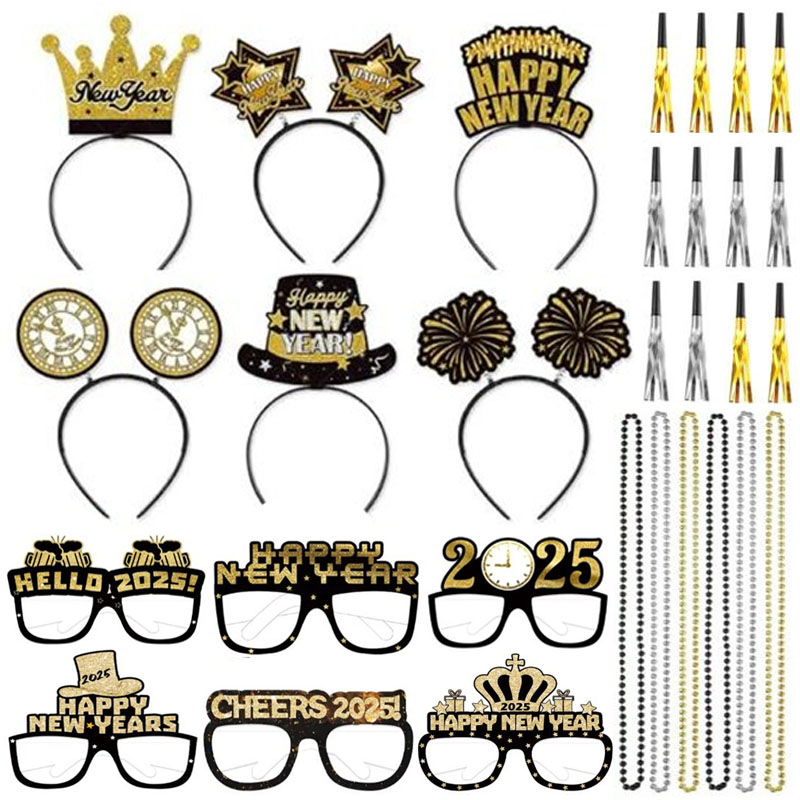
The black-and-gold display packs six glasses designs into two bottom rows and lets the sample styling surround them with band-mounted silhouettes – a glitter crown, paired stars, paired midnight dials, a top hat – plus loose tinsel clip-ins and faceted bead strands. Read it as a kit blueprint rather than a bill of materials: a venue program that runs one anchor eyewear style deep and borrows the neighboring wearable silhouettes off the same foil palette gives guests a full dress-up station from a modest piece count. Headbands, clip-ins and strands are not assumed components of any quote we issue on this page – they are photographed proof of what one art system can extend into when you ask.
The thirty-piece board: a full kit photographed
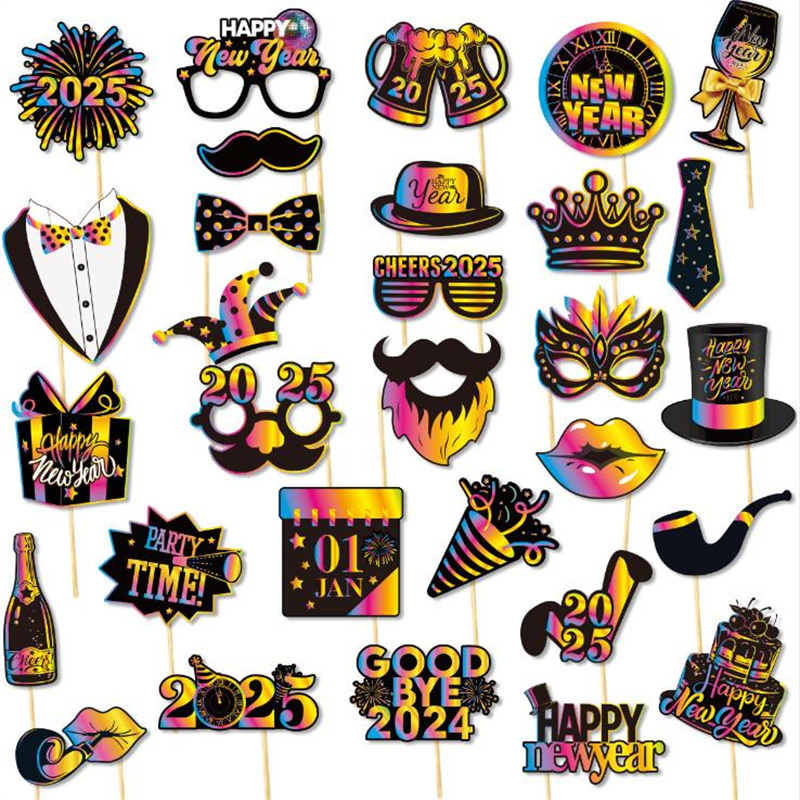
The holographic board below is the closest thing to a complete venue kit in one frame: around thirty skewered die-cuts laid in five rows, mixing eyewear shapes – shutter shades, numeral spectacles, a mask silhouette – with costume silhouettes (tuxedo front, bow tie, necktie, jester hat, top hats, mustache and beard, pipe) and countdown furniture (firework burst, clinking steins, a calendar page, a party popper, a two-tier cake, gift box, lips and a bye-and-hello year pair). The foil runs a shifting rainbow gradient against solid black shapes, and the wording on each piece – greetings, Cheers, a PARTY TIME burst – is sample art from a past run.
Buying a board like this works best as a subtraction exercise. Start from the full photographed spread, remove everything that does not match your event register, and keep the pieces that pass in multiples. A corporate gala might keep six shapes at three pieces each; a venue stocking a rental crate keeps twenty shapes and accepts that the crate photographs messy, which is exactly the point of a rental crate. The artwork system holds because every element shares one foil file, so a cut-down board costs nothing extra in design fees. Rental programs in particular should weight the subtraction toward wordless silhouettes – hats, masks, facial hair, drink shapes – because nothing in that group carries wording that expires the crate, and a board built this way stays sellable across school years, anniversaries and corporate cycles without touching a single die.
Two construction notes matter before any quote gets signed on a board this wide. First, the skewered pieces on the photographed spread are single-face: the reverse is plain card, and doubling the print onto the back is a per-design decision, not a free default, so price it only where guests will see both sides – a hosted photo wall, not a crate refill. Second, mixed-shape boards ship as assembled sets when the kit is the product and flat-packed when volume is the product. A venue selling prop time per guest at the door wants assembled; a distributor filling thirty crates wants faces and dowels in separate blocks and an assembly sheet in the carton. The same artwork drives both packouts, which is exactly what a one-system set should buy you. One further decision worth making at mock-up stage is stick length per shape: the numerals and steins on this board read small in plan view but photograph huge once a guest holds them at arm distance, while costume silhouettes held at chest height shrink in the frame – so set dowel lengths by how the shape gets posed, not by uniform convention, and the board’s photos improve at zero print cost.
Kit math by guest count and room type
Three reference points cover most planner conversations. A seated dinner for sixty with props at every place setting needs one eyewear unit per guest plus a shared skewered board per two tables – the wearable quantity drives the order, and the shared boards are the upsell. A standing cocktail room of one-fifty with one hosted prop table fills better from a single forty-piece board refilled twice than from forty pieces per guest; attrition into coat pockets, not guest shyness, sets the number. A photo-corner at a wedding – ninety guests, ninety minutes – runs comfortably on one mixed board plus one wearable set sized for heads counted by the caterer.
Convert those scenarios into piece counts before asking for a quote, and the design mix will already be half-decided. We price the 100-piece floor per shape first so the cost of breadth versus depth is visible in the same line item; a board of eight designs at 100 and a board of three at 300 can land within a few percent of each other, and only your room behavior picks between them.
Options you control per set
- Element mix: eyewear, skewered bubbles, silhouette props and frame pieces in one board, your verb balance
- Foil palette: black-and-gold, holographic rainbow, pastel gradient, or a color break matched to the event
- Pieces per board and designs per board, with spares ratio built in for rental crates
- Wording on every caption piece: your greeting, venue name, corporate line or countdown numeral
- Assembly: props glued to sticks for grab-and-go crates, or flat faces plus bundled dowels for local assembly
- Retail packs: shrink-wrapped kit boxes with a header card for shelf, or plain bulk cartons for warehouses
- FBA: barcoded kit units, polybagged per set, at your carton count
Specification summary
| Item | Curated photo-booth prop set boards (mixed eyewear + skewered props) |
| Size | No dimensions printed on boards; per-element sizes quoted against your target |
| Stock & Finish | Die-cut printed card fronts, glitter or holographic foil effects as photographed, clear plastic lens inserts on eyewear, wooden dowel sticks on skewered pieces; stock options quoted on request |
| Cutting | Per-design die-cut shapes with raised toppers; laid out on boards or flat-packed per kit |
| Printing & Artwork | One coordinated artwork system per set; free digital mock-up before production |
| Packing | Kit boxes, header-card retail packs or bulk cartons; pallets for container loads |
| MOQ | 100 pcs per design |
| Sample time | 3-5 days |
| Lead time | 7-15 days after artwork approval |
| Capacity | 1,000,000 pcs per month across our gift lines |
Seasonal refresh without re-tooling
Set boards age one layer at a time. The dies – the frame silhouettes, the bubble outlines, the hat shapes – are reusable indefinitely, while the caption layer (a year string, a greeting, an event name) is what should change each season. Photographed boards make this visible: a bye-year sign and a hello-year sign sit six inches apart in the same holographic file, because the countdown market prints both in one release and sells them in the same kit.
For buyers, that structure cuts the second order sharply. Season one pays for the full curated system; season two swaps wording files, keeps the layout approved, and runs to the same physical sizes. Sample verification stays fast because only the changed files print: 3-5 days back to your desk, bulk 7-15 days after approval. Capacity across the gift lines at 1,000,000 pcs per month means a countdown-season wave of kit orders does not stretch the window, provided the artwork signs off while the production calendar still has room – which, on ocean freight, is months before the shelf date, not weeks.
The close-up: how sets merchandise beside greeting stock
The final board shows the black-and-gold countdown set the other way – tight rather than fanned: skewered bubbles with marquee-dot borders, a firework roundel, a champagne bottle, an arrow sign, hats, a cake, a gift box, and a large decorated selfie frame whose border carries bunting, balloons, stars and a Roman-numeral clock, all printed against a matching best-wishes card face. This is the retail-adjacent view. Party stores that stock greeting cards and gift wrap can carry a kit box in the same aisle because the artwork registers already match their wall; venues buy the same board as a standing decoration between booked events, since the frame piece photographs as set dressing even with no guests holding it.
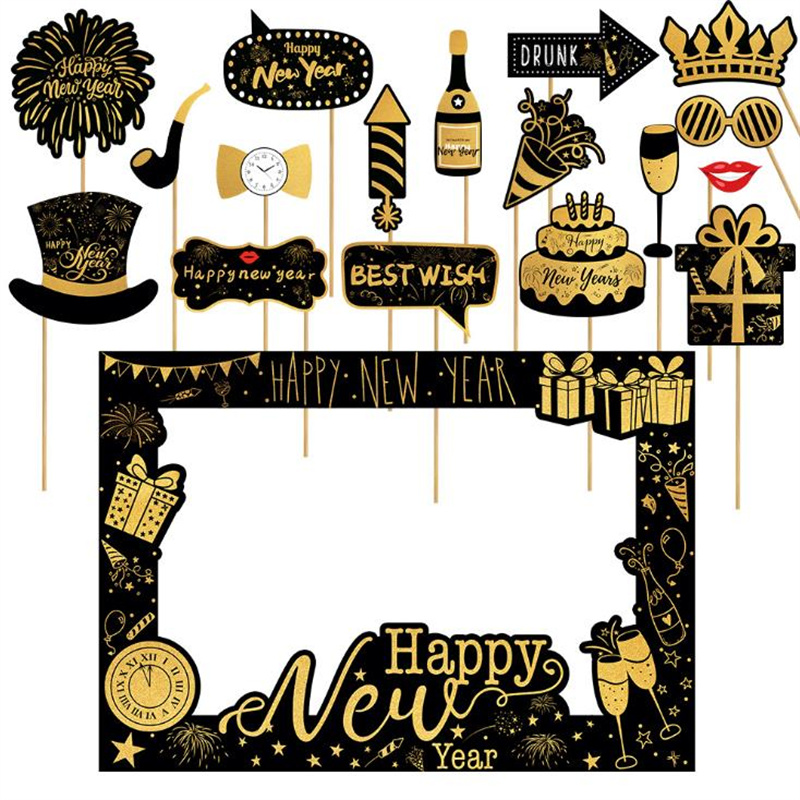
Two cautions carry into any board purchase. First, photograph the whole board before you cut the design list: pieces that read boldly at arm’s length – solid stars, full black lips, a crown outline – survive being held at distance; dense paragraph captions vanish in the final image, so keep one or two per board, not ten. Second, settle stick lengths at mock-up. A dowel cut too short forces guests to hold signs under their chins, and no foil finish saves the composition afterward.
Packing and shipping for mixed kits
Kit boxes ship one assembled set per box, nested face-to-face with divider sheets so foil edges stay clean, sticks bundled parallel so tips do not bruise neighbors. Flat-pack programs carton faces in design blocks with dowels banded separately, cutting bulk for couriers and letting an on-site team assemble during setup – a pattern venues like because assembly doubles as an activity for the pre-event crew. Ocean moves palletize the same cartons; express lanes – DHL, UPS, FedEx, TNT – handle the late-season kit wave when a room books with three weeks’ notice. FBA kit units get barcode-and-bag prep at your SKU count before the box seals, and carton marks follow one standard across channels so your receiving dock never opens a master to identify a set.
Send the room plan with the artwork: guest count, seated or standing, one hosted table or place-setting fill, retail shelf or rental crate. The mock-up comes back with a board layout, a per-design piece count and the 100-piece reference band already attached to it.
For agencies and corporate accounts buying boards as branded giveaways, one more configuration pays for itself: leave one or two caption designs as pure logo placements – the crown silhouette with your event mark instead of a greeting, the frame border carrying your sponsor line where the photographed sample shows a countdown word. Because those designs still ride the approved board palette, nothing on the print plate changes except the wording layer, and the giveaway photographs inside the venue for a full year of social posts. That is the difference between a prop board as cost and a prop board as media, and it is decided at the same mock-up stage as everything else. The set pages in the catalog list adjacent formats so a planner can quote the whole room – hand, face and wall – from one conversation rather than three supplier briefs, and the RFQ desk replies with per-design bands so the breadth-versus-depth call is made on numbers your finance team can audit.

Set-buying questions, answered
Does a set count as one design for the minimum order?
Can we copy one of your photographed boards exactly?
How far ahead should a venue order countdown-season kits?
Do you mix stick props and eyewear in one shipment?
What file do we need to provide before a mock-up?
Can kit boxes carry our own retail branding?
Related lines for a complete room
Set boards sit between two single-format pages in the catalog: photo booth props with sticks for handheld sign-only crates and novelty glasses props when the program is purely wearable favors. Full-room programs usually add the birthday decoration suite so wall, table and hand levels match. The party items category and the wider printed items range show adjacent formats, and the RFQ desk prices any board from your guest count in one reply.
Send the count, not the catalog number. A curated board quoted around a real room beats a stock set discounted into a drawer.


