Custom Photo Booth Props with Sticks | Bulk Party Kits
$1.20
Die-cut graduation and event signs on wooden dowel sticks, laid out as forty-piece photo-booth boards: speech bubbles, superlative arrows, mustache and lips silhouettes, mortarboards, diplomas and number-one badges in black-and-gold print. Years printed on our photographed sample boards are artwork references from past runs, not commitments – your own wording, palette and target sizes go onto a free digital mock-up before anything is cut. The minimum order is 100 pcs per design, so rental crates, school photo corners and venue fleets can reorder single hit captions without rebuying a whole board. Samples return in 3-5 days, bulk production runs 7-15 days after artwork approval, and flat-carton export packing with FBA prep covers shelf and fulfillment channels alike.
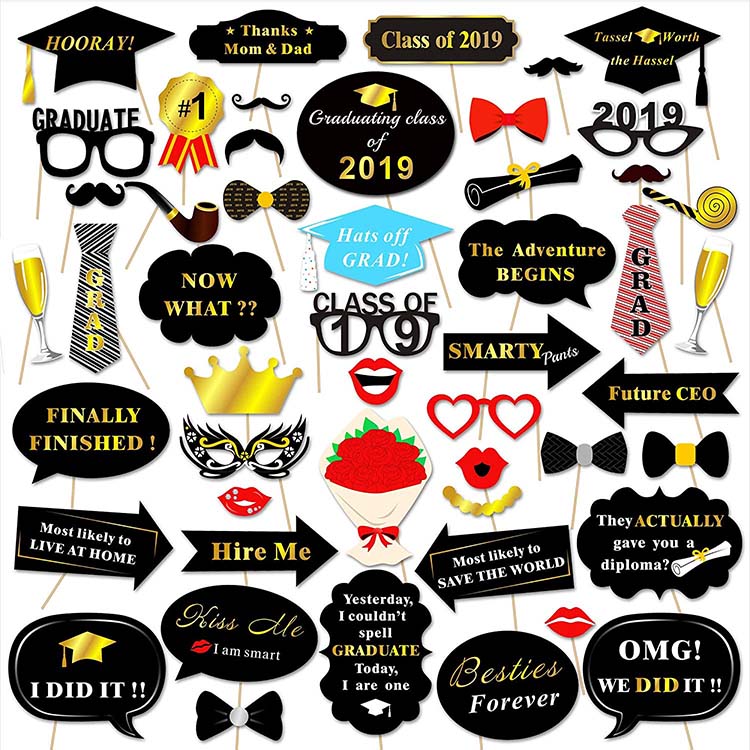
Custom photo booth props with sticks are the quickest way to stock a graduation booth, a school photo corner or an event rental crate without carrying inventory risk. Alice Gifts die-cuts each sign from printed card, mounts it on a thin natural-wood dowel, and lays finished props out as multi-piece boards like the photographed sheet below. The sample artwork runs a black-and-gold graduation register: speech bubbles reading HOORAY and FINALLY FINISHED, arrow signs reading Future CEO and Hire Me, plus wordless accessory silhouettes – handlebar mustaches, bow ties, mortarboards, rolled diplomas, heart-shaped glasses, lips, a pair of champagne flutes. Any year printed on these boards is a photographed sample reference, not a delivery commitment: your order carries your own wording, class year and colors, approved on a free digital mock-up before anything is cut.
What the photographed sheets prove about construction
Two things are verifiable straight from these images, and both matter when you are comparing suppliers instead of slogans. First, every piece is a flat die-cut with a printed white keyline edge and a drop-shadow graphic, glued to a round wooden stick that extends below the sign face – the classic lollipop-handle format a guest holds up beside their shoulder for the camera. The print itself is flat vector artwork: solid fills, script and block capitals, with the gold treated as a metallic-look ink gradient. There is no dimensional hardware, no fabric, no plastic molding in the photographed line, which keeps freight light and damaged-unit replacement cheap.
Second, no dimension is printed anywhere on the sheet or the close-up frames, so sign height, stick length and pieces-per-board are quoted against your target rather than fixed to a catalog number. If you need a five-inch bubble for a teen photo corner or a small rosette that sits flat on a gift table, send the measurement and the mock-up reflects it before tooling. Stock options beyond the photographed card – heavier board, coated or uncoated face, matte or gloss varnish – are likewise quoted on request, because guessing paper weights wastes everyone’s sample round.
Design families that fill one prop crate
The graduation sample line splits into four working families, and a balanced crate pulls from all four. Bubble signs carry the jokes: NOW WHAT??, The Adventure BEGINS, Kiss Me I Am Smart. Superlative arrows carry the roast material – Most Likely to Live at Home, Most Likely to Save the World – and aspirational versions like Hire Me and Future CEO. Accessory silhouettes (mustache, lips, bow tie, thick-rim glasses, masquerade mask, crown, pipe) are wordless, which makes them gender-neutral and age-proof for mixed crowds. Achievement motifs – mortarboard with tassel, diploma scroll tied in ribbon, the number-one medal with twin tails, a pinstriped GRAD necktie – anchor the ceremony angle for schools and family open houses. A board stacked with bubbles only reads flat by photo twenty; a board with the four families represented keeps getting picked up.
The five-piece detail shot below pulls out the premium end of the same artwork file: an ornate bracket-corner plaque, an oval class sign, a rolled diploma scroll, a bouquet of red roses in a cream cone, and a scalloped speech bubble, each on its own dowel. Venues use configurations like this as table displays for a head-table or sweetheart’s corner rather than guest grab-boxes, and the mix of typographic and pictorial pieces photographs well standing still.

Stick economics: breakage, reuse and reorder math
For an operator, the real unit cost of a prop is not the purchase price – it is how many events a board survives before it photographs badly. The sticks in these images are thin round dowels, the same stock used for lollipop handles: light, flat-shipping, and replaceable. Card faces take corner wear first; after a season of double-header nights, expect lifted corners and glue-point fatigue rather than ink failure. Two levers keep the math sane. You can build a spares ratio into the pack – one extra piece in six as loose replacements – so the board stays full on the night without emergency printing. And because the minimum order is 100 pcs per design, a hit caption or a standard mustache shape can be reordered alone without re-buying the whole crate.
Rental fleets that standardize on two or three core boards per contract year hold artwork cost flat and pay only for attrition. Franchise photo-corner programs do the reverse: identical artwork across locations so a replacement board bought in March matches the signage shipped last September. Both patterns work from the same base file; neither requires you to guess volumes up front, since each design clears the 100-piece floor independently.
Kit math: pieces per booth, boards per guest count
The photographed sheet shows a board of roughly forty-five pieces, and that band – forty to fifty props across eight to twelve designs – covers a two-hour booth serving eighty to one hundred and twenty guests at roughly one prop per photo with light duplication. A single school photo corner for a graduating class of sixty typically splits two mixed boards plus one spare design weighted to the cap-and-gown families. High-churn setups at carnivals or mall booths should plan a second board for the back half of the evening, when pieces leave the room inside jackets.
Before committing to a wide board, price the curve. Ask for the 100-piece reference band per design, then the 300 and 500 bands on the same artwork; the per-piece movement tells you whether fifteen designs at 100 each is worth it or whether three designs at 500 each serves the crate better. Combination questions resolve the same way: MOQ counts designs, not boards, so any combination that keeps every design at or above 100 pieces passes.
What you can customize
- Caption wording: replace all sample bubbles and arrows with your own jokes, class year, school name or brand line
- Colorway: black-and-gold as photographed, or any print palette you supply
- Sign height and stick length against your target dimension
- Board composition: pieces-per-board and design mix, including a spares ratio
- Cutting style per your packout: loose pieces on boards, flat-packed in design blocks, or assembled-in-carton
- Backing print or plain reverse, quoted on request
- Retail header-card packs or plain bulk cartons, sized for shelf display
- FBA prep: unit barcodes, polybag options, shelf-ready box counts
Specification summary
| Item | Photo-booth props on sticks, graduation/event line |
| Size | No dimensions printed on samples; sign height and stick length quoted against your target |
| Stock & Finish | Printed card faces, flat vector graphics with metallic-look gold print as photographed; stock options quoted on request |
| Cutting | Die-cut sign shapes with printed keyline border; sheet or board layout per packout |
| Printing & Artwork | Full-color digital print; free mock-up on your artwork before production |
| Packing | Flat cartons with divider sheets; retail box or header-card options; pallets for container loads |
| MOQ | 100 pcs per design |
| Sample time | 3-5 days |
| Lead time | 7-15 days after artwork approval |
| Capacity | 1,000,000 pcs per month across our gift lines |
Grad-season timing: samples, approval, freight
Graduation demand is front-loaded. Campus ceremonies cluster in late spring, and boards need to be in an office, a venue locker or a retail back room before the first tassel photo. Working backward from that shelf date: 3-5 days for samples once artwork files are usable, 7-15 days of bulk production after approval, then transit. Ocean freight from a finished carton can eat eight weeks comfortably, which is why fleet buyers release summer boards in deep winter. Courier lanes – DHL, UPS, FedEx, TNT – cover the late school order and the mid-season replacement wave in days, and the per-carton weight makes express viable exactly when it matters.
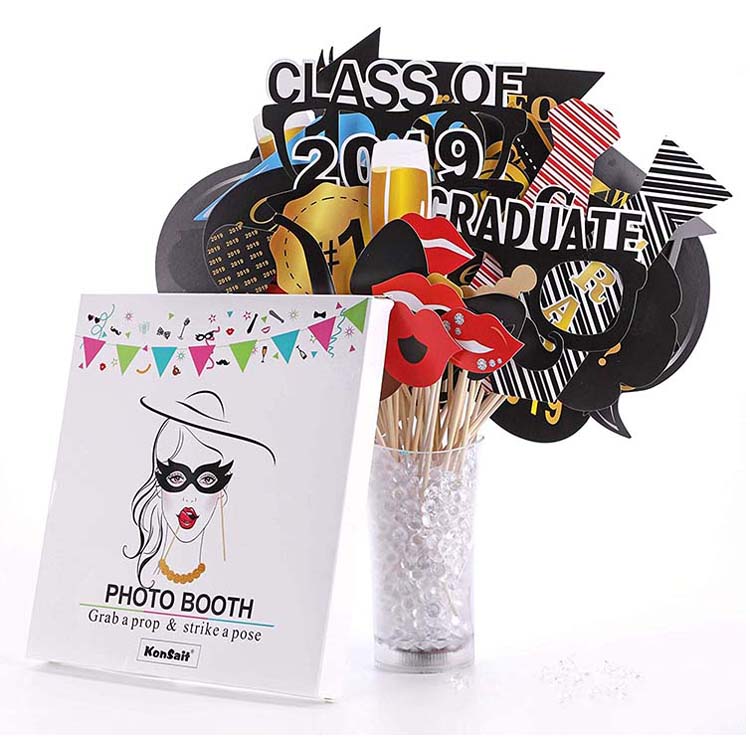
The vase-and-box display photographed below shows the merchandising logic between ceremonies: props bundled sticks-down in a fill-bead vase keep the board upright, visible and grabbable, and the same bundle drops back into its carton for transport. The sample box sitting beside the vase is staging from the photographed reference, not our packaging design.
Reuse, wear and storage between events
Flat storage inside the original carton, out of direct sun, is all the lineup photographed here asks for. Color holds because the print is on sealed flat card rather than fabric, and the five-piece set below keeps its register through repeated pack-downs provided the sticks stay bundled so dowel tips do not punch neighboring faces. The failure points are mechanical: corners and glue spots. A rubber-banded spare stick sleeve per board costs almost nothing and buys a season of repair headroom before a reorder is needed.
This is also where the wordless accessory families earn their shelf space. A mustache or pair of lips photographs correctly at any school, in any palette, and carries no year string that dates the board – so the pieces that survive longest in a rental crate are usually the ones that needed no copywriting at all. The same logic applies to reorder planning: a caption that names a specific class year sells its whole value in one weekend, while a black handlebar silhouette is still correct on the shelf eighteen months later. Buyers who split their design count deliberately – say six dated captions and six evergreen silhouettes in one production release – find that the evergreen half of the order absorbs the attrition and lets the dated half retire cleanly at season’s end, with no remainder liquidation needed.
Storage discipline is where most first-season fleets quietly lose inventory. Loose props thrown into a shared tote snap their dowels against each other, and the card corners on the bubble signs chip before the artwork ever fades. The configuration photographed below – a compact five-piece set with a blue mortarboard sign, a pair of clinking champagne flutes, black rimmed glasses, red lips and a gold number-one badge – shows the packing logic that avoids that damage: pieces flat, sticks parallel, no crossing angles, divider paper between layers. Operators who repack boards the way they arrive get a second season out of the same set without a replacement order, and retailers who restock from a flat carton rather than an upright tote stop losing sales to shelf damage. That five-piece format also doubles as a table display between photo sessions: one sign per graduate at the head table, returned to the carton at teardown, with no single-use waste either way. Schools ordering for a photo corner should also budget one spare of the three most-claimed shapes per board – the number-one badge, the lips and the cap sign disappear into backpacks faster than any bubble caption – and price that overlap against a replacement design at the 100-piece floor before adding a whole second board to the order.

Packing and shipping
Standard export packing is flat cartons with divider sheets between board layers, inner shrink wrap optional, outer cartons stacked on pallets for container loads. Retail programs switch to header-card packs or closed boxes sized for shelf display, and FBA prep with barcoded unit labels and single-piece polybags is routine across our printed party lines. Freight moves by sea, air or express courier – DHL, UPS, FedEx, TNT – against your forwarder or ours, and monthly capacity across the gift lines runs to 1,000,000 pcs, so a mid-window graduation reorder does not queue behind unrelated jobs. The packing reference below covers carton, pallet and courier configurations.
Two packing decisions specific to stick props move your landed cost more than most buyers expect. The first is whether dowels ship assembled or loose: assembled boards are heavier per carton at the freight quote but skip an assembly labor line at your warehouse, while flat-packed faces and bundled sticks cut down carton bulk and let a local team or a school volunteer crew do the gluing during the off-week. We quote both configurations off the same die so the arithmetic is visible before you commit. The second is carton count per school or venue on multi-stop drops. Event buyers shipping to several campuses in one week routinely ask us to pack to-route – each inner carton pre-labelled for its destination building – which turns one container receipt into five shelf-ready deliveries without a sort station. Neither option changes the printed goods themselves; both change what happens after the pallet lands, which is where graduation-season budgets usually leak. Confirm your destination mix and drop sequence with the artwork, and the mock-up round comes back with a carton plan already attached.
One more variable worth settling before the first pallet leaves: color-management expectations across reorder waves. Card faces printed in different runs draw their golds and blacks from separate ink batches, and the variance between a March board and a September board is real even when both match the approved physical sample you hold. Event fleets that mix boards across years should order the full crate in one release and hold stock flat in a dry room; brand programs that must match house color precisely should approve a physical proofed sheet, not a screen mock-up, and keep that signed reference for every season’s batch. Both paths are quoted the same way; the difference is whether your receiving check compares against a sample you keep or a tolerance you accept. Raising this at mock-up stage costs nothing and avoids the one argument no printed-goods buyer wins after cartons are sealed.

Questions buyers ask before the first order
Are the wooden sticks included with the printed signs?
What do the year marks on your sample boards mean for my order?
How do mixed designs work against the minimum order?
Can we reorder last year’s artwork with only the year changed?
Do you handle Amazon FBA prep for prop boards?
Related print and party lines
Photo-booth stick props share tables with several formats that pull different crowd behavior: wearable novelty glasses props for per-head favors, curated prop set boards for full-room kits, and birthday decoration sets when the same client books beyond the graduation season. The wider party items range and the printed items catalog show what else runs off similar artwork files, and the quote desk turns any of them around a spec sheet in one exchange.
Send the artwork – even a caption list is enough to start. A free digital mock-up comes back with board configuration and the 100-piece-per-design reference band, and your graduation crate is on a sample timeline within the week.