Custom Drawstring Bags With Logo | Cinch Bulk
$0.35
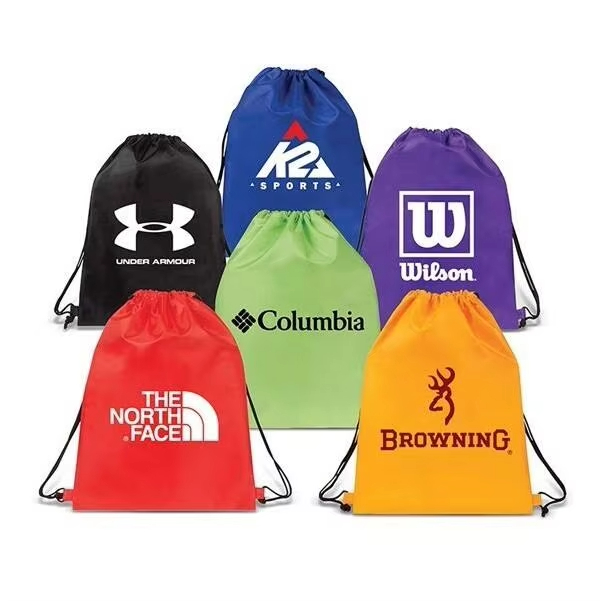
Season-scale squad carry: custom drawstring bags with logo for clubs, schools and district sports days. One round braided cord runs the hemmed neck casing, doubles down the side seams through silver-toned eyelets and locks with plastic toggles to become the shoulder straps – no zip, no flap, nothing to babysit between drills. Six shell colourways photographed – black, red, royal blue, lime, violet, amber – on a constant black cord harness, with the crest sitting in the centred mid-panel print zone that stays flat while the neck gathers. Sample artwork shown on the photographs belongs to its owners and is never reproduced; your own file only. MOQ 100 pcs per design, colours mix inside one design, 3-5 day sample, 7-15 days bulk after artwork approval, colour-coded cartons and FBA prep for online club shops.
Kit Day, Multiplied: Custom Drawstring Bags With Logo for Clubs and Schools
A squad of thirty turns up for pre-season wanting one thing on their shoulder: custom drawstring bags with logo that cost nothing to babysit – no zip to jam, no flap to lose, nothing to remember before drills. The cinch sack answers because it is a single panel, a single cord and a pair of eyelets, which is exactly the construction the photographs on this page show across six shell colours. It swallows shin pads and a change of clothes, cinches shut in one motion, and hangs by its own cord on any hook a locker room owns.
The shells are smooth, thin, lightly glossy synthetic cloth – the classic promotional sack face – sewn into a flat single-compartment pouch with topstitched sides, a hemmed channel across the mouth, and reinforced cord tabs or metal eyelets at the base corners. Nothing printed anywhere on the photographed product names a fabric or states a size, so fibre, weight and panel dimensions lock at quotation against a physical sample; what the images genuinely prove is the silhouette, the cord routing, the gathered neck and the hardware finish, and our copy stays inside that line.
For a kit manager the commercial point is arithmetic: one crest, one artwork, every roster slot covered in a single delivery. Production runs at MOQ 100 pcs per design, samples in 3-5 days, bulk in 7-15 days after artwork approval, with capacity of 1,000,000 pcs per month across our gift lines to absorb a whole district’s sports-day season rather than one team’s order – and the reorder after Christmas injuries is the same line reference, same tooling, same print screen.
One Cord, Two Jobs: How the Cinch Harness Works
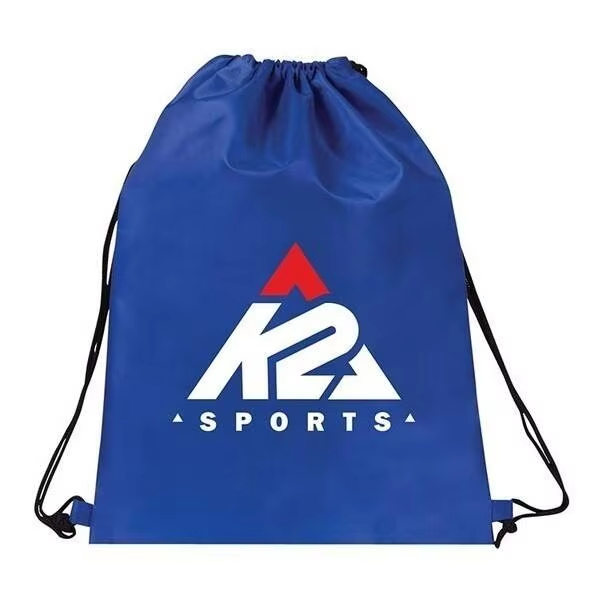
Read the construction as a system of exactly three elements and you have read the whole product. First: a hemmed channel across the top of the panel, through which a single round braided cord runs – pulling both tails gathers the mouth shut in one motion, and the fabric ruches into the cinched neck visible on the flat-laid royal sack. Second: the cord continues down both side seams and exits at the base, where it loops through metal eyelets or sewn-on corner tabs; those two exit points are what let the same cord double as shoulder straps once the bag is closed. Third: locking hardware – the flat photograph shows a black plastic toggle seated at the gathered neck on the right, with locks at the base tabs holding the loops at carrying length.
Every failure mode a school kit manager fears lives in that small parts list, so the reorder spec should name the parts: cord diameter, lock type (spring toggle versus fixed knot-stop), eyelet material, and whether the corner exit is a metal grommet or a stitched fabric tab – the six-sack cluster actually shows both treatments across the row, which is why we photograph rather than promise. Black cords on colourful shells give a mixed-shipping roster a uniform harness, and that is clearly the spec logic of the photographed set: cord and hardware constant, panel variable.
The geometry has one more operational virtue for youth squads: with the neck half-cinched and one toggle left loose, the sack breathes through training – wet jerseys and gym shoes sealed in a fully closed cinch bag is the one usage warning every kit manager learns the hard way. No zips, buckles or rigid frames means no pressure points against a shoulder during warm-ups, and a bag with no hardware to lose survives a decade of locker rooms. That is also the honest limit: this is one open compartment with no internal pocket, no water-bottle sleeve and no base panel – if your brief needs those, the belt-pack and tote lines on this site are the right product, not a quietly upgraded sack.
The Print Zone Is the Product: Placing a Logo on a Gathered Face
A cinch sack prints honestly in exactly one band: the mid-panel rectangle that stays flat between the gathered neck and the bottom hem. The flat-laid photograph proves the geometry – a centred graphic occupying roughly the central third of panel height, clear of the ruching above and the hem below – which is where a mark should sit so it reads straight when the bag hangs from its own cord on a locker hook. Anything higher distorts the moment the neck gathers; anything lower folds against the base seam every time the sack is stuffed and re-stuffed through a season.
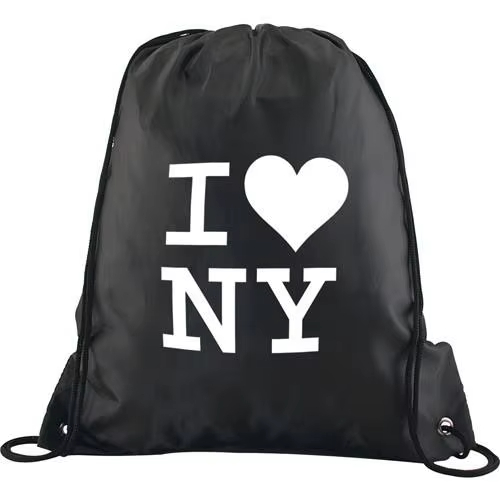
Technique follows the thin coated face. Flat screen print sits into the shell and survives the fold cycle best on a school-issue item; heat-transfer vinyl gives crisp edges for smaller marks and short-run colour swaps, like a tournament year or an age-group change; a centred one-colour lockup on a contrasting shell – the white-on-black in the last photograph, the red-on-amber treatment in the middle one – is the roster default because it reads from across a sports hall, survives machine-wash cycles and costs one screen pass for the entire delivery.
A necessary word about the sample artwork these photographs carry. Some of the pictured sacks show third-party company marks placed purely as print-zone demos; those marks remain the property of their owners, will never be produced for your order, and carry no implied sponsorship or partnership. Production on your order applies only artwork your club, school or league holds the rights to. A blank shell with your crest is the same panel, the same zone and the same cost structure – what the demos prove is position, contrast and size discipline, nothing beyond that.
Placement follows the crest’s shape. A wide horizontal wordmark wants the flat mid-band stretched left to right; a tall shield or torch-style school emblem usually needs a panel size-up rather than a squash, and that is a die decision, not an artwork fudge. Squad numbers are the one request that breaks the single-zone rule – individual digits mean individual transfers, one per athlete, quoted per number zone and produced from a spreadsheet you own. Most clubs settle for one shared face mark and save the per-name budget for the trophies.
Care instructions ride the same economics. A one-colour screen print survives a warm wash and line-dry; a large transfer panel cracks along its edges if families start putting sacks through hot cycles, and the complaint arrives at the club, not the laundry. Print technique and wash expectation are one decision, made once at mock-up, so the crest on the shelf in May still looks like the crest on the photo in September – and the district’s third-year reorder can reuse the file untouched.
Colourway Matrix: Six Shells on One Constant Harness
The cluster photograph arranges six sacks in two staggered rows, and the colour order is the whole catalogue logic of this line: black and red down the left column, royal blue and lime in the middle, violet and amber-gold on the right. Across every shell the cord stays black round braided, the corner exits stay silver-toned metal or matched tabs, and the panel cut stays identical – so one design file covers an entire mixed-colour delivery. That is how a district orders junior, intermediate and senior sections from a single crest with a colour per division, packed so each school’s cartons arrive pre-sorted.
The flat royal and the black sacks show how the same smooth face behaves under ink: the red mark on amber and the white mark on black both read opaque and flat, without bleed into the weave or a halo at the edges – the print story a school crest actually needs to survive a year of gym bags. Tone-on-tone specs – a darker mark on a matching shell, the way university shops often want it – move only the screen colour at mock-up stage with no tool change, and two-colour front-and-back layouts (crest on one face, squad wordmark on the other) are a second print pass on the same die, quoted as a line item rather than a new project.
Two practical packing facts fall out of a mixed-colour delivery. First, counts per colour per carton: a roster split of eighteen black, twelve royal and ten amber travels better as three labelled half-cartons than one mixed box that the kit manager has to sort on a Tuesday night. Second, artwork proofing per shell: a lockup that reads in white on black can vanish in white on silver-grey, so if your palette includes any pale shells, ask for the mock-up rendered per colour, not once. Both are free decisions at quote stage and expensive ones after the cartons are taped.
Storage behaves the same way a colourway plan does. Sacks flat-pack into a shelf bin rather than a wardrobe, so a district keeping two seasons of spare crests on the shelf spends centimetres of storage, not floor space, and the older stock stays visually matched to the current one because the file never changed. When committees rotate and a new registrar inherits the cupboard, the colour-coded cartons plus a single reorder reference are the difference between an orderly kit store and a mystery box of crests nobody can trace to a supplier – which is, quietly, the reason this format outlives every zippered alternative in the same budget bracket.
Roster Math: One Design per Squad, Not per Athlete
Here is the order sheet that keeps a season cheap. The crest does not change between an eighteen-player squad and a sixty-kid district program, and colour picks do not create designs – so a sixty-bag delivery across three colourways sharing one logo is still one design at MOQ 100 pcs per design: ordered once, produced once, split into cartons by roster slot. Where a genuinely second lockup exists – a booster-club mark on the back, a tournament yearline under the crest – that opens a second design count, and we say so in the mock-up before your budget discovers it. Replacement stock for injuries and new joiners mid-season draws against the same reference at the 100-piece floor, colour-coded so the kit store issues without opening cartons.
What You Can Specify on This Line
- Panel size and cut – dimensions quoted per brief; nothing on the photographs prints centimetres
- Shell colour from the black, red, royal blue, lime, violet and amber matrix shown
- Cord type, diameter and colour; toggle versus knot-stop locking hardware
- Base exit: metal eyelet or sewn cord tab, chosen per spec
- Print: flat screen or heat transfer, one-colour or multi-colour, centred mid-panel zone
- Back-panel print or squad-number zone – a separate pass on the same tooling
- Packing: per-athlete poly bags, colour-coded cartons, FBA prep for online club shops
| Item | Specification basis |
|---|---|
| Fabric | Smooth lightweight synthetic shell, low sheen; fibre and weight confirmed on your approved swatch |
| Panel | Single open compartment, topstitched sides, hemmed cinch channel, straight base hem – no gusset or pocket shown |
| Cord system | One round braided cord through the neck casing, down the side seams, out the base corners as shoulder loops |
| Hardware | Black plastic cord toggles at neck and base; silver-toned metal eyelets at the corners |
| Print zone | Centred mid-panel rectangle, clear of gather and hem; back zone as an added pass |
| Colourways | Six shells photographed; cords and eyelets constant across the set |
| Order floor | MOQ 100 pcs per design – colours mix inside one design |
| Sample turnaround | 3-5 days once crest file and colour pick are locked |
| Bulk turnaround | 7-15 days after artwork approval |
| Season scale | 1,000,000 pcs per month across our gift lines covers district-wide issue |
Size guidance without inventing numbers: a sack that must swallow adult boots sits a full hand taller than one sized for a nine-year-old’s gym shirt, and the photographs alone cannot bridge that gap because nothing on the shells is dimensioned. What the images do show is a generous top gather – enough opening to load bulky kit while the neck stays closeable – and cords long enough that the loops clear a school jumper worn over the straps. Lock panel size against the tallest roster in your program, not the average; nobody returns a bag for being two centimetres too roomy.
Season Timing: When a Kit Order Is Still Cheap
Cinch orders have two seasons and one enemy. The seasons are pre-registration bulk before term starts and mid-season replacement runs after losses; the enemy is the parent who wants crest-approved bags in fourteen days at the cheapest tier. Our clock answers that honestly: a crest file locked Monday gives you a free digital mock-up the same week, a physical sample in 3-5 days, and once you approve artwork, bulk production closes in 7-15 days – which leaves courier-to-venue freight feasible on a two-week runway, sea freight comfortable on six. The 1,000,000 pcs per month capacity across our gift lines means August – the worst week of the year for school gear – is a scheduling conversation rather than a rejection.
Price discipline follows the same calendar. Reference pricing anchors at the 100-piece tier and steps through volume bands; we quote against your roster counts rather than publishing a fixed unit price, because fabric weight, cord gauge and hardware finish are the live variables between a team that replaces sacks yearly and a district whose crest sacks outlast the coaches. Print passes add per face, not per bag, so front-and-back programs scale kindly. If a club wants a pilot batch now and a full-season order after trials, the pilot draws from the same tooling – sample once, reorder twice, never re-quote from scratch.
Packing, Freight and Club-Shop Fulfilment
Cinch sacks flat-pack into dense brick stacks, which makes freight planning nearly boring – the interesting decisions are labelling and drops. The standard pack is colour-coded master cartons with unit counts printed outside so the kit store issues by label; per-athlete poly bags are an option when squads register online and collect individually. A club that sells kit through an online store can receive the whole delivery FBA-labelled and prep-packed, per unit or per colour block, and single-unit plain-box dropship covers late joiners without a new production window. Because a crest delivery routinely splits across schools, sections or training sites, consolidated runs to one hub with sub-site carton coding stay the cheapest pattern almost every year.
Freight moves by sea, air, DHL, UPS, FedEx or TNT against the season opening, scheduled after the 7-15 day bulk window rather than promised in parallel with it – the honest sequence is sample, approval, production, then the lane that fits the calendar, and we will price two lanes in the same quote so the treasurer chooses the trade-off. The carton and lane reference sheet below attaches to every quotation on this line, so storage maths at the clubhouse starts from real cube and real weights on day one, not after the pallets arrive in the car park.

Do the printed sample bags carry brands you can reproduce?
Can one logo cover three team colours?
Which hardware lasts through a school year?
Is there a pocket or zip on this sack?
What panel size should a youth squad order?
Can the club reorder mid-season in small counts?
Complete the Kit Store
The cinch sack handles the training-night load; the rest of a season usually lives on the same order sheet. Travel weekends and sleepovers pair naturally with our hands-free belt-pack line for valuables, fundraiser and market-day carriers sit on the heavy-duty non-woven grocery tote page, and matchday programme handouts belong to the printed promotional tote line. Everything in soft carry is indexed under textile bags and all bags; send rosters and crest files through the request-quote page and one order covers the season.
One Crest, Every Locker Hook
Mail the crest file, roster counts and season date to [email protected], or ring / WhatsApp +86-15967739086. Free digital mock-up, 3-5 day sample, 7-15 days after artwork approval, MOQ 100 pcs per design – colour-coded cartons arrive ready for kit-store issue.