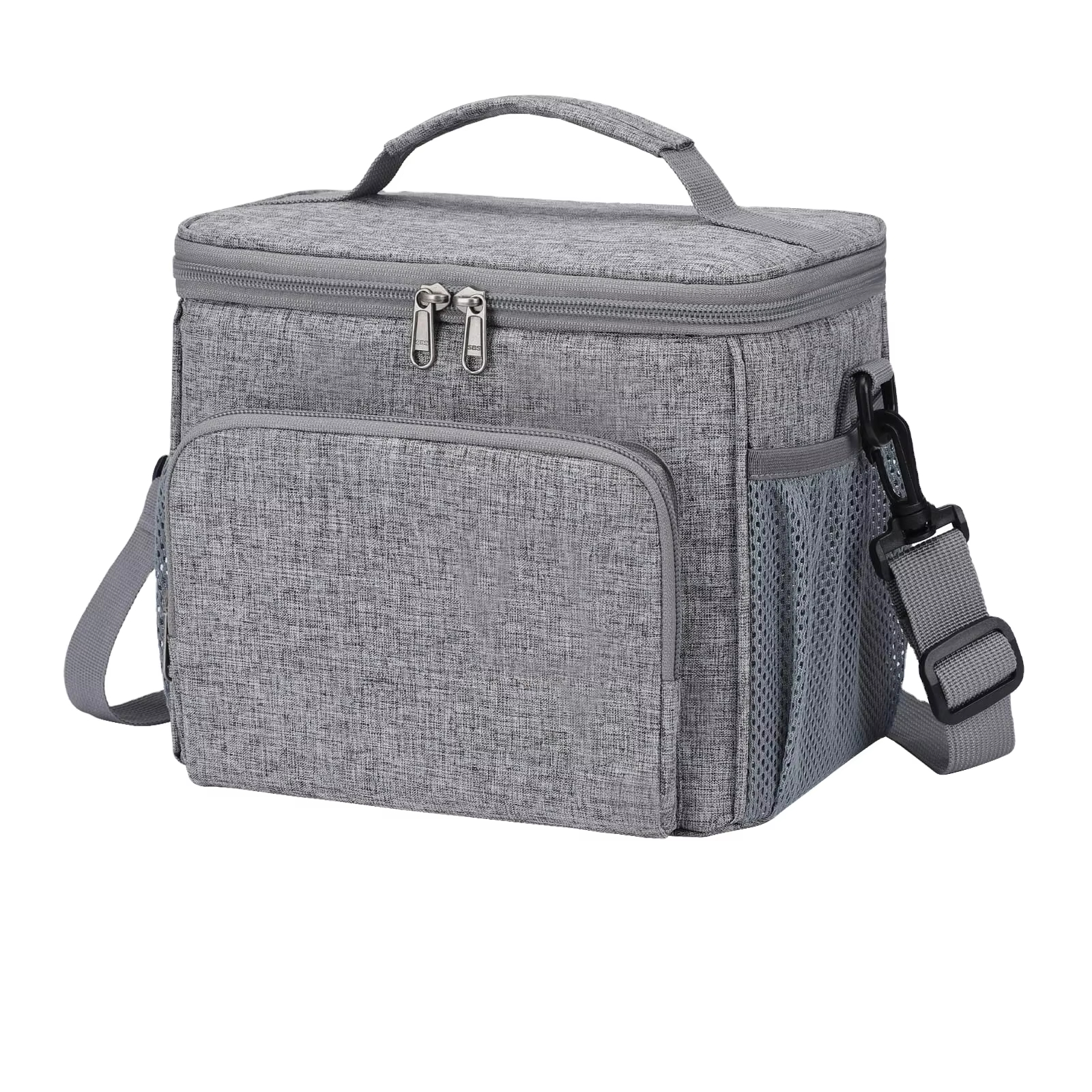
Custom Insulated Beach Cooler Bags | Foil-Lined Totes
$2.55
Day-trip cooler totes with a foil-lined interior and a welded liner seam proven in the photographs, on a heather-grey shell that stands open on the counter and waits for your mark. The listing graphic annotates this sample at eight litres, 27 x 18.5 x 20 cm and 0.39KG / 0.86LB; the packed photo proves four upright cans plus ice. Double-zip top, detachable adjustable strap, zip front pocket, twin draining mesh side pockets. We sell no cold-retention-hours number the pictures cannot support. 100 pcs per design, free mock-up on the actual grey, 3-5 day sample, 7-15 day bulk after artwork approval, FBA prep on request.
Custom insulated cooler bags beach vendors, resort shops and summer-campaign buyers can actually put a logo on: a heather-grey soft tote, foil-lined interior per the photographs, double-zipper top, and a full plain front face waiting for artwork. These are day-trip bags – the sized photo shows what they hold, the welded-liner photo shows how the interior is built – and Alice Gifts does not sell a retention-hours number the pictures cannot support. What we do sell: 100 pcs per design with a free digital mock-up on the blank face, reference samples in 3-5 days, bulk in 7-15 days after artwork approval, and 1,000,000 pcs per month across our gift lines behind seasonal retail spikes.
What Sits Outside the Cooler Aisle Already
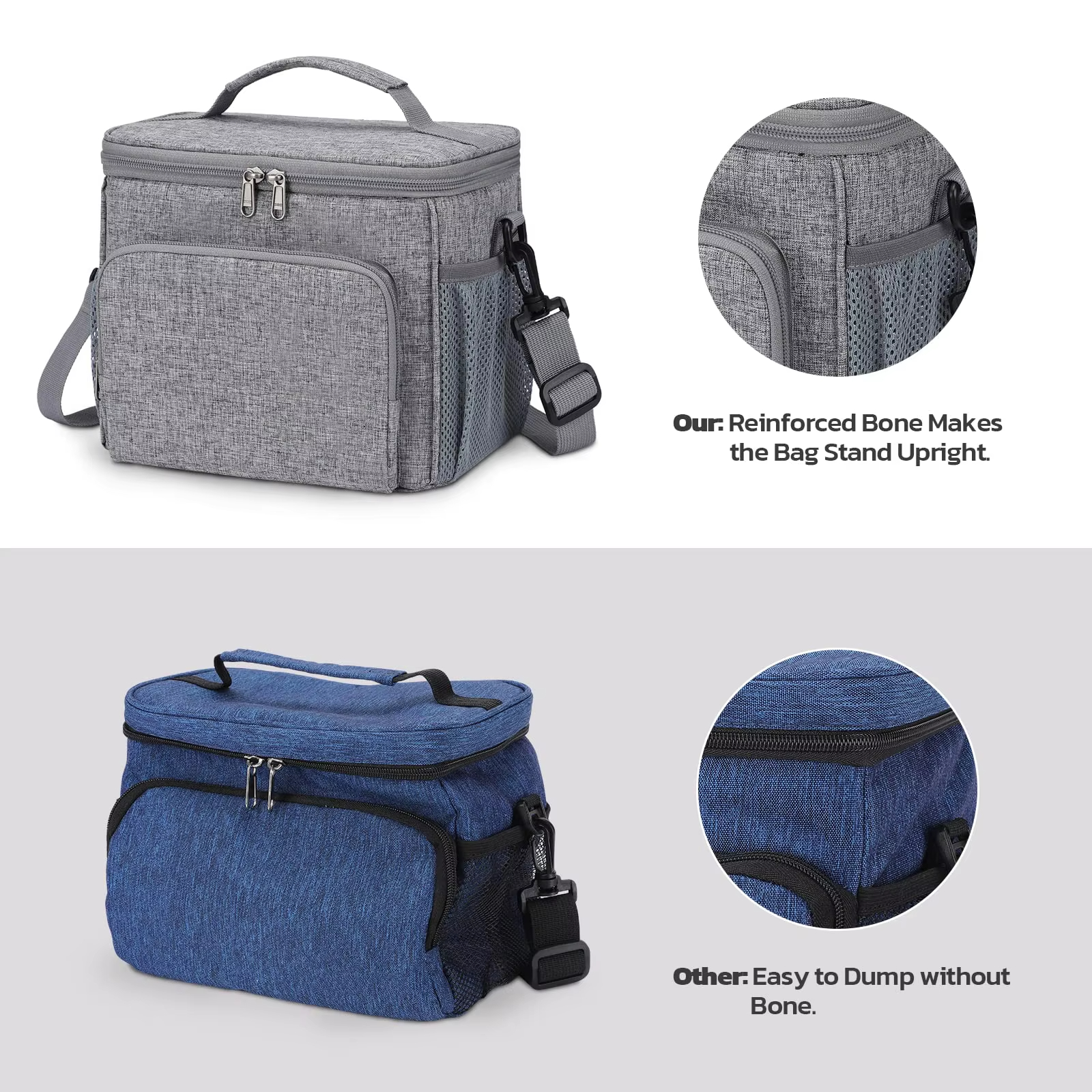
A hard plastic cooler box does one job on a tailgate and spends the other 350 days in a garage. The soft insulated tote answers the trips in between: a towel, sunscreen, four drinks and a lunch that needs to stay lunch. The photographed bag is boxy but collapsible at the seams, zips shut around the upper edge with two metal pulls meeting centre-front, and its exterior is a speckled grey woven cloth with matching piping – a neutral surface a brand can print without fighting the bag’s own colours. Nothing is pre-printed on any photographed side, which is exactly the point for a retailer: the blank shell is the product’s second job. Two ways to carry it come stock in the photo – a stitched webbing grab handle on the lid and a detachable shoulder strap running to side clips with a slide adjuster, so the same bag hangs off a lifeguard’s shoulder or rides a bike rack.
The Interior the Photographs Show
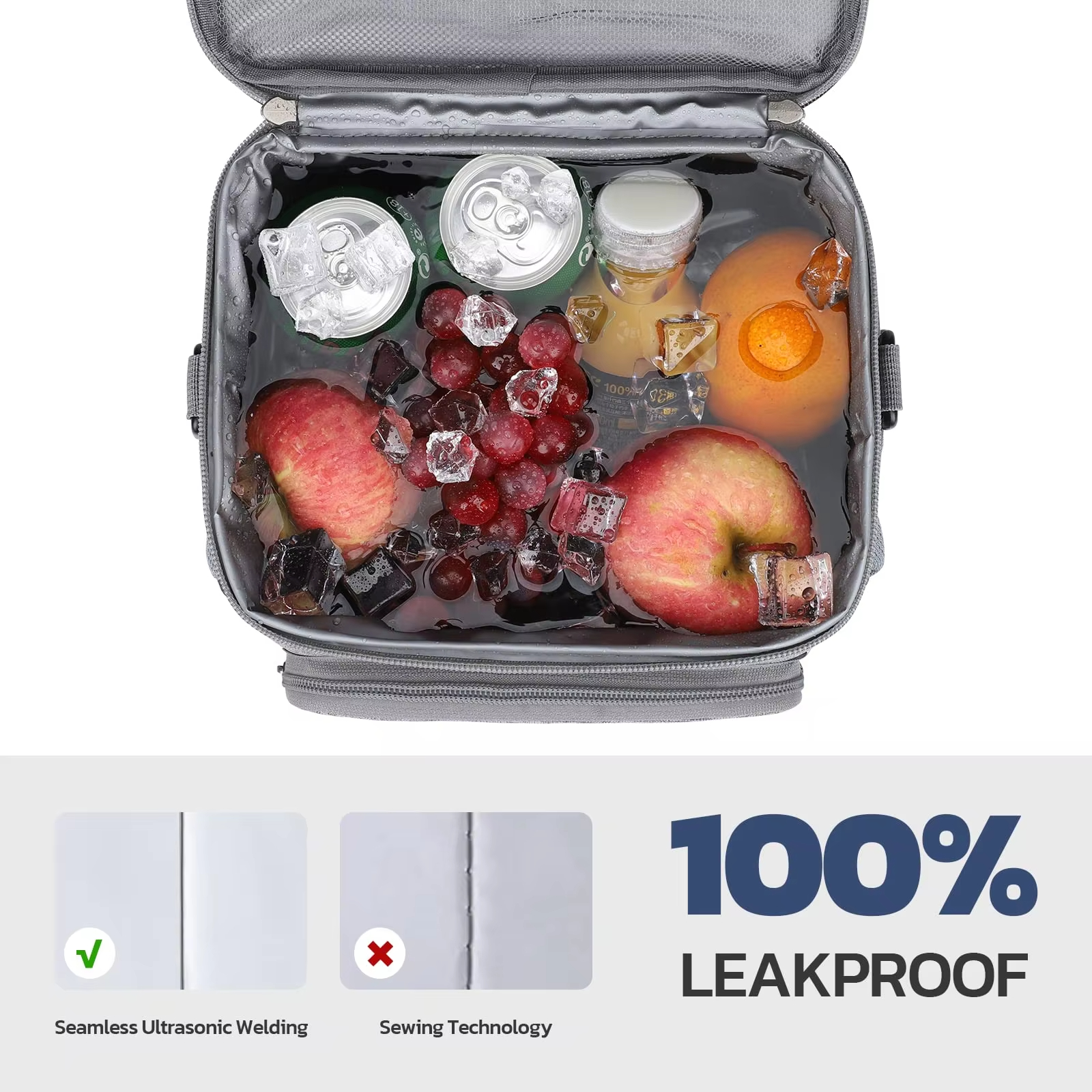
Open the lid and the construction reads plainly. The body is lined with a smooth pale foil-type thermal liner wrapped around a padded wall; the inside of the lid carries a zip-through mesh slip pocket sized for cutlery, napkins or a tea bag the size of nothing else. The overhead demonstration photo goes further: the liner is a continuous welded sheet rather than stitched panels – the fused seam in the comparison strip has no needle holes for meltwater to follow – and that photographed cavity holds ice cubes, loose cans and fruit sitting in a visibly water-filled interior. We describe the bag as the picture proves it: welded, closed-surface liner, shown carrying ice water without escaping. Whether melt stays cold for hour six or hour two depends on shade, load and how often the zip opens, and no honest listing can promise that from a photo, so no number is promised here.
Size Logic: Cans, Not Adjectives
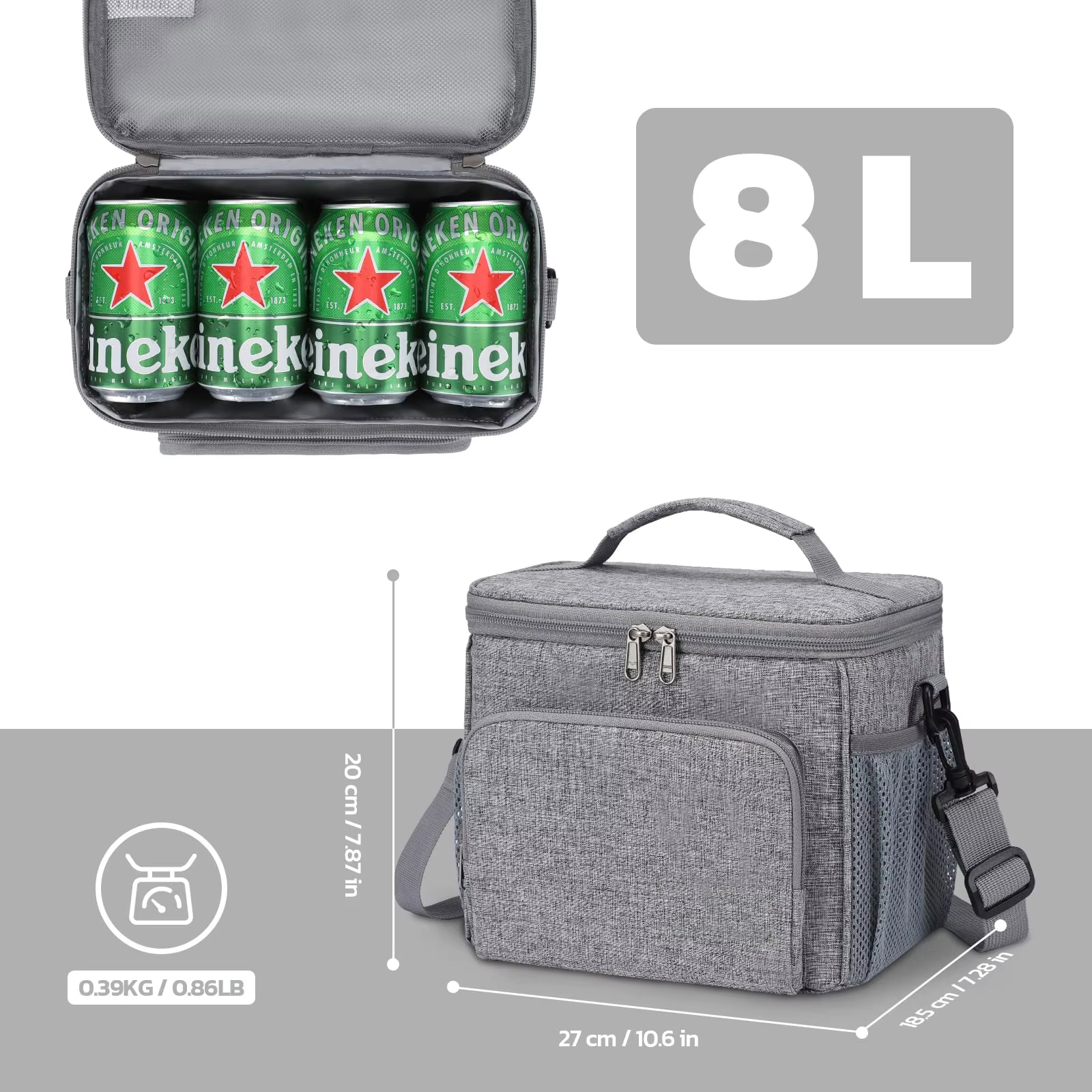
The listing graphic annotates this exact sample with photographed figures: an eight-litre capacity badge, a length of 27 cm (10.6 in), a depth of 18.5 cm (7.28 in), a height of 20 cm (7.87 in), and an empty weight annotated as 0.39KG / 0.86LB beside a scale icon. Read those as geometry, not marketing: eight litres is roughly four upright standard cans in a single row – the photo packs exactly that – plus headroom for ice around them, or a sandwich, two fruit and a bottle on a school-fruit scheme run. If your SKU plan needs more cans per shopper, you are buying a different bag, not a bigger promise on this one; scale up against the physical sample before the shelf tag is written, because the figure printed beside the bag is the figure that ships.
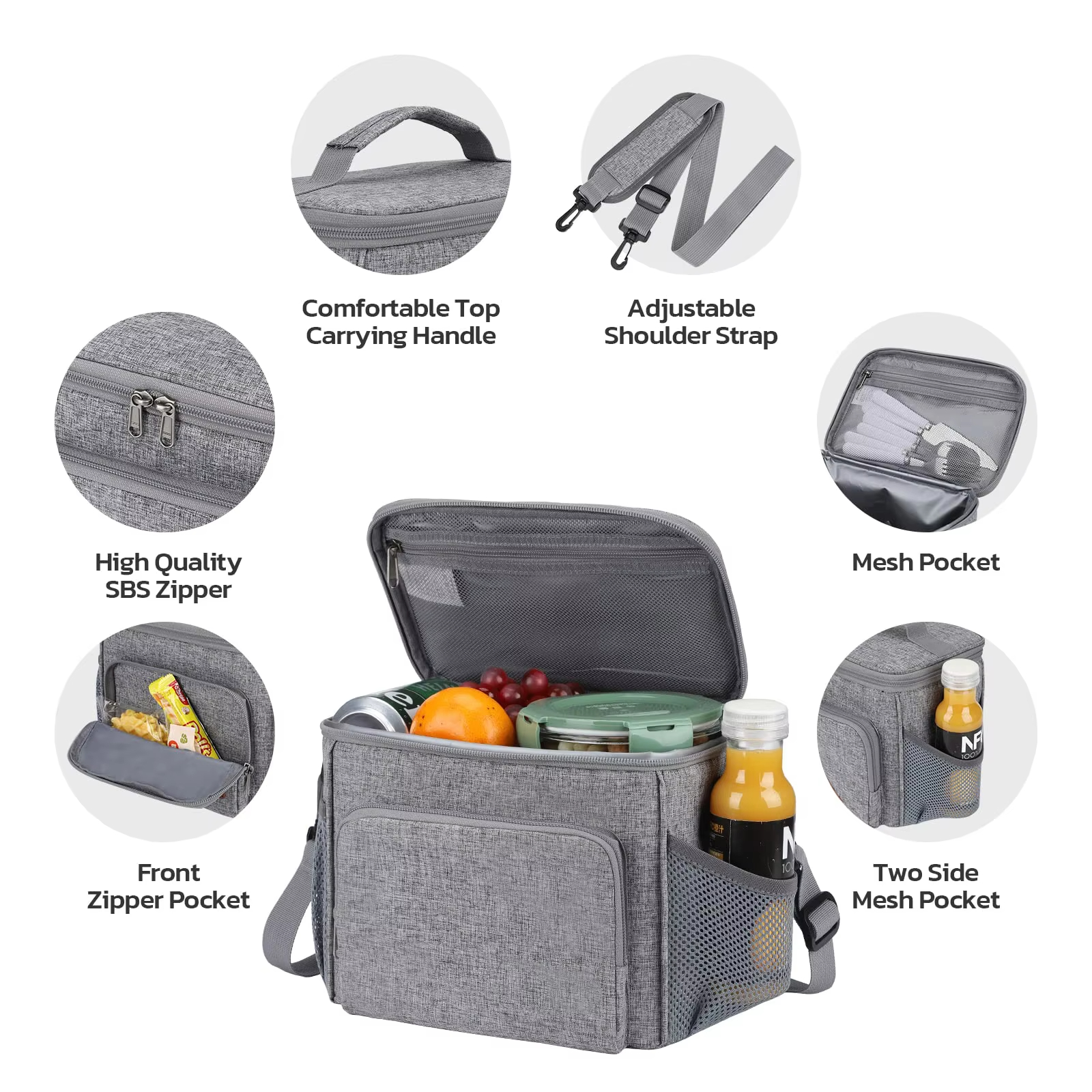
Six Carrying Details the Diagram Insets Point At
The feature diagram exists because buyers ask the same five questions per sample: the double-pull zipper wraps the top so the lid opens from either side; the front panel carries its own zip pocket for the things that melt-proof sleeves destroy – keys, cards, a paper ticket; the two open mesh pockets at the flanks swallow a bottle each and drain instead of pooling; the webbing handle is stitched at both ends to the top panel, not taped to a corner; and the detachable strap rides snap-hooks with a tri-slide so a tall shopper and a short one share the same stock unit. Every one of those details is visible in the frame rather than assumed from category habits, which is the standard this listing holds its own copy to. The drinks and snacks packed inside the photographed bag are props placed to show capacity – they arrive in your warehouse as empty bags. Read the six insets as a checklist for your own product page too: a retail buyer who never learns that the lid has a mesh pocket will never sell the parent the napkin story that pocket answers, and a beach operator whose staff cannot find the front zip pocket loses the sunscreen-tube-and-keys routine that keeps the main compartment sealed against sand. Hardware failures follow the same visibility logic – the snap-hooks are replaceable webbing components in this construction class, so a broken clip is a spares conversation, not a bin, and the quote desk can add spare hook sets to a cartons order when a rental fleet plans for three summers of wear rather than one.
Why the Corners Stand Up
Shape retention sells, and the comparison layout proves it by putting this sample beside a slumping lookalike. The photographed bag’s edges carry a stiffened, piped frame that lets the boxy body stand on a counter while a shopper loads it one-handed – and a bag that stands open holds itself open, which is how a checkout add-on gets packed instead of propped with a hand under it. The other shell collapses the moment its zipper drops, tipping contents into a heap and looking cheap on the same shelf. For a brand that prints its mark on the face, that is the difference between a logo held at eye height and a logo in a puddle of fabric at ankle height. The corner inset shows what to ask any supplier to prove: a reinforced edge that keeps the box rectangular when the compartment is empty. Squared corners also stack – a pallet of these boxes upright in rows, while slouch shells travel as loose bulk that shifts and creases in transit.
Where Your Mark Goes on This Shell
Print candidates follow the surfaces in the photos: the broad front face above the zip pocket takes the logo; the lid flap takes a secondary mark or a campaign line; the grey webbing handle can carry woven tape lettering for a hotel or league that wants the brand in hardware, not ink. Because the shell is a mid-tone marl, white and single-colour marks read cleanest on it – full-colour artwork is possible, but the speckle sits under every ink layer, so the free mock-up renders the mark on the actual grey, not on a white box. Artwork files, screen or transfer placement and tape colours all get proofed before tooling; anything the photographs cannot confirm – exact cloth denier, liner film type and your market’s import-compliance paperwork – is quoted on request against a physical sample rather than guessed in a listing paragraph, and your local market’s paperwork stays your side of the counter. Retailers running two brands through one shelf should also ask about position variety: the same logo centred above the front zip reads as a fashion item, while the same logo tucked small at the upper corner reads as a supplier’s gift-with-purchase, and switching which of those two placements a programme uses costs nothing once the proof is already signed, because only the file changes, not the tooling. A promotion that wants the mark repeated around the piping or across both flanks is a second quote line, priced as more print area rather than as a mystery surcharge – flag it at mock-up stage and the number arrives with the picture instead of after it.
Colour matching deserves one more paragraph because heather fabric punishes lazy artwork. The speckled grey body is not a flat Pantone chip; a saturated red placed on it reads two shades deeper than the same red on white board, and the free mock-up is rendered over the actual photographed surface precisely so designers catch that shift before bulk does. If your brand runs a pale single-colour wordmark, the marl eats fine detail first – keep strokes visible from half a metre, or accept a heavier line weight at proof stage. Pipe and tape colours can also be swapped to brand colour on request; the photographed grey-on-grey trim is the default, not the only build, and trim choices belong on the same mock-up sheet as the artwork so one approval covers shell, stitch and mark together.
Wash-care belongs in the same approval because a beach tote fails commercially in one way only: a faded mark. Shell print under a rinse-and-shade routine outlasts the same ink baked and scrubbed, so the care note you print on the hang tag should match what the sample survived, not what the artwork looked like fresh off the press. The liner gets the gentler instruction – wipe, air, stow open – because a folded wet foil liner is the one abuse this construction photographs nothing about; there is no mould claim or durability certificate on this page precisely because no photograph earns one yet. Retail buyers writing shelf copy should borrow the same honesty rule: describe the bag your shopper will hold in twelve months, not the render, and the free mock-up plus the couriered reference sample exist so both descriptions can be written before a carton seals rather than defended in returns after.
Who Restocks This Shape, and When
Three buyer types keep this line on a calendar. Resort and museum shops order before the Easter foot traffic and top up through July, treating the tote as the only fridge-adjacent SKU that leaves as a gift rather than a grocery run. Beverage brands use it as a retail-with-purchase promotion – the eight-litre geometry fits a four-can carrier story without screaming discount bin. Camp operators and swim schools buy it as parent-facing kit with the crest on the lid flap. All three hit the same wall: a June beach season cannot start from a March artwork file, because 7-15 days after artwork approval is production, not door-to-door. Lock the mock-up, take the 3-5 day sample across your merch team, then let our quoted monthly throughput absorb the July top-up without a re-quote. The retail-with-purchase mechanic deserves its own sentence: a shopper who watches four cans drop into the photographed compartment decides in seconds whether the add-on price is a joke, which is why the capacity shot and the dimension leader-lines exist before the logo conversation. Get the sample into a store’s hands before the endcap is built, because the decision the shelf makes is the decision the photograph cannot – whether the handle height clears a car seat back and whether the stand-open corners survive a summer of being stuffed and shaken. One planning habit separates repeat beach-season buyers from first-timers: they order the shell in the grey photographed here as the base SKU and treat print variants as satellites, so the blank tote ships on the shortest path whenever a midsummer sell-out needs volume without a second artwork round. That satellite logic protects margin too: the printed variants carry the artwork conversation and the proof round, while the blank shell carries the volume and the fastest transit, and a merchandiser who plans both from one purchase order can move a July endcap from “unbranded but in stock” to “branded next season” without either decision blocking the other. Camp operators run the mirror version of the same split – printed lid flaps for the camp identity, blank fronts so a camper’s name stays in a shoe rather than a logo – and the design-count rule at quote stage handles both patterns without inventing a third price class. Retail buyers should also steal the camp playbook’s quiet advantage: a lid-flap mark stays current even when the front print gets retired, so a shop that rebrands mid-season keeps selling usable stock instead of writing off an entire carton of obsolete artwork.
Specifications at a Glance
| Field | This listing’s position |
|---|---|
| Structure | Soft-sided boxy tote, piped stiffened edges, stands open unloaded per the comparison photo |
| Photographed figures | Eight-litre badge; 27 x 18.5 x 20 cm (10.6 x 7.28 x 7.87 in); 0.39KG / 0.86LB – cited as listing annotations |
| Liner | Smooth foil-type thermal liner with welded seams; no cold-retention hours promised |
| Carry options | Webbing grab handle, detachable adjustable shoulder strap, twin side mesh pockets, front zip pocket |
| Minimum order | 100 pcs per design against a free digital mock-up |
| Sampling | Reference sample in 3-5 days; production sample on request |
| Production | 7-15 days after artwork approval; 1,000,000 pcs per month capacity across gift lines |
Ordering Path From First File to Pallet
Send the logo file, the print placement you have in mind and your season date; the digital mock-up comes back free, placed on the heather-grey shell so nobody is sold against a white background. Choose a reference sample next – 3-5 days – and load it with the real cans or the real sandwich your shelf story uses, because capacity is only believable when your own product fits it. After approval, 7-15 days produces; a printed price tier for the 100-piece entry band sits on the quote, and deeper quantities move the unit figure down rather than moving a fixed number onto this page. The one thing to protect throughout: artwork lock before freight choice, never after. A sold-out endcap in July cannot be fixed by a faster boat, only by a file that was signed in April – which is why the ordering path above is written as dates, not as wishes, and why the sample slot should always be consumed by a merchandiser holding real product, not a mouse hovering over a PDF. The photographed bag folds – padded walls crease along their piping without cracking – so nesting cartons stay dense and the per-unit freight burden stays small for a seasonal buy. Individual polybags keep the liner clean through transit; cartons palletise to standard export builds shown on the reference chart further down. Ship sea for the spring build-up, air or express for the mid-season sold-out moment, and split pallets across store clusters or an Amazon shelf: FBA prep, pick, pack and labelling are supported off the same production batch. Freight routes available by sea, air, DHL, UPS, FedEx or TNT, and the packing desk can label cartons per store so a 5,000-unit order unpacks as merchandising, not as sorting.

Buyer Questions We Get Weekly
How many hours will this bag keep ice?
Will a printed logo survive sand, sunscreen and car boots?
Is the eight-litre figure enough for a four-can promotion?
Can the shoulder strap be branded too?
What paperwork covers the liner materials in our market?
Do you handle Amazon-destined cooler cartons?
Links to the Rest of the Bags Aisle
A cooler tote rarely travels alone on a purchase order. The textile side of the factory index sits at bags under the textiles category; paper carriers and campaign print live one branch over at the printed bags shelf and its parent printed-items directory. Pair it for the same shopping basket: the academy cinch sack handles squad kit days, the nine-colour kids backpack covers September, and the structured adult carry suits the weekend the ice was bought for. Artwork, quantities and liner questions all price in one pass at the quote desk – the same desk that quotes the fabric and liner details this page deliberately leaves unquoted.
The shortlist to send today: logo file, the four-can or six-can shelf decision, and your beach-season date. Everything else follows the same clock – mock-up free, sample 3-5 days, bulk 7-15 days after artwork approval.