

Custom Nylon Belt Bag | Hands-Free Logo Pack
$2.55
Hands-free carry that never lives in a drawer: a custom nylon belt bag fanny pack built to order with a perimeter-zip main compartment, a see-through mesh divider pocket inside, a horizontal zip channel across the back panel, and a ribbed webbing belt on moulded side-release buckles with a slide adjuster. Twenty blank colourways photographed, one centred logo zone, water-resistant shell fabric quoted per your approved coating – no protection ratings published from a photograph. MOQ 100 pcs per design, free digital mock-up, samples in 3-5 days, bulk 7-15 days after artwork approval, 1,000,000 pcs per month capacity across our gift lines. Sea, air, DHL, UPS, FedEx or TNT freight, FBA prep available. Send the artwork and event date to [email protected] or +86-15967739086.
Worn, Not Carried: Custom Nylon Belt Bag and Fanny Pack Production
A custom nylon belt bag fanny pack is the one promotional item that never sits in a drawer: it rides on the hip at a festival gate, swings across the chest on a night market street, and holds the passport, phone and cards that a traveller refuses to put down. That wearing habit is why this line keeps reordering. The logo face stays at chest height for hours, nobody pays for shelf space, and the next event crowd sees the same artwork again at zero distribution cost – a give-away that advertises itself on a moving body is hard to beat on impression economics.
The photographed sample is a compact black pouch, roughly hand-span width, with rounded corners, a piped edge, a zipper that runs around the front panel, and a single flat webbing belt. It is shown two ways in the gallery: clipped as a waist pack and slung short as a chest sling, because the same strap geometry serves both carries. Every shell on this page ships blank; the white word printed across the centre of the first photo is a placeholder marking your file zone, not a brand we sell. Nothing in our copy claims a fabric identity the photographs cannot support – the shell reads as a fine, smooth coated synthetic, and whether you specify a nylon face or a polyester one is locked at quotation against physical swatches.
For procurement, the line behaves like a hardware-and-panel spec sheet, not a soft-goods project. The decisions that move unit cost are fabric composition, panel thickness, pocket count inside one compartment, buckle and slider choice, zipper colour-match, and which print technique covers the logo zone. We produce this pouch at MOQ 100 pcs per design, run the sample loop in 3-5 days, and close bulk in 7-15 days after artwork approval, inside a plant capacity of 1,000,000 pcs per month across our gift lines – which is how a chain of festival merchandise stands or a commuter-giveaway program stays on one reorder code instead of five supplier accounts.
Pocket Architecture, Read Straight From the Photographs
Size a belt pack by its pockets, because that is the only honest way the format earns its space. The first detail sheet shows four macro insets around the hero shot, and together they settle the internal layout before anyone asks for a sample. Inside the main compartment sits a see-through net-mesh divider pocket – the close-up shows a hand pressing flat behind the open weave – that takes card-shaped items like transit passes, a stack of event wristbands or a folded note, keeping them visibly separated from keys and cables instead of lost at the bottom of a single cavity.
The lining photograph adds the second internal fact: the main cavity is finished in a glossy taffeta that resists snagging when a zipper slider crosses it, and the mesh panel hangs mid-cavity rather than being glued to either wall, so both faces of the divider stay usable at once. On the closure side, the hero view shows one zipper track running around the perimeter of the front panel, with a short cord-loop pull resting at the lower corner. The opened-flat pair of shots documents the next detail: at one end of that track sit two cord-loop sliders on metal pulls, meaning the compartment opens from either side – exactly what you want when the pack is slung across the chest and a hand needs in and out without doffing the whole bag.
The rear-angle photograph documents the third zipper. A horizontal zip channel runs across the face that rests against the wearer’s back, served separately from the perimeter track that wraps the right-hand side of the body. In travel-merch terms this is the anti-fumble pocket: it faces outward only when the pack rides behind you and stays hidden against your body when worn front – the exact behaviour buyers write into commuter and festival briefs. It is a working zipper with a metal slider and cord pull, not printed decoration, and we spell the pocket count out here because resellers routinely advertise channels a shell does not have. None of the photographs show a key clip, pen loop or elastic card slot beyond what is described, so if your brief needs those, they are add-on stitch work quoted against the sample, not assumptions baked into the price.
Zipper colour is another silent lever – the photographed black-on-black track disappears into the shell and lets artwork own the face, while a contrast-tape slider is a common spec for team and campus versions where pockets must be findable by feel in the dark. Tape colour, pull-tab material and whether the rear channel gets its own slider or shares the main track all settle on the same mock-up sheet before the 3-5 day sample is cut.

The Belt Harness: Webbing, Slider and Side-Release Hardware
The strap is the fit system, and on this shell it is a single flat woven webbing loop with a ribbed longitudinal weave, exactly as the buckle close-up shows. A rectangular plastic slide rides on the strap as the length adjuster, so one size ranges across a chest or a waist without pre-punched holes – the right geometry for giveaway programs where you will never know the wearer in advance. Both ends of the loop terminate in matching halves of a moulded black plastic side-release buckle; the hero photo deliberately shows one half clipped to its strap loop and the other dangling free so the release mechanism reads at a glance, and the slider adjuster appears at the opposite end of the same webbing.
Operationally, the buckle is what converts the item from a shoulder sling into a true waist pack in one click, and lets a visitor at a stadium gate doff and re-clip without fighting a zipper-loaded belt. The photographed hardware is matte black plastic across the sample set, which is a spec choice rather than an accident: black trim keeps a bright, cheap-looking edge from competing with your print, and it ages uniformly across dark lots. If your brand program wants colour-matched or metal buckle hardware instead, that is a quoted option with tooling implications, so lock it at sample stage – deciding after artwork approval moves the 7-15 day production clock.
We quote strap width, webbing density and adjuster travel against a physical sample rather than promising millimetre figures the photographs cannot prove. What the images do prove is that the belt exits the body low on both flanks, which keeps the pouch from riding up when the wearer walks or bends, and that there is no top carry handle anywhere on this model: the bag is engineered to be worn, never carried by hand, which is the difference between a belt pack and a small tote in the same price bracket. Reflective thread in the webbing is an available add-on for night-event kits and is quoted separately from the base harness.
Fit testing belongs in the sample round for one practical reason. Waist sizes in a giveaway audience run far wider than anyone on a brand team expects, and the adjuster travel on this webbing – visible as the extra strap length fanned out in the hero shot – is the margin that lets one order serve a festival crowd without a size matrix. Spec the strap on the long side if your venues skew adult, short if the program targets younger wearers, and ask for the sample to arrive threaded to its midpoint so the full travel gets tugged both ways. A strap sewn too short at bulk stage is a bin full of unsold merch; a strap checked at sample stage is a rounding error on the project plan.

Water, Coating and What We Put in Writing
One detail inset on the first sheet is a macro of the black shell with water sitting on the face in round beads. Beading is a real, visible property of a coated fabric, and it belongs in the conversation because hip bags get elbowed through rain queues and spilled drinks. What it does not do is prove a rating. The banner copy printed above that macro on the sample sheet is third-party marketplace decoration – we neither restate its wording nor inherit its claims, and a procurement officer should treat that entire call-out style the same way: it is advertising, not a specification.
Our written spec language stops at water-resistant shell fabric, quoted per the exact face cloth and coating you approve on the physical sample, with lining and seam construction confirmed separately. We publish no protection-class ratings, hydrostatic-head figures or seam-tape promises on this page, because none of them are provable from these photographs, and a buyer who genuinely needs rain-rated technical gear should be told that plainly rather than sold a number at giveaway prices. If your brief truly requires taped seams or a named coating standard, flag it before sampling: it changes fabric sourcing, price band and lead time, and we would move that requirement onto a different spec line instead of quietly upgrading this one.
Between showers, the coating’s second job is abrasion. A coated face wipes clean and stops the piped edges from fuzzing where a hip bag rides against denim all day, which is the quiet failure mode that kills reorders on promo carry goods. The glossy taffeta interior shown in the opened-flat shots dries quickly after a rinse, an operational fact for rental or reuse programs at venues, campsites and tour circuits. The pale colourways in the grid carry a slightly drier, matte hand than the black sample shown here, so plan coating choice and print technique together when your pick is a cream or sand shell rather than the photographed black.
Salt air and sunscreen are the other two quiet killers of coated shells on coastal tour runs and beach festivals. The coated face shown in the macro rinses clean with fresh water and dries fast, which keeps the branding legible through a season of use rather than chalky by week three; the uncoated alternative on this panel type powders and scuffs visibly within the same window. That durability, not rainfall, is where a coating earns its price difference on a promo budget – ask your buyer which one of those failure modes they have actually seen, and the conversation prices itself.

Twenty Colourways on One Blank Print Face
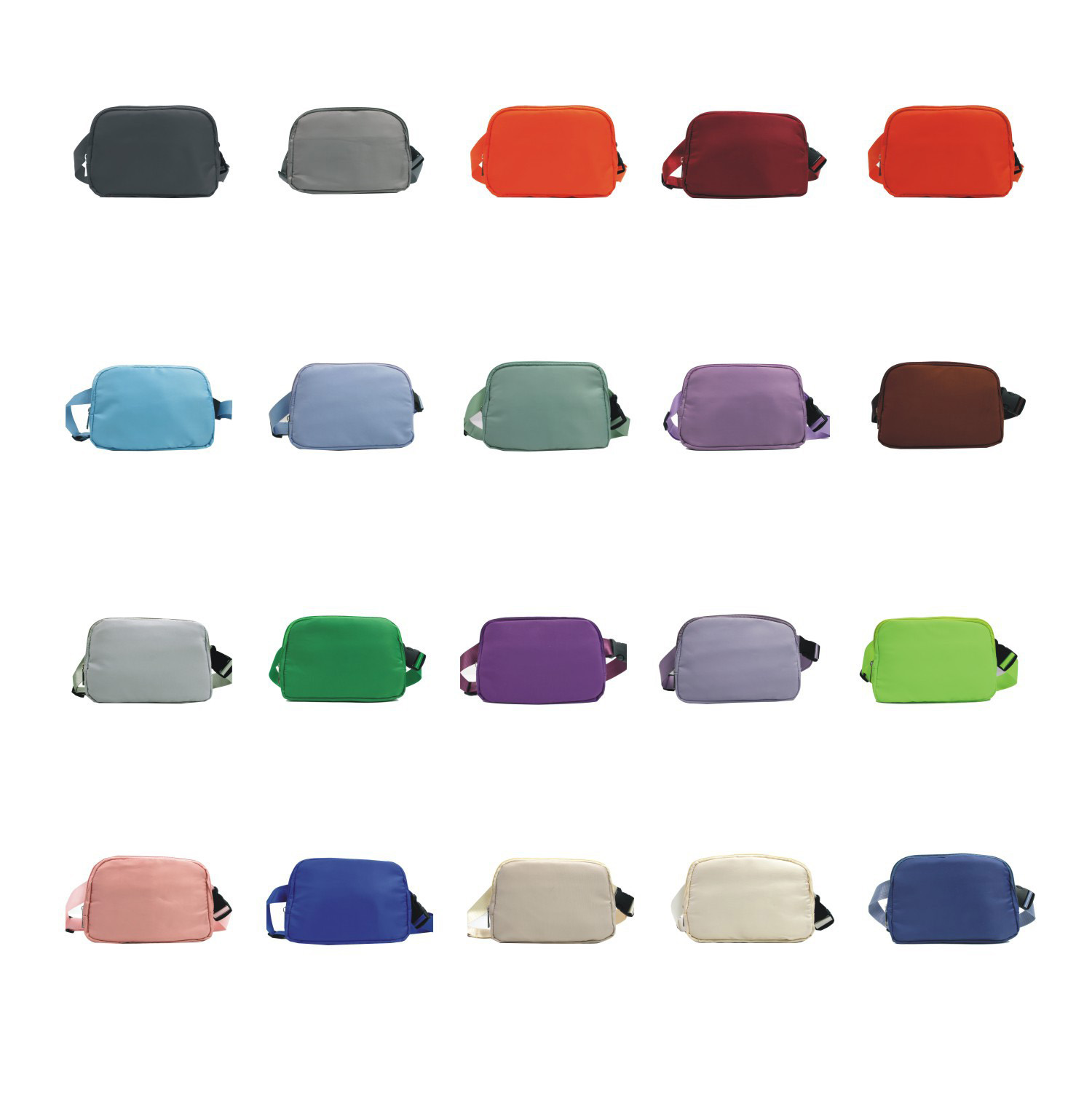
The colour grid photographs twenty blank shells of one model in a four-by-five layout, and that grid is the actual pallet logic for a giveaway line: one design, many picks, one reorder reference. Reading across the rows: charcoal, mid grey, orange, deep red, vermilion; sky turquoise, slate periwinkle, muted seafoam, lilac, chocolate; silver grey, kelly, purple, dusty lilac-grey, lime; then salmon, royal blue, sand, cream and navy. The two pale neutrals show a subtle ribbed cross-hatch on their faces while the rest read as smooth plain weave, and the navy shell arrives with a grey-toned strap – the one mismatched trim in the set – so spec strap colour explicitly if navy is your corporate pick.
Every shell in the grid is unprinted. The centre of the front panel is one flat logo zone, and its geometry frames what artwork can do: the perimeter zipper and piped edge bound the panel, so a compact lockup outperforms a full-bleed graphic here. Screen print and heat transfer sit flush on the coated face; embroidery requires a panel stabilisation check because the shell carries light structure rather than a soft unstructured wall; silicone badges read best against the darker colourways, where grey and cream trims flatter them. Hardware stays matte black across the set, which means contrast planning should be done against that black trim line as much as against the body colour – a tonal logo on a tonal shell will look like nothing at festival distance.
What You Can Change on This Shell
- Face fabric composition and denier – nylon or polyester class, confirmed against your approved swatch
- Colourway mix within one order; the photographed grid lists twenty shell options
- Strap width, webbing colour match, adjuster and buckle hardware choice
- Zipper count and layout – perimeter track, rear channel and inner mesh divider as line items
- Logo zone technique: screen, heat transfer, silicone badge or embroidery within panel limits
- Optional reflective piping, coloured cord-loop pulls or key-clip stitch-in – quoted as add-ons
- Packaging: individual poly bag, hang tag, venue-ready bundles; FBA labelling and prep on request
| Spec item | What we build for this belt pack |
|---|---|
| Shell | Smooth coated synthetic face; composition locked at sample approval – the photographs do not name the fibre, so it is quoted against swatch |
| Interior | Glossy taffeta lining with a see-through mesh divider pocket hung mid-cavity |
| Closures | Perimeter zipper around the front panel plus a horizontal zip channel on the back face; twin cord-loop sliders at one track end |
| Belt | One flat ribbed webbing loop, rectangular slide adjuster, moulded black side-release buckle halves at each end |
| Logo zone | Flat centre panel bounded by piping and zipper – compact lockup recommended over full-bleed |
| Colourways | Twenty shell colours photographed blank; strap colour-match specified per line |
| Minimum order | MOQ 100 pcs per design |
| Sampling | 3-5 days on the approved file and fabric pick |
| Bulk run | 7-15 days after artwork approval |
| Capacity | 1,000,000 pcs per month across our gift lines |
| Price band | Reference pricing at the 100-pc tier and up; the unit figure moves with fabric and hardware choices, so it is quoted, never fixed on this page |
Order Flow: From Lockup to Loading Dock
Ordering mechanics are deliberately simple, because a bag line sold into event calendars has to be re-runnable by someone who has never bought a bag before. Step one: send the vector lockup and a target colourway from the grid, and we return a free digital mock-up showing the mark at panel scale, positioned inside the zip frame. Step two: the physical sample follows in 3-5 days – actual shell, actual hardware, actual print at scale – because coated faces take ink differently than a PDF pretends, and the one honest check on a belt pack is pulling the real buckle open and shut with your keys inside. Step three: artwork approval starts the production clock of 7-15 days, and freight books against your event date rather than against a stock rotation.
The reorder discipline is the part procurement teams thank us for later. One artwork file, one line reference, and a season of reorders draws against the same tooling – colour is a pick inside a design, not a new design, so restocking forty units in royal blue after a hundred shipped in black and navy never restarts sampling. When the brand refreshes, the new master replaces the old against the same reference and only the print screens change. Reference pricing is anchored at the 100-piece tier and moves upward in volume bands; we quote per file rather than publish a fixed unit price, because fabric composition, hardware grade and pocket count are live variables on this model. Multi-venue resellers typically consolidate one production run to their largest hub with colour-coded cartons per sub-site, which keeps the freight bill in the ocean-freight column rather than the courier column.
Packing, Freight and FBA Prep
Belt packs nest flat, and that single fact is what keeps landed cost honest on a hardgoods giveaway: a pouch this size rides two or three deep per carton layer with the strap clipped against the body, so cube per thousand units stays small even for air-freight emergencies. The standard pack is an individual clear poly bag with the logo face forward, colourway blocks labelled at the carton boundary so a store team can pull one SKU without opening anything, and a master carton marked with unit count and lot. Optional hang tags and venue-ready bundles of six are quoted as pick-pack line items – a festival merch stand that opens cartons into trays of six sells faster than one that opens cartons into chaos.
Freight leaves by sea, air, DHL, UPS, FedEx or TNT against your event date, and split shipments across a festival season are scheduled inside the 1,000,000 pcs per month capacity window so a tour never queues behind another program’s reorder. FBA labelling and prep-as-a-kit are available when you resell this pouch as a marketplace add-on instead of handing it out at a booth, and single-unit plain-box drop-ship works for remote-team welcome packs – the strap can ship clipped separately to keep parcels thin and postal rates sane. The packing and shipping reference chart below travels with every quotation we issue for this model, so carton dimensions and lane choices enter your planning file on day one, not after the purchase order is cut.

Do you publish a rain rating for this belt bag?
Is the rear zip pocket on every colourway?
Can we mix several colours inside one 100-piece design order?
What print survives on a coated belt-pack face?
How fast can this line land before a festival season?
Can you drop-ship single units instead of cartons?
Related Carry Lines on the Same Quote Sheet
The belt pack owns the hands-free slot, but a giveaway program rarely stops at one bag. Club and school volumes usually pair it with custom drawstring bags with logo for locker-room carry, retail programs bolt on heavy-duty non-woven grocery totes for checkout aisles, and event teams add printed promotional tote bags as the welcome-desk handout. More soft-goods carry options sit in the textile bags catalogue and the full bags category; single-source the mix through the request-a-quote page and one artwork file travels with every line item.
Put the Logo at Chest Height This Season
Send the lockup, target colourway and event date to [email protected], or ring / WhatsApp +86-15967739086. Free digital mock-up, physical sample in 3-5 days, 7-15 days after artwork approval, MOQ 100 pcs per design – one reorder code from the first festival to the tenth.


