Custom Wedding Thank You Cards – Black & Gold Suite
$0.60
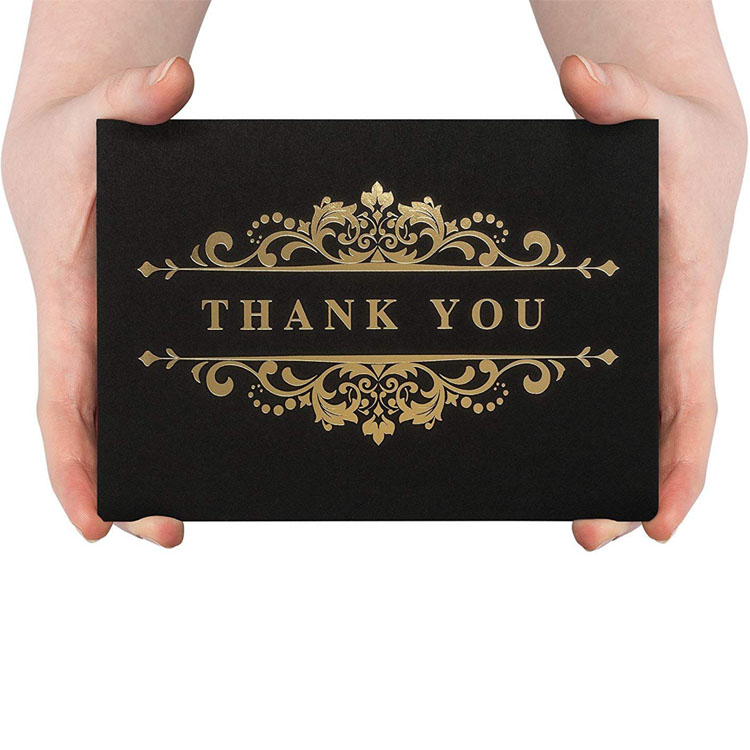
Custom wedding thank you cards for couples who ordered their invitations from a real design file. The photographed suite runs matte black landscape faces under metallic gold foil: a plain script thank you, a framed tracked-capitals treatment, a lowercase line over a full-width damask band, and capitals bracketed by mirrored scrollwork, all one family, plus the folded card standing tent-style beside a reception glass. The ivory pointed-flap envelope stays plain so the card carries the decoration, with names, dates and keepsake wording added as your text layer from the invitation master. Lock the face at the invitation stage and release quantity when your address list settles. MOQ 100 pcs per design, samples in 3-5 days, production 7-15 days after approval.
A wedding suite gets printed in waves: save-dates, invitations, day-of paper, and finally the thank-yous that go out after the last guest has traveled home. Custom wedding thank you cards are that last wave, and the couples who plan well order them in the same breath as the invitation, because nothing wrecks a post-wedding budget, or a bride’s patience, like re-creating a design system from memory three months after the venue invoice cleared. The photographed suite on this page shows one disciplined answer: matte black faces, metallic gold lettering, ornamental scrollwork, and a plain ivory envelope that lets the card be the event.
Matched at the Invitation Stage, Ready When You Are
Suite continuity is a print decision, not a styling one. When the thank-you face is laid out from the same type file as the invitation, the foil color mixes identically, the ornament scale repeats, and the couple’s monogram or script sits at the same optical center across the whole paper family. Couples who order thank-yous separately usually pay twice: once in the design hour to reconcile files that drifted, once in a second setup fee for a die that almost matches. Our line planners hold wedding-season files so the day-of cards and the post-wedding wave run against one artwork master, with quantity added later; the file, the die and the foil tooling are the expensive parts, and paying for them once is the entire trick. That is also how you survive the real post-wedding constraint: guests should not wait. A matched thank-you waiting in a closet beats a perfect one still in revision three weeks after the reception.
Four Ornament Routes, One Palette
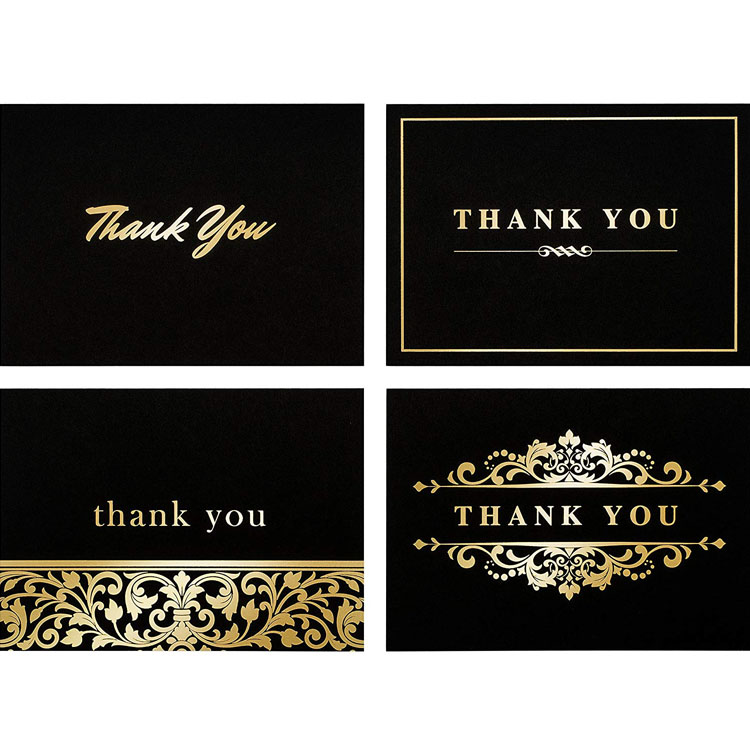
The design-family photograph is the useful one: four landscape faces on matte black board, all gold, no two alike. The plainest prints a single script Thank You, nothing else, the calligraphic capital trailing a long flourish. The second frames tracked serif capitals inside a thin inset gold rectangle, a small filigree divider breaking the rule beneath the words. The third drops a lowercase serif line into open space and lets a full-width band of baroque scrollwork, acanthus curls and fleur-de-lis repeats, own the bottom edge. The fourth brackets tracked capitals between mirrored flourishes above and below, rules extending to diamond terminals. What those four prove is a spectrum, not a catalog: a couple chooses how much ornament carries their formality level, and every rung of the ladder prints from the same black-and-gold file family. Choose the plain script for a black-tie dinner wedding; choose the bracketed serif when the invitation itself was ornamental. The scrollwork reads formal without a single flower printed, which is exactly why black-and-gold galas keep ordering it.
There is a procurement reason the four-up layout exists at all. Couples decide ornament level by squaring faces against each other, not by reading one card at a time, and planners run that comparison with the whole family in the room. When a couple asks for a fifth variation, a script face over a damask band, say, that is a hybrid of two files already in the family, not a new design system, so it proofs fast and stamps from the same foil tooling. The one-line script and the bracketed serif faces also demonstrate the range of metallic coverage, which is the actual cost driver on this product: a full-width damask band lays down many square centimeters of stamping area per card, while a single script line uses a fraction, and that difference moves a quote long before board or envelope choices do. Ask for the coverage comparison when you are torn between a quiet face and a decorated one; one sample run can carry both for the same setup.
Note what none of the four faces include: no name lines, no date fields, no return-address captions. They are presentation faces, and your message block lives on the reverse or the insert when your wording convention demands it. That separation is deliberate and it is what keeps one design reusable across a whole guest list regardless of who signs what.
Planners should also weigh print-run psychology. Show a couple two families of faces at once and the decision closes in one visit; show them one card per email and the suite stalls for weeks. The four-up sheet above is how our studio sends proofs for this genre, because ornament weight, cap height and diamond terminal detail all compare honestly only side by side, at true size, under the same lamp.
One Card Face, Three Wedding Jobs
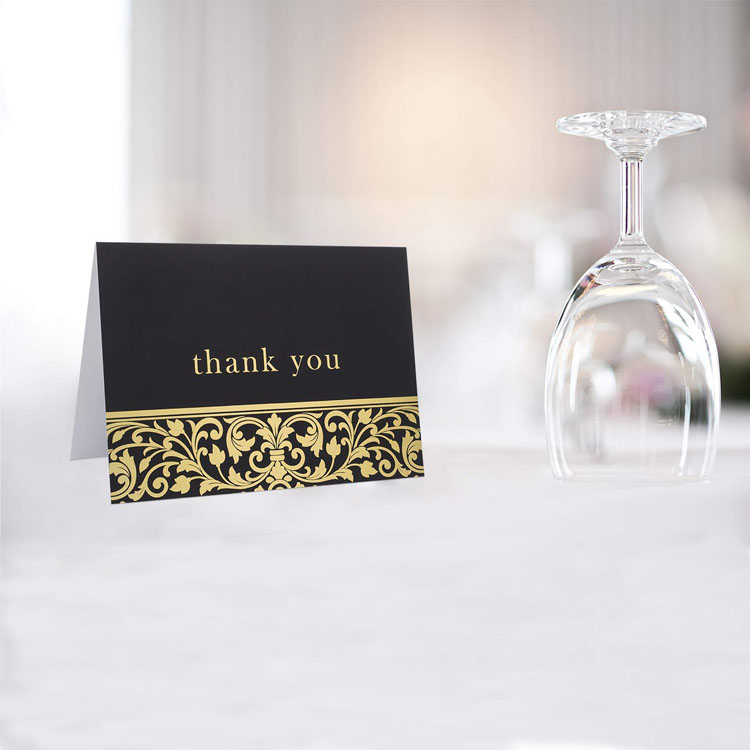
The reception-table shot shows the folded card standing as a tent beside an inverted glass, and that staging reveals a second life most couples never plan for. A folded thank-you face doubles as a place-card holder on banquet tables, a menu anchor, or a favor tag when the count is generous. Ordering extra against the same plate costs cents per piece because the sheet is already imposed; ordering a matching day-of item later means a second setup and a second proof cycle for artwork that already exists. When you size the guest list, decide whether your thank-you quantity includes day-of duty, because five hundred pieces printed once beats three hundred reprinted with a variant fold.
The fold itself is a spec. The photographed card creases cleanly with the rear panel peeking as a gray sliver at one edge, standing without a prop, which means a score and fold that holds on a table, not a crack through the foil layer. Matte black board with gold stamped on a fold line is a known risk zone; ask the sample for the tent orientation and check the crease before you sign plates.
Two more day-of applications the same face supports without new artwork. Set inside a place-card holder on a banquet table, the folded card reads as part of the tablescape rather than signage, and guests take it home instead of leaving it with the florist, which quietly converts your place cards into the thank-you inventory you were going to mail anyway. Favor bags tie a smaller version of the same ornament face to napkin rings or menu decks when the suite was designed from the start with one art file in two sizes. Planners who brief suites this way report the same benefit twice: paper budget stretched further, and zero mismatch between what guests saw at dinner and what lands in their mailbox weeks later. None of that requires a second design; it requires a second quantity decision made while the plate is still warm on the press.
Timeline pressure makes this arithmetic concrete. Reception schedules slip, guest counts drift upward when plus-ones materialize late, and a suite ordered at 250 with no margin becomes a re-order at 300 five weeks after the wedding, when the couple is back at work and nobody wants another proof cycle. The disciplined brief builds the buffer in at the start: guest count, a day-of allowance for table duty and damage, and a small correction reserve for returned mail. All three quantities come off one approved master, band into the same carton, and cost one setup instead of three. Planners who write suites this way report that the thank-you wave finishes in one weekend of handwriting at the kitchen table, which is the actual experience couples remember about the post-wedding paperwork.
The Envelope Is Part of the Suite, Not an Afterthought
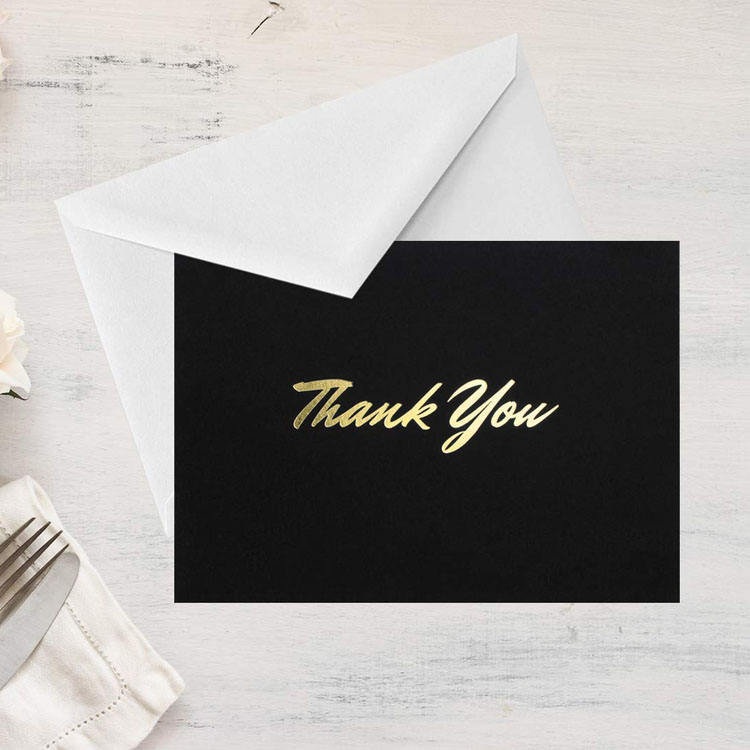
In the final flat lay, a black landscape card with a gold script face rests half over an open ivory envelope, its pointed flap angled up on whitewashed wood beside a cream rose and a folded linen napkin. Read the pairing carefully: the envelope is plain, matte, unlined as photographed, cool white to ivory, and the card is doing all the decorating. That is a cost truth worth understanding early. A black envelope with gold return address, or a lined interior peeking behind the flap, are both quotable upgrades, but the photographed suite demonstrates the elegant-cheap route: neutral paper, dramatic insert, and the couple’s message handwritten on the card itself. Size the envelope to the fold, not to the card’s flat dimension, and ask for a fit sample with the folded card inside before bulk seals ship. Wedding stationery is small enough that a half-inch mismatch turns a beautiful suite into a bent corner at every single mailbox.
Wording Zones and Keep-Sake Conventions
- Face: ornament and Thank You line exactly as the four photographed treatments, or your invitation’s own script
- Names: couple names or monogram placed as a text layer on the reverse or inner panel; file comes from your invitation master
- Date convention: wedding date, engagement date or none, all standard keepsake choices, printed per design
- Message body: blank for handwriting as photographed, or typeset keepsake wording quoted from your text list
- Envelope: ivory matte as shown; black stock, gold return-address printing and linings quoted against a fit sample
- Quantity logic: guest count plus day-of duty plus a reprint margin for address corrections, one plate run
- Mixed tiers: formal scrollwork face for elder relatives, plain script face for friends, each counted per design
Suite Build Sheet for the Season
| Item | Custom wedding thank you cards, black-and-gold foil suite matched to invitation files |
| Size | Landscape folded format as photographed; exact flat and folded dimensions confirmed with your envelope fit sample (no size printed in photos) |
| Stock & Finish | Matte black cardstock with metallic gold foil as shown; no raised relief claimed from photos; alternative board colors quoted on request |
| Printing & Artwork | Foil ornament faces, optional inner message or name layer; free digital mock-up from your invitation artwork |
| Envelope or Extras | Ivory matte envelopes with pointed flap as photographed; lining, seals and printed return addresses as quoted extras |
| Packing | Cards and envelopes banded separately in counts, interleaved in inner boxes, export masters per freight chart below |
| MOQ | 100 pcs per design |
| Sample time | 3-5 days |
| Lead time | 7-15 days after artwork approval |
| Capacity | 1,000,000 pcs per month across our gift lines |
Ordering Against a Wedding Calendar
Peak wedding seasons compress everything. Ceremony dates in late spring mean invitation proofs fight for press time in February, and the same queue exists for the thank-you wave if it was not locked earlier. The safe pattern we see from planners: approve the suite master with the invitation, keep the thank-you quantity uncommitted, then release production 7-15 days after the final address list settles, shipping by air or courier when the date is close and by sea when the season is far. Physical samples come in 3-5 days, which is exactly the window a couple needs to judge foil under home lighting rather than a screen. The 100 pcs per design floor is low enough that a split-suite order, script face for most guests, scrollwork face for the formal block, stays realistic instead of aspirational. Listed pricing holds the 100-piece tier as a reference; guest-count quantities get quoted per foil coverage, which is where ornament-heavy faces actually cost their money.
Packing and Freight to Your Door or Your Planner
Wedding orders ship in counts that matter at a dining table: cards banded in fifties, envelopes banded loose so the couple and four friends can assemble without peeling glued pairs, everything interleaved in an inner box inside a corner-guarded master. Sea, air, DHL, UPS, FedEx and TNT all quote; direct-to-home courier is normal for the final wave, and planners running multiple couples can consolidate suites in one master with per-address labels. Cards travel flat and sleeved against humidity so the foil never blocks off in a coastal summer transit.

Wedding Thank-You Questions from Couples and Planners
How late can we add thank-yous to an invitation order already in production?
Do the photographed cards have our names printed on them?
Is the gold real foil or metallic ink?
Can one design serve the banquet tables and the mailbox?
What envelope comes with the suite by default?
How many extra cards should a wedding order include?
Paper That Travels With Your Suite
See the cards category for the rest of the folded-print range and the printed items index for boxes and tags that carry the same artwork season. Rehearsal-dinner favors bundle from festival gift sets builds, and parties mailing seasonal greetings can compare the flat-mail custom christmas postcards page for a different delivery format. Play-deck keepsakes for a bachelor-weekend gift live at themed playing cards. To price a suite, request a quote or write [email protected], +86-15967739086.
Send the invitation master, set the guest count, name the ship-by date. A free digital mock-up next, the foil suite in hand within 3-5 days, and the thank-you wave out the door before the gifts are unpacked.
Picture the suite on the reception thank-you table: black faces, gold script, ivory envelopes fanned in a gift-box liner. We stage your names and date in exactly that flat-lay as a free mock-up, then post a foil sample pair in 3-5 days so couples feel the stock and check the script size before the order opens.