Custom Waterproof Vinyl Stickers Bulk | Die-Cut Decals
$1.20
Die-cut vinyl decal packs for bottle skirts, luggage shells, laptop lids, cafe counters and merch tables, printed at our factory from 100 pcs per design. Every artwork photograph on this page is a physical cutting off our own press: contour shapes with white keyline borders, flat-colour faces, matte-to-low-sheen finish as shown. Film thickness, gloss or textured laminate and weatherproofing level get selected against your stated surface and exposure – hand-washed versus dishwasher, market stall versus ski bag – then confirmed on a signed production sample before the bulk run starts. Free digital mock-up with scale and cut lines, physical samples in 3-5 days, production closed in 7-15 days after artwork approval, capacity 1,000,000 pcs per month across our gift lines. Sheets, loose packs or counter rolls; sea, air and express freight; FBA labelling and shelf-ready pack-outs done in-house.
When a purchasing team types custom waterproof vinyl stickers bulk into a search bar, they are usually pasting that exact phrase into an RFQ email two days later. This page answers it directly: we print die-cut vinyl decals for bottle skirts, laptop lids, luggage shells, café counters and merch tables, at a factory that runs more than one job per line every day. What we do not do is invent spec sheets. Every photo below shows artwork that actually left our press. Film grade, laminate and outdoor exposure ratings get confirmed against your application in writing before bulk run starts – quoted on request, then printed, then shipped.
The Decal Packs Our Buyers Reorder, Season After Season
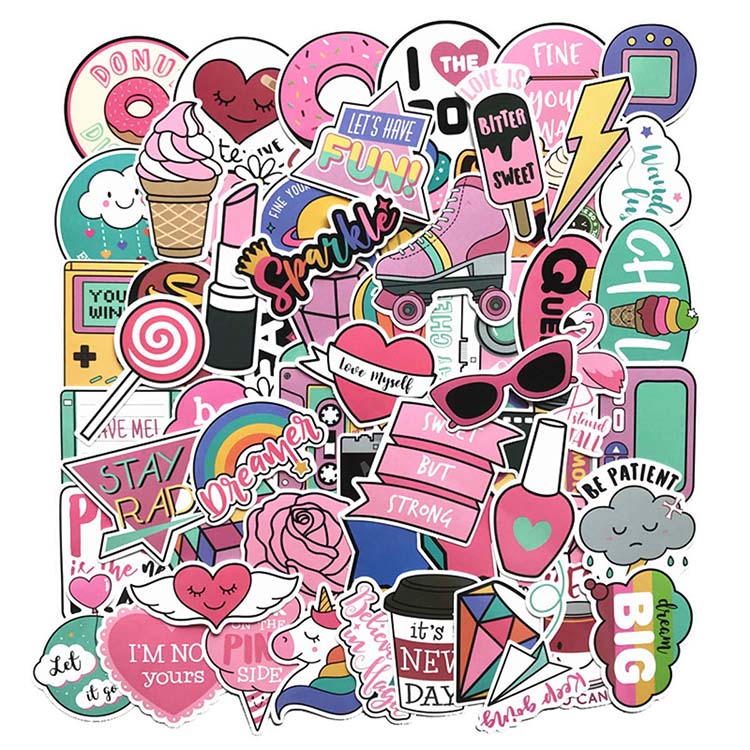
The first photo is the format most cafés, bands and small consumer brands ask for: a dense pile of individual die-cuts, each one its own contour, white border and all. Around forty shapes share a single artwork theme – dessert props, retro gadgets, affirmational wordmarks, one-liners in block caps and script – so a customer can decorate a water bottle in two minutes without a designer touching it. This is why sticker packs sell at registers: the artwork does the conversation, the decal does the advertising.
Every piece in the pile carries the same construction cues you can check on arrival: printed face, contour cut following the artwork silhouette, and a clean white keyline that separates the design from whatever surface it lands on. Relative sizes vary inside one pack – the word shapes read smaller, the food illustrations bigger – which is deliberate. Mixed scales keep the pile visually crowded once applied to a 750 ml bottle, and that crowded look is what drives repeat purchases.
Purchasing staff should read that pile as a SKU model, not a free-for-all. A pack built from one artwork sheet carries one design code, one approval, one reorder line in your system – and the customer still experiences forty “different” stickers. Splitting the same motifs across separate designs would multiply your minimums for no commercial gain. We lay out packs around a single shared theme per sheet precisely so the register SKU stays simple while the drawer feels full, and when a season needs a refresh, the sheet layout changes while the pack-level product code survives.
Consistency across reprints is the other half of that SKU story. Each new art sheet re-enters the same colour-managed press lane, and the proofing rhythm is identical every time, which is why brands keep a reference print card from the first approved batch. Ask your own question in reverse when briefing artwork: does this red have to match the previous run exactly? Say so in the mock-up email. A palette reference – spot colour number, hex value, or a physical print from your own packaging – costs nothing to honour when it arrives before the plate, and becomes an expensive argument when it arrives after a delivery nobody approved.
Rolls versus sheets is the other conversation the pile forces you to have early. A café that hands packs across a counter wants loose packs in a drawer; a bottling workshop that labels two hundred tumblers an afternoon wants the same artwork kiss-cut on a roll fed into a dispenser, and a distributor filling goodie bags wants stacks of sheets shrink-banded forty to a case. None of these formats changes the artwork file – only the winding, the backing weight and the packing line – yet choosing wrong costs a restock you cannot use. Tell us the hands that will actually touch the stickers: customers, staff, or volunteers working fast at a table. That sentence picks the format better than any catalog default, and the mock-up email is the right place to write it.
Why White-Border Die-Cuts Outperform Plain Rectangles
A die-cut border is not decoration. It is a handling feature. Peel time drops because the cutter never passes through ink, edges resist lifting on curved surfaces like bottle shoulders and helmet shells, and the white keyline gives busy artwork breathing room against loud backgrounds. When buyers compare quotes, the border decision usually hides inside the tooling line item; here it is visible in the photo because it changed how the product sells.
The same border answers a question resellers get constantly in customer email: why is there white around the edge? Once a listing photo shows the keyline and a pack description calls it a die-cut contour border with a protective white edge, the refund conversations stop happening, because the product arrived looking exactly like the picture. Artwork teams should design knowing that the contour path lives in its own layer of the file; if a die-line has to hug a tight inner curve, we can cut the keyline narrower at proof stage, and the mock-up will show both versions so nobody guesses what lands on the bottle.
The grid arrangement in the next photo shows the same logic from the opposite direction: nine shapes spaced on a controlled layout so a customer sees silhouette variety at a glance – gems, a faceted stone, stars with extruded edges, a ring doughnut, a striped balloon, a bloom. Nothing is cropped by a rectangle; every outline is its own shape. For retail cards and planner-style packs, that grid presentation converts browsers because the sheet reads like a sampler, not a remainder bin.
There is a cost angle too. Full-bleed rectangular labels waste sheet area; contour packs nest tighter, so a single printing plate stretches across more sellable pieces per square meter. On a 100-piece opening order the difference is trivia. On the 5,000-piece reorder that follows, it is money back in the margin.
Storage behaviour quietly rewards contour cutting as well. Loose rectangular labels curl at the corners when humidity swings in a container; a die-cut pack with a white border is structurally stiffer at its edges and survives a sea leg plus a warehouse rack without telegraphing damage to the end customer. That is not a marketing sentence – it is one reason the buyer’s arrival inspection checklist starts with corners. When you write your own receiving notes for decal packs, add: border uniform, no ink cracks along tight inner curves, no lift on the keyline. Three checks, no tools, and they catch the two presses that cut corners off-spec before your customers do.
Nesting economics deserve one plain example. Take a sheet size that carries sixteen two-inch contours with comfort gaps; rearrange the same motifs for tighter nesting and it carries twenty-one. Same plate, same ink, same labour, thirty percent more sellable stickers from the identical material cost – which lands directly as pack-value flexibility: either a fatter pack at your current retail price, or the same pack count at a lower landed unit cost for your marketplace listing. When your artwork set has five to twenty shapes per pack, our layout desk runs both nestings and quotes both, because the prettier grid and the cheaper grid are usually different files, and the right answer depends on whether you compete on shelf wow or on price per piece.

What the Photography Actually Proves About Construction
Soft shadows on a lit backdrop, edges lifting slightly off the surface – these shots are physical cuttings, not renders. That matters when you evaluate supplier claims. The fourth photo on this page is a two-row flat lay of snack-shaped decals: a takeaway cup, a cupcake, a shake cup with a straw, a spiral lollipop, a swirl cone, a gable-top carton, a bar on a stick, a can with a smiley. Five of the eight carry printed wording. The artwork style across the whole set is flat colour with bold black outlines, the look that survives small print sizes and stays readable at arm’s length on a moving laptop lid.
Read the shapes again as a quotation worksheet. A gable-top carton and a takeaway cup are tall narrow silhouettes that cut cheaply and nest tightly; a swirl cone with its stick is a long diagonal that wastes a little sheet area but photographs beautifully; a spiral lollipop is the cheapest round in any pack because rounds are standard tooling and need no custom plate at all. That single observation is the die-cut cost hierarchy in miniature, and it applies to your artwork the same way: if you are choosing between two logo treatments for a decal line, the one with fewer tight internal corners prints cheaper, cuts faster and lifts off the backing sheet more cleanly in a classroom or a bottling line. Ask for the nesting estimate with your mock-up and we will show the pack-size effect of your silhouette choice in actual cents per thousand.
Finish, honestly, is where we hold the line: the photos show matte-to-low-sheen faces. Any gloss, glitter or textured laminate option gets confirmed by sample before your bulk order, not promised from memory. Same rule for film thickness and adhesive tack. If your brief says dishwasher-safe bottle decals or four-season luggage decals, we quote the matching stock against that sentence – and only then does the spec sheet say it.
What you should not do is reverse-engineer our sample into a listing claim. If your signed sample survives four wash cycles on your bottle, write that sentence, with your bottle in it. If it does not, write the shorter sentence. Decal marketplaces are full of listings promising everything and refunding dishwashers; a supplier that hands you a tested, narrow truth is cheaper than a supplier that hands you a broad claim and a chargeback fee. Our sample program exists for exactly this reason: the physical piece is the contract, the spec sheet follows it, never the other way round.
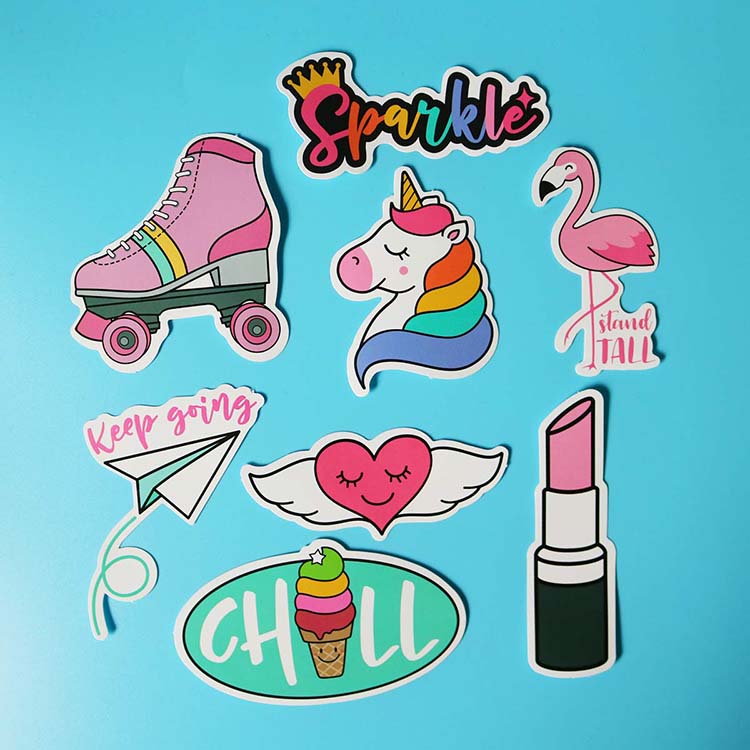
Surfaces, Service Life and the Conversations We Have Before Printing
Vinyl decals live or die by the surface they meet. Powder-coated water bottles, anodized aluminium laptop shells, polycarbonate luggage, painted steel on a food truck, glass with cold condensation cycles – all behave differently under the same sticker. When you send a target surface, we pick film and adhesive against it rather than defaulting to one house stock. That single sentence in your RFQ – “goes on 500 ml steel bottles, hand-washed, not dishwasher” – changes the quote in specific, defensible ways.
Preparation instructions belong on your pack, not in apology emails later. A decal applied to a cold, sweaty bottle edge lifts within days; the same decal on a wiped, room-temperature, dry surface holds for seasons. We print application notes into header-card copy for resellers – clean, dry, press and hold for thirty seconds, wait an hour before the first wash – because the failure rate on that one sentence explains most return piles we hear about from other brands’ distributors. Surface energy is invisible; instruction cards are cheap; the combination is the difference between a merch line that reorders and one that becomes a markdown bin.
Outdoor exposure follows the same discipline. UV fade, edge lift and adhesive creep are three separate failure modes with three separate fixes, and which one matters depends on whether decals spend the summer on a market stall tote or the winter on a ski-bag shell. Tell us the season and the substrate; we confirm the weatherproofing level in writing before the plate is made, and the production sample proves it.
For resellers, the practical upshot is a product story you can print on your own header card without hedging. We would rather hand you a confirmed spec late than watch you refund a box of decals that curled off cold bottles in week three.
A practical way to brief this line without over-committing: send the three failure fears your current product actually has. “Week two: edges lifting on curved bottle” and “month four: colours washed on a sunny windowsill” are usable sentences; “make it waterproof” is not, because every face film is waterproof against a wet cloth and the honest dividing line lives in the adhesive and the laminate. Once the fear list is written down, our studio picks the construction that answers it, prices it, and – crucially – gives you the sample and the spec language to repeat in your own listing copy. Resellers who follow that sequence ship product descriptions that survive customer scrutiny; the ones who copy a competitor’s bullet list get the chargebacks their competitor quietly budgeted for.

Merchandising Economics for Cafés, Bands and Small Brands
A statement decal pack is the cheapest branded item most small brands can carry. It ships flat, weighs almost nothing, and every applied pack turns the owner’s laptop into signage for the café or label that gave it away. Margins support that model: register-priced packs still clear room for artwork costs when tooling is amortised across the reorder cycle, and our 100-piece floor per design keeps a first run affordable for an act with two hundred mailing-list fans.
Bundle math works here too. The same plate can print a pack variant for vinyl subscribers and a single-hero decal for poster-table sales; splitting one artwork file across formats costs layout time, not new tooling. Ask for the mixed-format quote before you commit to one SKU – buyers routinely save four figures over a season by doing that.
- Custom shapes: contour die-cuts following any artwork silhouette, plus circles, ovals, rounded squares
- Custom sizes: from 1″ mini decals to 6″ wall-scale shapes, quoted on request against your file
- Sheet layout: free-form packs or grid sheets, mixed-scale within one pack on request
- Formats: sheets or rolls; roll winding for counter dispenser boxes
- Print: CMYK artwork plus white ink layers for transparent parts
- Finish options: matte, gloss, textured and protective laminates quoted on request
- Adhesive tiers: permanent and removable, selected against target surface
- Artwork: vector files preferred; we trace and tidy raster uploads at proof stage
Spec Snapshot: Durable Vinyl Decal Packs
| Parameter | What we build by default |
|---|---|
| Item | Custom die-cut vinyl decal packs and sheets for bottle, luggage, laptop and counter decoration |
| Size | From 1″ mini to 6″ wall decals quoted on request; mixed scales inside one pack available |
| Stock & Finish | Printed vinyl faces, matte-to-low-sheen as photographed; gloss, textured and laminate stock options quoted on request |
| Cutting | Die-cut / kiss-cut contour shapes; sheet or roll formats |
| Printing & Artwork | CMYK plus white ink; vector artwork preferred, tidy-up included at proof stage |
| Packing | Poly bags per pack, counted into cartons; retail header cards optional; FBA labelling and prep done in-house |
| MOQ | 100 pcs per design |
| Sample time | 3-5 days |
| Lead time | 7-15 days after artwork approval |
| Capacity | 1,000,000 pcs per month across our gift lines |
Samples, Proofing and How an Order Actually Starts
Every order follows the same three checkpoints, and none of them need a call. First, you send artwork or a rough idea; a free digital mock-up comes back showing placement, scale and cut lines against your target surface. Second, approved files turn into physical samples in 3-5 days – the decal you stick on the actual bottle you sell, not a generic proof card. Third, once you sign off the sample, bulk runs finish in 7-15 days. Reference pricing at the 100-piece tier comes with the mock-up; per-unit rates land once your exact pack size and laminate choice are in the spec.
Teams juggling several motifs should mix small quantities across designs instead of ordering one deep SKU. With 100 pcs counted per design, a five-motif launch is a 500-piece order, not a 2,500-piece bet. Test the pack, find the hero shape, then restack the order on the winner.
Packing, Freight and FBA Prep
Decals ship flat and heavy-ish in small footprints, which makes them good freight citizens. Standard packing is packs bagged, counted into inner boxes, inner boxes into export cartons with corner protection; header-carded retail packs get banded so cards do not abrade in transit. Freight runs by sea for reorder stock, by air or express couriers – DHL, UPS, FedEx, TNT – for launch dates and replacement runs. Amazon-bound orders arrive labelled and cartonised to FBA requirements, shelf-ready without a prep center stop.

Questions Bulk Buyers Ask Before Their First PO
How many pieces of each design do I have to commit to?
Can these decals survive wet bottles and outdoor use?
What artwork files do you need, and can you fix ours?
Do you supply sheets, rolls, or loose packs?
How long between purchase order and cartons leaving the factory?
Can you ship straight to Amazon fulfillment?
Where These Decals Sit in Our Print Catalog
Decal packs share plates, film stocks and proofing lanes with the rest of our sticker production line, and the wider printed items catalog covers the notebook, card and packaging siblings that brands bundle with them. If your project needs clean removal instead of permanent hold, removable vinyl decals carry their own line and spec logic. For gift-wrap touches, gold foil sticker sheets run the metallic side of the same order desk, and weekly planner icon sheets plus kawaii food die-cuts cover stationery and kids retail. Ready to price your artwork? Send the RFQ – target surface, quantity, deadline, three lines is enough to start.
One more thing before the form: send the photograph of the surface you actually plan to stick this on. It makes every later answer on this page true.