Custom Thank You Cards Wholesale Bulk Insert
$0.60
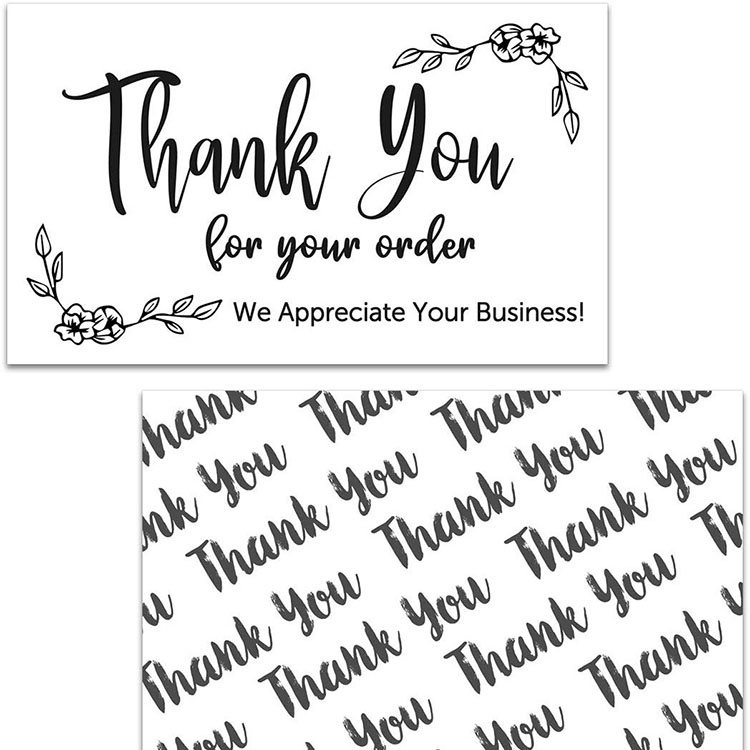
Custom thank you cards wholesale at the cheapest unit tier in our card lines: flat landscape order-insert cards for Shopify, market-stall and FBA pack-out stations. Photographed faces run white stock with black script lettering and line-art floral corners, sized 2.1 by 3.5 inches per the listing’s dimension arrows, with no fold, no envelope and nothing that slows a packer’s grab from a bin stack. Every text zone is a file-level swap – headline, sub-line, closing line, optional QR or discount block – and a companion all-over Thank You pattern sheet turns one artwork family into brand tissue and void fill. MOQ 100 pcs per design, samples 3-5 days, bulk 7-15 days after artwork approval, FBA labeling and insert co-pack supported.
Custom thank you cards wholesale: the cheapest piece of margin in your pack-out line
These custom thank you cards wholesale runs target one buyer: the small-business shipper who puts hundreds of parcels a week through a kitchen table or a third-party warehouse and needs the parcel to say thank you before the tape gun does. The photographed product is exactly that – a flat, landscape, pre-printed insert card, white stock, black script saying Thank You for your order over a line-art floral sprig in two opposite corners, no envelope, no fill-in fields, nothing that adds handling seconds to a pack-out station. Insert economics reward the boring choice: the loose card is the cheapest unit tier in our card lines, it survives being grabbed by the handful off a stacking bin, and it costs less per parcel than a sticker, a stamped mailer or an included gift. The wholesale logic is a per-order cost calculation, not a stationery calculation: one design file, one print run, ten thousand identical drops into ten thousand boxes. This page argues quantity math; if your event needs a matched card-and-envelope gift, that lives on our thank-you card plus envelope set page instead.
What the stack photo proves about insert-grade stock
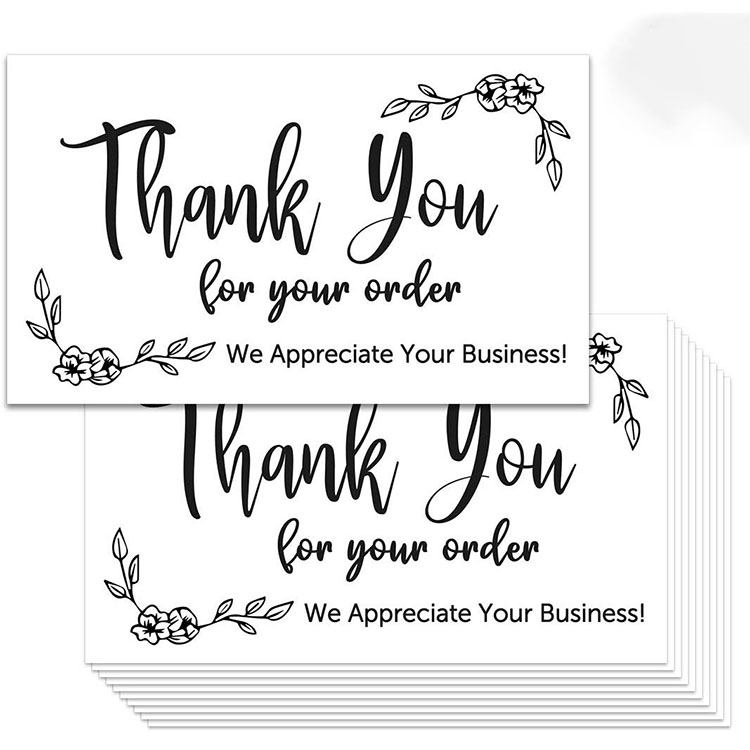
The opening image shows one card face-up over a fanned pack of identical cards, edges splayed so the count reads as volume rather than a single gift. Three build facts fall out of it. One: the piece is flat, not folded – a single landscape panel with no crease, which is why it slides into a poly mailer under the merchandise without bulging the seal or scoring a fold line against contents. Two: the ink side is one color on white; flat black over an uncoated matte face costs nothing per extra color to change wording or logo, and it photographs identically in every parcel photo your customers post. Three: the card stack casts soft shadows with visible air gaps between sheets, consistent with card stock stiff enough to lift off a bin edge one card at a time – the grab-test that decides whether packers actually use the inserts or leave them in the box. Exact grammage is not printed on any photo, so the paper weight for your run quotes on request; send our desk a photo of a competitor insert you are replacing and we match stiffness tier before sampling. Because the sample artwork carries only generic placeholder copy – Thank You, for your order, We Appreciate Your Business! – every zone is yours to overwrite: swap the line-art sprigs for your mark, replace the script with your tagline, or keep the layout and simply drop a logo where the bottom-right tagline sits. The floral corners are decorative template furniture, not a required design; stripping them for an all-typography face is a same-file edit that does not touch price.
Storage reality rounds out the stack picture. Loose flats live in open bins, under dispensers or inside a mailer shelf without any ceremony, and because nothing is folded there is no crease set that opens over months in humid storage. Count discipline at the bench improves too: a band of fifty stands upright in a bin and packers grab one card at a time without fanning the whole band, which keeps the assembly line’s rhythm – box, product, tissue, insert, seal, label – unbroken. That rhythm is why insert buyers rarely reorder a fancy format: the cost of a slow pack-out minute compounds across every parcel, and the flat card was designed to be invisible to the process while still visible to the customer opening the box.
When a wave finishes and the bin bottoms out, the same inner-pack spec pulls straight off the next carton with no sorting – a detail quality teams care about far more than the last design flourish.
The 2.1 x 3.5 inch annotation and why it matters to packers
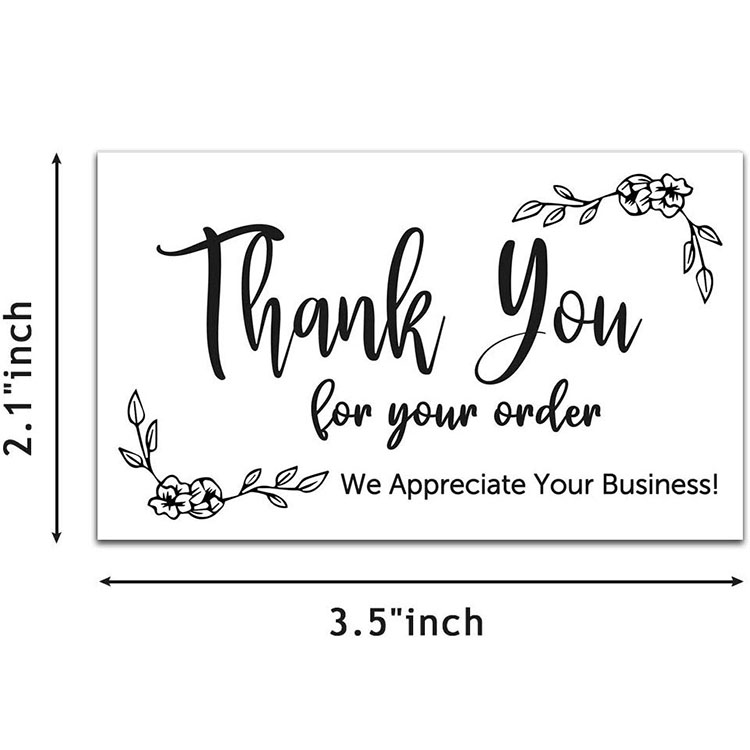
The specification diagram marks the card with dimension arrows – 2.1 inch height, 3.5 inch width – as a listing annotation rather than print on the card itself, and that footprint is the entire insert economy in two numbers. A landscape of this proportion drops into a standard business-card sleeve, a poly mailer flap or a box lid without tape, because 3.5 inches is a card-width norm that packers already handle by reflex; nothing awkward about it needs a second hand. It clears the common 4×6 photo slot price step and prints many-up on sheet stock, which is where the low unit cost comes from – same press sheet, more cards per pass, less waste trim than a square format. The proportion also fits the window of a standard #10 envelope for sellers who occasionally mail the card solo, and shrinks packaging height dramatically compared to folded cards: a carton of these flats gains density that folded stationery simply cannot match, cutting dimensional weight on courier lanes. Planogram note for retail resellers: the same face packs into counter stacks behind checkout, one sleeve per flavor of message – order-thanks, review-ask, repeat-purchase code – each sleeve a separate design at MOQ 100 pcs per design, but sharing one sheet so reorders of two or three sleeves run together. The three-line layout in the diagram (large script headline, smaller script sub-line, sans-serif closing) is a template that tolerates heavy text substitution without redesign: a discount code line, a review link, or a handle in the closing zone all sit on the existing baselines.
On the diagram itself, note what the arrows do and do not claim. They set a footprint, not a grammage or a coating system – the listing gives no paper weight print, so sample first if your insert must pass through a laser printer for per-order notes. Some sellers do exactly that: buy the blank-faced tier, print order numbers at the desk, then insert. If your station is inkjet rather than laser, request the sample with the coating option quoted on request; curl from a hot fuser against an inkjet drum is a different failure mode, and both live at the bench. The clean diagonal composition of headline, sub-line and closing line in the diagram is also deliberate OCR-friendliness: the phone camera scanning a parcel photo can read all three tiers, which quietly supports social reposts of your box.
The corner sprigs, mirrored on the diagonal, are the cheapest possible way to make a black-and-white face feel designed rather than generic; keeping them while swapping all three text tiers is a common compromise between brand-look and file-level simplicity.
Batching, mixed designs and the reorder rhythm
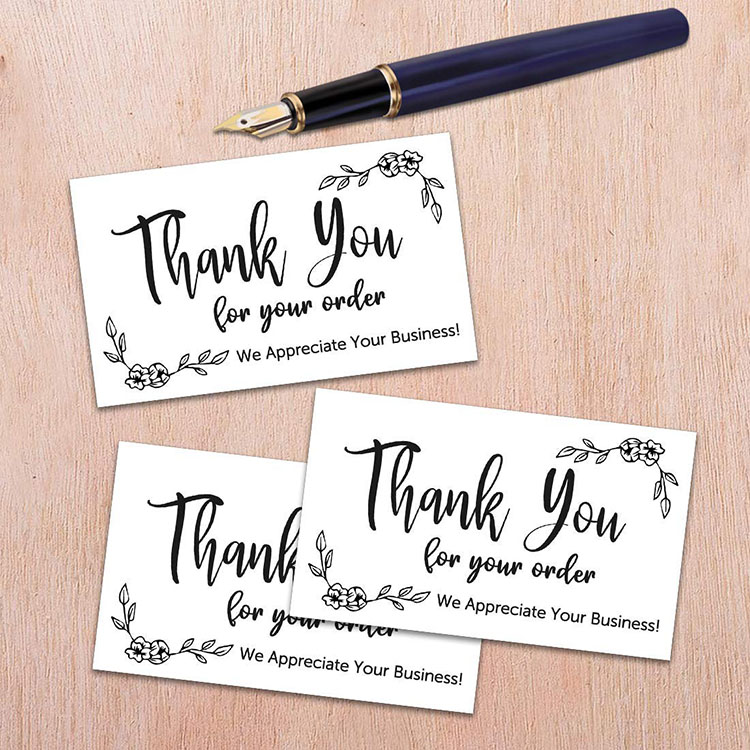
The three-card scene with a plain prop pen makes the batching argument visually: identical faces, loose count, no packaging ceremony between units. In production terms, insert buyers order by wave length, not by campaign. A shop averaging forty parcels a day burns roughly a thousand inserts a month, so the rational pattern is one annual design family printed quarterly – a 1,000-piece drop per quarter lands inside the same 7-15 day window after artwork approval and keeps every carton the same paper stock as the season before. Mixing is supported at the file level: six message sleeves under one artwork sheet pay six MOQ 100 pcs per design floors, and cartons can be pre-mixed by ratio – say three order-thanks sleeves for every review-ask sleeve – packed to your inner-count spec so a new carton opens straight onto the assembly line. The photo’s unbranded pen is worth one honest note: it is a styling prop implying handwriting, but these inserts ship loose precisely so nobody handwrites; at high volume the pack-out cost of signing anything exceeds the sentiment gained. Keep handwritten touches for low-volume premium orders and let the printed face carry the thank-you at scale. Artwork turnaround stays boring on purpose: send a logo file and two lines of copy, receive a free digital mock-up the same week, approve, and the clock reads 7-15 days to finished cartons. When a print run completes, spare capacity across our lines holds 1,000,000 pcs per month, so a surprise spike – a viral listing, a market stall, a wholesale trial order – reprints the identical file with no new proof, usually inside the next weekly ship cut-off.
Freight behavior of this tier deserves one concrete aside for small importers: flats in count banded inner packs compress well under carton lids, so a mixed order of inserts plus another flat printed line travels as one shipment with shared cube, not two parcels. Sellers testing a new product line routinely start with the cheapest possible branded touch – a thousand inserts at the same print plant as their hang tags – and the loose tier is usually where that experiment begins because the reorder decision is a spreadsheet, not a sentiment.
One caution for consolidators: inserts shipped loose fill dead space in another line’s cartons beautifully, but tell the order desk whether they need their own sleeve count labels – warehouse putaway scans pick by label, not by guess.
Because there is no fold, edge scuffing never happens, which matters once cartons move on forklifts rather than hands – the corner rub that ruins folded retail cards leaves a flat insert face untouched under the band strap.
Pattern companion sheets and turning one file into brand paper
Below the card face in the last photo sits the same message system run as an all-over pattern: the script Thank You phrase tiled in offset diagonal rows, cropped at every edge, printed on a companion sheet. Read it as a program lever rather than a second product. Brand-pattern tissue, void-fill slips and header cards for your box all draw from one repeat file built off the insert artwork – a single design fee stretched across packaging touchpoints that all carry the identical lettering. Sellers who already order these inserts ask for the repeat as an add-on line on the same proof, and it ships as sheets rather than formed paper so you cut it to your own box dimensions. For the e-commerce review economy, the card face also takes the ask the photos do not show but the file can hold: a QR code block, short review URL or discount line set into the bottom-right closing zone where the sample tagline sits. Treat that as a custom artwork variant, not a printed feature of the pictured stock. Every tier – loose insert card, pattern companion sheet, QR-equipped face – shares one truth: the cheapest unit cost in this catalog comes from staying flat, one color, no envelope ceremony.
Insert Economics in One Table
| Item | Loose thank-you insert card, single landscape face (no envelope) |
| Size | 2.1 in x 3.5 in per the dimension-arrow diagram on the listing photo; other flat formats quoted on request |
| Stock & Finish | White card stock, matte face, flat one-color print; GSM not printed on photos, quoted on request with stiffness sample match |
| Printing & Artwork | Black or spot/full-color on white; swappable headline, sub-line and closing zones; optional QR or code block; free digital mock-up |
| Envelope or Extras | None with the loose tier; matched sets live on the thank-you cards with envelopes page; companion pattern sheets per artwork file |
| Packing | Loose counts in inner sleeves, bins or shelf cartons; pre-mixed design ratios by spec |
| MOQ | 100 pcs per design |
| Sample time | 3-5 days |
| Lead time | 7-15 days after artwork approval |
| Capacity | 1,000,000 pcs per month across our gift lines |
Quote math for a pack-out station
Unit cost here behaves differently from gift stationery: the driver is up-on-sheet, not embellishment. A flat landscape prints many-up from one plate set, so per-thousand pricing improves steeply between a 1,000-piece top-up and a 10,000-piece wave – the page lists a 100-piece reference tier because it is the entry door, not the operating number. Send your monthly parcel count and we quote the burn-rate band instead, including how many reprints the annual quantity covers at your average daily drop. Samples arrive in 3-5 days so a packer can run the grab test off a bin stack before the wave prints. One more lever with real weight: consolidation. Because inserts ride the same freight class as the packaging they live in, sellers buying mailers, stickers and cards together ship one combined export carton; sea, air and DHL / UPS / FedEx / TNT lanes all quote against that merged cube rather than three separate small parcels.
Packing, freight and FBA co-pack
Insert cartons travel flat, banded by count or loose-filled to bin spec, and stack against any parcel supply in the same shipment. For FBA sellers we label and pack units into inbound cartons and co-pack these inserts inside product boxes at the factory where your SKU prep allows, which removes the pack-out step from US warehouses entirely. The composite below shows the racking, sort line and courier lanes behind export shipments.

Why buy loose cards instead of thank-you sets with envelopes?
How many thank-you cards should a busy shop order per wave?
Can the card carry a QR code or review link?
What file do you need for our logo version?
Do you co-pack inserts into product boxes for FBA?
Pack-out supply neighbors
Shippers who need the gift moment instead of the insert moment should jump to thank-you cards with envelopes, where set construction is the argument. For event seasons, our fill-in birthday invitation cards share this page’s one-file, many-uses logic, and the cards category holds the rest of the flat-pack lineup. Send your monthly volume to the quote desk for burn-rate pricing.
Get the insert into next week’s parcels
Email [email protected] or call +86-15967739086 with parcel volume, message lines and your logo; a mock-up and a 3-5 day sample slot follow immediately.