Custom Monthly Planner Stickers | Grid Sheets MOQ 100
$1.10
Custom monthly planner sticker sheets built on real date grids: month blocks with weekday rows and abbreviation pills, TO DO and GOALS headers, habit-icon tiles in a sage, periwinkle and blush palette, kiss-cut on a white liner. Built for journaling brands, stationery subscription boxes and planner publishers – one sheet can carry calendar, checklist and tracker in a single colour story. MOQ 100 pcs per design, free digital mock-up, physical samples in 3-5 days, bulk 7-15 days after artwork approval, capacity 1,000,000 pcs per month across our gift lines. Sizes quoted from 1-inch minis; sea, air and express courier shipping with FBA prep available. Send your month list, year and palette for a reference price at the 100-pc tier.
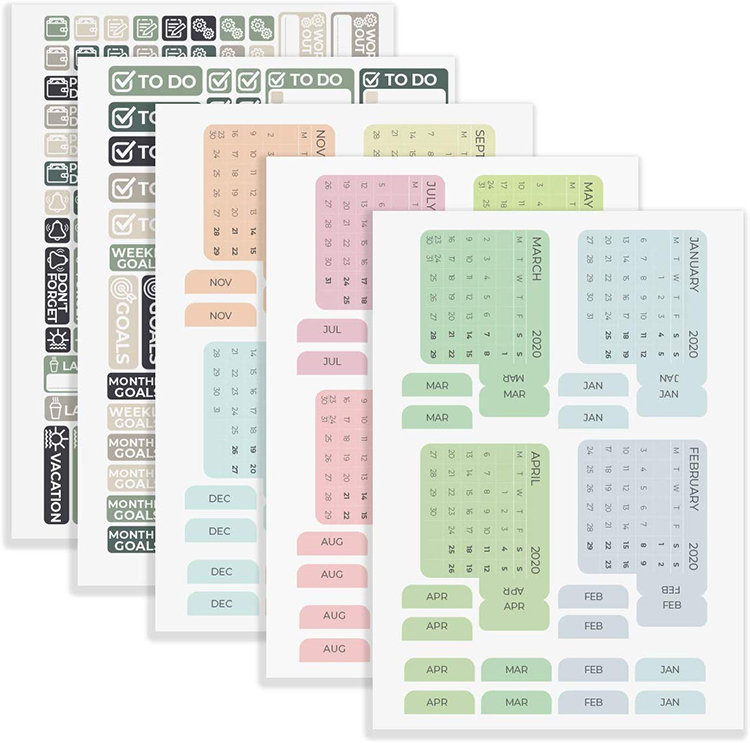
Custom monthly planner stickers for journaling brands, stationery subscription boxes and planner publishers. The photographed sheet system starts with the month grid itself: rounded colour blocks headed JANUARY, FEBRUARY, MARCH and APRIL, seven-column day matrices with weekday rows, and matching abbreviation tabs printed as small pills beside each block. Sage, periwinkle, blush, peach and mint fields sit on a white release liner, printed flat and matte, kiss-cut so each piece lifts cleanly off the sheet. We print your version of the mechanic: your calendar year, your month names, your palette, your header wording, from 100 pcs per design.
The Date Grid Is the Product, Not the Decoration
Planner sticker packs fail in one of two ways: the grids do not match the calendar the buyer actually keeps, or the decorative icons carry the pack while the functional pieces run out mid-month. The photographed sheets solve both. Every month block stacks the full month name and the year along its right edge, keeps the day numerals in a tight 7-column matrix, and pairs the block with its own abbreviation pills – MAR, APR, FEB, JAN – printed in duplicates so index flags do not have to be rationed. Blocks alternate two ways across the liner: a 7-day row running MO to SU, and a Sunday-first row running S to S, which means Monday-start and Sunday-start planners can each find a matching SKU without a custom die-line.
Around the grids, the same liner carries the checklist hardware a monthly review needs: TO DO header pills and ruled blocks with checkbox glyphs, GOALS targets with concentric-ring icons, stacked WEEKLY GOALS and MONTHLY GOALS tabs, and a banner column that reads WORK OUT, MOTIVATION and VACATION in knockout caps. A separate strip of square habit tiles covers the tracker layer – bell, book, bottle, gear, heart, sun, runner line icons on alternating cream and forest-green fields. For a brand owner, this is the argument to put on the listing: one sheet carries the calendar, the checklist and the tracker in a single colour story, so the pack sells as a system instead of a handful of cute shapes.
Palette discipline is part of the value. The photographed set holds one restrained family – sage and forest green, periwinkle, blush, peach, oatmeal – which means monthly drops shelf-stack into a coherent line rather than reading as twelve unrelated packs. Subscription operators with a fixed seasonal colour calendar can lock that calendar at artwork stage and reuse the layout all year.
Who Buys Month-Grid Refill Sheets
The clearest customer is a journaling or planner brand that sells a physical monthly refill. Their box needs one sticker product per month, a fixed slot in the packing list, and a supplier who can repeat the identical die-line for twelve consecutive drops. Because MOQ is 100 pcs per design, a pilot of a single month costs the same as a pilot of the whole year – you decide which one you want to validate first.
Stationery subscription boxes are the second profile. For them the arithmetic is per-box fill cost, carton density and a January mail date that never slips; flat sheets ship light and stack flat, which keeps the shipping slot predictable. Gift and souvenir channels buy the same mechanic as undated year grids for corporate gifting, and education suppliers bundle these sheets with agendas at the back-to-school peak. Amazon private-label sellers pair the sheets with their own planner for bundle listings – we can handle FBA labelling and prep so the bundle arrives shelf-ready.
If you are testing demand before committing to a twelve-month calendar, start with the month that anchors your box – typically JANUARY – and order the same layout in two colourways rather than two calendars. Reusing one die-line across colourways keeps the run inside a single design cost and gives the listing a variant story for free.
Planner-box publishers have a third requirement nobody else asks for: the sheet has to survive being the last item into the mailer. Sticker liners travel at the bottom of a box that carries a spiral agenda, a pen and a tin of clips, so the sheet is the cheapest part of the kit and the most visible dent if it arrives cracked. Flat-stiffened packing solves that; it is a spec line, not a surcharge conversation, and it belongs on the first sample approval so drop twelve arrives like drop one.
The refill arithmetic is what makes this page different from a generic sticker listing. A subscription operator sells continuity, so the sticker slot inside the monthly box has to clear the same desk every month with the same effort: same sheet footprint, same bag size, same position in the packing sequence, artwork changes limited to the month name, grid and seasonal colour. One die-line repeated twelve times costs one tooling conversation, not twelve. Publishers of undated agendas take the mirror strategy – the grids are year-agnostic on request, with the year printed as replaceable text – which lets a January gift buy, a birthday buy and a September back-to-school buy all pull from the same stock.

What the Photographed Samples Prove
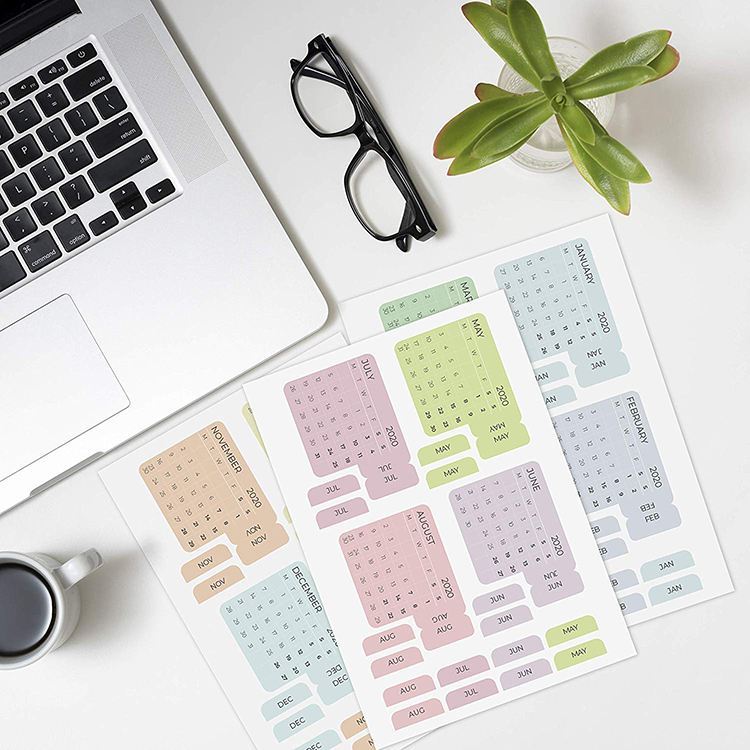
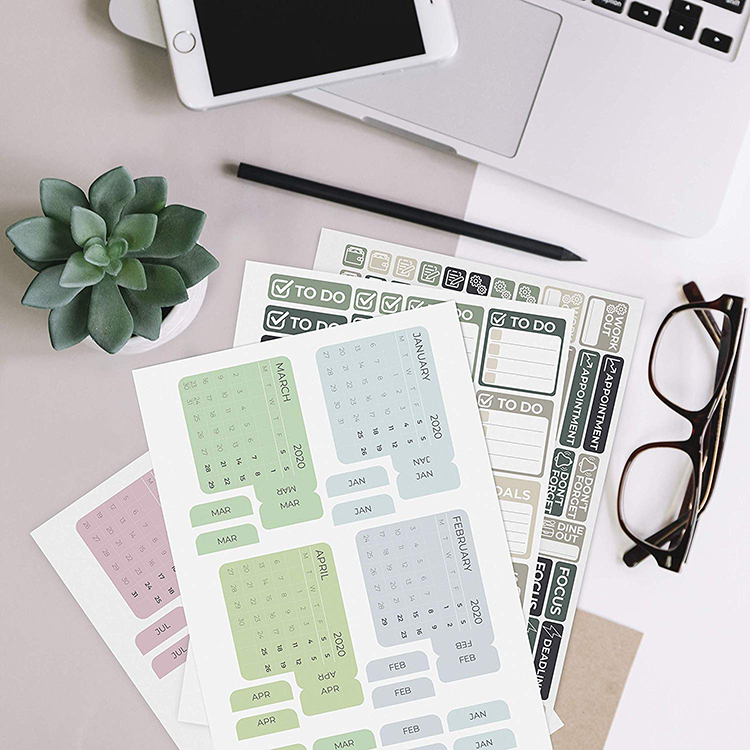
Four images were reviewed before this page was written, and the copy only repeats what they show. Sheet one fans four white liners with rounded corners: a habit-icon grid, a TO DO/GOALS header stack, warm-tone month tabs (NOV, JUL, MAR, DEC, AUG), and a front sheet with 2020 grids for MARCH, MAY, JANUARY, APRIL and FEBRUARY, the February block correctly running to 29. The desk scene puts the sheets next to an open planner whose own spread is headed JANUARY with dates 1 through 31, and a fan of coloured sheets whose side tabs read MONTH and WEEK – the tab vocabulary you would expect from a refill programme. The third shot shows a coordinated set with peach trim carrying month blocks in mauve, soft green, lavender, tan, mint and periwinkle. The fourth adds the category-label column: APPOINTMENT, DON’T FORGET! with a bell glyph, DINE OUT, FOCUS and DEADLINE stacked as vertical pills.
What the photos do not prove is equally controlled on this page. No sample carries printed dimensions, so sizes stay in the quoted range. The liner could not be confirmed as paper or vinyl from the images, and no adhesion or smudge data was tested, so stock and pen compatibility are quoted on request with a physical sample – 3-5 days – before you commit anything to a listing. The visible year is 2020, which is sample data, not a limit: supply any calendar year at artwork.
Read that evidence list as a buying checklist for your own listing copy. Every claim that survives this page – the knockout-caps headers, the two weekday conventions, the duplicate abbreviation pills, the February-to-29 grid, the MONTH and WEEK side tabs – came off the four photos, which is exactly the density a retail bullet list can borrow without inventing anything. Claims the photos cannot support – paper versus vinyl liner, ink smear resistance, adhesive strength through a year in a filled journal – are held at quote-on-request and settled with the 3-5 day sample. That discipline protects you on the listing: your product page states what the sample proves, your review section matches it, and neither the marketplace team nor a complaint cycle finds daylight between the two.
One detail worth copying from the photographed boards into your own proofing routine: grid alignment. Every month block in the samples is keyed so the first of the month lands under the correct weekday letter, and February prints 29 in the leap year shown. When a customer receives twelve grids for a real calendar year, an off-by-one weekday row is a one-star review pattern, not a typo. Proof every month against your target year at artwork – the free digital mock-up goes out with weekday alignment marked, so that check happens before the sample, not after.
Specify Your Own Line
Every layer of the photographed system is separable, which is how one tooling set stretches across a product line:
- Calendar content: year, month names, language, Sunday-first or Monday-first grid, optional holiday or lunar-phase dot marks like the ones printed on the sample grids
- Tab set: abbreviation pills, full-name pills, or the MONTH/WEEK side tabs from the fanned colour sheets
- Header wording: TO DO, GOALS, WEEKLY GOALS, MONTHLY GOALS, DEADLINE – or your brand’s own checklist phrases
- Habit icon library: swap the bell, book, bottle, gear, sun and runner tiles for custom line icons from your artwork
- Sheet architecture: all-twelve-months on one liner, one sheet per month, or a mixed grid-and-header sheet for a single hero SKU
- Colour: one palette across the year, or per-month colour coding locked to your seasonal drop plan
- Packaging: polybag, kraft or printed sleeve, header-card retail hang, multipacks per mailer box
- Private label: your logo on liner, packaging or both; barcode-ready labels on request
- Format: kiss-cut sheets as photographed; roll format for high-volume dispenser lines quoted on request
Mixing designs inside one MOQ is usually the buyer’s key question, so here is the plain rule: one artwork layout equals one design. A sheet that carries all twelve grids is one design; twelve separate month sheets are twelve designs at 100 pcs each. Most subscription operators run the middle path – three layouts (winter, spring, summer/autumn colourways) with month text switched at artwork – and pay for three designs, not twelve.
Habit-sheet variants work the same way: a tracker sheet whose icon column stays fixed while the header row rotates (WATER, READ, MOVE, SLEEP – or your brand’s own vocabulary) is one layout with seasonal text. Retailers who list a base pack plus monthly limited editions get the scarcity play without the tooling bill, and the edition artwork is a colour-and-header swap we turn around between bulk slots.
Artwork handoff is deliberately shallow for repeat drops. Send a layered PDF or AI file, or simply a spreadsheet of month names, header phrases and hex references against the approved layout – the layout itself is frozen, so monthly changes are text swaps that re-prove in a day. Colour references are settled on the physical sample, not a screen: the sage-to-periwinkle family on the photographed liners shows how little chroma this category wants, and a press proof against your planner paper avoids the one return driver this SKU has, pages that look washed out next to the box photo.
Specifications at a Glance
| Item | Custom monthly planner sticker sheets – month grids, abbreviation tabs, checklist headers, habit icons |
| Size | The liner photos carry no printed dimensions; sheet and piece sizes quoted from 1" mini tabs up to 6" blocks |
| Stock & Finish | Flat matte print, white release liner; stock options quoted on request |
| Cutting | Kiss-cut on sheet, rounded outer corners as photographed; single die-cut pieces on request |
| Printing & Artwork | Full-colour offset or digital; free digital mock-up before production |
| Packing | Polybag, printed sleeve or header-card retail pack in export master carton; FBA prep on request |
| MOQ | 100 pcs per design |
| Sample time | 3-5 days |
| Lead time | 7-15 days after artwork approval |
| Capacity | 1,000,000 pcs per month across our gift lines |
What the 100-piece tier costs depends entirely on your sheet spec, so pricing travels with quantity; we do not publish a flat rate.
Order Flow: Artwork, Sample, Bulk
Send the grid list (months, year, weekday start), header wording, palette references and any logo files – AI, PDF or high-resolution PNG all work. We return a free digital mock-up showing sheet layout, cut lines and tab placement. Approve the layout and a physical sample ships inside 3-5 days – enough to check pen behaviour, liner peel and colour against your planner paper before the bulk slot opens. Once artwork is approved, bulk takes 7-15 days; the line sits inside a monthly output of 1,000,000 pcs across our gift lines. For a January box drop, freeze artwork in autumn: approval to door needs the 7-15 day production window plus your chosen transit, and mail dates do not move.
Reorder logistics are deliberately boring: once a layout is approved it is archived against your account, so a re-run is a quantity and transit decision, not another artwork cycle – which is what makes a monthly refill programme feasible at MOQ 100 pcs per design rather than a one-time launch gamble.
Packing, Shipping and Retail Readiness
Sheets go out flat between stiffeners, banded in retail-count bundles, then into export cartons sized to your pack format; carton counts and weights are quoted per final sheet size so box fill stays predictable. Ocean, air and courier lanes all work – DHL, UPS, FedEx, TNT among them – pick against your replenishment window. FBA sellers: labelling, prep and shelf-ready bundling with your planner SKU are handled here. A monthly-refill line is a twelve-promise commitment; the packing spec should be locked on the first sample so every drop after it is boring, which is exactly what a subscription operator wants.

Questions Buyers Ask Before Ordering
Do the month grids print for a specific calendar year?
Is every month a separate design at 100 pcs?
Can the stickers be written on with pens?
What sizes do the sheets and stickers come in?
Sheets, or rolls?
How does a January subscription drop get scheduled?
Related Print Lines and Your Quote
Browse the wider sticker collection and the full printed items catalogue for adjacent SKUs: reward sheets for classrooms (school-supply reward stickers), name-label lines for garments (no-iron fabric labels) and nursery gear (baby bottle name labels), plus removable wall decals for the room the planner lives in. Party-season add-ons sit in the party items category. When your month list and palette are ready, request a quote and the free mock-up comes back with the 100-pc reference price attached.