Custom Thank You Cards with Envelopes Matched Sets
$0.60
Custom thank you cards with envelopes engineered as one matched set: a white landscape face with watercolor florals and bold THANK YOU type, sized to slide into a kraft triangular-flap envelope that closes under a round printed sticker repeating the bouquet. This page argues the pairing mechanics a gift-set buyer cannot skip – envelope cut chosen from finished card trim, closure survival in transit, blank interior sized per the photographed 4 by 6 inch annotation, and pack formats from loose component sleeves to assembled belly-banded retail units. Envelope color, lining and interior print options quote on request. MOQ 100 pcs per design, samples 3-5 days, bulk 7-15 days after artwork approval, FBA labeling and mixed export cartons available.
Custom thank you cards with envelopes, engineered as one matched set
Custom thank you cards with envelopes are a construction problem before they are a design problem: a card that gifts well has to sit inside an envelope that closes, seals, packs and shelves as a single unit, and every mismatch between the two halves becomes a return, a bend or a warehouse workaround. This page is written from that engineering angle – pairing, sizing, closure and pack format – for buyers who need the whole assembly specified rather than just a pretty face. The photographed set demonstrates the standard build: a white landscape card with a watercolor floral cluster anchored top-left over a bold black THANK YOU line, matched to a natural kraft envelope with a triangular flap, closed by a round printed sticker repeating the same bouquet in miniature. Four images, four decisions: face and margins, stack density at the seal, card-into-envelope fit, interior function. The loose no-envelope tier exists separately for parcel inserts; what follows argues for the set form, where the envelope itself is part of the product cost and the unboxing.
The pairing stack: what the envelope pile tells a packager
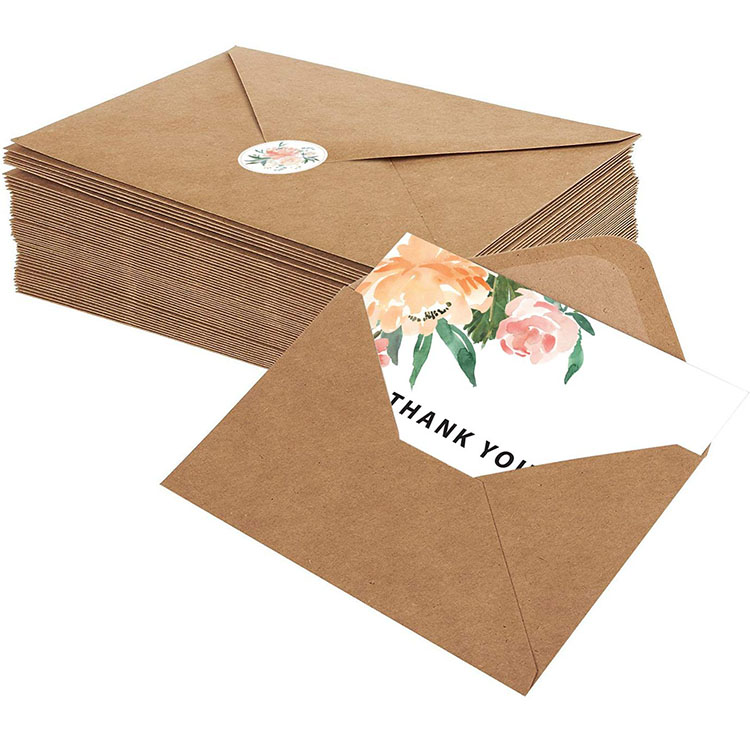
Start with the background pile – a dozen or more kraft envelopes stacked face-down, backs to camera, edges flush. That image answers three packing questions at once. First, construction: the classic diamond body with a V-shaped sealing flap and a centered round adhesive sticker shows how the set closes without a gummed strip or tuck tab, which is the cheapest reliable closure at volume and the one that survives transit compression without popping. Second, density: unprinted kraft envelopes in a tight pile nest with almost no trapped air, so a thousand units occupy a small, predictable carton cube – and the sticker is applied at the flap tip, not the body, keeping the stack flat rather than bumpy. Third, color behavior: natural kraft is a warm mid-tone that photographs consistently under warehouse, phone and retail lighting, and it hides shipping scuffs that a white envelope would show on the shelf. The envelope body itself carries no ink in the photo, which is a cost decision worth understanding: an unprinted envelope means your art budget concentrates on the card face and the seal sticker, two small print units instead of three large ones. If your brand wants envelope printing anyway – a return address band, a handle, a tone-on-tone logo – it quotes as an added press pass per unit, and the mock-up stage is where you see whether kraft or a white envelope makes the print legible. For set programs we typically band envelopes in fifties, count-check the sticker stock separately, and let the pack line marry card to envelope at the bench, so a damaged card never drags a good envelope into the reject pile.
One procurement subtlety in the pile: envelopes and seals consume inventory on different clocks. Envelope stock is stable across programs, while sticker seals carry your current artwork and go stale the moment a campaign ends. Order seals as a separate line item at their own count, and the envelope pile keeps working for next season’s face without becoming dead stock. Kraft also behaves predictably under label adhesives: the uncoated fiber surface grips a sticker edge without the corner-lift you get trying to seal a gloss-coated envelope, which is exactly why kraft-and-sticker became the default closure grammar for gift stationery, and why the photographed set uses it instead of a tuck tab that shows wear after one open-and-close.
Cost transparency note for the pile: kraft envelope stock is the single largest variable in this set after the card itself, and an unprinted, sticker-sealed kraft is the floor price – the sticker covers closure and branding art in one die-cut circle, which is why the photographed program repeats the bouquet there instead of printing the envelope body. Lined envelopes, colored bodies and printed flaps each lift the set price in predictable steps you can model on the sample quote.

Face geometry: margins, grip point and why the hand matters
The held card is the face spec in one picture. A watercolor cluster – peach bloom, blush rose, trailing greenery, small coral and mustard accents – sits anchored in the top-left corner, bleeding toward the edges; the greeting THANK YOU runs bold, all-caps and wide-tracked through the center-right; everything else is deliberately empty white. That asymmetry is not decoration, it is function. The empty lower-right field is the zone where your shop name, a website line or a single social handle can be printed without touching the art, and because the type sits on white rather than over the florals, small secondary text stays legible at card scale. The grip itself proves handling behavior: the thumb holds the lower edge, fingers behind, and neither the artwork nor the greeting lives where fingers naturally touch, so the printed face survives being passed hand to hand without rubbing at a hot-spot; matte print over a smooth white sheet means no fingerprint shine either. The thin white margin framing the art matters at the die-cut stage too – full-bleed florals would tolerance-hunt on every guillotine setup, while a margin absorbs registration drift silently. Square corners, landscape format, clean trim: the face is engineered to be produced a hundred thousand at a time and still look intentional. Custom zones that ride the same file: greeting swap (thanks, gratitude, appreciation wording), floral palette shift, logo in the open field, a second language line under the greeting. Each new artwork file is one design at MOQ 100 pcs per design.
Scale reads differently when the card comes pre-folded – the bi-fold versions stand tent-style on a counter and present the same face geometry with an interior already engineered for message or photo. Both the flat variant and the folded variant quote from the same printed sheet, and the choice is made in the die-cut step: one fewer crease line or one more, scored so the fold closes square without a puff. Ask the mock-up stage to show your artwork in both configurations; the florals anchor top-left either way, but the fold changes where a logo line sits relative to the greeting, and catching that before bulk is free.
On the hand-hold specifically: ask for the same grip test on your own sample. The correct set feels like one object – the card neither rattles loose in an oversized envelope nor binds in a tight one, and the thumb pressure that holds the face should not bend its corners, which is where a too-thin card stock announces itself before a customer ever opens the flap.
Sizing math and the seal: matching the halves
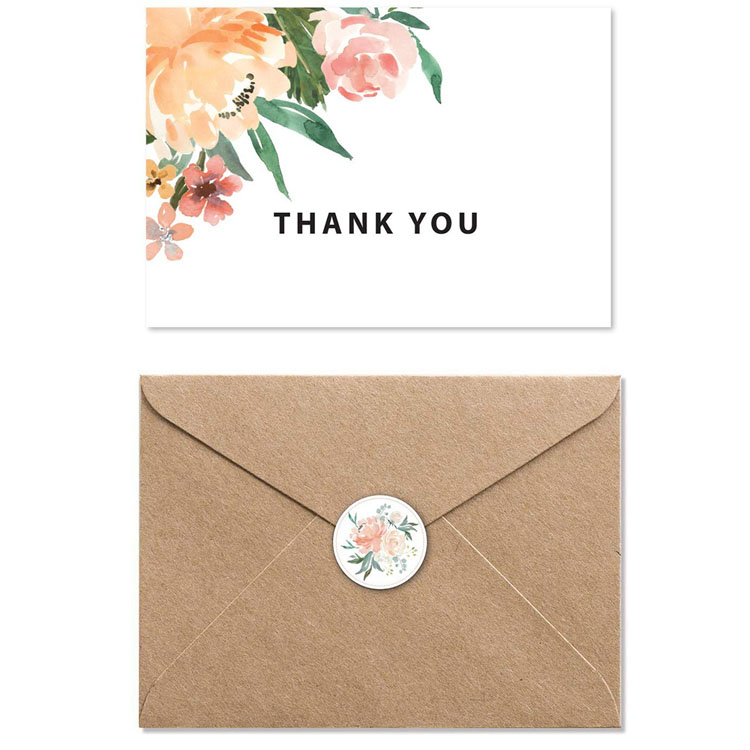
The paired shot – card centered above its sealed envelope, both flat on white – is the image a buyer should study before signing a quote, because the set’s sizing relationship is the most-forgotten spec in greeting procurement. The envelope shows the flap-side geometry the pile introduced: kraft body, triangular flap closed to center, round sticker printed with the miniature bouquet seated exactly at the flap point. On fit: the envelope is cut to accept the card with working clearance, so the card slides in without corner curl and the flap still lies flat under the sticker – which is the whole set’s core tolerancing problem, and it is solved by choosing the envelope size from the finished card size, never the reverse. In the industry’s common language, a folded 5×7 (A7) card travels in an A7 envelope with a few millimeters of play; the formats on the photographs carry no printed numerals, so we match envelope size to your artwork’s trim after the mock-up locks, and lining, adhesive strip versus sticker, and envelope color all quote on request as set variants. The seal deserves its own cost note: a round printed sticker is the lowest-risk closure we run – no moisture strip activation, no peel-and-reseal failure in humid freight, and the sticker art repeats the card bouquet, so the set reads designed from across a table. Belly-band or sleeve pack formats replace the sticker with an outer band when you want retail shelf packs; both configurations ship from the same card and envelope stock, which keeps inventory simple between seasons.
Sticker versus sleeve is the other seal-side fork. A belly band wraps an assembled card-in-envelope set and prints on the band instead of the components, which retail buyers prefer because the band carries the shelf information – count, size, brand – while the envelope stays unprinted and cheap. A cellophane sleeve with a sticker tab does the same job for gift-box programs that need dust protection at the wholesale end. All of these closures protect the same two printed surfaces, and every one of them ships from one artwork family, so a program can switch pack formats seasonally without re-proving the face.
Bench test protocol on your sample round, in four moves: slide the card in, seal the sticker, shake the set against a palm, then open and reseal once. A set that passes all four without corner curl, sticker lift or flap warp is ready to pack; anything that fails is a sizing or adhesive question to answer before the bulk cut, not after.
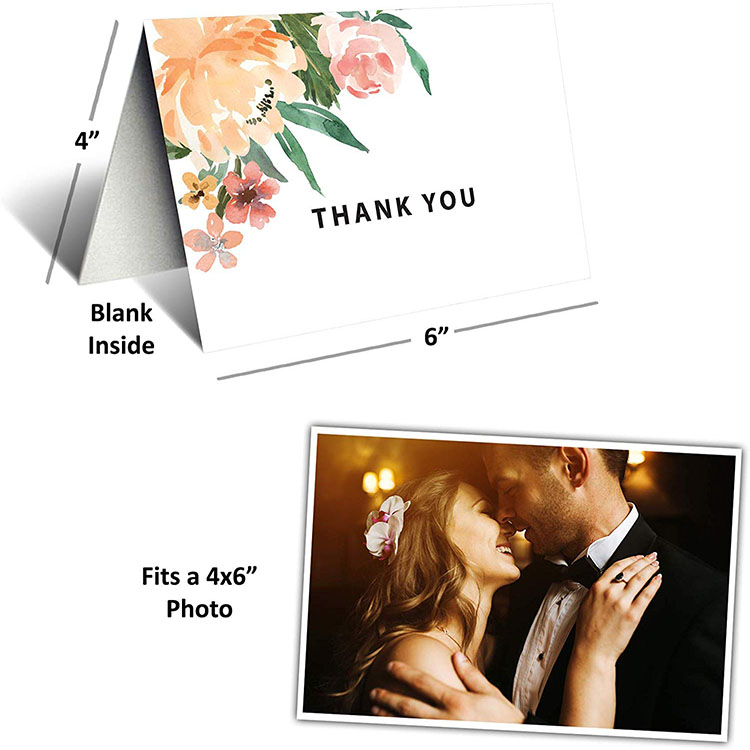
Interior function: the 4 x 6 annotation and the blank panel
The final frame is the set’s spec card. The bi-fold tent shows the front – florals and greeting – and the opposite panel flat gray, marked with the annotation Blank Inside, while beside it a sample photograph stands under the label Fits a 4×6 inch Photo, with dimension guides marking the card face at 4 inches high by 6 inches wide. Read those annotations as the listing’s own claims rather than our verified metrics: the interior ships unprinted, which is the correct default for thank-you sets because the message is the sender’s job, and the blank panel’s size relationship to a 4×6 photo is what makes the format useful as a photo-gift envelope – customers who print event photos at the drugstore kiosk can slot one inside before sealing. The 4×6 pairing also explains the kraft envelope size above it: a 4×6 interior target sets the card trim, the card trim sets the envelope cut, and the envelope cut sets the carton stack height, which is exactly the sizing chain this page exists to manage in one order. Custom moves on the inside: a printed monogram corner, a quote panel, a tinted flood, or a photo-corner jig printed in one color so a glued 4×6 sits square – each is an artwork decision at proof stage, not a tooling change. If your set never needs interior printing, the blank default keeps the unit price honest.
Set Construction Terms in One Table
| Item | Thank-you card with matched kraft envelope and sticker seal (bi-fold or flat variants) |
| Size | Photographed annotation marks the face 4 in x 6 in with 4×6 photo fit; A7/A6 pairings quoted on request against final trim |
| Stock & Finish | White matte card face, full-color watercolor print, flat black type; natural kraft envelope; GSM quoted on request |
| Printing & Artwork | Swappable greeting, palette and logo zone; blank interior standard, printed interior optional; free digital mock-up before production |
| Envelope or Extras | Kraft V-flap envelope with round floral sticker as photographed; lined, printed or gum-flap variants and belly-band packs quoted on request |
| Packing | Cards flat in sleeves, envelopes banded by count; sets assembled or pair-at-bench pack plans per spec |
| MOQ | 100 pcs per design |
| Sample time | 3-5 days |
| Lead time | 7-15 days after artwork approval |
| Capacity | 1,000,000 pcs per month across our gift lines |
Order flow: proof the set, then pick the pack format
A set has one more decision than a card: where the halves get married. Ship cards and envelopes in separate inner packs and let your team pair on demand – cheapest, and damaged pieces never compound. Or receive assembled units: card in envelope, sticker applied, optional cellophane sleeve and band, straight onto a counter or into a gift box – a handled-unit price that quotes against the same artwork files. Pre-production samples cover both paths in 3-5 days, so a buyer can run the slide-fit test by hand – insert, seal, shake, unseal – before approving the pack format that carries the order. Bulk completes 7-15 days after artwork approval, and the page price anchors the 100-piece reference tier; set pricing re-quotes by quantity, closure choice and sleeve spec, never as a flat printed unit rate. Capacity of 1,000,000 pcs per month across our gift lines keeps seasonal surges – graduation thank-you waves in June and holiday sets in October, provided every face and seal file clears proof before the same freeze date.
Export packing and fulfillment lanes
Cartons ride sea, air or DHL / UPS / FedEx / TNT express. For FBA sellers we label assembled sets into inbound cartons or pack components loose for 3PL pairing, whichever your prep center prefers; retail buyers get header-card or belly-band shipper formats off the same stock. The composite below maps the export operation: racked cartons, the parcel line and the courier wall every order moves through.

How do you size the envelope against the card so the set actually fits?
Is the round sticker a real closure or just styling?
Can I order cards and envelopes separately packed?
What is the smallest matched-set order?
Does the blank inside really hold a 4×6 photo?
Related pages around the thank-you program
If your use case is a parcel insert rather than a gift set, the loose tier lives at bulk thank-you insert cards, argued from pack-out economics instead of pairing mechanics. Gift-giving companions include fill-in birthday invitation cards and pet birthday cards with envelope for themed shelves. Browse the cards category or send set dimensions and closure preference to the quote desk.
Spec the set before the season
Email [email protected] or call +86-15967739086 with card trim, envelope preference and pack format; the mock-up and a fit-tested sample follow in 3-5 days.