Custom Baby Bottle Name Labels | Nursery Roster Sheets
$1.10
Custom baby bottle name labels for daycare feeding rooms and nursery rosters: writable pill fields under a clear face film, generic cartoon animal icons and colour-coded borders that sort a shelf before a toddler can read. Sized to bottle curvature from a sample you send, ordered as blanks for on-site marker writing or printed names straight from your class spreadsheet – one layout carries the whole roster, colour and name variants included. MOQ 100 pcs per design, free digital mock-up, 3-5 day physical sample for your own wash and scrub test, bulk 7-15 days after artwork approval. Third-party marks visible on the sample boards stay out of every file; flat sheet packs, fanned display boards or retail header cards, with sea, air or express freight and FBA prep.
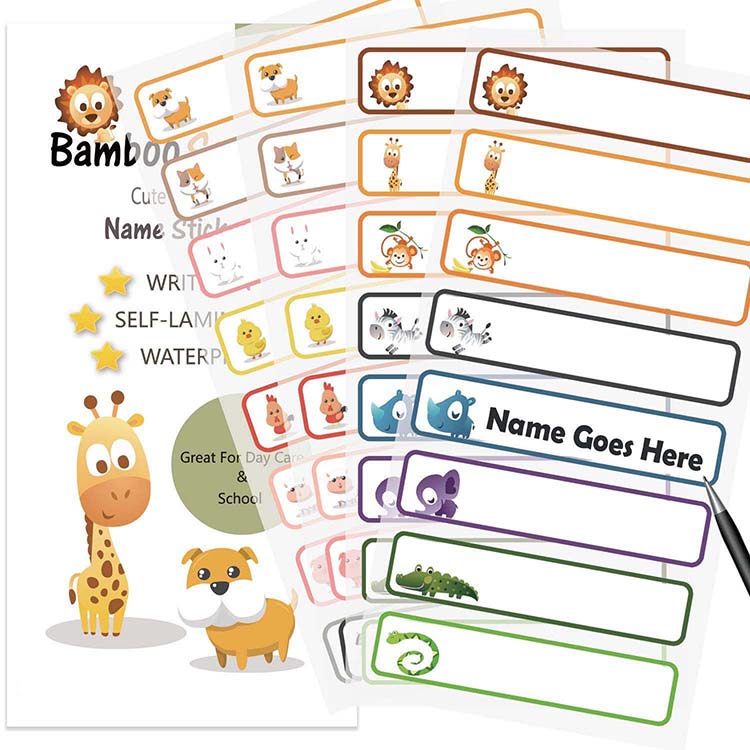
Custom baby bottle name labels for daycare feeding rooms and nursery rosters, printed on writable pill-shaped fields sized to wrap a bottle, cup, sippy lid or formula tin. The photographed sample boards show the format: translucent sheets fanned so each row reveals a cartoon animal icon – lion, giraffe, monkey, zebra, hippo, elephant, crocodile, snake, dog, cat, rabbit, chick, squirrel, pig – each label ringed by its own border colour, the name field left blank for a marker or pre-printed from your roster file. One label per child, one colour per group, and a feeding shelf that sorts itself. Runs start at 100 pcs per design with your artwork replacing the sample’s own marks entirely.
Curvature, Fit and the Bottle Problem
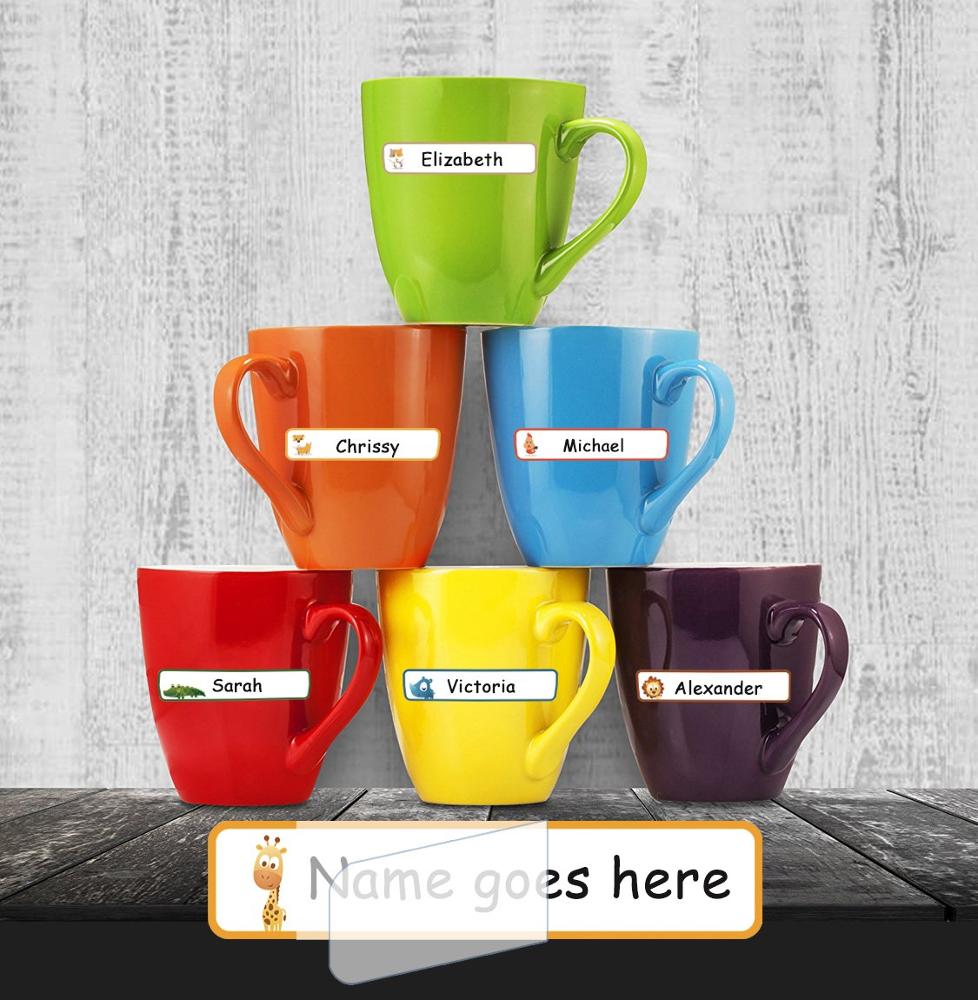
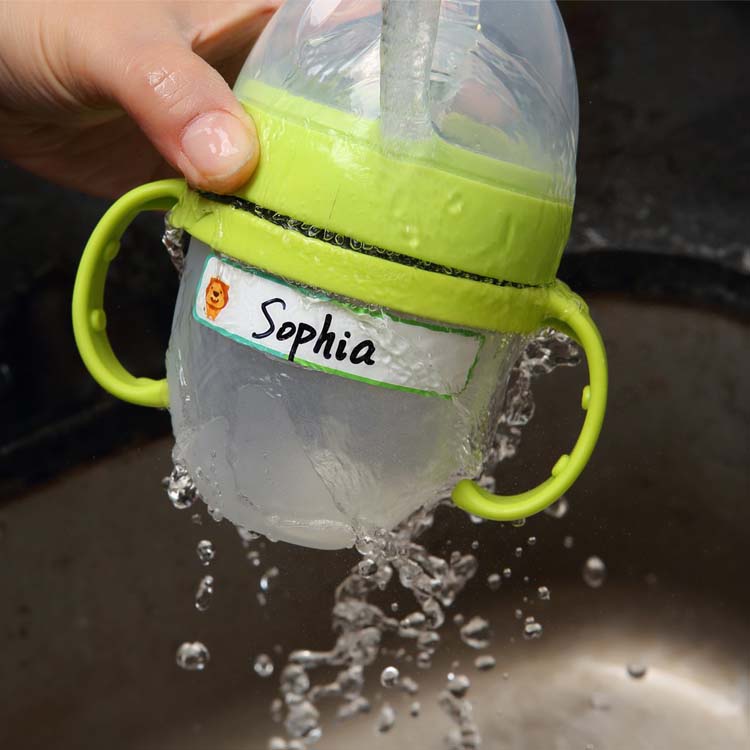
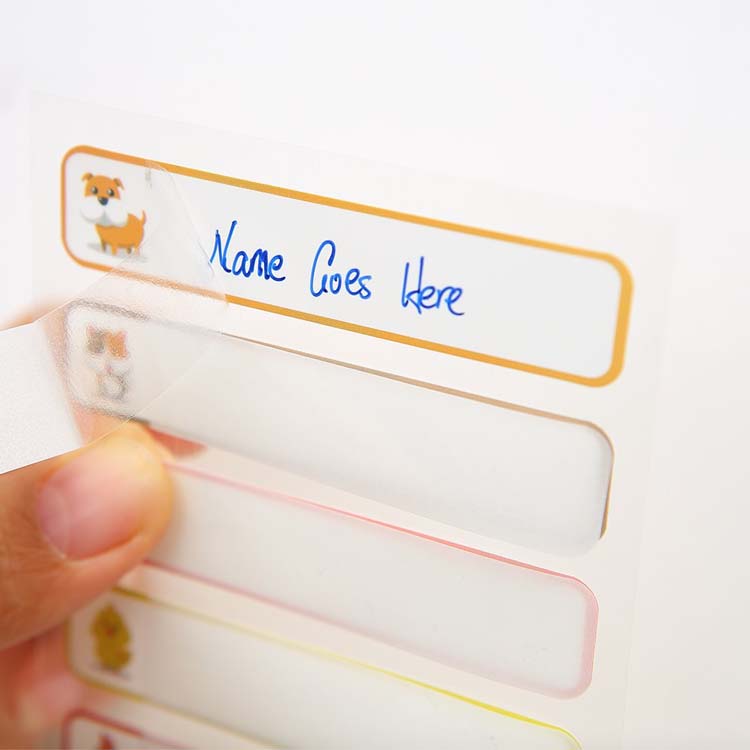
Bottle labels fail on geometry, not adhesion. A flat rectangle on a tapered baby bottle corners up within a day; the photographed pill shape – a short icon stub and a long name field, soft ends – is the shape that seats on a curve without lifting, because its height stays low while its length carries the name. The scale demo on the mug pyramid makes the same point in the round: six coloured mugs, six labels, each centred on the barrel where the surface is straightest, no wrap past the handle line. For production, label height against bottle circumference is decided at artwork: send one actual bottle, one cup and one lid from your nursery’s shelf and we size fields to fit before the mock-up is drawn. The rinsed-cup photo shows the placement rule directly – label on the translucent lower body between the handles, flat, clear of the seam ring – which is also the placement that survives daily scrubbing. The pen entering the sample frame makes the blank-field workflow explicit – a ballpoint or fine-tip marker writes the name before application, so a parent can label the bottle the night before nursery – while facilities with faster turnover skip the pen and print the roster instead. Blank versus printed is an operations choice, not a quality one, and both lanes run on the same die. Sheet fan-out is the third decision: the photographed boards stack multiple sheets so the animal library reads as a complete set – one sheet per animal band, or a single mixed sheet for small rooms. Mixed sheets cut the SKU count a facility must reorder; fanned single-theme sheets photograph better on a retail card. Same pill die, different merchandising, priced from the 100-pc tier either way.
Roster Economics: Colour Borders as Free Data
A feeding room with twenty toddlers needs a sorting system, not decoration, and the border-colour logic in the sample boards is exactly that: the animal and the colour together identify a child before they can read their own name. When a facility buys per class roster, one sheet layout can carry eight or twelve border-colour variants of the same pill – colour is artwork, not tooling – so the class of 200 costs one design, not two hundred. Two ordering lanes cover the market: blank writable fields, written on-site with a marker (the photographed demo even enters a pen tip into frame, pointing at the field), or printed names supplied as a roster spreadsheet. Daycare chains tend to order printed because turnover happens faster than handwriting dries; independent nurseries order blanks because a September sheet is still useful in June.
Two placement rules fall straight out of the photos. First, the label centres on the widest flat band of the barrel – not the taper, not the print line manufacturers put near the base. Second, anything that gets sterilised or microwaved should carry the label on the outer body, where the nursery can see it at the shelf; the rinsed-cup shot demonstrates exactly that reading-distance placement, water running over the face while the name stays under its film. Sizes stay quoted rather than guessed – nothing on the samples prints a dimension, so we scale the pill to the customer’s actual bottle before the mock-up goes out.
The Laminated Surface, Handled Honestly
Two things the photographs prove, and one they do not. They prove a printed name field being peeled out from under a clear face film – the column close-up shows the fingers lifting that transparent layer off the second label – so the construction is label-plus-overlaminate, the field protected under a clear skin. They prove a rinsed-cup demo: water running over the applied label, label staying down and legible. What the images cannot prove is how any specific stock behaves in a steriliser, dishwasher or bottle-warmer cycle over months, so we keep our performance language at that level and quote the rest: face film, adhesive and wash tolerance are sample-first – physical samples in 3-5 days, run your own cycles, publish what passes. The promo panel visible in the sample shot belongs to another company (its wordmark, its animal mascot, its own truncated feature bullets); none of that wording or artwork carries into your files or this listing – your run uses your brand mark or none. The badge slot on the promo panel, captioned for day-care and school use, shows where your own use-case line belongs on a retail card: purchase-trigger copy, not feature copy, and it swaps per market without touching the label die.
The mug pyramid is also a merchandising lesson: the same label reads on six different coloured surfaces, which means a retail pack can promise match-everything neutrality without printing six variants. Parents extend the set beyond the feeding room without a second SKU – cups, lunch boxes, snack tins, the shoe rack – and the facility benefits too, because a label that works on the bottle and the coat is a label that never needs a re-sort at enrolment. Border-colour systems are how a room of twenty stays sorted without anyone reading a word, and the sample boards demonstrate the whole vocabulary in one fan.
How far to take those photographs in your own copy, precisely: the fanned sheets prove the layout, the pill fields, the animal-and-colour pairing, the blank name zones and the glossy face film. The rinse shot proves a printed name staying legible under running tap water at that moment. Neither proves months of dishwasher racks, steam cycles or warmer abuse, so the honest listing separates them – format claims from the photos, performance claims from your sample test, and the 3-5 day sample as the bridge between the two. A facility buyer reads that separation as competence; a marketplace auditor reads it as a page that does not have to be fixed after a complaint.
Specify Your Nursery Naming SKU
- Pill geometry: icon stub plus name field; height sized to your bottle/cup curvature at artwork
- Border colour system: one colour per class group, roster-mapped in a single layout
- Animal set: generic cartoon icons from our library, or your own mascot-free artwork – never the sample board’s third-party mark
- Field: blank writable as photographed, or printed first-name variants from your spreadsheet
- Face film: overlaminated construction as shown; stock options quoted on request with a tested sample
- Sheet architecture: fanned multi-sheet boards for retail display, single-sheet refills for on-site ordering
- Size: no dimensions printed on the samples; quoted from 1-inch minis up to large fields for tins and trays
- Format: kiss-cut sheets as photographed; roll format for a labelling station quoted on request
Seasonal rhythm for this line is institutional, not gift-driven: enrolment waves in late summer and January, with mid-year roster-print top-ups. A chain on standing orders values the boring option – one frozen layout, new name files monthly, same 7-15 day turnaround.
Standing-order logistics deserve two lines because they win chains: a facility that approves one frozen layout in July can send a monthly names file and receive printed sheets on the same 7-15 day slot, with the same carton count every time. Nothing in that flow requires a new mock-up, a new proof cycle or a new conversation – the only moving part is the spreadsheet. Mid-year top-ups for new enrolments print from the last quarter’s file with two names added, and the colour map grows by row instead of by design.
The consumer lane deserves its own short note because chains are not the whole market. Parents buying for one child order the mixed multi-animal sheet as a gift box – the fan format exists precisely to photograph abundance – and they add a matching sibling set at a second baby. That demand runs gifting-calendar, not enrolment-calendar, so a nursery brand carrying both lanes stocks the same layout twice: roster packs for September, gift-ready fan packs for spring registry season, one artwork, two selling windows.
Colour also does quiet merchandising work beyond sorting. The photographed borders run brown, orange, black, blue, purple, green, yellow, red and pink across the animal rows – a full primary palette with no single theme dominating, which is precisely what lets a facility assign colours without starting a gender-stereotype argument at enrolment. When a brand buys the same pill format for retail, that palette becomes the shelf story: one box of twelve animals, twelve colours, and the parent picks the child’s favourite off the fan without needing a label size chart.
Specifications at a Glance
| Item | Custom baby bottle and nursery name label sheets – pill fields, colour borders, animal icons |
| Size | Pill height scaled to your bottle curvature; fields quoted from 1" up to 6" for tins and trays |
| Stock & Finish | Glossy clear face film over the printed field, as the peel photo shows; other stocks quoted on request |
| Cutting | Kiss-cut rows of rounded-rectangle pills on white liner; display fan boards optional |
| Printing & Artwork | Full-colour icons and borders; blank or roster-printed names; free digital mock-up |
| Packing | Flat sheet packs in polybag, fanned retail boards or header-card packs; master carton; FBA prep on request |
| MOQ | 100 pcs per design |
| Sample time | 3-5 days |
| Lead time | 7-15 days after artwork approval |
| Capacity | 1,000,000 pcs per month across our gift lines |
Reference pricing is quoted from your spec at the 100-pc tier; we do not publish unit rates.
The sample boards also show the retail-side visual language: a fanned sheet stack that reads as abundance (more animals than any one sheet holds) and a badge slot aimed at the purchase trigger – day care and school use – which your header card can carry in your own words.
Order Flow: Roster File to Feeding Room
Start with the placement kit: one bottle, one cup, one lid representative of your shelf, plus the child list or the blank-sheet decision. Free digital mock-up returns pill size, border-colour map and per-sheet count. A physical sample in 3-5 days covers your own wash-and-scrub test; production then runs 7-15 days from approval, inside monthly output of 1,000,000 pcs across our gift lines. Printed-roster orders add only file-cleanup time: send names as a clean column, receive proof, approve, produce. Late-summer enrolment stock wants approval by mid-summer; standing monthly roster top-ups lock a repeat slot on the same frozen layout. For a first purchase, order the sample plus a minimum retail test of the blank lane at MOQ 100 pcs per design – it sells through a gift window while the printed-roster programme is still being negotiated, and both shipments share one carton schedule.
Packing, Freight and Multi-Site Delivery
Sheets ship flat between stiffeners; retail display boards are banded so the fan stays fanned in the carton. Cartons are counted and weighted against your final sheet size. Standing-order stock usually moves by ocean; when a term start is fixed, air cargo or a courier – DHL, UPS, FedEx, TNT – carries it. Chains with multiple facilities can drop-ship per-site pallets of roster sets; FBA sellers get labelling and prep for retail sheet packs in the same run.

Questions Nursery Buyers Ask
Will these labels actually stay on a curved baby bottle?
Can we sort a whole feeding room by label colour?
Marker or machine – who writes the names?
Are the sample boards’ brand mark and mascot ours to reuse?
How do I state durability without overpromising?
What quantity does a class roster run need?
Adjacent Lines and Your Quote
Naming a child does not stop at the bottle: the same roster feeds no-iron garment labels for the coat pegs, reward sticker sheets for the circle-time table, and parents buy month-grid planner stickers that track feeds at home. Room-side decor sells to the same families through removable wall decals. Browse the sticker category, party items for birthday-season bundles, and the printed items catalogue for the rest of the naming programme. The quote page is where your roster file and bottle sample start the run.