Custom Gold Foil Sticker Sheets | Metallic Seal Labels
$1.10
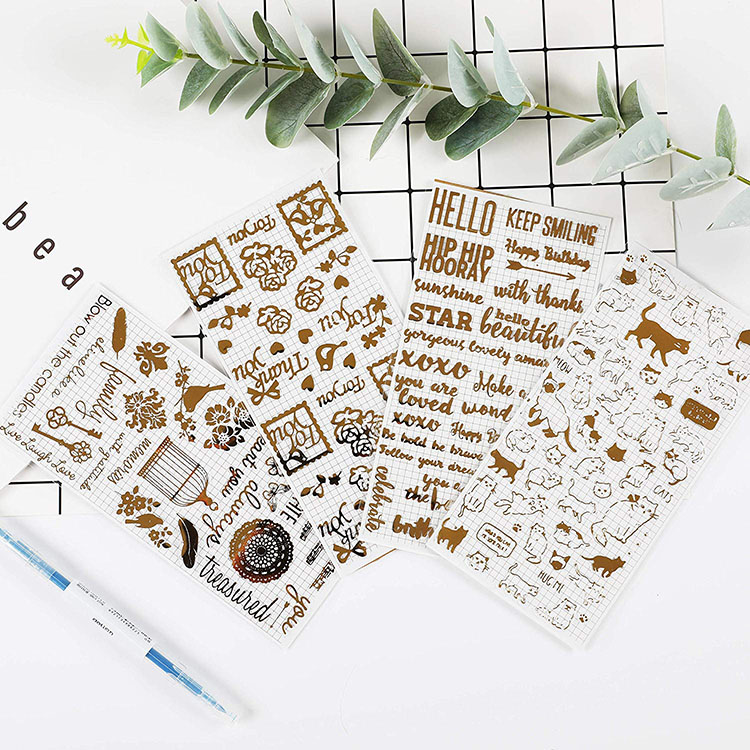
Custom gold foil sticker sheets hot-stamped in true metallic gold on clear or white carrier, for gift-box seals, candle jars, wedding favour bags, bakery packaging and premium planner accents. Photographed samples show greeting-script wordmarks in mixed type styles, filigree keys, wire birdcages and dense cat grids on faint grid backing, kraft hang-hole header cards fanned for shelf presence, and a single clear die-cut held between fingertips that proves the metal sits on the surface and the interior stays transparent. Foil tone, carrier and stroke weight are decided against your real box, jar or envelope; the metallic sample gets judged under your own lighting before anything plates. MOQ 100 pcs per design, free digital mock-up, samples 3-5 days, bulk 7-15 days after artwork approval. Sea, air and express freight; FBA prep in-house.
Gold foil changes what a sticker is allowed to do. A printed label identifies; a hot-stamped metallic seal closes a box, dresses a candle jar, upgrades a wedding favour bag from craft-bin to gift table. That premium behaviour is why custom gold foil sticker sheets hold their own price point in stationery retail and packaging programs, and why buyers search for them by finish instead of by adhesive. Our stamping line runs exactly this format: greeting-script wordmarks, wreaths, keys, birds in wire cages and feline grids, all pressed in metallic gold onto clear or white carrier – the pieces photographed on this page came off our press, not a mood board.
Three questions sort themselves out before any plate is made, and a buyer who answers all three in the first email gets a faster, cheaper project. The foil tone you mean – bright champagne gold and deep antique bronze read completely differently on kraft box, white envelope and candle glass, and the photograph that convinced you was lit for a camera, not for your shelf light. The carrier you need – clear film that vanishes on a jar, or white paper that adds contrast on a matte box – is a surface decision that comes before the stamp decision. And whether your metal covers a wide solid block or a hairline outline, because solid fields and single-stroke lines are two different stamping conversations with two different approvals. Quantity, packing and freight on foil orders run the same clock as every other line in this factory: the 100-pc floor, the 3-5 day sample, the signed piece that has to sit on your actual packaging under your actual lighting before the bulk schedule starts.
Foil Is a Process, Not an Ink Colour
First thing a buyer should hear from a supplier: gold foil is not yellow ink with sparkle. Hot stamping presses heated foil film into the substrate so the metal sits on the surface with its own reflectivity – which is why every photo here shows genuine metallic sheen that shifts with viewing angle, from pale champagne highlights to deep bronze in shadow. Ink that looks gold is a colour; foil is a bonded metal layer, and shoppers buy the flicker of it as hands pass the shelf. That is the entire price difference, and it is also the engineering difference: stamping needs its own die, punishes hairline strokes, and behaves per-stock. The close-up on this page proves it better than any paragraph: a single clear die-cut held between fingertips, the gold forming only the structural lines of a birdcage while the interior stays fully transparent. That combination – clear carrier plus reflective line art – is a foil-and-die-cut construction statement printed on one piece, and it is the look gift-packaging buyers ask us to match.
What the Photographed Sheets Show About Assortments
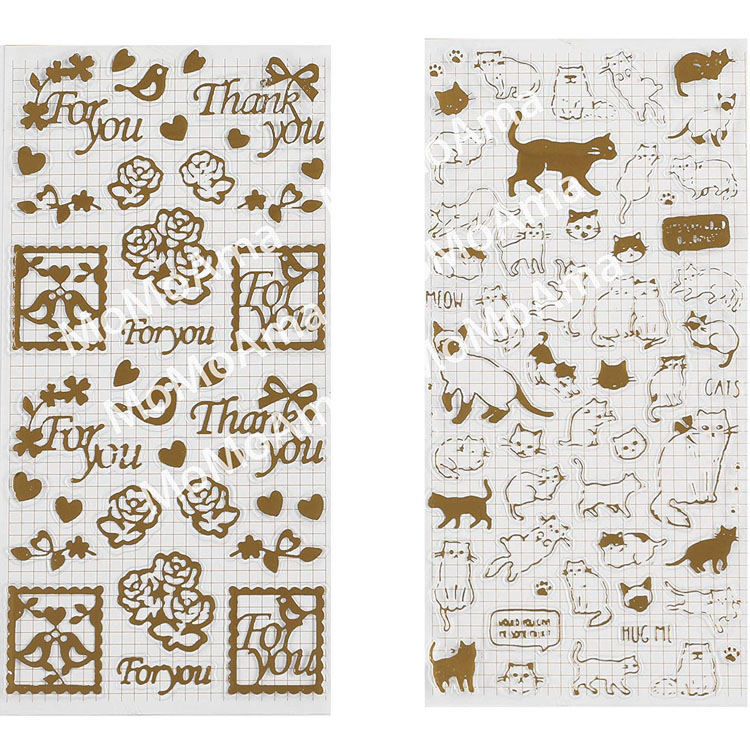
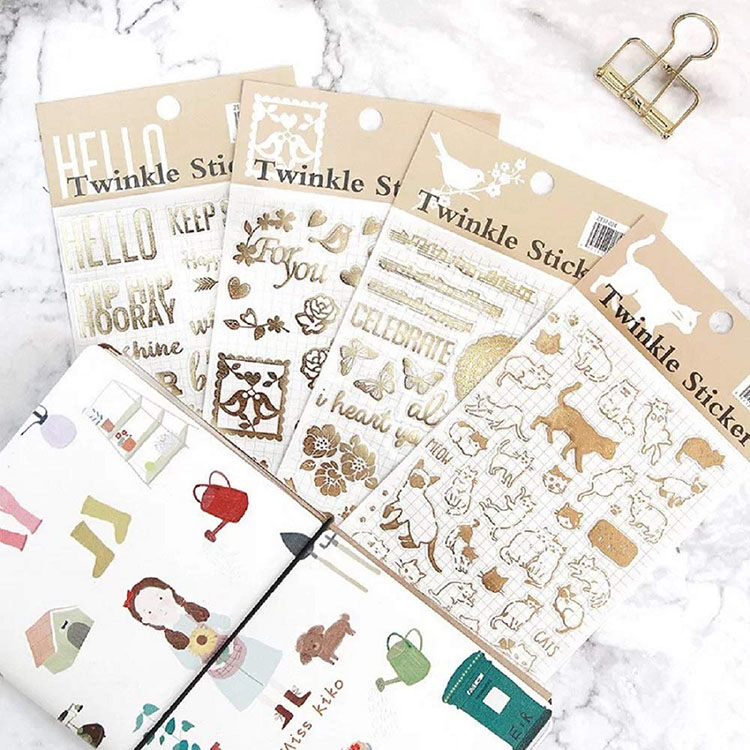
The four-sheet fan above is a working assortment model: a key-and-cage sheet, a rose-and-heart sheet, a type-heavy greeting sheet and a cat sheet, each carrying a different mix of block capitals, flowing script and fine line ornaments on a faint grid ground. That last one is an instruction for your own layout file: a light grid backing reads as “craft supply” on a stationery shelf and doubles as a peel guide for customers placing small seals straight. When we build sheet layouts for foil clients, we borrow this logic – dense word marks down one column, pictorial line art down the other, so the same SKU serves journalers and gift wrappers without splitting the run.
Assortment is also how a foil program survives price scrutiny. A buyer comparing one seal design at 100 pcs against a twenty-motif sheet at 100 sheets sees the same per-piece foil cost – but the sheet carries twenty conversations with the customer’s hand and the single seal carries one. The stamping die covers the sheet area, so motif count inside one sheet is layout work, not tooling multiplication. If you are building a foil line from scratch, start with two or three coherent sheets – one typographic, one pictorial, one occasion-themed – and let sales tell you which one earns the fourth.
The grid backing visible on these sheets does three jobs at once: it tells the shopper’s eye this is craft product, it gives a straight reference for centring a seal on a box flap by eye, and it hides tiny registration drift between stamping and cutting, which on pure white stock becomes visible against a straight wordmark. Ask for it on your first proof and see whether your motifs sit better with the guide lines present; most foil programs keep them after that test.
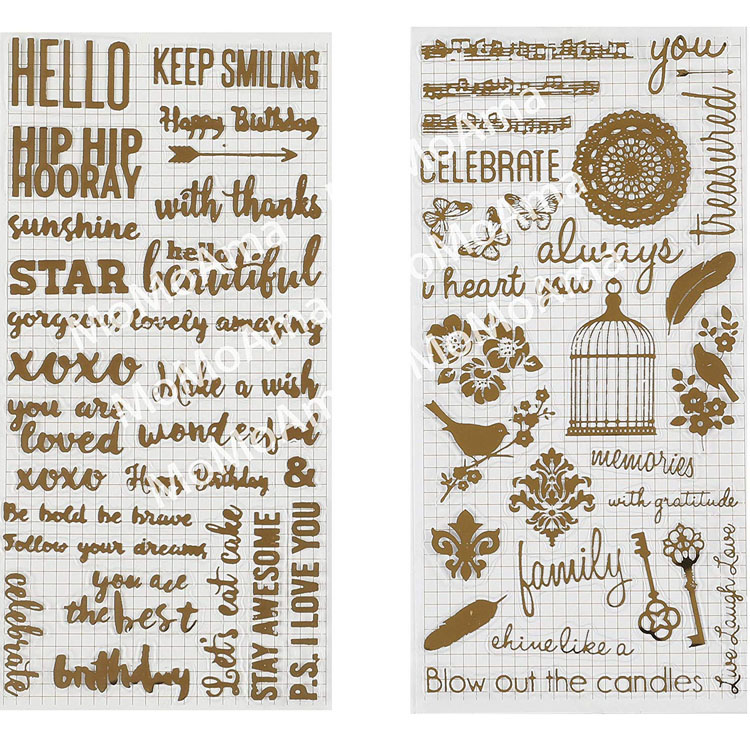
Wordmark counts are the other dial worth pricing deliberately. The photographed greeting sheet carries several phrases in the same family – block capitals, flowing script, outlined frames – which is how an assortment sheet justifies a premium over a single-design seal sheet: the foil cost per sheet is roughly area under the stamp, and four phrases in a column cost little more to plate than one repeated. Stationery brands use that asymmetry constantly: one sheet sells the whole vocabulary of a wrapping table – the hello, the thanks, the happy birthday – and the shopper who would never buy forty identical seals buys the twenty-piece assortment instead.
The marble shot below shows the retail half of the same program: kraft header bands, punched hang holes, the sheets fanned for shelf presence, a planner notebook beside them already carrying printed accents. A header card with a hang slot is the difference between a flat pack and a peg hook, and peg hooks are where stationery margins are made. We print headers, hang-hole and all, inside the same order – and we keep them neutral: third-party marks visible in some sample photography stay off your production files entirely.
Header bands deserve one construction note while you are looking at them. Kraft stock with a punched round hang-hole is the cheapest retail-facing element in this product family, and it carries more perceived value than any foil upgrade per cent spent. The two variables that matter: the hang-hole must sit above the artwork’s top line so the peg shadow never crosses a motif, and the header colour – kraft brown or printed white – should be chosen against the foil tone, because warm brown flatters deep bronze while clean white pops bright champagne. We can print both header colours on the same order and ship them as shelf-tested A/B units; the reorder split tells you which one your customers actually picked up.

Where Gold Foil Seals Actually Get Used
Order volume on this line clusters in five places worth naming because the spec conversation differs in each. Gift-packaging programs seal kraft boxes and tissue with foil rounds or squares; the metallic edge makes a paper bag read as boutique without a second print run. Candle, bakery and apothecary brands use foil wordmarks as closure labels where tamper-evidence is replaced by ceremony – the peel itself is the unboxing. Wedding and event stationery buys favour stickers and envelope seals in warm metallics, usually in short runs timed to event dates, which our sample-first process suits perfectly. Journal and planner brands add a foil accent pack as their premium SKU sitting beside matte function sheets. And gift-set assemblers slip single foil sheets into boxes of socks, tea or notebooks as the perceived-value item that costs cents per unit. Send the use case; the stock, adhesive and sheet layout follow from it rather than from a catalog default.
Each cluster prices differently, and knowing which one you are prevents a wasted quote round. Wedding and favour work is short-run, date-driven and artwork-heavy: hundreds of packs, many tweaks, sample-per-revision patience. Packaging work is the opposite – one artwork, steady reorders, spec locked after the first approval, and value won on per-unit cost and carton consistency rather than on novelty. Planner and stationery brands sit in the middle: seasonal drops of three to five sheet designs that share stock, so the fourth design in a series costs layout time, not new stamping. Tell us which of the three you are, and the mock-up arrives with the right assumptions baked in – revision count, laminate choice, pack format – instead of the generic ones.
Candle and bakery brands arrive with a specific failure memory: a foil seal that lifted off a warm jar within days, because heat softens ordinary sticker adhesive and a label peeling off a product is a packaging defect, not a sticker story. That use case needs a heat-aware adhesive grade and often a placement above the wax line rather than on the body. Wedding buyers arrive with the opposite fear: adhesive that works too well and tears the envelope flap on the morning of the event. Two orders, two conversations, one factory – and both get resolved on the sample, which is why the 3-5 day proof cycle is non-negotiable on this line rather than a courtesy.
Price honesty on foil, once more: the stamping die is the reason a 100-pc order costs per piece more than the same quantity of printed stickers. It is also the reason the 5,000th piece of that same design is nearly free of tooling. Foil programs are built to be amortised across a season of reorders on unchanged artwork; if your design changes weekly, printed metallic-look is the honest format, and we will quote it gladly and label it truthfully. If your design is a signature, foil is the format that pays you back.
Clear or White Carrier, and Why the Choice Matters
Foil line art behaves differently on the two carriers visible in these photos. On clear vinyl, only the metal prints – a cage outline floating on a glass jar, a script wordmark on a cellophane favour bag, with the substrate disappearing. On white paper, the same artwork lands with contrast and reads at a distance, better for kraft-box seals where the ground colour competes. Mixed-carrier orders are routine: the artwork file is shared, the stock is not, and the quote treats them as parallel jobs from one tooling set. Fine-line foil – filigree keys, feather strokes, music staves like those on the tall sheets in this gallery – demands tighter registration than solid blocks; if your artwork leans filigree, say so at mock-up stage and we proof on your actual substrate instead of a house card.
The pair of tall word-and-ornament sheets in this gallery shows two more layout schools worth borrowing. One stacks typographic stickers in loose vertical columns with a few pictorial accents – arrows, butterflies, a doily, a fleur motif – so every word mark reads as its own peelable prize; the other runs a single dense cat grid with tiny labels tucked into the corners, which is the layout of a themed novelty pack rather than a greeting assortment. Both are production files, not mood boards: every piece sits inside a carrier-sheet boundary that our cutting die follows, and both formats absorb a recolour or a word swap without touching the die at all. That is the economical way to extend a foil line across seasons – change what the metal spells, keep the cut.
For gift-packaging buyers the layout question flips: you are not selling peelable variety, you are selling a closure. The same cage or wordmark printed once per sheet position becomes a production seal line – forty identical seals on a forty-strip sheet, die-cut so each peel is one motion, no sorting, no counting. We run both schools on the same stamping plates because the plate does not care whether a motif appears once or twenty times; it cares about stroke weight and area. Which means the assortment pack and the closure strip can share a tooling cost, split the artwork fee across two products, and give your catalog a premium SKU and a production SKU from one approved file.
Design services on this line run practical rather than precious: hand-lettered scripts redrawn as production vectors, monogram sets built from a font you license, mood ornaments lifted from a photograph you shot. If a motif is too fine for foil at your chosen size, our studio thickens the stroke or suggests a break across two pieces and shows both options on the digital mock-up before anything is committed.
Design Services and What You Can Change
- Artwork: your greeting words, monograms or line motifs, or redraw from a hand sketch at proof stage
- Foil colour: gold as photographed; other metallic tones and matte laminate options quoted on request
- Carrier: clear vinyl or white paper stock, matched to the surface the seal will meet
- Shapes: contour die-cuts for single motifs, squares and rounds for seals, grid sheets for packs
- Sheet format: one design repeated, or mixed-assortment sheets like the photographed fan of four
- Sizes: from 1″ mini to 6″ wall decals quoted on request; no dimensions are printed on our photos
- Headers: kraft or printed hang-hole cards for retail pegs, banding and shrink options
- Pairing: combine matte printed sheets from the planner line into one mixed foil-and-print order
Spec Snapshot: Hot-Stamped Foil Sheets
| Parameter | Foil-line default |
|---|---|
| Item | Custom gold foil sticker sheets for gift seals, wedding favours, candle packaging and planner accents |
| Size | From 1″ mini to 6″ wall decals quoted on request; sheet layouts scaled to your pack-out |
| Stock & Finish | Metallic hot-stamped gold foil on clear vinyl or white paper; matte-look laminates quoted on request |
| Cutting | Die-cut and kiss-cut contour shapes, seals and sheets; grid backing as a layout option |
| Printing & Artwork | Foil stamping plus printed inks where the design asks; vector artwork preferred, redraw included at proof |
| Packing | Sheets banded or bagged, counted into inner boxes and export cartons; hang-hole header cards optional; FBA prep in-house |
| MOQ | 100 pcs per design |
| Sample time | 3-5 days |
| Lead time | 7-15 days after artwork approval |
| Capacity | 1,000,000 pcs per month across our gift lines |
Sealing an Order: Mock-up, Foil Sample, Run
Foil is unforgiving of phone-screen approvals, so the proofing rhythm on this line is deliberate. Send artwork or a written brief – word list, motif style, carrier – and a free digital mock-up comes back showing sheet layout and where the metal lands. Then comes the physical foil sample in 3-5 days, viewed under your own lighting because metallic colour judgement changes with angle and temperature; approve it against the box, jar or envelope it will seal, not against the proof PDF. Bulk finishes 7-15 days after artwork approval, and season planners should note the obvious calendar truth: wedding and gift-box demand clusters hard before holidays and spring event season, so the mock-up email for a November peg-hook program belongs in August.
Budget note for first-time foil buyers: reference pricing at the 100-piece tier covers the stamping die and one proof cycle inside the setup line, which is exactly the number most event and gift brands want to see before they commit a season. The digital mock-up carries that reference cost from day one – no per-design artwork fee surprises at plate stage, no sample charged twice if a revision follows within the same project week.
Ordering rhythm for gift programs has one quirk worth planning around: metallic sheet deliveries prefer flat, cool, dry storage over the stacked-floor reality of most warehouses. Foil bonded to clear vinyl is dimensionally stable, but kraft-backed sheets in a humid container corner will wave at their edges, and a waved sheet on a peg strip looks like damage even when the stamp is perfect. If your destination is a humid coastal DC, mention it at the packing-spec stage – the fix is a moisture bag and a stiffer carton liner, both quoted as cents, both cheaper than a photo-bad review.
Storage guidance in one paragraph, because it decides how your stock photographs on arrival. Foil sheets like their cartons flat, cool and out of direct sun; clear-vinyl carriers are dimensionally forgiving, kraft-backed paper is not, and a waved sheet on a peg reads as damage even when the stamp is flawless. Coastal or humid DCs: ask for the moisture bag and stiffer liner at the packing-spec stage – cents per carton, decided before the quote, not after the complaint. Event kits heading to venue storage should ship in the same flat cartons with a marked this-side-up arrow, because a favour sheet that arrived folded once in a hall closet cannot be un-folded at all.
One last calendar note for gift-packaging programs: the foil lane is busiest in the eight weeks before the gifting holidays, when every candle, bakery and boutique brand tops up its seal stock at once. Artwork locked early samples fast; artwork locked late waits behind artwork that was locked early. The 3-5 day sample clock is real, but it starts when your file does, which is the actual scheduling lever on this page.
Packaging and Shipping for Fragile-looking, Sturdy-actually Goods
Foil sheets ship without the anxiety foil buyers expect. The stamp is bonded to the carrier; scuffing, not flaking, is the real risk, so sheets travel interleaved, banded flat, and packed into rigid cartons that survive pallet stacking – exactly the packing photographed here at the dock stage. Freight by sea for shelf restocks, air or DHL, UPS, FedEx and TNT for event-date orders, and FBA-bound cartons arrive labelled and prep-checked. Interleaving tissue between foil sheets for a gift-box program is a free instruction; putting a rigid divider in every inner box costs a few cents and saves the metallic edges from each other.
Why the interleaving fuss, when foil looks so tough? Because the sheen that sells the sheet is the same property that records a scratch. A stamped surface under compression – ten packs stacked in a carton during a long ocean leg, corner to corner – will mirror the pressure exactly where weight concentrates, and those mirror-lines photograph terribly in your listing even though the sticker still seals beautifully. The fix is boring and cheap: pack to carton strength rather than carton volume, keep inner boxes rigid, and do not underfill so the stack shifts between handoffs. We build foil carton specs around your sheet size first and your quantity-per-carton second for precisely this reason; a printed sticker line can forgive a loose box and a foil line cannot.
Two carton decisions that foil buyers routinely get wrong cost nothing extra when made early. First, carton size should match your finished sheet instead of the other way around: a sheet that slides a few inches inside an oversized box abrades against the carton walls on every truck transfer, and the scuff shows as dull patches in the metal exactly where a customer opens the pack. We box to the confirmed sheet footprint before production starts, not after. Second, set the inner-box quantity equal to your retail display unit – one inner per shelf drop, one label per inner. Assembling the same program across mismatched inners turns warehouse receiving into a sorting job nobody budgeted, and repacking foil sheets by hand is how freshly stamped edges get nicked. Both choices are free at the mock-up stage and expensive at the dock. Wedding clients shipping favour sheets to a venue should also ask for a carton split by delivery address rather than by product; the per-box freight cost is the same, and two volunteers with two boxes beat one confused courier at a ceremony hall.

Foil-Shop Queries, Straight Answers
Is hot-stamped foil different from printing gold ink?
Can foil seals stick to kraft boxes, glass jars and cellophane bags?
How small can foil line artwork go before it breaks up?
What quantity starts a first foil order?
Can I buy foil sheets together with printed planner or pack stickers?
Neighbouring Products for the Same Program
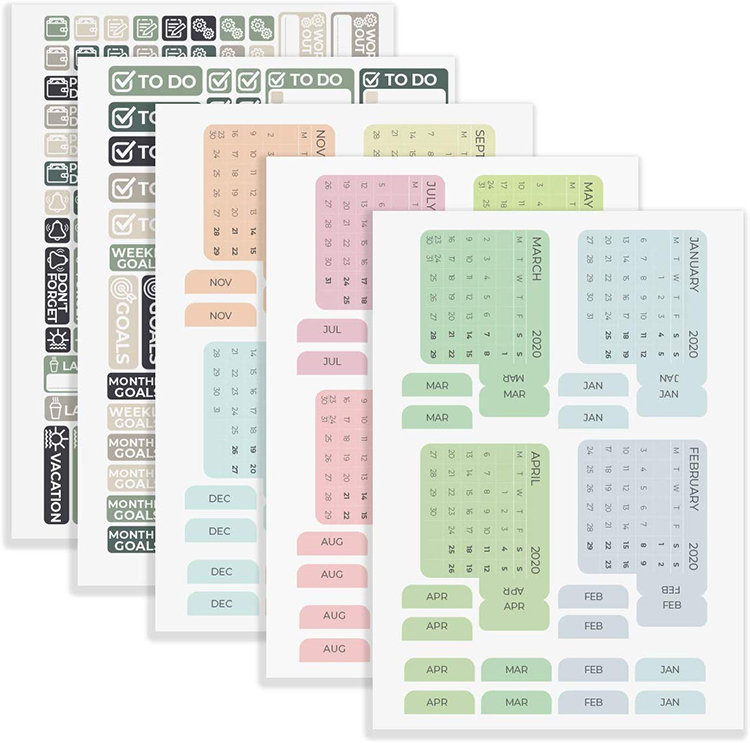
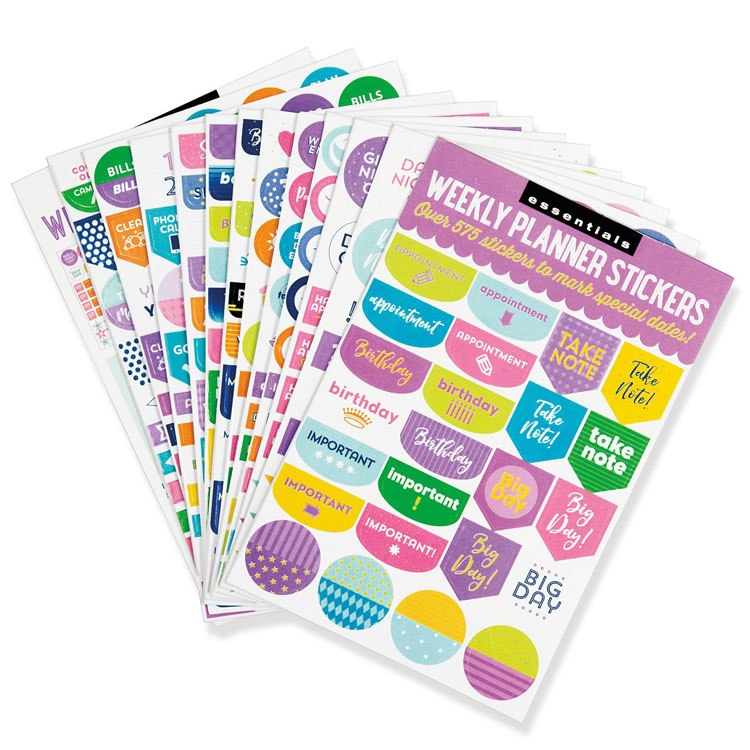
The full sticker category holds every finish this order desk runs, inside the broader printed goods catalog that gift-packaging buyers mix freely. Performance decals live on separate pages: waterproof vinyl for bottles and luggage handles the wash-and-wear brief, while removable decals cover campaign signage. On the stationery shelf, weekly planner icon sheets are the matte counterpart to a foil pack, and kawaii food die-cuts serve the kids-retail end of the same peg strip. Favour-table add-ons – plates, banners, napkins – sit in the party items category and ship with foil sheets on one invoice. Send the sheet count, carrier and event date through the quote page and the mock-up starts that week.
One closing instruction that saves reprints: photograph the real box, jar or bag the seal will close, and attach it to the artwork file. Foil judged on a screen is approved twice; foil judged on the substrate is approved once.