Custom Greaseproof Paper Bags for Bakery & Deli Counters
$0.10
Custom greaseproof paper bags for bakery and deli counters: handle-less grease-resistant stock, cited strictly per the photographed spec, in white or tan faces, with straight-cut, pinking-cut or folded-band mouths. The size ladder spans nugget sleeve through tall fry and lunch formats, visible as four graduated sizes in our rack photo; exact dimensions quote on request. Print one face with your mark or run the deep-burn sizes blank and mix printed plus plain on one purchase order. Food-contact filings in your market stay your obligation; we supply the written material spec that supports them.
Order floor: 100 pcs per design | Sample: 3-5 days | Bulk: 7-15 days after artwork approval, off 1,000,000 pcs per month across our gift lines. Free digital mock-up at true size on your chosen shell. Flat-packed scored export cartons; freight by sea, air or express — DHL, UPS, FedEx, TNT; FBA labelling supported. Email [email protected] or +86-15967739086 with consumption by size and your artwork for a spec sheet back, not a brochure.
Custom greaseproof paper bags for bakery and deli counters, made for the moment behind the glass: a clerk scoops, a bag opens, the order is in and handed over in three seconds. This line is the counter tier of our paper bag programme — handle-less grease-resistant stock in white and tan, cut to size ladders that match real display cases, with a single-face logo print doing the branding while the paper does the barrier work. Alice Gifts specifies the grease-resistant character strictly per the photographed spec on each order sheet, and treats food-contact compliance paperwork as your market’s own obligation, which is exactly how importers should want it: material traits in writing from us, end-use declarations filed by you.
What the Counter Bag Has to Survive
A checkout carrier is judged by how it carries. A counter bag is judged by what it contains: hot pastry releasing butter, a fried item still giving off oil at the surface, sugar and crumbs working into every crease. Grease is the failure mode here, not drops or tears — an untreated sheet lets oil migrate visibly within minutes, and a customer’s hand discovers the stain before the branding does. That is the entire reason this tier exists: paper that has been through a grease-resistant treatment, holding its look through a walk to the car park instead of blooming translucent at the base corner.
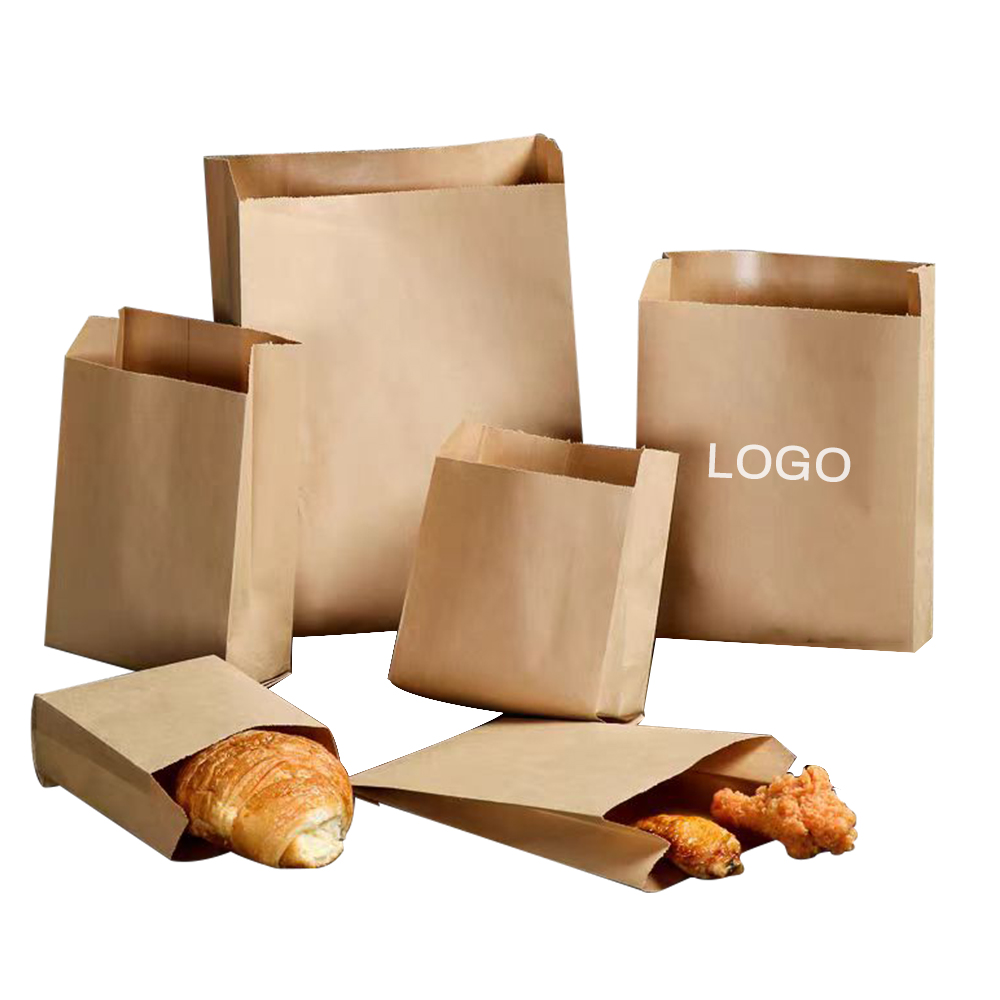
The first photograph shows six bags of graduating sizes in tan stock, four standing empty and two lying open with samples inside — a flaky pastry in one, breaded pieces in the other. Two details matter to a buyer. The mouths are cut two ways across the group: a clean straight cut and a zigzag pinking edge, both shown as production options rather than accidents. And at the inner rim of the standing bags you can see a faint gloss against the matte outer face — the treated side, photographed honestly. We will not oversell that picture: the barrier is a material trait per spec, and your order sheet carries the written figures for the sheet we run for you, not the figures from this stock photo.
Barrier Performance: What We Will and Will Not Say
Here is our compliance discipline in plain procurement language. Grease resistance is a measurable property of the finished sheet, so we quote it as a spec line: the treatment class, the basis weight, the barrier behaviour against oily contents. What we do not print on this listing are certificates and safety declarations as sales decoration, because those documents belong at the point where your goods clear your market’s rules — and they are your filing obligation as importer, not our marketing material. You get the written spec from us; you file the paperwork your own authorities require, using the spec sheet we provide.
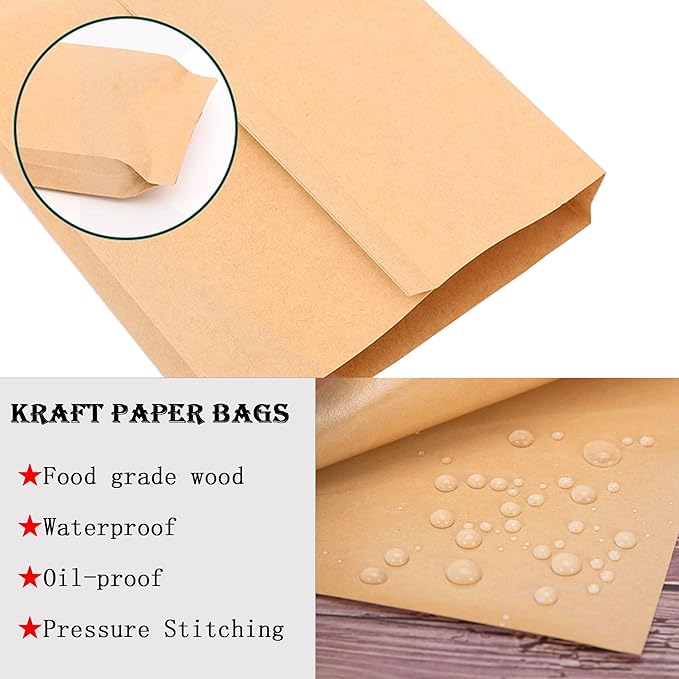
The second photograph is useful for understanding how supplier imagery should be read. It is a listing layout rather than a product shot: one bag lying flat with its top edge turned down, a circular magnified inset showing the creased mouth in close-up, a grey panel carrying the supplier’s own headline and bullet claims, and a macro photo of droplets sitting on the sheet surface. The droplet picture is a photographed visual demonstration of surface behaviour; the bullet strings are third-party marketing text from the image’s source and we do not repeat them. When you order from us, the spec sheet replaces both: numbers in writing, from us, matched to the run you actually bought.
One distinction worth teaching your purchasing team, because it settles most arguments with catalogue suppliers: water behaviour and oil behaviour are not the same property, and a single photograph can prove only one of them. The beading shot shows a liquid sitting on a surface — useful, honest, and about water-based spills. Grease is a different animal: lower surface energy, warmer out of the fryer, and it migrates through paper by a different route. A sheet can bead a droplet beautifully and still bloom translucent where a croissant corner pressed against it for twenty minutes. So on your order sheet the two behaviours get two separate spec lines, each with its own measured figure, and we will happily explain why a listing photo that shows only one of them is telling you half the story.
The practical test we recommend costs nothing: fill three candidate sizes with your actual hottest, oiliest product, leave them on the counter through a full service, and look at the outside faces at closing time. Translucency at the base corner, softening at a glued seam, and ink lifting where grease crept are the three findings that matter. Buyers who run this test before approving a container almost never need to run a claim after. Buyers who order from a photograph sometimes do — and a claim across an ocean is slower and more expensive than an afternoon of croissants.
Flap or Open Mouth: Two Ways to Close a Counter Bag
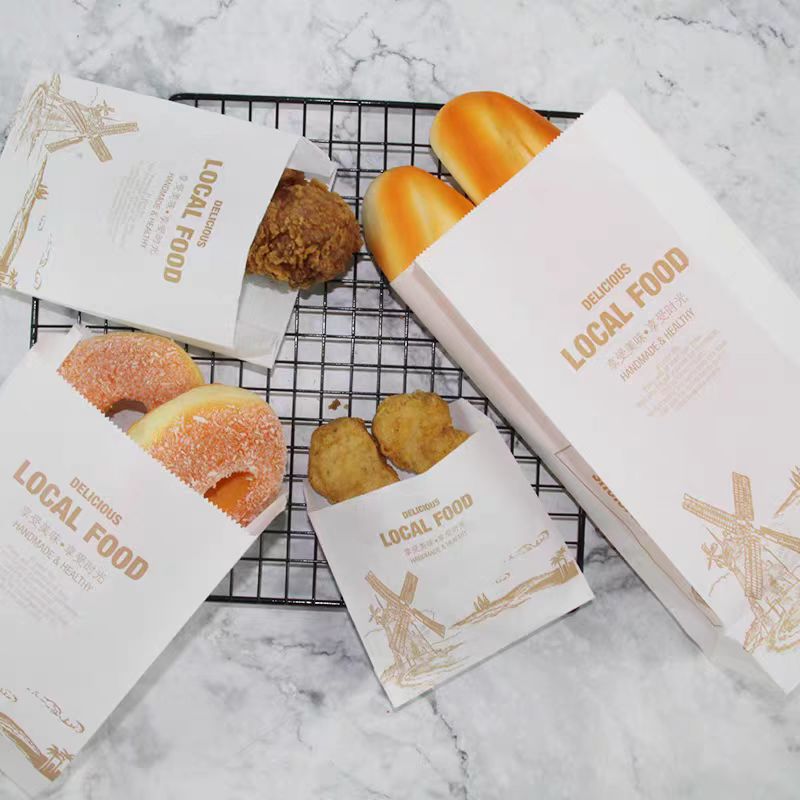
Two mouth styles appear across the photographs, and they serve different counters. The open-top style — straight cut or zigzag cut, standing wide — is the speed choice: a clerk scoops with tongs, the bag never leaves one hand, and an folded twist takes half a second if the customer wants a cover. Every bag in the third photograph works this way, sized so a single item drops in without folding.
The turned-down style appears in the listing layout above: the mouth creases over into a band, closing the contents without a clip. It suits counters that hand bags across a distance — a drive-through window, a market stall, a table-service pastry grab — where the fold keeps crumbs out and gives the clerk a place to press a stamp or stick a seal. Both styles run on the same grease-resistant stock; the fold-over edge costs one creasing step, and we price it visibly on the quote rather than bundling it silently.
There is no hardware on this tier: no cord, no ribbon, no punched grip. That is a decision, not an omission. Counter bags are stuffed from one hand and gone in ten seconds; handles slow the pack, cost a component, and never feature in the customer experience. When your line needs a walk-away carry, the kraft carrier page covers that job properly, and we will honestly route your enquiry there.
Hygiene and handling shape these two styles more than design taste does. An open mouth means the bag never touches a work surface on its way to the customer: it springs from a wrist-stack under the counter, gets scooped into, and leaves. That flow is why pinking-cut edges exist at all — the zigzag helps a clerk separate one bag from a nested stack without pinching two at once, which is a small irritation multiplied by four hundred orders a day. The folded-band version trades a second of packing speed for a closed parcel, and it pairs naturally with a paper twist tie or a stamp pressed onto the flap if your counter uses them.
Choose by counting steps, not by looking at catalogues. Time your own staff bagging a hot pastry order in both styles on a sample run — we ship blanks in 3-5 days precisely so this test happens in your kitchen with your product, not in our studio with stock photography. The winner is whichever style removes one step from the peak-hour rush; in our experience that is the open mouth two counters out of three, and the fold band wins where the order travels: delivery racks, catering drops, walk-up windows with a long hand-off.
Reading a Print Job Off a Photograph
The third photograph earns its place because it shows a print decision, not just bags. Four white bags stand on a black wire cooling rack, graduated from a small sleeve to a tall lunch size, each printed on the front face only with a metallic-gold single-zone layout: a wordmark block, a tagline line, a small illustration and a body text block. That sample artwork belongs to its owner and is not offered as a design; the production lesson is what it demonstrates about your own file.
Gold-look printing on white paper reads as considered branding at counter distance, where fine detail dies anyway. Notice what survives on those bags at two metres: the wordmark mass, one illustrative mark, nothing else legible or needed. Small type and dense paragraphs do their job on the menu board, not the bag. When you send us a logo, we will mock it at true size on the exact bag size you picked — the same preview discipline shown across our printed lines, applied to your artwork file instead of the sample in this photo.
The print method conversation matters more on this tier than buyers expect, because the substrate is treated. Grease-resistant coatings change how ink sits: some barrier finishes repel water-based inks at the edges of fine rules, which is a press-side problem you never want to discover at 30,000 pieces. Offset handles small detail on treated stock reliably at production volumes; flexographic is the workhorse for simple one-colour marks on bag paper; and any file that lives or dies on hairlines gets a physical proof, not just a screen mock-up, before plates are finalised. None of that is printed in a photograph either, so it belongs in the artwork call — ten minutes on a headset prevents an entire container of regret.
One honest caveat about the rack photo: the gold on those sample faces reads metallic under studio light, and metallic-look results on bag paper depend on the ink or foil route chosen, the coating on the specific sheet, and how the bag is lit on your counter. We will state plainly on the mock-up which route your file is being proofed through, because “it looked like the picture” is the most expensive sentence in custom printing. If your brand needs an exact Pantone, send the number with the artwork; if you only have a website screenshot, say so, and colour matching happens against a physical swatch strip rather than a screen you calibrated once in 2019.
Size Ladder: From Nugget Sleeve to Lunch Tall
The two printed sets on this page span the working ladder of a fried-food or pastry counter, and you can see four distinct footprints in the rack photo alone. A typical deli or takeaway operation runs three to five sizes in parallel: a small sleeve for two or three pieces, a medium square-bottom bag for a pastry or burger, a tall narrow format for fries and sticks served upright, and one larger bag for mixed boxes. The exact widths, heights and gussets are not printed on our photographs, so we quote our size ladder on request or cut to your drawing — including matching a bag you are already buying and want to cost down.
Ordering guidance from repeat counter clients: buy the middle sizes deep and the extremes shallow. A bakery moves pastry bags all day and buys the tall format once a week for catering boxes; a fried-chicken operation inverts that curve completely. Send us a week of your consumption by size, even rough, and the order split usually lands within one conversation — better than the even split a first-time buyer tends to guess.
What the Last Photograph Adds
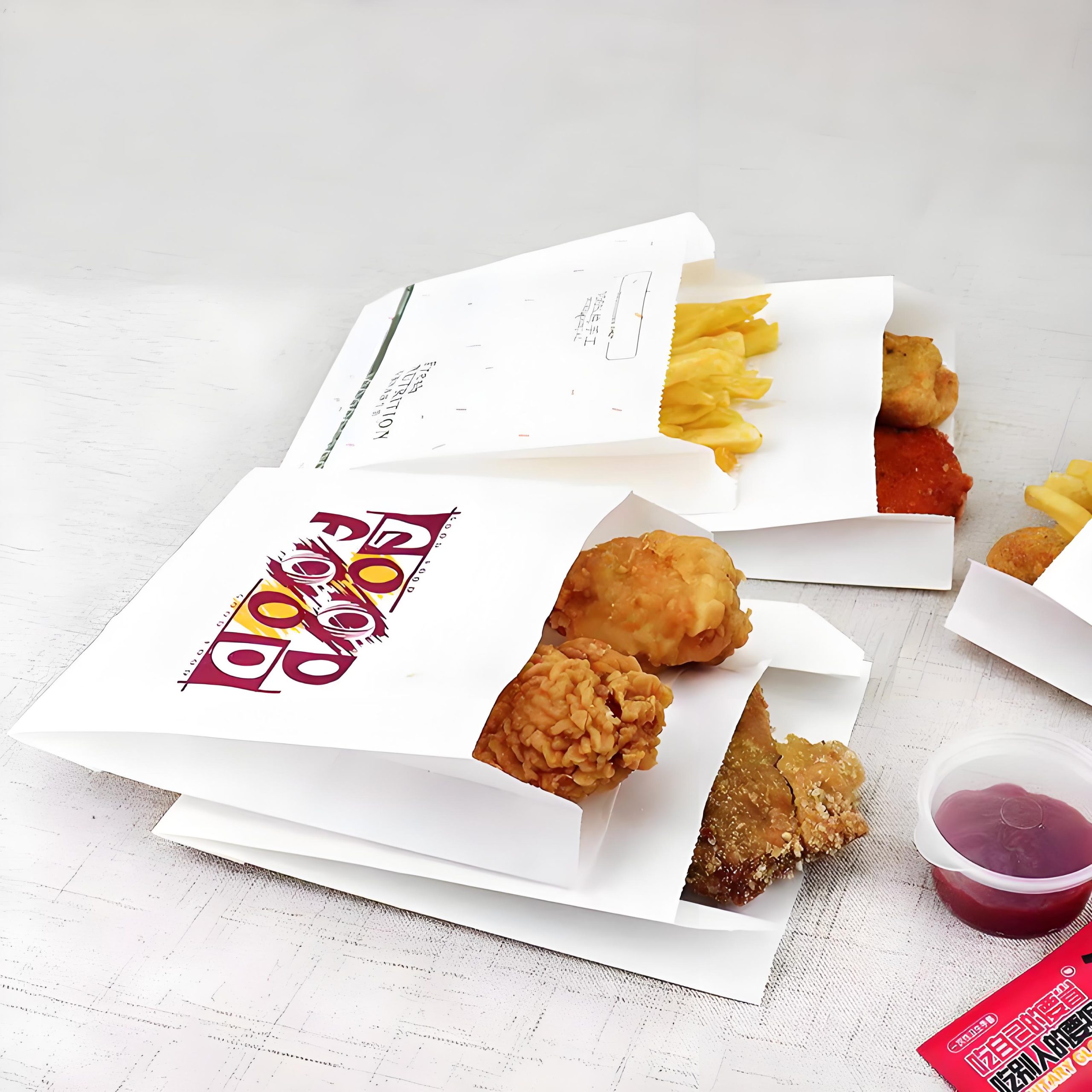
The overhead shot brings the messy reality of a fried-food counter into frame, and every printed element inside it is sample artwork belonging to its owners — reproduced nowhere in our copy, listed in our image notes for the swap queue. Strip the graphics away and the structural information is genuinely useful. The two flattened bags show how the mouth folds into side tabs when pressed down: the same open-top shell lies flat in a drawer under the counter, one-hand-pop under the fryer scoop, and the fold tabs create the stiff band clerks grab. The two plain sleeves with zero print prove the blank-stock order type: no artwork, no plate, just the sizes you burn through weekly. A clear sauce pot and a printed card sit in the scene as merchandising props; they are neither offered nor produced by us, and the card’s text strings — Latin fragments and characters alike — stay quoted nowhere.
For your own order the practical extract is simple: mix printed and plain on one purchase order. Print the size that faces the customer across the counter; buy the deep-consumption workhorse sizes blank at a lower unit cost. Nobody at the till notices the unprinted bottom sleeve, and your print budget stretches to the face that sells.
Options You Can Specify
- Paper: white or tan grease-resistant counter stock; basis weight and treatment class quoted per order sheet
- Mouth style: straight cut, zigzag pinking cut, or turned-down fold band
- Sizes: our counter ladder on request, or your existing dimensions matched to the decimal
- Print: blank, one-face one-colour, or one-face multi-colour; no hardware zones to pay for
- Ink and finish choices discussed at artwork stage; print survives counter handling, not the dishwasher
- Order floor: 100 pcs per design per size, mixable across the ladder
- Documentation: written material spec from us; your market’s filing obligations stay with you, supported by our sheet
Counter-Line Reference Table
| Decision point | Position on this line |
|---|---|
| Paper family | Grease-resistant treated stock, white or tan face, photographed across four images here |
| Carry hardware | None by design — stuffing speed outranks carrying on a served-over-counter order |
| Mouth variants | Straight cut, pinking cut, or a folded band shown in the layout photo inset |
| Barrier wording | Cited strictly per photographed spec; written figures attach to your order sheet |
| Compliance stance | End-use food-contact filings are the buyer’s own-market duty; we supply the spec to support them |
| Size ladder | Sleeve through tall lunch formats; full dimensions quoted on request, absent from photos |
| Order floor | 100 pcs per design |
| Sample dispatch | 3-5 days |
| Production window | 7-15 days after artwork approval |
| Line capacity | 1,000,000 pcs per month across our gift lines |
Sampling and Repeat Orders for Counters
Counter buyers sample differently from boutiques, and the flow reflects it. Stage one, blank stock: a handful of sizes in your chosen paper so cooks can load real product — hot, oily, sugary — for an afternoon and report back. That costs 3-5 days including dispatch. Stage two, artwork: your mark mocked at true scale on the winning size, free, before anything is engraved or cut. Stage three, production: 7-15 days after artwork approval. Reorders then run on a standing spec, and most kitchens settle into a monthly rhythm because a counter cannot be photographed empty on delivery day. The capacity behind that rhythm is 1,000,000 pcs per month across our gift lines, shared honestly with our other programmes — which is why the 7-15 window exists as a range, not a promise.
Packing, Cartons, Freight
Counter bags arrive flat-packed in scored export cartons, sleeves nested so one carton holds a full day’s consumption for a busy shop without crushing the mouths. The reference chart below shows carton markings, dimensioning and how pallets get staged before a container or express pickup; per-size carton counts appear on the proforma so your receiving team checks quantities against paper, not memory. Freight leaves by sea for standing-programme depth, by air for a forgotten festival weekend, and by DHL, UPS, FedEx or TNT for the single-carton emergency that every multi-site kitchen has produced at least once. FBA-style labelling and pick-pack prep are supported when your counter brand also sells through marketplaces.

Frequently Asked Questions
Do these counter bags carry a food-contact certificate from your factory?
How is the grease resistance actually specified on my order?
Why do none of the bags on this page have handles?
Can I order some sizes printed and the rest blank?
What sizes exist in your counter ladder?
Where This Page Sits Next to the Others
This is the served-over-counter tier of our paper bag programme. If the job changes to bags customers carry out of the shop — cord arches, ribbon, a punched grip — the kraft carrier specification lives at custom printed kraft paper bags. If the counter is a display case and the merchandise needs to be visible through the paper before the sale, the see-and-buy tier is custom paper bags with window. The whole family indexes at printed paper bags under printed items, and reusable fabric totes for the same brand sit in textile bags.
Send your size consumption, mouth-style choice and artwork through the quote desk, or write to [email protected] / +86-15967739086. First reply carries a spec sheet and a mock-up — not a brochure.