Custom Leather Travel Journal Folio with Passport Pocket
$3.98
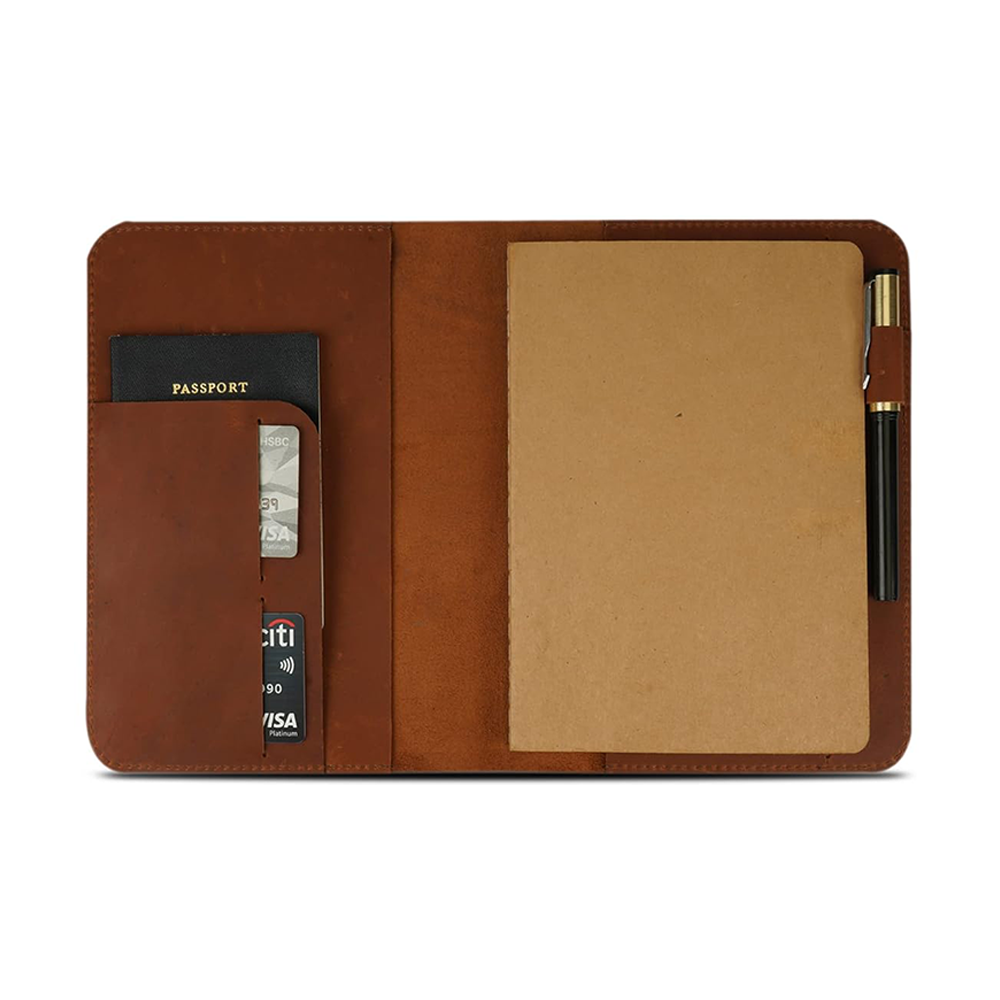
Travel-ready folio build with the document carry solved: a wide slip pocket for a passport and boarding passes, two die-cut card slots, an A5 pad cradle that refills in seconds, and a stitched pen tab, all framed in tonal edge stitching on a tan pull-up leather-look PU shell with a blank face for your deboss or foil mark. The listing’s own feature graphic names each pocket by function, and pads ship as separate refills, not as bundled contents. Airline crew kits, hotel welcome amenities, honeymoon packs, tour programs: MOQ 100 pcs per design, samples in 3-5 days, bulk in 7-15 days after artwork approval.
A custom leather travel journal passport holder has to work two jobs at once: keep documents flat and findable at a check-in counter, and give the writer a real notebook rather than a cramped notepad. This folio build does both from one fold-over cover. The photographed unit pairs a document slip pocket with two die-cut card slots on one panel, a notebook cradle with a stitched pen loop on the other, tonal edge stitching around every panel, and a blank cover face waiting for one debossed or foil wordmark. It is the gift line hospitality groups, tour operators, and corporate travel desks order when they want the logo carried through airports instead of left in a drawer.
Everything factual below is anchored to the four photographs on this listing, including the feature graphic whose printed callouts name the pockets and slots by function. Props staged into those photos are staging, nothing more, and the page says so plainly rather than letting an image imply contents that are not shipped.
Reading the Feature Graphic: What This Folio Actually Has
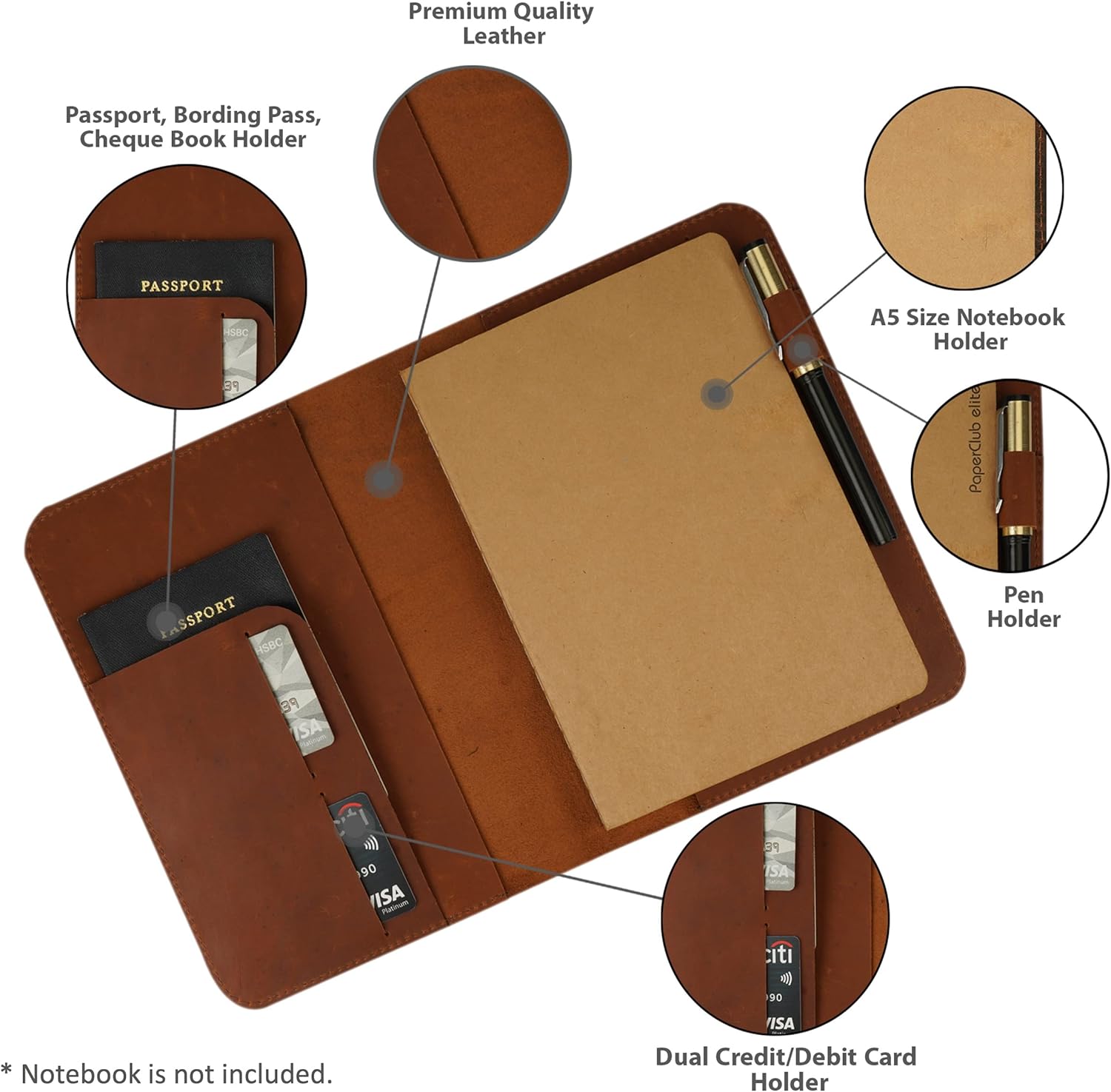
The listing’s own infographic diagrams the construction with five ringed close-ups tied to printed labels. In plain terms it claims: a leather-look exterior; a document pocket sized for a travel book, boarding passes, and cheque-style documents; an A5-size notebook holder; a pen loop; and dual card slots stacked vertically. A small printed disclaimer at the graphic’s foot states that the notebook is not included, which is exactly right for a folio program: the pad is a consumable refill, and your order ships the organizer.
Why that component set matters commercially: every element answers a travel-desk complaint. Loose boarding passes crease in handbag bottoms, so the wide slip pocket holds them face-up. Queue-and-pay days eat time, so two dedicated card slots beat digging through a wallet. Note-taking mid-layover fails when there is nowhere to write, so the cradle carries a pad while the loop stops the pen rolling under a seat. A folio that fails any of these reads cheap within one trip; this configuration was built as one piece and stays one piece.
Two further callouts from the same graphic deserve their exact printed words: the leather caption promises premium quality leather, the document caption names what the big pocket holds, and the card caption says dual credit or debit card holder, each tied to a zoomed inset of that feature’s stitching or cut. The five insets are not decoration; they are the audit trail a purchasing officer follows when comparing three suppliers on a shortlist, because stitch spacing, mouth radius, and slot depth all read in the rings at magnification that flat lay never shows. When you shortlist folios, ask every vendor for this same five-ring proof; suppliers whose photography cannot zoom each pocket are telling you their construction is not repeatable.
On materials, the honest summary: the product spec tree carries this shell as PU leather with a pull-up, distressed finish, while the grain photographs show tonal shading typical of leatherette or crazy-horse styling and the graphic’s own caption claims premium quality leather. Either reading gives the same shelf story: a waxy matte surface that scuffs into a patina rather than showing wear as damage. Genuine leather construction, different hardware, or a smoother PU finish are quoted on request against a physical sample, so specify at proofing and audit at sample, not from this page.
That disclaimer also protects the buyer’s own product page. Hospitality purchasing teams routinely get burned by amenity photography that implies bundled contents, and a supplier that prints its exclusions directly on the feature graphic is a supplier that has run those disputes before. Read the rings, read the footnote, and spec the refill line on a separate quote if your program wants pads arriving with the shells.
Panel by Panel: The Tri-Fold Anatomy, Photographed
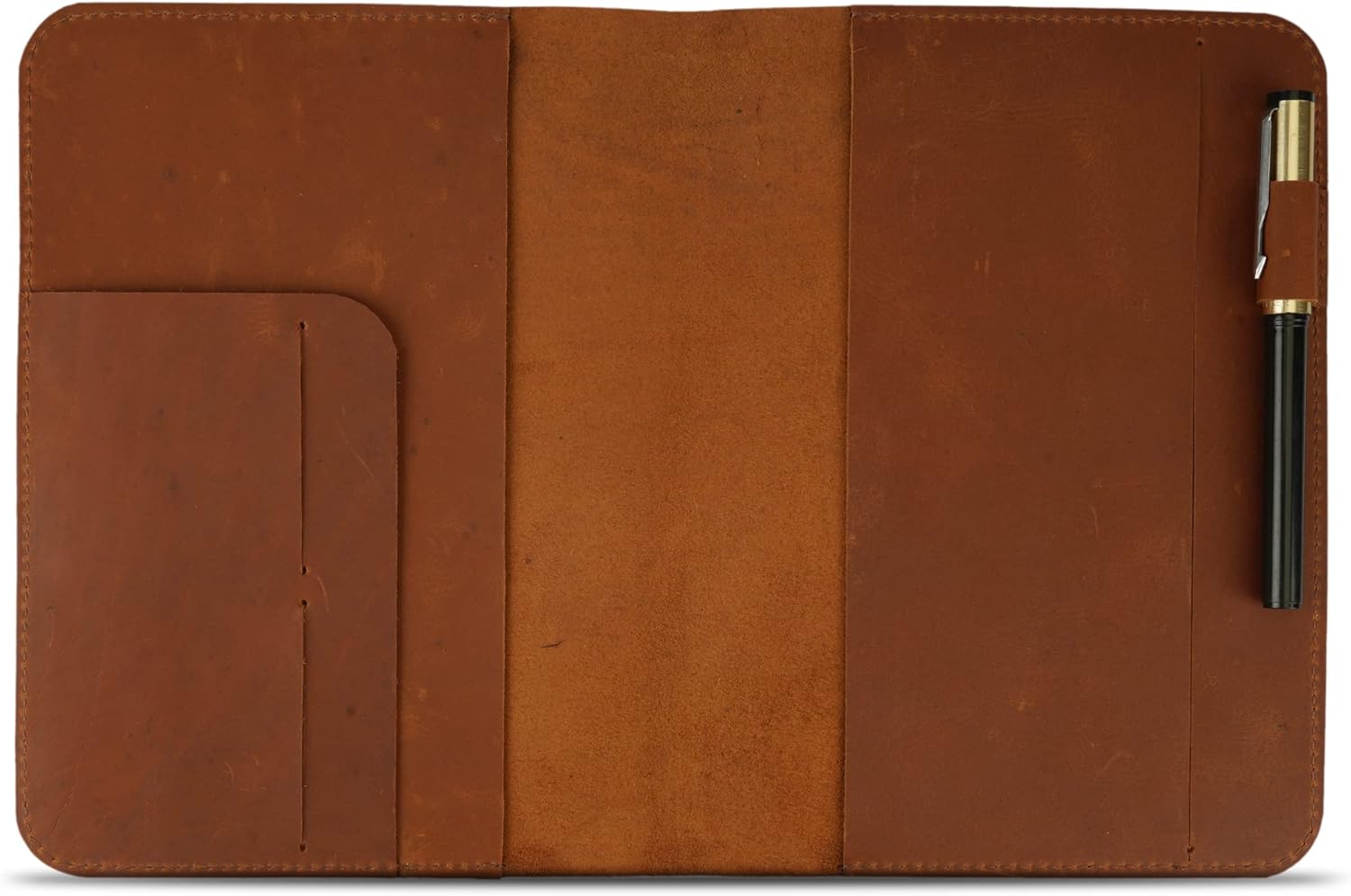
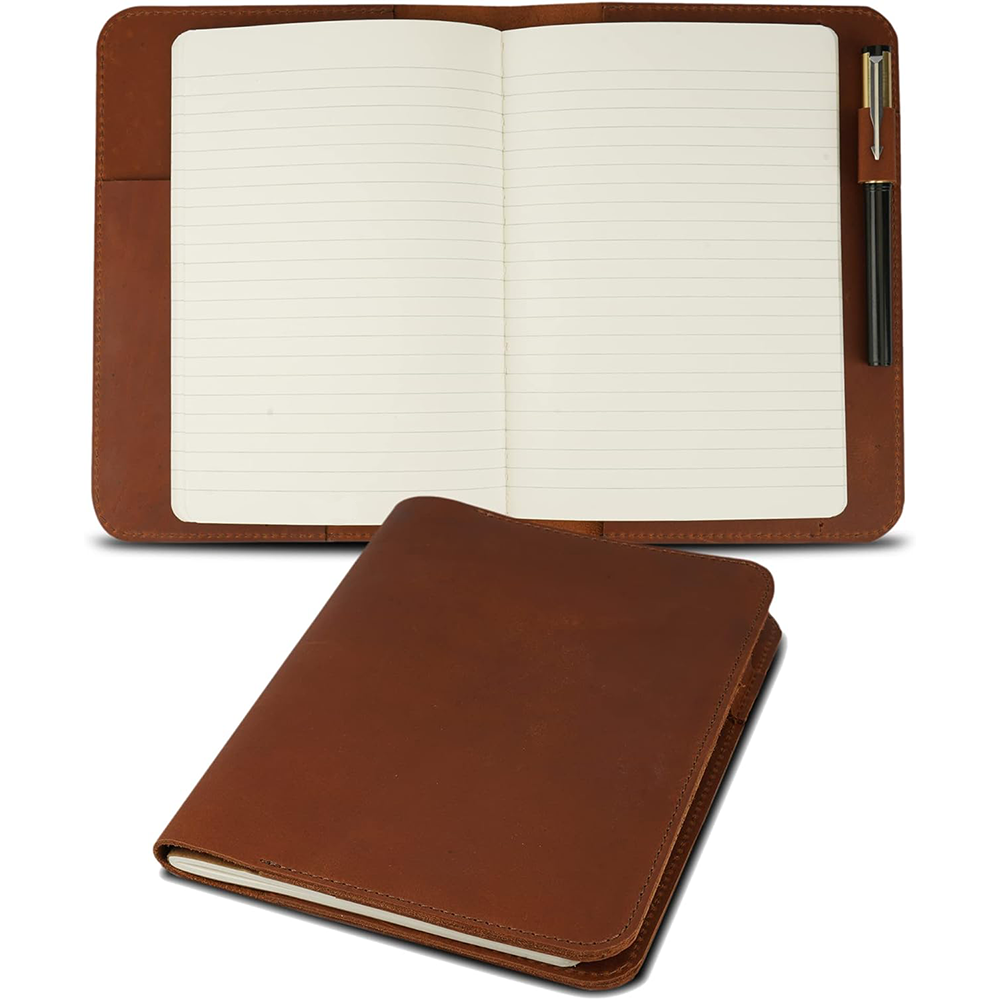
The fully-open shot shows three vertical panels joined by two fold seams. The outer panels carry the grained working faces; the center panel reads as the softer napped side of the material and works as the spine, with no pockets and no hardware of its own. Every perimeter edge, panel, and pocket is finished in tonal stitching with rounded corners, and that stitching is where durability either holds or fails in year two of crew use.
Why the tri-fold beats the simple bifold for program use: the center panel exists so both working faces can be loaded without the fold eating into either pocket. A bifold organizer forces the document pocket and the pad cradle onto the same two leaves, and the book bulges at the seam within a month. Here, the suede-face spine takes the thickness penalty instead, the outer leaves stay flat, and the closed profile stays slim through a jacket pocket or a seat-back. Stitch density on that spine is the specification auditors should watch on the sample: even tonal thread with no skipped loops at the fold line is what keeps a folio from splitting along the crease after a year of daily zipping through a bag.
Construction details worth putting on your spec sheet: the left slip pocket is a separate cut piece laid over the panel, stitched along three edges with the top free as the insertion mouth and its upper corner rounded so documents slide in without catching. The right panel carries a full-height narrow slot stitched with a single vertical line, sized for card stock or folded notes, plus a short pen tab anchored by two horizontal stitch runs that grip the barrel without crushing a slim writing instrument. There is no hidden compartment, no zip, and no phone pocket in these photographs, and this page does not claim any of them.
Pen fit deserves a line of its own because buyers always ask. The photographed loop holds a capped metal-barrel pen upright, and the tab’s stitch depth is fixed, so send your chosen pen to the sample request when it must pair with a branded writing instrument; diameter and cap length get verified against the real tab, not a drawing. Hotel groups standardizing on a generic metal stylus or a slim ballpoint slot in first, and the sample notes the clearance on the packing list so reorders inherit it.
Document fit gets the same test. Travel booklets differ by a few millimeters across issuing countries, and the slip pocket’s depth is cut to the photographed proportion, not to an average. Load the sample with your tallest expected document plus a folded boarding pair and one business card in each slot; a pocket that swallows documents loosely reads generous until the folio is inverted over a security tray. If a property wants an inserted room-key card holder or a smaller voucher pocket added to the panel, both exist in the folio family as stitched variants and get drawn onto the same proof.
Logo Placement, Monograms, and Color Programs
The closed view is the money shot for gifting buyers: a clean tan cover with perimeter stitching and nothing printed on it. That blank face is the specification, not an omission. Debossing presses the mark into the pull-up grain without paint or foil to abrade at the corners; foil reads sharper from a distance in a welcome tray. Either lands within the 100-piece-per-design minimum, where one design means one cover treatment plus one logo file. Programs that need tiering run deboss for crew stock and foil for guest-facing pieces as separate designs on one purchase order.
Placement geometry matters more on a folio than on a journal because the cover face is larger and the stitching frames it. Front-cover lower placement reads classic on a desk and survives the thumb-rub wear line of a handled bag; spine-adjacent placement shows when the folio stands in a welcome-tray display. The sample stage is when the mark gets positioned against those real use cases, at production depth, with the exact grain batch, and the photograph of that signed sample becomes the position record every later wave copies. Ask for it in writing on the approval sheet: a folio with a logo two centimeters too high looks like a mistake forever, and forever is exactly how long these things get kept.
Honeymoon and VIP packs take the personalization one step further. Initial monograms, couple names, or property crests can be produced as small runs folded into the same tooling conversation, and the pre-production sample carries your actual lettering so kerning and depth get signed before bulk. Where a program needs per-recipient engraving-plate style naming at scale, route it through the boxed-set page linked lower rather than this folio, because serialized names change the work-hour math per unit.
Refill economics finish the ownership story a hotel engineer or crew manager cares about. The cradle grips a standard A5 pad by friction, not glue or stitching, so housekeeping restocks a tired folio in seconds and the shell stays in circulation for years of amenity cycles. Programs that budget per-property quantities often order the folios once and the refills seasonally, two separate purchase orders with the pad line quoted lighter, because a refill program carries no tooling at all. That durability math is the difference between an amenity expensed annually and an amenity standardized once, and every hospitality buyer who has replaced a $6 plastic document wallet twice a year understands the difference immediately.
Color options start from the photographed tan with tonal thread and darker contrast stitching visible on some panels; espresso, black, and natural tones quote against swatches, with stitch color and hardware kept consistent across a program’s waves. Pantone-matched PU runs exist at this MOQ tier, and the sample you sign becomes the shade record every carton references.
Where Hospitality and Travel Programs Stock This
Four proven placements, each with different quantity math. Airline crew kits: 300-1,000 units a year, debossed logo, standardized pen pairing after the loop-fit sample, distributed through uniform desks rather than gift boxes. Hotel VIP amenities: 100-250 units per property season, foil mark, welcome note slipped into the card slots at turn-down, pad stocked separately by housekeeping. Honeymoon and milestone packages: low four digits per year across a resort group, monogram covers, boxed downstream by the property.
Tour operators and study-abroad programs round out the set: pre-departure welcome packs where the folio replaces three disposable items, and the document pocket quietly cuts lost-boarding-pass incidents on multi-leg transfers. Across all four, one cover tool serves the whole tree; what changes between waves is logo depth, thread color, and whether units ship banded, boxed, or bare for the property to dress. Capacity across our gift lines runs to 1,000,000 pcs per month, so a crew expansion and a resort opening can draw from the same line in one quarter.
Mix-and-match rule of thumb before the first order: split quantities by design, not by department. Two cover colors or two logo treatments mean two designs at 100-plus each. A single tan deboss serving crew, welcome desk, and events is one design at whatever total, priced from the tier table.
Folio Construction and Terms
| Item | Custom A5 PU-leather travel folio journal holder with document pocket, card slots, pad cradle and pen loop |
| Size | Folio shell sized for A5 pads per the printed A5 Size Notebook Holder callout; alternate trims quoted on request |
| Paper & Ruling | Pad is a separate refill, not included per the listing disclaimer; ruled pads shown in photography, other ruling quoted on request |
| Cover | Tan pull-up leather-look PU hard shell, rounded corners, tonal edge stitching, blank face for logo |
| Binding | Fold-over stitched shell: document slip pocket with rounded mouth, dual vertical card slots, notebook cradle, stitched pen tab, suede-style spine panel |
| Logo & Finish | Blind deboss or foil on cover grain; contrast or tonal thread; genuine-leather builds quoted on request |
| Packing | Individual box or sleeve per spec, inner packs, five-layer export cartons; FBA labeling available |
| MOQ | 100 pcs per design |
| Sample time | 3-5 days |
| Lead time | 7-15 days after artwork approval |
| Capacity | 1,000,000 pcs per month across our gift lines |
Proofing, Production, and the Travel Calendar
The sample-first path fits this product unusually well because fit issues are physical, not visual. Card slot depth for a specific document, pen clearance in the tab, pad thickness in the cradle: each gets verified on the 3-5 day sample you sign, and the production clock of 7-15 days after artwork approval starts from that signature. The displayed price on this listing anchors the 100-piece tier for one design, so multi-color or multi-logo programs scale by design count with the same floor per file.
Season anchors: holiday amenity stocking wants approval by late October on sea freight; crew-kit renewals align to uniform-contract months rather than retail calendars; wedding-season resort packs order in Q1 for a June-through-September run. Nothing about these windows changes the terms; they only decide which proofing lane your artwork joins. Undated folio stock never expires, so programs build safety inventory cheaply between waves.
Packing and Freight
Folios ship flat in individual boxes or sleeves, nested into inner packs and five-layer export cartons at fixed counts per SKU so receiving teams at properties or hubs can audit cartons without opening them. Freight routes by sea for program restocks and by air, DHL, UPS, FedEx, or TNT for samples and soft-opening deadlines. FBA labeling and carton compliance prep happen before departure for resellers running this shell through marketplace warehouses.

Questions Travel-Program and Hospitality Buyers Ask
Are the notebook, pen, and cards in the photos part of what I receive?
Will an A5 pad plus loaded pockets bulge or warp the cover?
Is this PU or genuine leather, and which ships by default?
Can a hotel group order welcome-amenity and staff-copy quantities on one PO?
Can we run guest initials for honeymoon packages?
Our pen program uses a slim metal stylus, will it stay in the loop?
Neighboring Product Pages
Folio programs usually complete against three siblings: the ruled journal notebook when the desk copy needs pages but not pockets, the boxed journal set for ceremony presentation pieces, and the full notebook category for the rest of the stationery tree. Refill pads, bands, and collateral print alongside in printed items, and new program specs open at the request-a-quote desk.
Deck Your Travel Program
Send the logo file, pen reference, and document set to [email protected] or +86-15967739086. The mock-up returns free, the loaded sample lands in 3-5 days, and the shell arrives stamped to the exact grain you signed.