Custom Acrylic Cake & Dessert Display Stands | Alice
$25.00
Pyramid-shell dessert stands on solid gloss-black plinths: polished clear panels over internal shelves that step cupcakes one-two-three in the footprint of a coaster, with metal hinge plates and magnet seats letting the cap open for loading. The metallic name band on the base is a personalization zone – your event title or brand by print or engraving. Acrylic is the display architecture; liners and plates are the contact layer, written into the order with your inspector in mind. Free mock-up, samples in 3-5 days, bulk 7-15 days after artwork approval, MOQ 100 pcs per design, film-and-foam export packing for the event season.
A Custom Acrylic Cake Display Stand That Handles the Dessert Table Photo
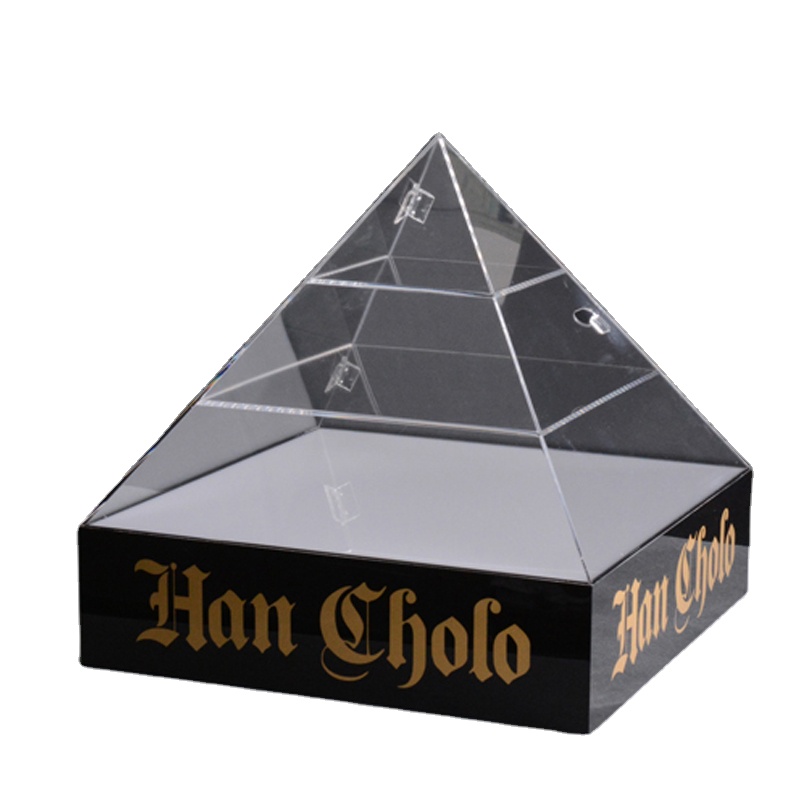
A custom acrylic cake display stand for dessert tables earns its place differently than a bakery case: it has to photograph clean from the head table, survive being loaded and unloaded by event staff, and arrive on-site without a single chipped edge. The format photographed here is the pyramid shell on a plinth – a square-based dome of polished transparent panels centred on a solid glossy black base block, with internal clear shelves splitting the interior into levels. The styled shot shows how it works in service: cupcakes in paper liners stepping one-two-three across the top shelf, middle shelf and plinth floor, seven pieces in a triangular layout that reads at twice the height of the same count lying flat. Caterers, bakery retail counters and event-rental fleets all reorder this shape for one reason – a small footprint buys a vertical dessert presence.
Why Pyramid Shells Win on Table Real Estate
Buffet economics are linear-footage economics: a dessert table charges by the running meter, and every stand that stores more presence per centimetre of tabletop is worth its purchase price. The pyramid does that geometry for free – the square base occupies a plinth-sized patch while the three internal levels present at dome height, so the bottom tier gets the plinth top as its floor and the upper shelves cantilever the smaller counts toward the apex. Front-on sightlines matter equally: two triangular clear panels meet at matching slopes, and because the acrylic carries no tint, the frosting colours read through the shell exactly as they do outside it, while the black plinth below acts as a dark matte frame that makes pale icing pop in photographs.
The photographer angle is not vanity – it is how the format gets rebooked. Event accounts sign off dessert tables from the previous year’s gallery, and a pyramid with visible tiers and a clean dark base repeats in a way that flat platters never do. For bakery retail the same logic runs on the shelf: one stand of seven looks like a curated counter, three flat trays of seven look like a lunch line. Height sells; the shell keeps the pieces dust-shaded while they hold.
The Lid Hardware, Because Loading Is Not a Two-Person Job
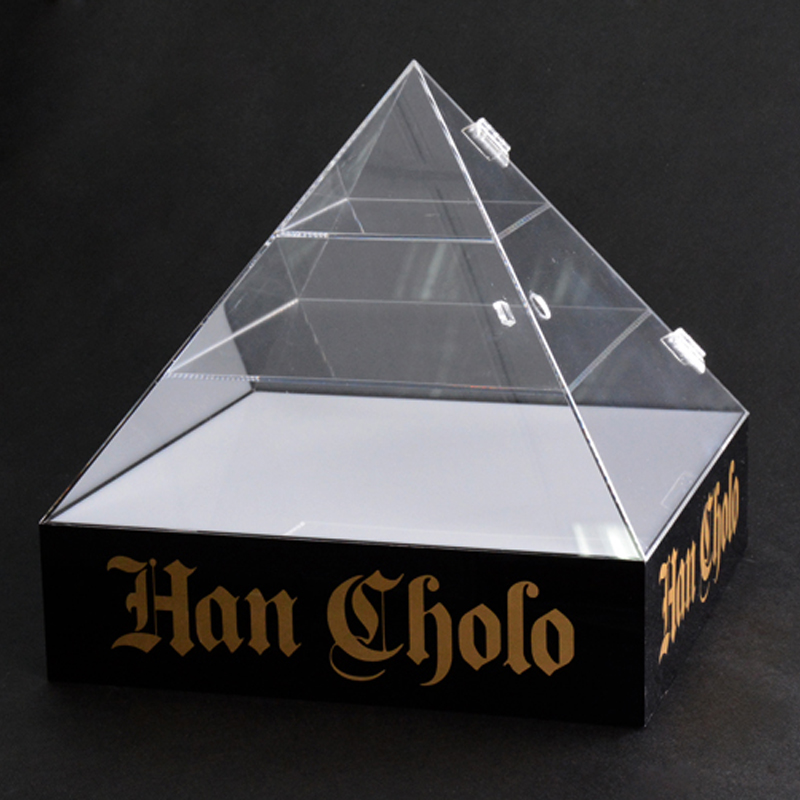
The second photograph is the one rental fleets care about: it puts the closure hardware in frame. Along the pyramid’s right slopes you can read small rectangular metal hinge plates with fixing holes, and two compact round elements at the edge line – magnet or clasp points that hold the assembly shut. That means the dome section lifts or swings as an opening cap: staff load the shelves and place pieces without disassembling the stand, and the shell returns to its seated position against the plinth. This is the practical difference between event hardware and window decoration, and it is why the plated-and-hinged variant is the one that gets checked, cleaned and re-checked every weekend. Fixed-dome versions remain the cheaper spec for single-set purchases where the bride loads once and nobody touches it again.
Hardware specification matters because event crews are not one person. The hinge plates fix through with visible countersinks, and the magnet points let the shell reseat on a two-hand lift instead of a fiddly alignment pass. At forty stands per wedding, five saved seconds per reseat is an hour of crew time that shows up in the load-out schedule, which is why rental operators ask for this exact photograph angle – the dark-background shot doubles as the loading instruction nobody has to write down.
Tiers, Shelves and the Personalized Base Band
Inside the loaded shell, the shelving plan is visible through the clear panels: two horizontal acrylic shelves span the interior, joined to the triangular faces with small clear connector tabs at the slopes and apex – discrete blocks rather than metal brackets, so the structure keeps its all-clear read. Add the mirror-flat plinth top as the third level and the served layout is exactly the 1-2-3 step shown with product. Loading sequence is a shelf-stability conversation too: the heaviest pieces belong on the plinth floor where the stand’s center of gravity sits lowest, while the top tier takes the smallest counts so the pyramid reads as a taper instead of a stack. Bakeries that run macarons on the upper shelf and standard cupcakes below report the same reset time either way, and the clear connector tabs keep every plane level when crews rotate product mid-service. Tiers load back-to-front so the tallest frosting clears the apex slope.
- Pyramid footprint and height scaled to your dessert sizes; drawings quoted from target piece dimensions
- Shelf count: two internal shelves plus plinth floor as photographed; additional tiers quoted
- Shell route: hinged/magnet-seated cap as shown, or fixed dome
- Plinth: solid block, gloss black photographed; finishes and colour board options on request
- Name band: metallic print or engraving on base faces, left unmarked, or batch-numbered
- Edge treatment: polished slopes, iridescent refraction banding visible in the loaded shot
The plinth front carries the other half of the event function. Both studio shots show a metallic name band running across the base faces, printed on two sides so the mark reads from the table front and from the aisle. Treat those letters purely as decoration-zone proof. Your own event title, brand or table number goes into that band by print or engraving, and repeat-ordering rental fleets commonly leave it blank and sell the clean look instead. For multi-table programs the band turns logistical: engraved batch numbers sort tables inside the carton, the venue walk-through runs without the seating chart beside it, and attrition gets counted by number when a crate returns one short at teardown. Band production runs from your artwork file at the same price step as the blank base – the engraving or print pass happens on the bonded plinth before the shell is fitted, so nothing on site needs to be marked or aligned by event staff.
One spec detail the loaded shot settles for catering buyers: the lower tier’s floor is the plinth top itself, a mirror-flat black surface, which is why pale icing reads hardest on it – buyers who prefer a lighter base for contrast should ask for a mirrored insert panel over the plinth top rather than a board colour swap.

Handling Acrylic on a Food Table – the Honest Boundary
The responsible answer about food display is a zoning answer. The photograph shows every cupcake seated in its paper liner on the shelf – that is how these stands are used and how they are packed in your event plan: the acrylic is the display architecture, the liner, liner cup or a placed plate is the contact layer. We build decorative riser structures, not direct-food-contact surfaces, and if your health inspector requires a rated contact surface for anything resting on the shelves, raise it at quote time so the zone between decorative board and contact-facing insert is written into the order rather than assumed. Cleaning is accordingly simple: shelves and shells wipe down behind the liners, plinths get a damp cloth, and nothing on the stand sees frosting grease at the edges the way a rimmed glass dish would.
Acrylic-versus-glass handling is the other half of that same talk. Shells are lighter to carry in armloads, chip only on a hard corner drop, and a nicked edge can be re-polished at the shop instead of binning a whole piece – the reason event hardware fleets standardize on this material long after the first replacement quote. Glass domes shatter outright in a load-out van; that risk is why this format is built as acrylic end to end and shipped film-wrapped.
Specification Sheet for Rental and Catering Buyers
| Item | Acrylic pyramid dessert display stand with plinth base, internal tiered shelves and hinged shell option |
| Size | Pyramid and plinth dimensions set to dessert scale; standard three-level layout as photographed |
| Board & Thickness | Clear acrylic for panels, slopes and shelves; black board plinth; gauges confirmed per size at sample |
| Decoration | Gold or colour metallic name band on plinth faces, print or engraving; shell and shelves kept clear |
| Assembly or Mounting | Bonded pyramid shell with metal hinge plates and magnet/clasp points; shelves joined by clear connector tabs; plinth acts as floor and foot |
| Packing | Filmed panels, edge guards, cavity foam in double-wall export cartons; FBA prep on request |
| MOQ | 100 pcs per design |
| Sample time | 3-5 days |
| Lead time | 7-15 days after artwork approval |
| Capacity | 1,000,000 pcs per month across our gift lines |
From Drawing to Wedding Season
Send the stand target – dessert dimensions, shelf count, band text – and the free digital mock-up places your name band and shows tab positions before you commit. Samples fly out in 3-5 days so a rental buyer can load real product on-site and test the cap swing. Bulk completes in 7-15 days after artwork approval within capacity of 1,000,000 pcs per month across our gift lines, which is how spring ceremony season and year-end corporate catering both get served without queueing behind each other. Pricing references the hundred-piece tier; unit cost tracks height, shelf count and hardware, and the real number lives in your quote.
Packing Brittle Geometry for Repeat Event Handling
Pyramid edges and polished slopes are the casualty list of bad packing, so the rule here is no contact and no leverage: each stand travels film-wrapped with hinge hardware guarded, panels suspended in foam-cut cavities inside double-wall cartons rated for event-crate stacking. Ship by sea, air or courier (DHL, UPS, FedEx, TNT); FBA prep follows the same cavity layout when stands route through fulfillment. Rental fleets that store between seasons should treat the carton as the storage crate – the packing picture below is the layout your dock receives.

What Catering and Rental Teams Ask First
Is the pyramid shell removable for loading?
Can the shelves take fondant-heavy pieces?
Does the name band survive repeated wipe-downs?
What is the lead time before a May event season?
Do you supply replacement shelves for fleet attrition?
Can I order the plinth in white or brand colour?
The Rest of the Acrylic Event and Retail Map
This tablescape page shares its catalogue family with adjacent jobs: counter merchandising and elevation hardware is specced on the bracket riser page, small lidded keep-cases for favour and jewelry retail are on the display cube listing, open gift-presentation trays live at the jewelry gift box page, and tobacco-counter closure detail is argued on the humidor page. Event programs that pair printed signage with hardware can reach across to the printed items line, and the acrylic items category keeps the full format list in one place.
Bring the dessert, the date and the band text; the pyramid gets drawn around all three, mocked free, and quoted against the hundred-piece tier before you say yes to anything.