Custom Trade Show Staff Uniforms with Logo
Booth crews get judged at thirty paces and at the handshake. These custom trade show staff uniforms with logo run hoodies, tees and caps on one measured chest-zone sheet, then extend the same black visual system into rope-handle carrier bags across a size ladder, wall clocks, oversized desk mats and replaceable counter panel graphics. Each line clears the 100 pcs per design MOQ independently, so eight-person crews and hundred-person show runs size without forced over-ordering. True-scale mock-ups cover every surface before physical samples arrive in 3-5 days, bulk finishes 7-15 days after artwork approval, and cartons are built for venue load-in windows or FBA prep between shows.
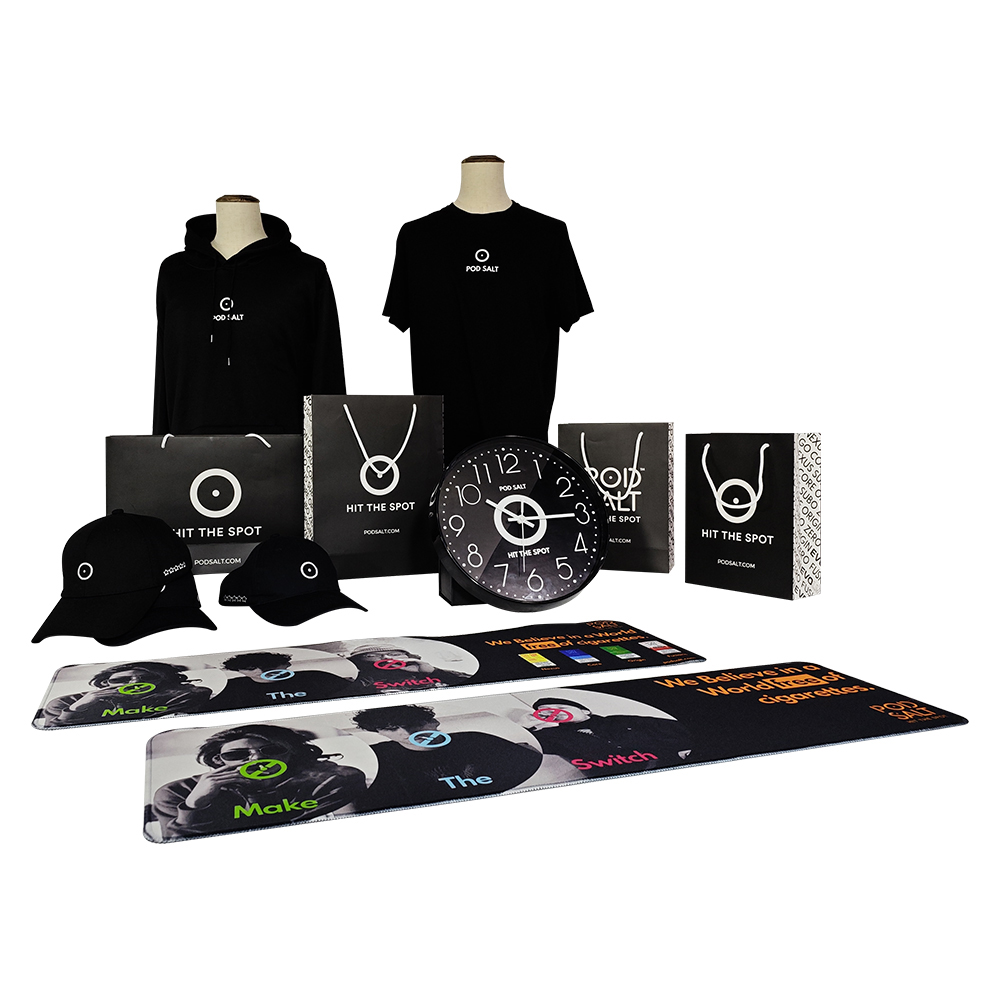
Booth crews are judged at thirty paces and at the handshake, which is why custom trade show staff uniforms with logo work as one system rather than as separate clothing and giveaway purchases. The photographed kit shows the pattern every expo floor rewards: two garments on forms so staff read as a team, four takeaway bags in a size ladder so product handed out travels cleanly, a wall clock and oversized desk mats as the furniture giveaways people photograph at the counter, and two caps to round out the crew wardrobe. Every surface in the shot is black with a light print zone in a fixed place, and that discipline, not the individual items, is what makes a booth look funded instead of improvised. The copy below treats each piece as construction and placement, because artwork belongs to your file, not to these samples.
The Crew Wardrobe: Two Garments, One Chest Geometry
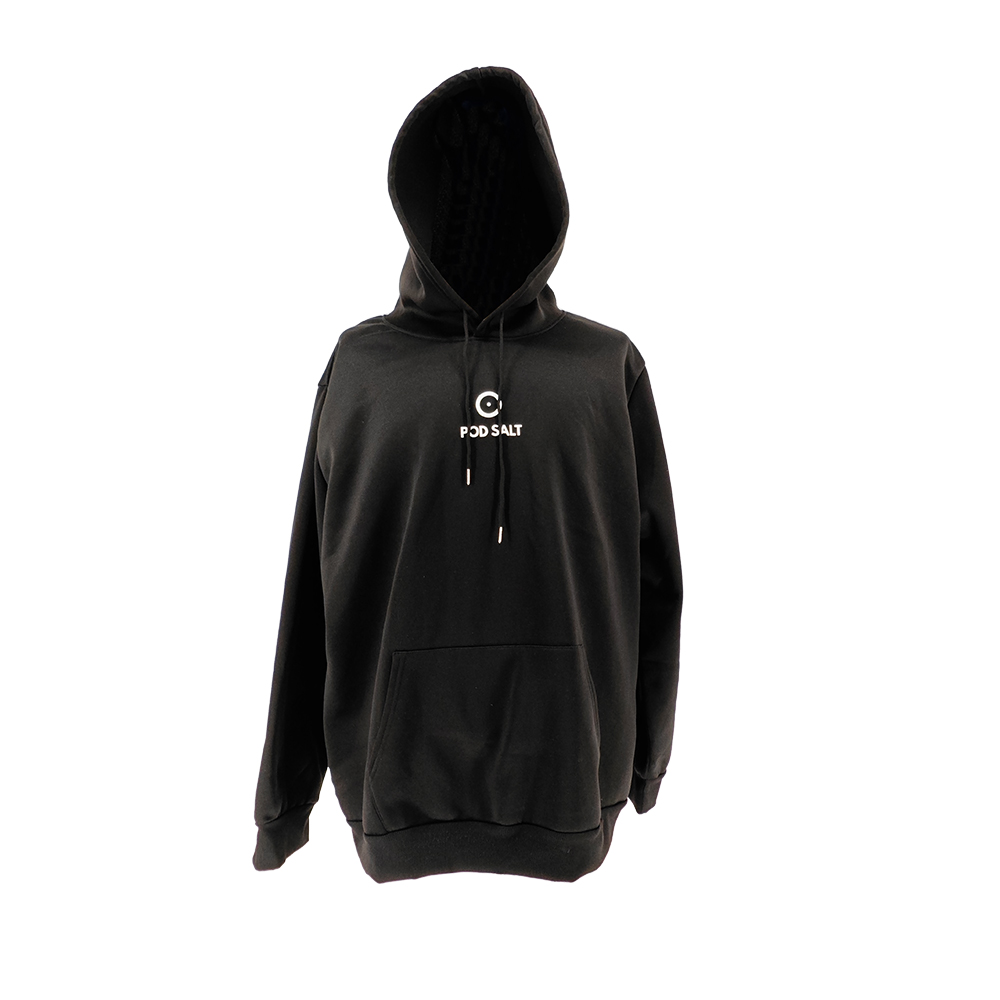
The hoodie and tee on the forms demonstrate the layering logic of a three-day show. Midweight fleece hoodie with a raised double-layer hood, flat drawcords finished in metal aglets, kangaroo pocket, ribbed cuffs and waistband; underneath or instead of it, a matte jersey crew tee in the same black. Both carry the same compact print stack on the center chest: a small emblem above one short line of type. That single decision, fixed chest placement with identical scale on both garments, is what makes photographs of the floor crew read as a uniform even when half the team runs warm and skips the hoodie on day two.
Embroidery versus print is the first real spec conversation for expo apparel. A center-chest stack under eight centimetres across embroiders cleanly on fleece; the same mark on a lightweight tee warps the fabric unless it is printed. The photographed set keeps the geometry small in both cases, which lets you order hoodie and tee with one artwork file and two decoration methods chosen per fabric weight. Caps extend the system with the ring-and-dot device embroidered at front-panel center, sized to stay legible under hall lighting and small enough not to overwhelm a low-profile crown.
Crew sizing itself deserves a paragraph before any artwork conversation, because garment orders fail on curves more often than on prints. Send us the split by garment rather than one headcount: which staff prefer the hoodie as daily wear and which treat the tee as the floor uniform, how many caps for a rotation crew that grows on the weekend, whether your booth has an all-gender curve or a fitted block. Most crews of eight to twelve order a deliberately blunt curve, one to two pieces per size, so nobody at load-in is without. We pack by garment, by size, labelled at the inner-box level, so the team lead can hand out the wardrobe in three minutes out of two cartons while the booth is still going up.
A practical durability note from repeat-show buyers: fleece hoodies live past the expo floor, which makes them the de facto company jacket for the following winter, and the tee is the item your crew wears to the after-event. That is why we recommend the same garment colours the booth itself uses, not the colours from last year’s one-off run. The photographed black pair is the safest version of this logic: black fleece and black jersey take light-coloured chest marks on any substrate and stay in rotation long after the banner graphics get retired between seasons.
What the Crew Hands Out: the Rope-Bag Ladder
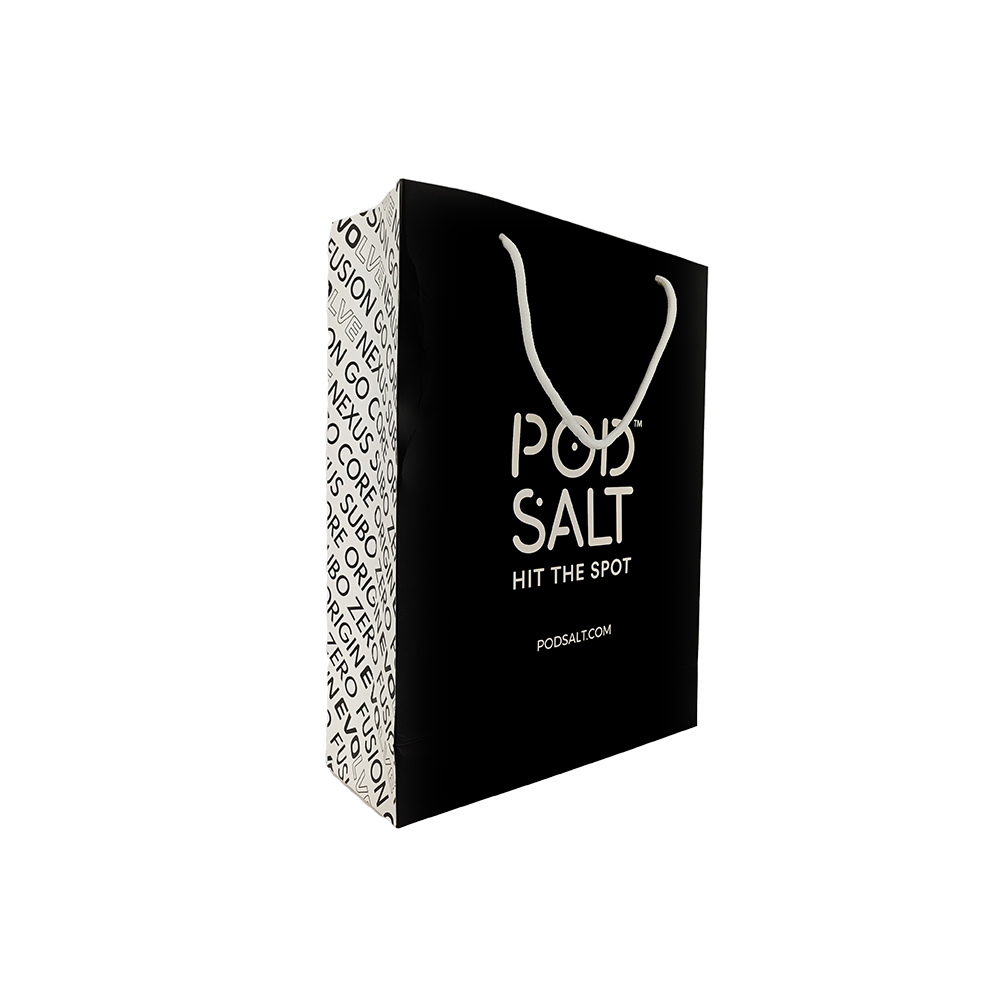
The four paper bags in the composite stand between apparel and giveaways as the transfer layer: whatever leaves the booth travels inside one of them. Coated cardstock, crisp corners, flat bottoms, twisted cream rope handles threaded through the top rim. One landscape-format bag faces wide product; three portrait formats stack by height for everything from boxes to rolled material. The photographed bag shows the placement trick that makes a black carrier look expensive: keep the face minimal with a centered light print block, then run the side gusset edge-to-edge with a dense typographic pattern in the contrast colour. Guests read the plain face as brand and the busy gusset as design, and the two together cost the same one plate.
Handle choice is the most-asked bag question in our inbox, so here is the short version. Twisted paper cord, as shown, reads premium and costs less than ribbon, but its weight ceiling depends on the card grammage underneath; satin ribbon handles carry heavier contents and change the bag’s price band entirely. Booth handouts usually land between two and five hundred grams of packed product, which the photographed rope configuration handles comfortably at the stated card weight. We will quote the exact rope thickness per format against your actual packed item, and if the heaviest demo kit in your show bag exceeds that number, the answer is a heavier board, not a smaller bag.
Bag sizing against your product is a show-season constant. Landscape formats take flat-packed goods; portrait formats take gift boxes stacked with tissue. We recommend ordering the ladder in two heights per format rather than one, because the smaller box inside a larger bag shifts and scuffs the print, and because the rope anchor point is where handle tear actually happens under weight. Specifying rope thickness against your heaviest packed item at quote stage is a one-line decision that saves the visible failure mode at the counter.
One more angle on the carrier line: bags are the only element of the booth kit that visits your competitors. A visitor who collects from six exhibitors fills one good bag and abandons five cheap ones, and the surviving bag becomes the mobile billboard for the rest of the hall, the taxi ride and the office return. That is why the gusset pattern deserves real design attention rather than leftover space: at every handshake distance, the side panel is the surface facing outward. For VIP handouts, add a tissue-and-seal pass at the packing stage and the same bag doubles as the closing-meeting gift wrap, which keeps a second SKU out of the order entirely.
Booth Furniture That Gives Itself Away
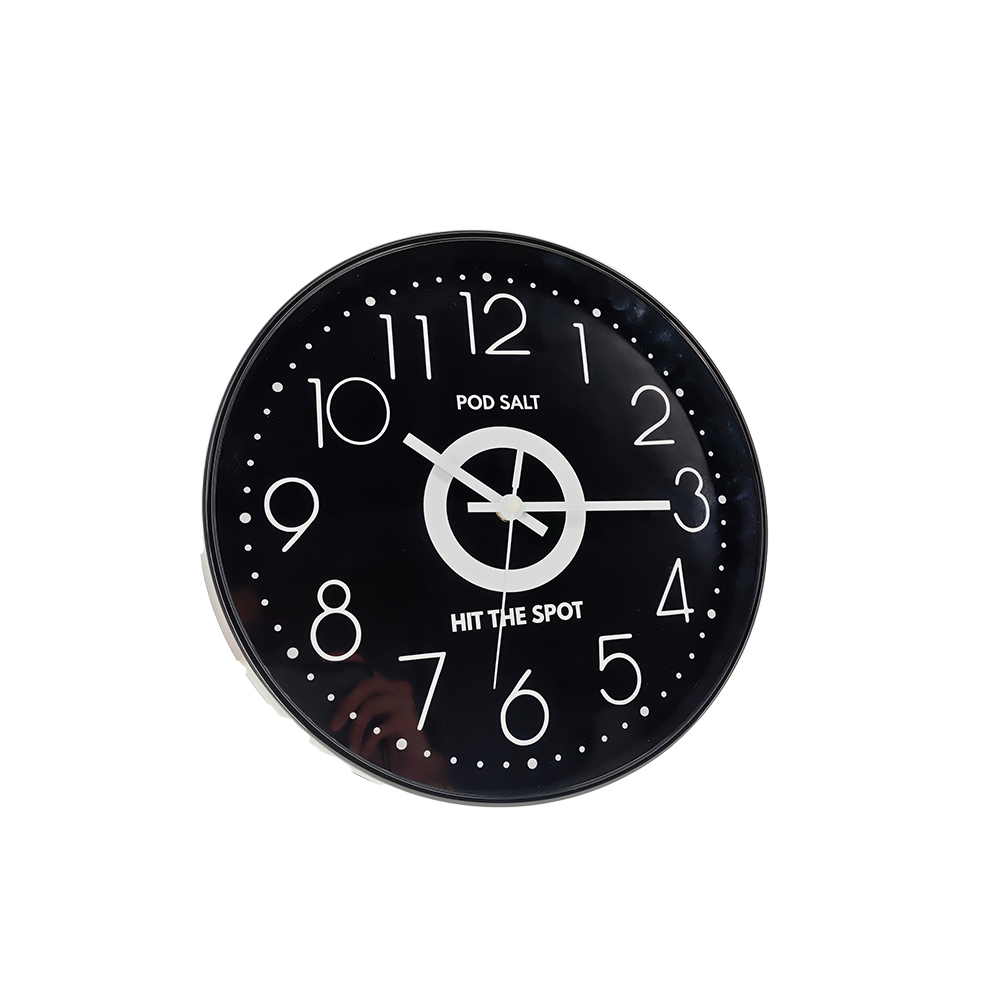
The clock and the mats are the two giveaways that leave a booth standing. A round analog wall clock with a glossy black dial, white Arabic numerals, minute dots and clean white hands holds its print zones above and below the center hub, two short horizontal fields that any brand manager understands instantly. Oversized desk mats in the composite run as cloth-top, rubber-base format with a full-bleed sublimated layout: three circular photo vignettes across the working field, accent-colour type, and a corner print block at the far edge. Both items share one property: they are furniture first and merchandise second, which is exactly why they get kept, used daily, and photographed onto other people’s desks long after the hall clears.
Order logic differs from apparel. The clock is a small-quantity, high-presence piece: two per booth, plus a run as a VIP counter gift. The mats are quantity pieces that staff sit at and visitors lean on; forty to a hundred per show is normal, and the same artwork file survives both uses without resizing because the corner zone carries the brand while the vignette field carries the story. Neither line has a size curve or a colour decision beyond substrate, so they slot into the same production window as the wardrobe with no extra sampling round.
Mechanically, the clock is simpler than buyers fear: the photographed unit is a battery movement inside a thin rimmed case with a side access point on the bezel, which means nothing on the wall needs an outlet and the dial artwork is one flat disc print, quoted like any other printed surface. Power details, hands length and mounting hardware go on the spec sheet quoted exactly on request; what the artwork file needs is a circle of the right diameter and two clear text bands that the numeral ring does not crowd. The mats behave like any dye-sublimated textile panel: full-colour photo zones print in the same pass as the type, and the rubber base gives the desk presence the composite photographs plainly, a mat that stays where you put it even when a laptop slides across it.
Both furniture pieces reward the same buying habit: pair them at quote stage rather than ordering separately. The clock anchors the counter visually while the mats absorb the conversation, and a booth that runs one clock plus ten mats tells visitors the brand is established without saying it in a panel of text. Reorder cycles differ, which the packing sheet tracks by line: clocks get foam-cut inner trays because a crushed bezel corner is a visible failure, mats flat-pack or roll depending on format with the printed face never against a carton wall.
The Fixture Layer: Counters That Match the Crew
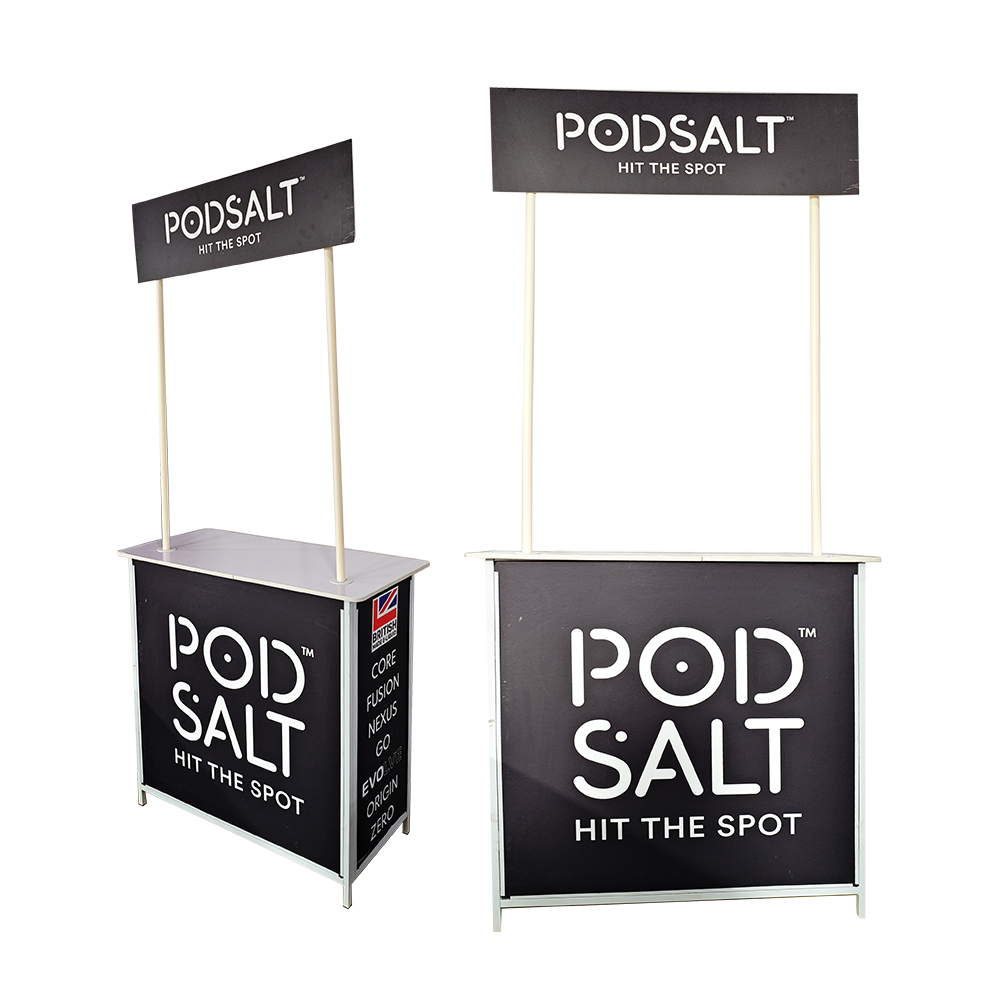
The two counter units photographed at angle and front complete the system above the giveaways: waist-height box counters on satin aluminium extrusion frames, matte black graphic panels front and side, cream upright poles carrying a header sign that repeats the same lockup from chest height to standing eye-line. The side panel runs a vertical list zone and a small corner emblem field; the header carries the brand block against black. Because the graphics are panels rather than printed structures, the entire fixture travels as flat packs and re-skins for the next show with new panels only.
For multi-show years this is the piece that pays for the programme discipline. One artwork system covers wardrobe, bags, clock, mats and counter panels; when a season changes the message, only the panels and the mat layouts reprint. Crews move between cities with identical visuals, and a booth never looks like last year’s furniture wearing this year’s hoodie.
Reading the two counter photographs side by side is itself a buyer’s guide to booth staging. The angled unit reveals the side faces: a vertical column zone for the running list and a compact emblem field near the top, which is precisely the placement that works when a counter sits perpendicular to aisle traffic rather than square to it. The front-on unit shows what visitors actually see from the walkway: one large centered block on the counter face and the header duplicated above it, so the same mark reads twice in a single line of sight from different heights. Frame joints at the corners and short stub feet at the base carry the structure; the top surface stays clear for demos because printed detail below eye height belongs to the front panel, not the work surface. When your booth plan has counters at two orientations, spec both zones at mock-up time, and one artwork file will still cover them.
Assembly reality matters at quote stage more than catalogue photos suggest. These counters build without tools beyond the frame’s own fasteners: extrusion corners clip, panels seat into channels, poles thread into the counter top and the header rests on two uprights. A two-person crew with the flat packs and ten minutes has the fixture standing before the first badge scan, and the same ten-minute logic reverses at teardown for the next city. Because the printed boards store flat between shows, one frame set can serve a season of consecutive events with a panel reprint only when the artwork itself evolves, which is where the fixture line earns its MOQ instead of paying for it.
Black Uniforms and Print-Zone Consistency
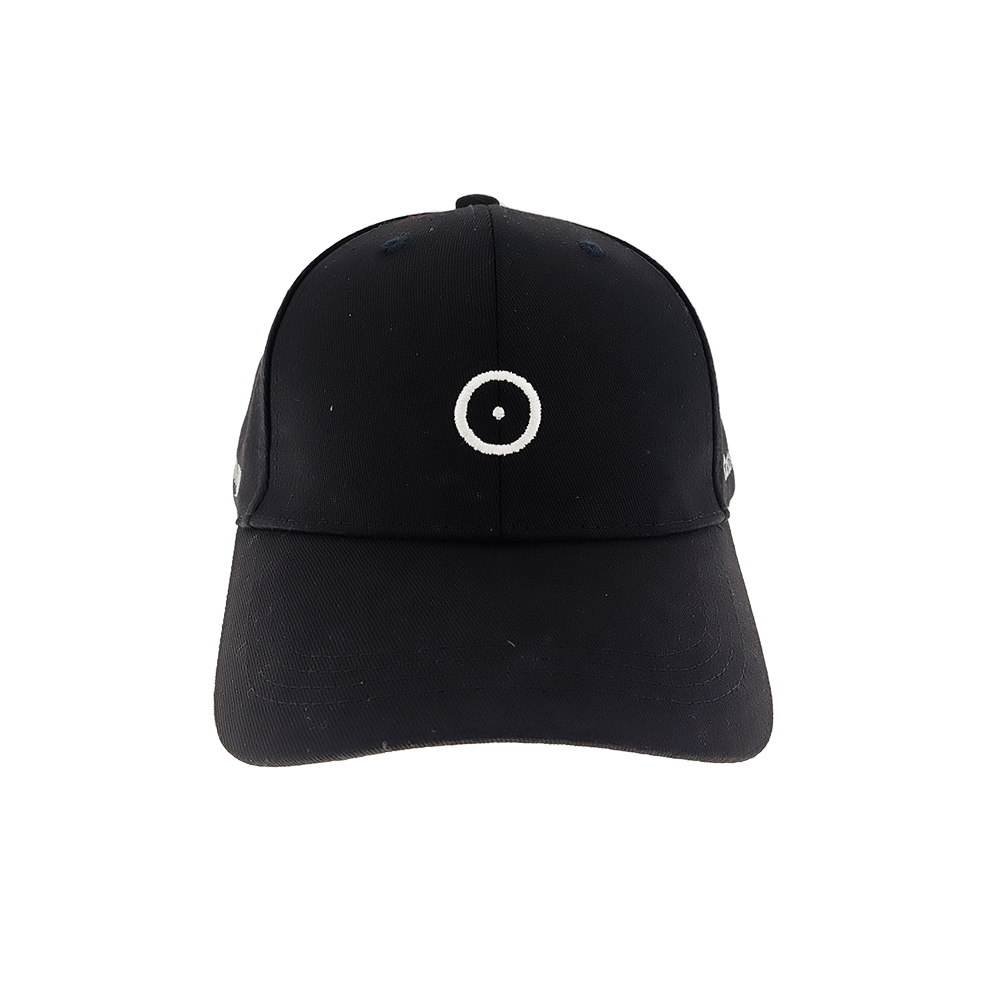
A crew wardrobe in black succeeds or fails on light-on-dark contrast management. Screen print on fleece sits on the fabric surface and can feel heavy at chest scale; embroidery raises the same mark with thread sheen under hall lighting; heat transfer edges show on ribbed cuffs if the zone is placed too close to a seam. The photographed set handles it with a rule any brand can copy: the same lockup, the same center-chest anchor, the same maximum width, chosen per garment rather than forced across all of them. The cap shown here proves the geometry translates at embroidery scale: a ring-and-dot device at panel center, small marks tucked to the side seams, nothing competing with the crown structure.
Ask for the zone map at mock-up stage, not the flat logo sheet. Every item in this family answers to a different canvas: chest width and fabric weight on the hoodie, front-panel stiffness on the cap, dial diameter on the clock, corner field on the mat, panel count on the bag. One signed mock-up pack showing the mark at true scale on all seven surfaces is what prevents the day-before-the-show email about why the logo looks different on the tee.
Side placement on caps gets over-designed almost every time. The photographed low-profile crown carries a small mark at the left edge and a second micro-device at the right, both sitting inside the panel seams rather than crossing them, which is the mechanical requirement: a side zone that wraps a seam puckers within a week of wear. Keep side marks under two centimetres, treat them as signatures rather than messages, and reserve the readable brand for the front panel that faces the visitor. Crew caps live through a show being tossed onto counter corners, borrowed by walk-ins and reissued on day three, so a crown that keeps structure after handling is worth more than any decoration detail on it.
Wash and wear specs close the wardrobe file. Fleece hoodies take cold cycles and air drying; jersey tees shrink predictably if the block was not compacted at knit stage, which is a fabric selection question resolved before printing, not after. The photographed garments are displayed unpackaged on forms because these are catalogue samples, and your real cartons should carry per-garment polybags with a size sticker visible from the carton edge. Three days of booth staffing is a logistics event; a crew that finds its sizes in ninety seconds is a crew that spends its first hour on the floor instead of in a storage closet.
Adjustable Build Points
- Garment mix per crew size: hoodie, tee, cap; fabric weight and fit block per line
- Chest zone: embroidery, screen print or transfer at identical measured scale across garments
- Bag ladder: landscape and portrait formats, rope colour, single-face versus gusset-pattern layout
- Clock dial layout: print zones above and below the hub, bezel and hand colour
- Desk mats: oversized cloth-top format, full-bleed sublimated artwork with corner brand zone
- Counter fixture graphics: replaceable panel sets for header, front and side faces
- Colour alternatives beyond black on request for any line in the family
Booth Kit Spec Table
| Item | Custom trade show booth uniform and giveaway set programme (multi-SKU) |
| Set contents | Configured per show: pullover hoodie, crew tee, caps, rope-handle paper bags in landscape and portrait formats, wall clock, oversized desk mats, counter graphic panel sets |
| Materials | Cotton/poly fleece; jersey cotton tee; cotton twill caps; coated cardstock bags with twisted rope handles; printed dial with metal hands; cloth-top rubber-base mats; aluminium extrusion counter frames |
| Colour | Black family with light print zones; alternate colourways per line on request |
| Logo | Embroidery, screen print, sublimation or pad print per substrate; free digital mock-up at measured scale across all seven surfaces |
| Packing | Polybag per piece, flat-packed bags, carton dividers for clock faces and mats; export master cartons per line |
| MOQ | 100 pcs per design (each line or panel set counts separately) |
| Sample time | 3-5 days |
| Lead time | 7-15 days after artwork approval |
| Capacity | 1,000,000 pcs per month across our gift lines |
Ordering Backwards from the Show Dates
Expo calendars punish forward planning optimism. Work the timeline from the build-day instead: artwork locked six weeks out, physical samples in 3-5 days landing on a desk for sign-off, production 7-15 days after approval, freight timed so cartons arrive at the venue city two days before load-in, never the same morning as it. Bags and apparel survive courier comfortably; the clock and counter panels deserve the protected air leg because a crushed bezel corner is a visible booth failure. The displayed price figure on this listing anchors the 100-piece tier, and multi-show-year programmes re-quote on volume rather than per event, which is where consolidating the whole family into one supplier starts showing real savings.
Packing, Freight and Show-to-Show Replenishment
Packing for this product family is genuinely different from apparel-only orders. Bags ship flat in shrink-wrapped blocks with corner protection so the crisp folds stay crisp; mats roll or flat-pack depending on format, with the printed face never against a carton wall; clocks get foam-cut inner trays; counter panels pack as dimensionally stable boards that stack with the fixtures. If your team operates a marketplace storefront between shows, FBA labelling and prep can run on the same cartons before departure. Replenishment mid-season splits cleanly: garments reorder by crew size, panels reprint per show, and the bag ladder re-runs with new gusset artwork without touching anything else. Freight options cover sea for the annual programme, air for the mid-season show, DHL, UPS, FedEx or TNT for the rescue order.

Trade-Show Programme Questions
What follows mirrors the real inbox traffic from event marketing teams planning booth staffing and giveaways, asked with a date already on the calendar; the last entry covers what happens when the show list itself changes.
Can hoodies, tees, caps and bags share one MOQ count?
How early must artwork be approved for a spring show?
Will the chest mark look the same on fleece, jersey and a cap crown?
Can counter graphics reprint while the fixture frame carries over?
Are the desk mats sized to fit a booth counter top?
What if the crew headcount changes after production starts?
Pages Worth Comparing Before You Spec
The wider gift sets category holds adjacent programme types: graduation class sets apply the same one-seal logic to school buyers, cafe and retail counter sets cover the merchandise-till version of a one-lockup family, and company anniversary recognition sets handle internal milestone gifting. Weather-season add-ons for outdoor expo events sit on the umbrella and electric fan gift sets page; if the kit is for handing over rather than laying out, start with the box-packed gift sets subcategory instead.
Spec the Show Kit
Send the booth dimensions, the crew count by garment preference, the show dates and your artwork; the true-scale mock-up pack across hoodie, tee, cap, bag, clock, mats and counter panels returns within working days. Start at the request-a-quote page, +86-15967739086, or [email protected]. Samples in 3-5 days, bulk 7-15 days after artwork approval, and the floor crew arrives already dressed.