

Custom Coffee Mug Warmer Gift Set
$2.50
A desk gift that gets used the day it is unwrapped: a custom coffee mug warmer gift set packs a glazed lidded mug, a gold-tone spoon and an electric warming coaster into one die-cut rigid box with a matching ribbon-handle carrier bag. Four photographed colourways — teal, deep green/black, pink and white-box — share one foam geometry and one gold accent rule, with your wordmark replacing every sample monogram in the mug’s print zone. The warming pad’s electrical figures are destination variables, so spec and certification docs are quoted on request, never assumed on the page. MOQ 100 pcs per design, samples 3-5 days, production 7-15 days after artwork approval, FBA prep from the same line. Book the December file in September.
A Custom Coffee Mug Warmer Gift Set For The December Desk
Seasonal executive gifting has one unforgiving rule: the object has to be usable the day it is unwrapped, in the environment the recipient actually works in. A custom coffee mug warmer gift set — the phrase procurement teams are typing in December — answers that rule with three components and one box: a glazed lidded mug, a gold spoon, and an electric warming coaster, presented in a die-cut foam gift box with a matching ribbon-handle bag that needs no wrapping paper. The photographed configurations run teal, deep green, black and pink; each carries a small gold monogram sample on the mug face, and that zone is where your wordmark goes. The warming plate in every shot shows its heat caution marking as photographed — the printed safety surface you would expect on a desk appliance — and nothing else about that appliance is guessed on this page: electrical specification and certification documents are quoted on request, per destination, at quotation stage.
The commercial frame holds all year: MOQ 100 pcs per design, free digital mock-up before tooling, physical samples 3-5 days, production 7-15 days after artwork approval, displayed price anchoring the 100-piece tier. Capacity across our gift lines runs 1,000,000 pcs per month, which matters in a season when every brand in the city discovers desk gifting in the same six weeks.
Two buyer types keep landing on this box from opposite directions. HR and office-management teams order it as an onboarding object — the new-hire welcome that says the desk is yours now, arriving solo on a Monday or inside a wider notebook programme. Advancement, partnership and client-development teams order it as a winter relationship instrument: one box, no size chart, no flavour guesswork, and one of the rare corporate presents a recipient uses weekly inside the very building it was gifted in. Both buyers run the same three inputs — a signed artwork file, a colourway decision matched to the audience, and a destination list that drives the electrical documentation loop. Everything below this section serves one of those inputs, and the sooner all three arrive together, the closer the programme sits to the 7-15 day production floor rather than the ceiling.
The presentational case is just as load-bearing: most December gifts are handed over inside one cardboard outer, and this one is not. Matching carrier bag, foil-trimmed lid, foam-suspended components — the box performs the entire gifting moment at a reception desk or a dinner table without a single wrapping sheet, which is why finance programmes like it. The receiving experience is part of the product, and here it is tooled for.
One planning variable is worth naming before the section list begins, because it decides more of your calendar than print does: this is a mixed-channel box. The ceramic half travels as tableware, the warming pad half travels as small electrical goods, and destination requirements attach to the second half, not the first. A one-address office shipment and a two-hundred-name dropship list are different compliance shapes even when the logo and glaze are identical, and the earlier your ship-to list arrives with the artwork file, the more likely the production runs at its 7-15 day floor rather than its ceiling.
What Is In The Box, Surface By Surface
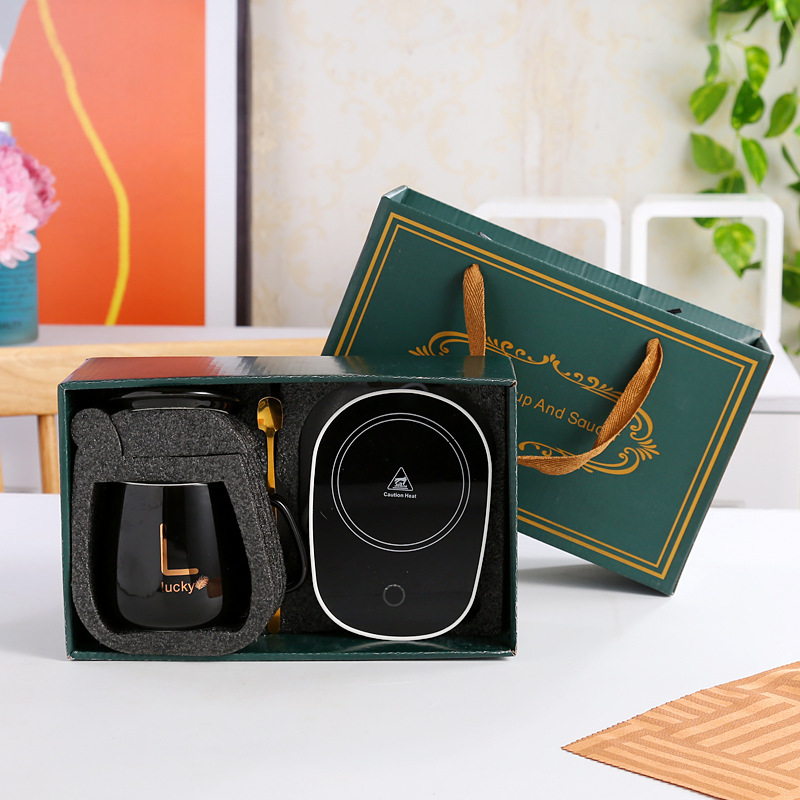
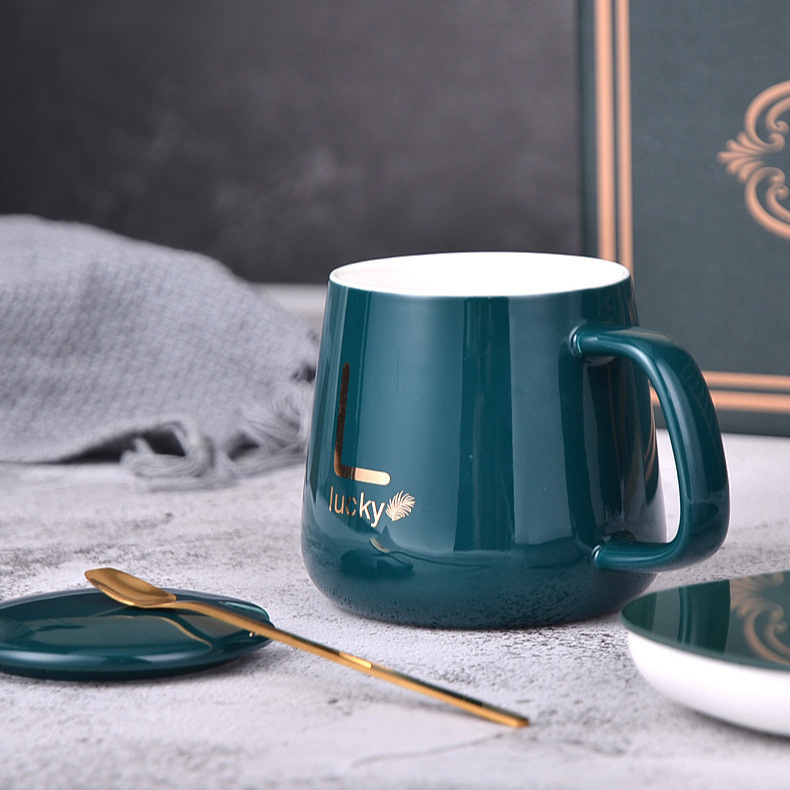
Open the featured box and the foam does the talking: charcoal die-cut trays hold the mug in its cavity, the lid in its round cutout above it, the spoon in a knife slot between, and the warming coaster in its rounded recess at the right, each item immovable in transit and lifting out by a thumb notch. The mug is high-gloss glazed ceramic in deep teal with a white interior and rim, a matching lid with a small slot cut for a spoon handle, and the gold monogram sample — a tall initial, a small word and a leaf glyph — printed on the face. That print zone is the whole gifting argument: a wordmark in metallic gold on a gloss glaze reads as commissioned tableware rather than as branded giveaway, and the mug keeps being used long after the event.
The coaster is a rounded-square pad, dark face with a pale trim ring, two concentric gold circles marking the heating zone, a centred triangle warning icon above its caution text as photographed, and a small circular touch-control mark near the front edge; a cord exits the body in the lifestyle shots. The spoon is polished gold-tone metal, slim enough to live in the mug slot without rattling. Everything else — the saucer in the styled set shots, the patterned side dish, the foil-trimmed green box panel behind — is the same colour story extended across the packing. The set photographs as a complete desk moment, which is exactly why it survives the recipient’s first week: it does not require a drawer, an adapter or an instruction manual before use.
Two details in the styled teal photograph earn a mention because buyers ask for them in email within a week of quoting. First, the saucer: the small tonal dish under the spoon is part of the glaze family, offered when a programme wants the full cup-and-saucer presentation on a board table; the boxed warming version uses the same mug body without the saucer cavity in the foam, and which variant ships is a line on your order sheet, not a factory default. Second, the second dish visible at the frame edge carries its own gold ornamental pattern on the interior well — that patterned-side-dish route exists for programmes that want the lid to double as a rest, but it changes the tooling count, so we price it as an option and photograph it honestly as part of the family rather than promising it inside a standard three-piece box.
Why does all this surface-level geometry matter to a purchasing decision? Because seasonal gifts are judged as objects, not invoices. The recipient’s first thirty seconds — lifting the lid, watching the foam present four aligned items, reading one gold mark on one face — is the entire user experience of the programme, and it is designed here at the tool and die-cut stage, before anyone prints a logo. A box that arrives with a loose cord, a chipped glaze edge or a lid that took tape to close becomes the story of your gift, in a way the cost per piece never captures.
The Warmers Are Desk Equipment, Bought Like It
Here is where this page differs from every seasonal gift listing you will shortlist: the warming coaster is an electrical surface, and we treat it that way in the paperwork rather than in adjectives. Voltage, wattage and plug configuration are destination variables — a unit for an EU procurement office, a US campus residence and a Gulf headquarters are not the same electrical object with the same print on it. This page publishes none of those figures because the correct ones depend on your ship-to countries; spec and certification docs are quoted on request against your destination list, before artwork approval, and the sample you sign is built to the same sheet the shipment follows.
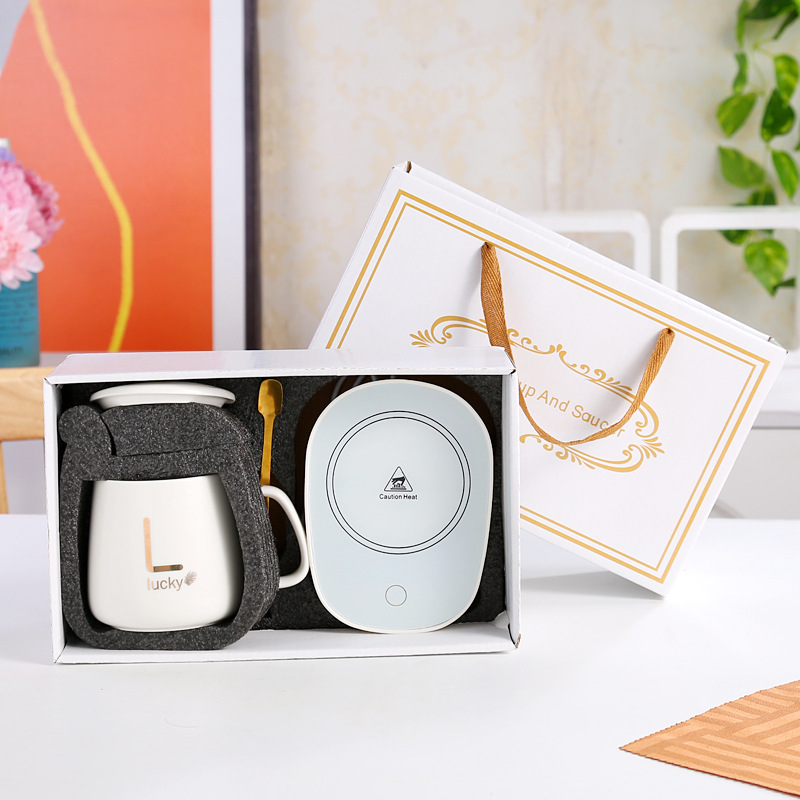
Operating behaviour is described as photographed, not as claimed: the surface shows a marked heating zone, an attention triangle with caution text, and a touch control. That marking is the safety copy the manufacturer prints on the plate; the photographed pieces render it in English or in Chinese depending on the sample batch, and your order takes the language and symbol set its destination requires. What we will not do — anywhere on this page, or in a quotation — is promise a hold temperature, an auto-shutoff interval or an energy figure that has not been verified for the exact component revision shipping to you. Procurement teams asked for those numbers at sample stage get them in writing at sample stage; teams who read them off a marketing page somewhere else deserve the audit they eventually do.
There is also a practical desk-hygiene answer the photographs show plainly. The mug in the black configuration sits beside the pad in its foam slot, and the pad’s own printed rings define where the mug belongs: a marked zone, not a bare slab guests guess at. That is a deliberate choice over a borderless design — a recipient who has never seen a warmer before still knows where to set the cup, which is the difference between the pad being used on day one and being filed as a mystery accessory. The white cord visible in the black and pink shots exits at the body edge; its length is a destination-spec variable, so the number lives on the quotation sheet rather than on this page, and the packing channel in the foam keeps the coil flat against the pad body during travel.
One more honesty note that pays dividends later: the caution marking differs between photographed batches — one plate renders it in English, one in Chinese, one with an exclamation and one without — because those are stock samples from different regional runs, not three variants of your order. Your set takes one marking language: the one its destination requires, named in the same row of your spec sheet as the plug and the documentation package. Proofing a safety surface against a regulatory expectation is exactly the kind of thing the 3-5 day sample window exists to settle.
Colourways For Every Department
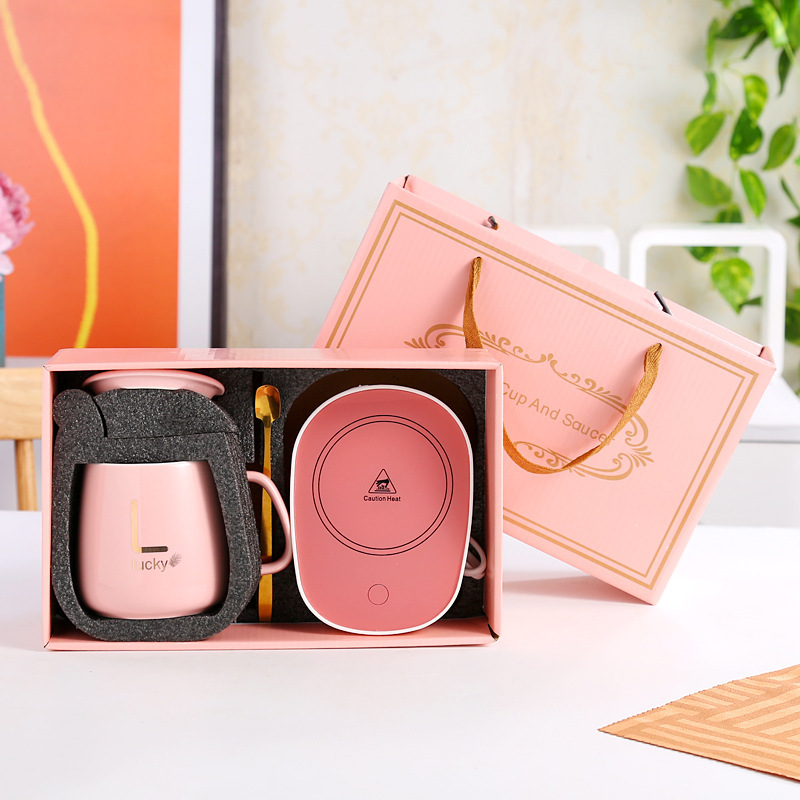
Four photographed treatments of one set, and the assortment is the merchandising strategy. The deep teal with gold trim — the opening configuration — reads institutional and gender-neutral, the safe default for client-facing gifts and large mixed cohorts. The black mug on green box with white plate marking is the sharper, quieter version for finance and legal desks. The pink edition, bag scrollwork and all, is the edition a women-network programme or a spring graduation gift actually wants — same foam cut, same zones, a different emotional register on a shelf. Every component in a set is colour-matched at production: glaze on mug and lid, plate body, cord where visible, box wrap, bag face and rope handle, which is the difference between a coordinated gift and a grab bag of near-misses.
Gold as the accent metal across all four colourways is deliberate: metallic gold holds contrast on teal, black and pink glazes alike, keeps the monogram zone legible at desk distance, and pairs with the saucer-and-spoon finishing without introducing a second hardware colour into the programme. Your wordmark inherits that zone — the mug face is a print or decal position, the box lid and bag face are the outer positions, and the coaster surface itself stays unprinted because its safety marking and touch control already populate the plate. We say that plainly up front: the warming pad is not a logo opportunity, and programmes that learn otherwise mid-proof lose a week.
Buyers frequently ask whether the box exterior changes between colourways. It does, and deliberately: the teal and black editions ride a dark-green wrap with double rose-gold foil border lines and an embossed corner ornament, the pink edition swaps to a tonal pink wrap under the same gold treatment, and a white-box variant exists for programmes whose brand palette cannot host dark greens at all. The foam inside stays charcoal across the family so components present with maximum contrast regardless of exterior choice, and the bag follows the box: rope handles on the teal and black editions, ribbon handles where the programme reads more formal, gold scrollwork centred above your lockup position. None of these are surprises at delivery because all of them appear, colourway by colourway, in the sample round.
The pink edition deserves its own planning note. Institutions running women-network gifting, school-facing programmes and spring recognition events order it as a standalone campaign, but corporate year-end runs increasingly mix it into a colour assortment on purpose — three colours in one carton, distributed by recipient choice at the event desk. That mixed-carton behaviour is a packing instruction, not a production one: the foam and box are identical across colours, so mix ratios are decided at pallet-build to your sheet and a colour that sells out faster than the others can be topped up alone, still inside its own 100-piece design floor, without disturbing the rest of the program.
Sizes, Taken From The Spec Graphic
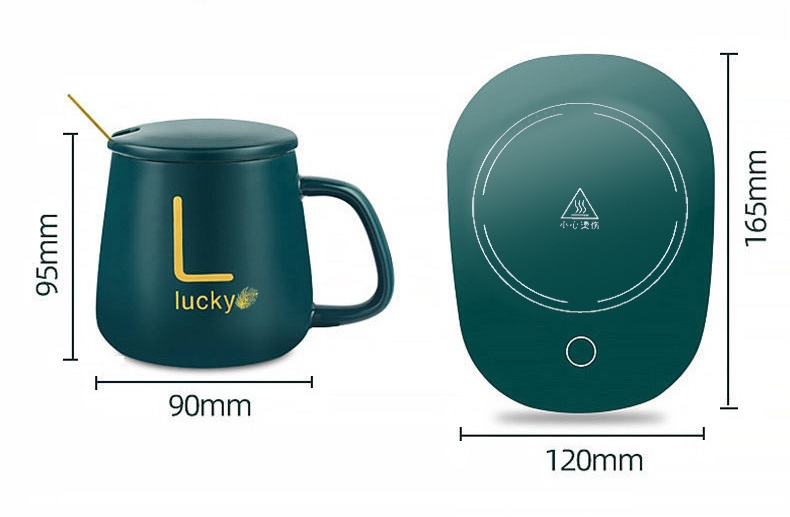
The dimensioned plate above is the only numeric source on this page, and the numbers come straight off it: the lidded mug measures 95 mm tall by 90 mm across its body, and the warming pad measures 165 mm by 120 mm with its corner radii softened for the foam cut. That geometry answers the two questions every desk-gifting buyer checks mentally: will the mug ring sit inside the marked heating zone — a 90 mm footprint on a 165 by 120 pad clears the circle comfortably with room for lid-off overhang — and will the boxed set lie flat in a gift bag, a laptop bag and a standard parcel. The spec drawing also shows the lid slot and the plate’s touch-button position, which is where you judge whether the spoon stays through the slot or beside the cup.
Because the drawing and the photographs show a matte-finish spec unit alongside gloss lifestyle units, note the honest difference: the glaze variants photograph high-gloss, the flat-finish coat exists in the same tooling, and the sample you approve is the finish that ships. Print methods follow the surface — decals and kiln-fixed printing for gloss glaze, pad print on matte coat — and all of them are quoted per position on your mock-up rather than assumed from a package deal.
Read the same plate as a logistics drawing too. A 165 by 120 mm pad inside a box sized around a 95 mm mug means one rigid set footprint per gift, and carton counts fall out of that geometry: fixed sets per master, predictable pallet heights, and per-address dropship quantities that a courier accepts without freight-class arguments. Home-office gifting — where a December list of two hundred names each gets one parcel, not one pallet to one office — lives or dies on that arithmetic, and it is another reason the boxed set is specified as a single parcel object with the bag packed flat rather than as a bundle of loose items.
For brand teams the drawing settles the artwork question before a designer opens a file. The mug face on a 90 mm body gives a comfortable print field roughly the width of a business card; a two-line wordmark at that scale stays legible across a desk without becoming a decal mural, and the mock-up renders your file at that exact proportion rather than at a flattering slide size. Glaze print method — kiln-fixed decal versus transfer — is chosen for your colour, gloss level and wash expectation, and both routes are photographed on the sample so the sign-off is visual, not verbal.
The drawing also resolves a buyer question that photographs cannot: which way the set sits on a desk. The mug is dimensioned at 95 mm tall — taller than a standard coffee cup, closer to a travel tumbler — and the pad is wider than it is deep, 165 mm across the front. Together they describe a warming arrangement designed around the mug standing centred in the marked circle rather than anywhere on the surface, and a recipient who ignores that geometry is the one who emails your helpdesk about a cold coffee, not a buyer who misread the specification.
Where the numbers stop, honesty starts. The drawing covers body geometry only — no capacity figure appears on it, so this page publishes no volume claim; if your programme needs the mug’s fluid capacity, the cup-and-saucer variant’s dimensions or carton densities per master, they come on the quotation sheet measured from the production sample, the same sample your logo gets signed on. Boxed-set outer dimensions follow the chosen foam cut and bag channel rather than a fixed template, which is why they are quoted per configuration and not printed here as a generic figure.
A word on why the sizes matter commercially rather than technically. A mug at 90 mm across keeps its ring fully inside the pad’s marked heating circle even when the lid rests half-off on the slot, which is the actual way people use warmers between meetings. A pad at 165 by 120 mm fits in front of a keyboard without claiming the mouse lane, which is the actual way desks reject objects. Programs that gift larger, heavier mugs on smaller pads quietly get put in a drawer; this geometry is why the boxed set keeps its promise a year later in a photograph from the recipient’s home office rather than in a lost-and-found bin at facilities.
Customisation Zones
- Mug face: metallic gold or white decal/print on gloss glaze — the monogram zone shown in every photo; wordmark, crest or recipient name variants
- Mug lid and handle side: kept clean as standard; second-position quotes available
- Warming pad surface: unprinted as a rule — heat caution marking and controls occupy the face
- Box lid: centred foil, print or blind deboss; the first impression on a reception desk
- Carrier bag face: gold foil lockup matching the lid; rope or ribbon handles colour-matched
- Foam insert: colour-matched charcoal or grey per set; slot layout fixed by the photographed geometry
- Spoon: gold-tone standard; engraved handle position quoted per run
- Assortment control: one signed artwork master governs mug, box and bag zones across all four colourways
Reference Specifications
| Item | Mug + electric warming coaster desk gift set with lidded ceramic mug, gold-tone spoon and die-cut rigid gift box, matching carrier bag |
| Set contents | Lidded mug, warming coaster, spoon; boxed as photographed; bag included per channel spec |
| Materials | Glazed ceramic mug with matching lid; metal spoon; warming pad body with printed heat caution marking and touch control; rigid paper box, die-cut foam, coated paper bag with rope/ribbon handles |
| Colour | Teal, deep green/black, pink and white-box colourways photographed; gold accent standard; programme colours matched per signed set |
| Logo | Decal/print on glaze, foil or deboss on box and bag; mug face shown with sample monogram; warming pad face not printed; electrical spec and certification docs quoted on request |
| Packing | Gift box in die-cut foam, bag packed flat, master cartons per routing sheet |
| MOQ | 100 pcs per design |
| Sample time | 3-5 days |
| Lead time | 7-15 days after artwork approval |
| Capacity | 1,000,000 pcs per month across our gift lines |
December Gifting Runs On A September Clock
Every year-end programme fails on the same date: not in December, but in October, when artwork should have been approved and the freight booking missed the pre-holiday air rate. Work backwards from the party. Production is 7-15 days after artwork approval for this set; physical samples, once your mark and colourway matrix are signed, take 3-5 days; the free digital mock-up round — mug face, box lid, bag face, all three zones — belongs to the first week after enquiry, not the last. Sea freight wants the order landed eight-plus weeks before the gifting date; air and express (DHL, UPS, FedEx, TNT) rescue later decisions at later prices. Electrical destinations complicate the calendar only if you start late: plug variants and any documentation packages should be named in the same email that sends the logo file, because a ship-to list discovered in December does not move a production date — it moves a delivery date.
Packing, Freight And FBA Prep
Ceramic plus electronics is a packing problem, not a product problem, and the die-cut foam solved it at design time: mug, lid, spoon and coaster each sit suspended in their own cavity, glaze never touching print faces, cord coiled and carded beside the pad body in the packing channel you specify. Master cartons take fixed set counts with divider sheets; bag faces are interleaved so foil does not scuff against foil; carton marks follow your routing codes. For organisations reselling the set through an online store or shipping donor packs from a warehouse, FBA pick-pack-label runs from the same line, barcodes applied over the shrink sleeve rather than onto the gift box itself. Freight terms: sea, air or express, EXW or FOB, quoted against the destination list that also drives the electrical spec sheet.

Questions Procurement Teams Ask In October
What are the voltage and wattage of the warming coaster?
Is the gold monogram on your mugs a brand we would be receiving?
Can a mixed order split across the four colourways?
Will the mug fit the warming pad, and is the pad sized for standard desks?
How close to December can we order?
Can the same artwork serve this set and a plain mug-only line?
Neighbouring Gift Boxes Worth Opening
Compare formats before you commit a season: the stationery-first executive box lives at the notebook, pen and flash drive gift set; the drinkware-led tray at the custom water bottle gift sets page; hospitality welcome trays at hotel welcome gift sets; one-wordmark campus programmes at university promotional gift sets; weather-and-cooling combos at the umbrella and electric fan gift sets. The gift sets index and box-packed shelf hold the wider rigid-box range.
Lock The December File In September
Send the wordmark, the colourway split and the destination list. You receive a mock-up across mug, box and bag, a line-itemed tier quote, and the electrical spec and certification package quoted on request for every ship-to country. Samples 3-5 days; production 7-15 days after artwork approval. Direct: +86-15967739086, [email protected], or the request-quote desk. The form below reaches the same team.


