Custom Festival Hand Flags with Sticks – Bulk Event Print
$0.65
Custom festival hand flags bought the way events actually buy: attendance times flags per hand, plus a reserve, against a calendar that runs backwards from the date. Printed polyester cloth on sticks – white plastic rods with gold ball finials for crowd quantities, or metal rods with black foam grips and ferrule collars for crews and marshals – with hoist hardware chosen per job: a sewn sleeve channel for waving on a rod, or a two-eyelet header band for lashing lines across floats and festival gates. Silk screen carries flat spot-colour artwork; dye sublimation carries photographic, full-bleed files; twin-sided two-panel builds keep both faces reading correct for the camera. The photographed samples include a stock placeholder medallion and a fluorescent checkered pair; one star-motif sample is official-flag print proof only, and replication of protected national or state flags stays out of production – orders run your-design artwork on your rights. MOQ 100 pcs per design, free digital mock-up, proofs in 3-5 days, bulk in 7-15 days after artwork approval inside 1,000,000 pcs per month across our gift lines. Sea, air or DHL / UPS / FedEx / TNT, FBA labelling supported.
Bulk custom festival hand flags are a head-count purchase. A parade route with five thousand marchers, a campaign rally that fills an arena, a stadium end that wants every supporter holding the same thing at the same photo moment – the buying question is not what a single flag looks like, it is how many identical flags can be in that many hands before event day, at a unit cost the budget survives. That is the lane this listing sits in: printed polyester flags on sticks, ordered by attendance maths, made to artwork you own, and delivered on a calendar that runs backwards from your date.
Order by Attendee Count, Not by Curiosity
Count the way event teams count. Expected attendance, times flags per hand – one per attendee is the standard kit, and parade blocks, volunteer corps and paid crews often take two, one to wave and one to hand out – plus a five to ten percent reserve for drops, early giveaways and the stacks that never make it back. That number is your purchase quantity, and it moves the way events move: parades and civic festivals cluster in spring and late summer, election years concentrate rallies into short windows, concert and stadium seasons spike demand into the same six-week band. Production capacity across our gift lines runs to 1,000,000 pcs per month, so a five-figure quantity is a scheduling conversation, not a feasibility one.
The entry point stays deliberately low. MOQ is 100 pcs per design, which means a 5,000-piece program can split ten ways across candidate names, sponsor marks, set-list artwork or block assignments – one hundred pieces per design – while a single-message buy stacks into one deep SKU. Every artwork variant counts as its own design for the minimum; a two-sided flag with different artwork on each face still counts as one design. The economics reward planning, not speculation: print breadth for message testing, depth for the message that wins.
The Print Zone: What the First Sample Actually Proves
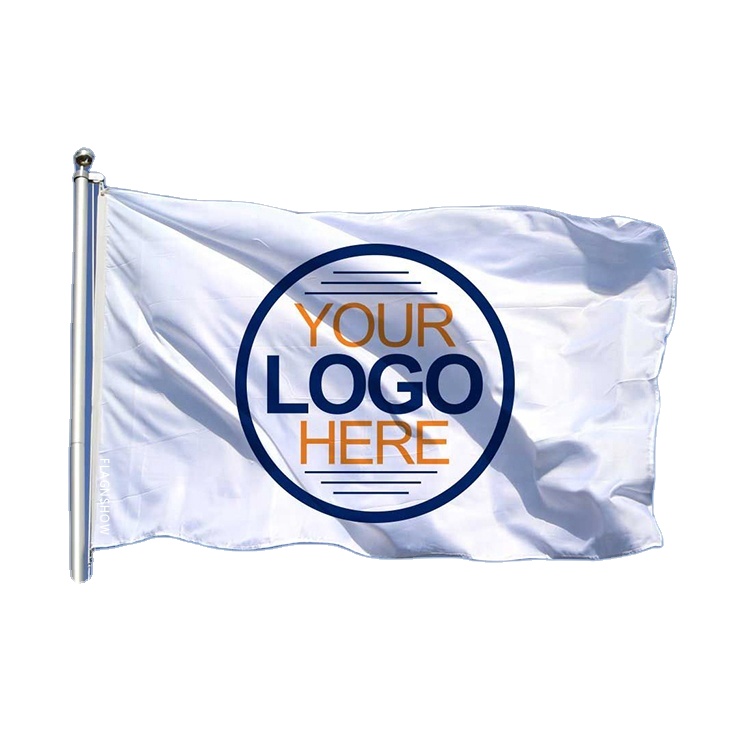
Strip the stock placeholder medallion artwork off this first shot and look at the geometry underneath, because that is what your file inherits. A white polyester field, hemmed on the free edges, hangs from a hoist sleeve that a slim silver pole slides through, capped by a small ball finial. The graphic sits dead-centre as a ringed medallion with stacked rule-lines above and below it – the classic emblem slot. Two build logic options follow from that layout. The centred device keeps a large plain border, which reads formal and photographs clean against a crowd: municipal bodies, associations, anniversary marks. The edge-to-edge alternative floods the whole field with colour and drops the logo on top of it, which is what campaigns and tour merch tend to want, because a full bleed of one brand colour is legible from the back row of a grandstand and a centred badge is not.
What the sample proves about the print itself is flatness. The medallion’s two-colour navy and warm-orange graphics sit with sharp edges and solid fill on a smooth synthetic face – no banding, no fuzzy outlines, no weave bleed at the ring. Two print routes back that behaviour on this line. Silk screen laying down spot colours is the workhorse for limited-palette artwork at quantity: dense, saturated blocks of colour, consistent across thousands of pieces, and the right pick when your design is flat shapes, stars, stripes, checkerboards or a bold wordmark. Dye sublimation takes the continuous-tone jobs – photographic band artwork, gradients, multi-hue illustrations with tiny type – and prints them edge to edge through the polyester face so the colour is in the fabric rather than on top of it. Your artwork decides the route; both are quoted against the same file stage.
One construction decision most buyers miss before the first photo moment: single-sided versus twin-sided. A single print on thin flag cloth throws a mirrored, slightly muted version of your logo to whoever stands on the opposite side of the aisle – fine for a march all facing one way, wrong for a stadium end that shoots against the flags. A twin-sided build sews two printed panels back to back so both faces read correct, at the cost of a heavier seam line on the hoist. If your event has a camera and a crowd facing the camera, quote twin-sided and decide on the number.
Header Hardware, Two Ways to Put Cloth on a Pole
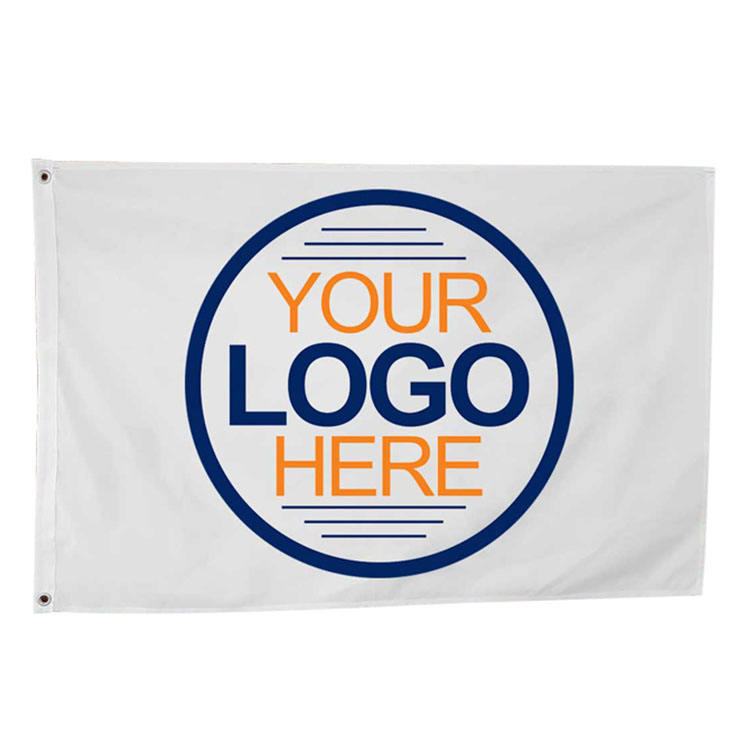
The second sample lays the flag flat and shows the other hoist option: a reinforced vertical header band on the left edge carrying two metal eyelets, one near each corner, while the top, bottom and fly edges finish in thin turned hems. There is no pole in the shot, which is the point – the eyelet header is the hardware for tying, lashing and hooking rather than slipping over a rod. Rope lines across a parade float, grid rows hung between scaffolds at a festival gate, balloon-string bundles at a launch event, wall draping in a campaign office: all of them want eyelets, not sleeves.
The sleeve header on the first sample wants the opposite job – a rod goes through the channel and the flag flies square off it, which is what a hand-held flag at a rally needs. So the real hardware menu is a combination: sleeve or eyelet on the cloth, plastic rod or metal rod in the hand. White plastic rods with gold ball finials, as the third sample shows, are the lighter, lower-cost stick – smooth, plain-cut at the lower end, appropriate where thousands of hands swing them and nobody should risk a cut. Metal rods with a black foam grip and a small silver ferrule at the cloth corner, visible on the fourth sample, are the marshals-and-crews build: a grip that stays put in a sweating hand at a finish line or a safety marshalling point, and a shaft that survives being stabbed into ground at a photo stop. Mixed kits are normal – cheap plastic sticks for the crowd quantity, foam-grip metal rods for staff – and both combinations run under the same 100 pcs per design structure.
Hem detail on both samples is worth stating plainly because it is the part that survives or fails a hundred-hand event: the free edges are folded and stitched, not raw-cut, and the hoist side carries its function hardware – sleeve channel or eyelet band – as a separately stitched vertical strip. That parallel seam line is where a waving flag spends every Gram of force its fabric gathers from the wind, and on both photographed samples it is clean, straight and undistorted at the corners the eyelets sit in.
A Word About the Star-Sample Fan, and Official Flags
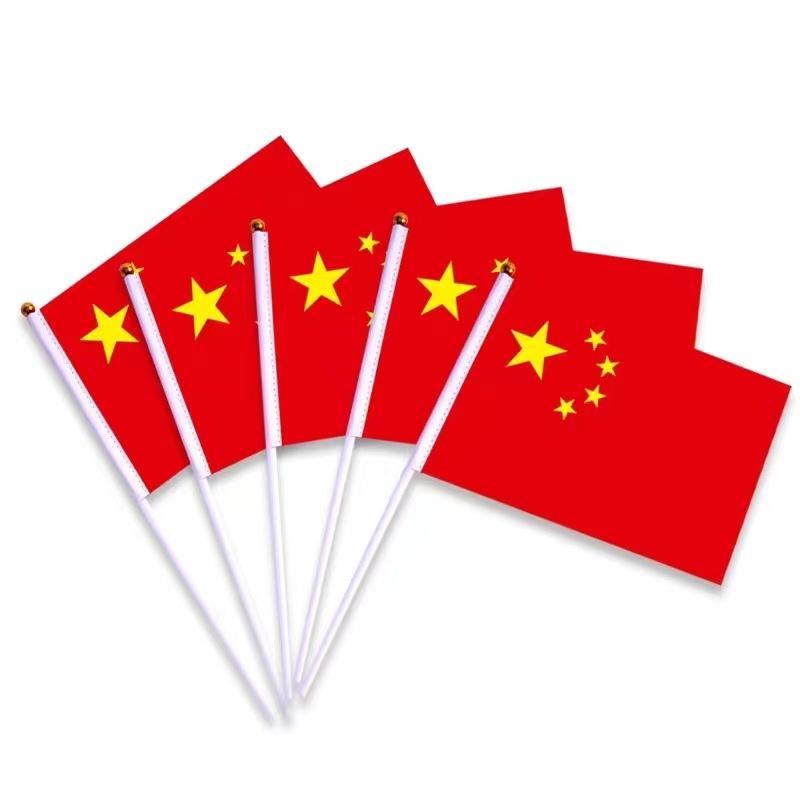
Five fanned flags on white rods with gold finials fill the third photo, and the artwork they carry is an existing official national design – red ground, star devices in the canton arrangement everyone knows. It stays on this page as print proof and nothing more: the sample demonstrates exactly what flat screen print does at quantity – solid saturated red edge to edge, crisp yellow star points, no bleed at the diagonal overlaps where five flags cross. It is not a catalogue offer, and we are direct about the boundary: we do not reproduce, recommend or quote replication of protected national flags, state flags or official seals. Anyone who needs genuine official flags buys them through the designated channels that govern them; a gift factory printing them to order is not that channel. What this line does instead is your-design artwork – the flag that carries your own device, your campaign mark, your team emblem, your original field pattern. The mockup on the first two samples exists precisely to show where that design zone sits.
The Order Path, File to Carton
Buying quantities of custom festival hand flags is a four-gate process, and each gate has a fixed turnaround you can put in a project plan. Gate one: send artwork as a flat print file – vector or high-resolution PDF or AI preferred, with your colour references – and the studio returns a free digital mock-up showing your design on the flag and stick combo, correct side, correct scale. Gate two: a physical proof runs 3-5 days from file sign-off, couriered to you, and it is the gate where colour and hand feel get checked against reality rather than a screen. Gate three: the bulk window closes 7-15 days after artwork approval, with gift-line headroom at 1,000,000 pcs per month, so even a six-figure piece count slots into a calendar week rather than a season. Gate four: shipping. Base volume moves by sea; anything that has to be in hands before a fixed date moves by air or by express courier – DHL, UPS, FedEx, TNT – and FBA inbound labelling is supported when the flags land in an Amazon warehouse instead of a venue loading dock.
Work the calendar backwards from event day, not forwards from an idea. An outdoor gala on a fixed Saturday wants its cartons on the floor two weeks early, which puts courier orders at roughly six to eight weeks out and sea orders a season ahead – the buyers who fill stadiums cheaply are the ones who committed to artwork before everyone else discovered the date. Halloween markets, Christmas-season promotional parades and spring civic events all share one trait: the demand spike is short, the reorder window is shorter, and the cheap insurance is printing the reserve quantity in the same run.
Checkered Proof: Fluorescent Colour at Event Scale
Before the checkerboard pair, read the hardware story the red fan told. Those five sample sticks are the light end of the stick menu: smooth white plastic rods, plain-cut at the lower end, a small gold ball finial only where the cloth tops out. Nothing about them is precious, which is exactly why crowd quantities get built on them – tens of thousands of hands swinging, dropping, stacking them back onto a registration table, and a broken stick is a two-cent replacement instead of a liability conversation. The metal rod with the black foam grip in the next photo is the other end of that same menu, and the two coexist in one order without argument: plastic for the crowd tranche, foam-grip for the crew tranche, both under the same artwork file and the same approval signature.
The fourth sample pair shows what happens when a hand flag carries no logo at all. Two rectangular fields, printed checkerboard in fluorescent orange-red against high-visibility yellow-green, mounted on slim silver metal rods with black foam grips and a collar ferrule where the rod meets the cloth. No text, no emblem, no size marking printed on either flag – just colour blocks with hard boundaries. That is the construction motorsport finishes, safety-day runs, restart zones and hi-vis party packs buy: a pattern anyone reads in under a second, produced the same way as a logo flag, screen-printed spot blocks or sublimated fills on the same polyester.
Two details in the photo earn their place in a spec conversation. First, the hoist edge on each flag is a stitched sleeve that fully captures the rod, and the rod terminates below it in a molded grip – the whole assembly is one insertion, no separate handle to lose at a handout table. Second, the checker squares print with crisp boundaries and no colour migration at the joins, which is the flat-block quality you can expect from spot-colour work on this cloth.
There is a third detail buyers miss until the post-event debrief: what a fluorescent pair does after the event. Hi-vis checker fades unevenly when it lives in a sunny loading dock between weekends, so rental fleets, race series and school safety programs that re-issue the same sticks all season buy against a rotation plan – two sets in circulation, one working while one rests in a dark bin – rather than one set run into the ground. The poly-bag packing stage in the photo set’s final section is where that rotation starts: flags that ship bagged are flags that store bagged, and the bag is doing UV and scuff duty long before anyone waves the cloth again.
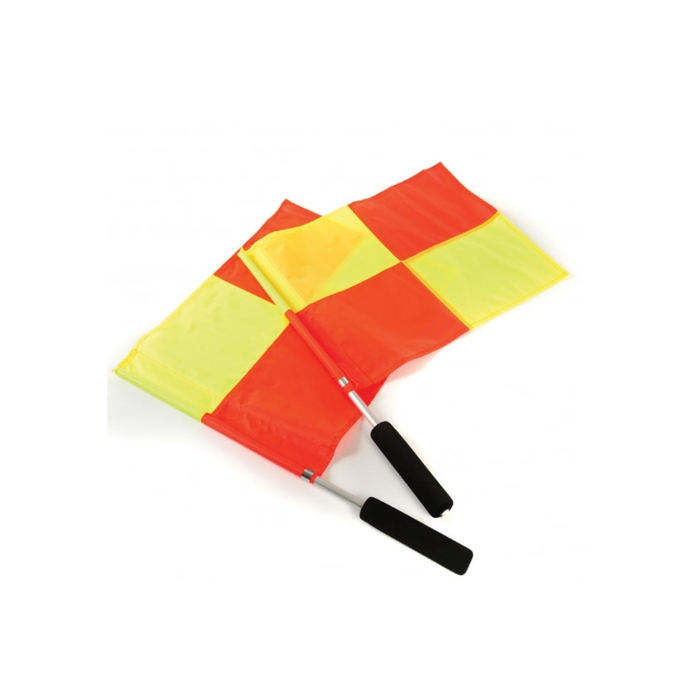
Buyers order this checker format on three recurring calendars. Track days and grassroots racing run spring through autumn, and the finish-line pair is the single most photographed object at the event, so clubs and series re-buy per season rather than per year. School safety days, cycling marshal programs and workplace traffic-marshalling trainings want the hi-vis reading at distance over a logo reading at distance – a sponsor mark on the same square would cost the pattern its two-second legibility, and experienced buyers know it. And retro-racing party supply, the lane that buys orange-and-lime checker as table décor for themed 5K finishes and garage-party stock, orders the same construction in single-message depth under the 100 pcs per design minimum. None of these three need twin-sided panels, because a checkerboard mirrors into itself – the one case where the single-sided build loses nothing on the far face.
Colourway rules follow the design rule: one pattern is one design, so swapping the fluorescent pair for your event’s two-tone checker does not change the minimum, it starts its own count of 100 pcs. Fluorescent spot inks live in a narrower palette than standard screen colours, so if your artwork demands exact hi-vis matching, send the reference from a physical swatch rather than a screen value and the proof run settles it before bulk cuts.
Packing, Cartons and the Inbound Lane
Flags fold flat and go into individual poly bags, gather into inner cartons at whatever count the quote locks for your kit mix, and ride out in master cartons built for pallet or parcel, whichever cube the freight lane wants. Rods ship bundled separately or pre-inserted depending on the kit spec – pre-inserted sticks arrive venue-ready at the cost of carton length, flat-packed cloth plus loose sticks buys denser cubes for ocean freight, and both are quotable against the same event calendar. The trade-off is arithmetic, not preference: a pre-assembled unit is faster to hand out at a registration desk but roughly fixes your carton dimensions at the stick length, while a flat-packed unit can ride a standard master and save freight on the big sea tranches.
For marketplace sellers, units can pick-pack-label into FBA-compliant prep on the same line, so one purchase order can split into a container of base volume, a courier tranche of reserves and a direct-to-FBA run without three suppliers. Mixed-carton packing – sticks in one carton stream, bags of cloth in another, or pre-assembled kits in a third – is normal on this lane and gets listed on the packing sheet before the carton count is locked. The diagram below is the reference picture for the whole packing stage, from poly bag through inner and master cartons onto the freight mode.

Specifications
| Item | Custom Festival Hand Flags – printed polyester flag on stick, event-quantity build |
| Field size | 30 * 34 cm listed size, or your custom cut – the samples carry no printed dimension of their own, so the figure stays a listing number, not a photographed spec |
| Fabric | Polyester flagging cloth, smooth synthetic face as photographed |
| Print routes | Silk screen for flat spot-colour artwork; dye sublimation for continuous-tone or photographic files |
| Sides | Single-sided standard; twin-sided two-panel sewn build quoted per design |
| Hoist finish | Sewn sleeve channel for rod insertion, or header band with two metal eyelets – both photographed above |
| Stick options | White plastic rod with gold ball finial; or metal rod with black foam grip and ferrule collar |
| Edge finish | Folded, stitched hems on free edges as photographed |
| Artwork rule | Production prints your own designs on your own rights – official, national or state flags and protected seals are never replicated |
| MOQ | 100 pcs per design |
| Sample time | 3-5 days after you sign off the file |
| Lead time | 7-15 days following artwork approval |
| Capacity | 1,000,000 pcs per month across our gift lines |
| Packing | Polybag per unit, inner carton, export master; rods flat-packed or pre-inserted |
| Shipping | By sea, by air or by express courier – DHL, UPS, FedEx, TNT; FBA labelling supported |
Where This Sits in the Textiles Line
Hand-held flags are one of three flag lanes on this site, and picking the right one saves a quotation round. If the brief is desk-top or car-window quantity branding rather than crowd waving, the mini waving flag line runs the small stick-and-sleeve format with individually bagged units. If the requirement is standing vertical signage in front of a store instead of cloth in hands, the business advertising flag page covers the large-format build. All three live in the flags category inside the wider home textiles line, and events commonly bundle a flag order with merch from other categories into one enquiry through the quote request desk.
Festival Flag Questions, Answered
How many hand flags should an event order?
What is the minimum order for custom festival hand flags?
Can the flags print on both sides?
Can you reproduce the national or state flag shown on one sample?
Which stick should we choose – plastic or foam-grip metal?
How far before event day can an order land?
Send the Date and the Head Count
Put the event date, expected attendance, artwork status and target delivery city on one sheet and send it through the form below; bundling flags with other categories is one extra line on the quote request list. A free digital mock-up, a landed-cost estimate and a calendar that fits your date come back from the same team. WhatsApp / Tel: +86-15967739086 | Email: [email protected]