Custom Enamel Coffee Mugs, Rolled-Rim Steel Camp Mugs
$0.70
Glossy vitreous enamel over a steel body, with the rolled rim, contrast interior and colour-matched handle that make the classic camp mug read instantly on a shelf. Our photographed samples cover single-spot emblems, one-colour outdoor slogan graphics and continuous full-wrap patterns, and the colour-chart and tint-step pages show spot-colour matching against physical cards, so your brand reference becomes a fired coat you can approve in hand. MOQ 100 pcs per design, free digital mock-up, samples in 3-5 days, bulk in 7-15 days after artwork approval, with FBA labelling and sea, air or courier freight arranged from our side.
Custom enamel coffee mugs with the rolled rim that sells the camp look
Our custom enamel coffee mugs are the classic campfire form: a steel body with a glass-fused glossy coat, a rounded rolled lip at the mouth, a white enamel interior and an open C-handle moulded in the body colour. This page is for buyers who need that exact silhouette – not a printed ceramic look-alike, but the vitreous enamel-on-steel construction you can hear when you set it down. Merchandise teams for outdoor brands, festival shops, campgrounds and coffee roasters keep ordering this shape because the nostalgia reads instantly on a shelf, and because one mug can wear a single-colour emblem as convincingly as a full-wrap illustration.
The displayed figure anchors the 100-piece tier rather than fixing a unit price for your program. Body colour, print method and how many artwork designs you split the order across all move the real number, which arrives in writing on your quotation. Everything below is written from our own sample photographs, and where a photo prints a number, we say what the photo prints.
Construction you can verify from the photographs
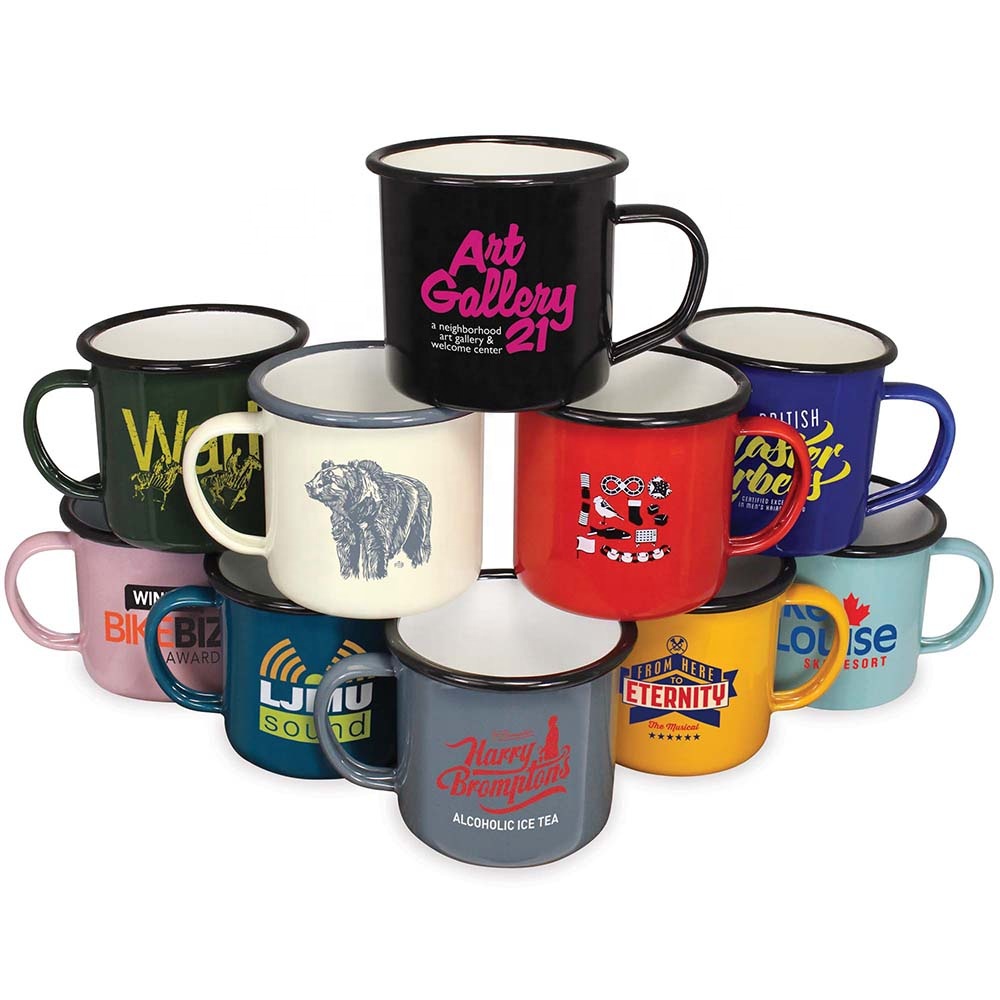
In the ten-up pyramid above, every mug is the same tooling wearing a different colour and a different sample print from past orders – black, forest green, cream, red, royal blue, pink, teal, slate grey, golden yellow and light blue, with handles turned left and right so each front panel faces the camera. The prints themselves are deliberately not reproduced in this copy: they are former customers’ artwork, kept here purely as evidence of what the front zone takes – script wordmarks stacked over taglines, boxed pictorial crests, icon-pattern grids, retro beverage locks, theatrical title treatments. One page of your own art replaces all of it.
The tipped pair in this gallery shows the construction detail buyers check before sampling: a straight-walled cylindrical body, the bead of the rolled rim in a contrasting solid, a deep unprinted interior in a second colour, and a handle whose outer curve picks up the rim accent. That rim-and-interior two-tone is the honest tell of enamelware; a decalled ceramic copy can fake the outside but never the way a solid rim colour wraps the whole mouth. Glossy specular highlights across every photographed surface confirm the fired vitreous coat rather than a matte plastic dip.
Handle orientation is not decoration in these photos – it is a specification conversation. Every photographed mug shows an open C-handle moulded in the body colour, sized for a gloved hand, which is why the camp shape keeps winning outdoor retail slots over slim café handles. When you compare our sample against a competitor’s at a buying meeting, run three checks the photographs make possible: does the rim bead wrap the entire circumference without thinning, does the handle attach at the body rather than to the glaze layer, and does the interior coat reach the base evenly. All three are visible on a tipped mug in good light, which is why our own gallery includes tipped shots – you should demand the same angle from any supplier before you approve a bulk file.
Spot-colour matching against physical cards
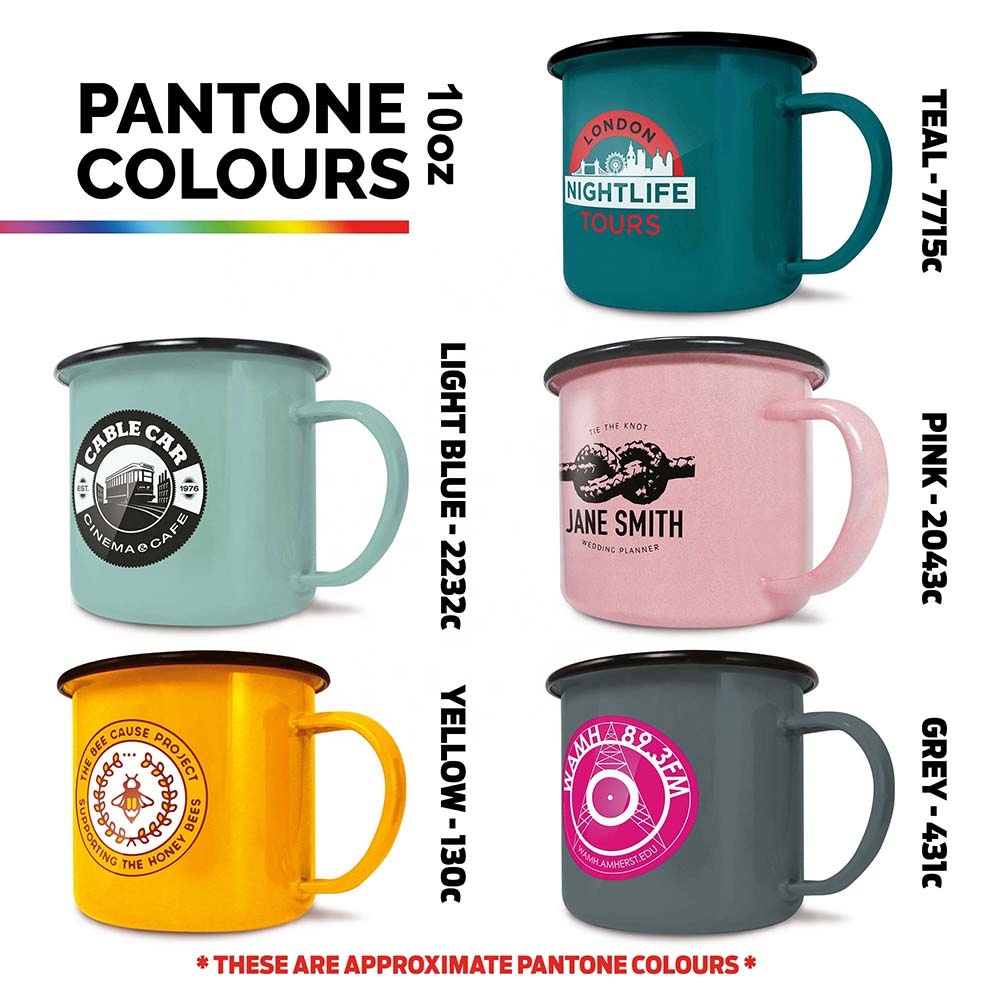
Colour is the reason this line gets re-ordered, and our demonstration page is the one to judge us against: five mugs arranged beside a printed chart that labels each body with a spot colour – the photographed codes read TEAL 7715C, LIGHT BLUE 2232C, PINK 2043C, YELLOW 130C and GREY 431C, with the body size printed on the chart as 10oz. A red line at the foot of the chart states the shown colours are approximate, and we repeat that warning because a colour card mailed to you is worth ten screen pixels: request the physical colour standard matching against our enamel tiles before you lock a PMS reference into a purchase order.
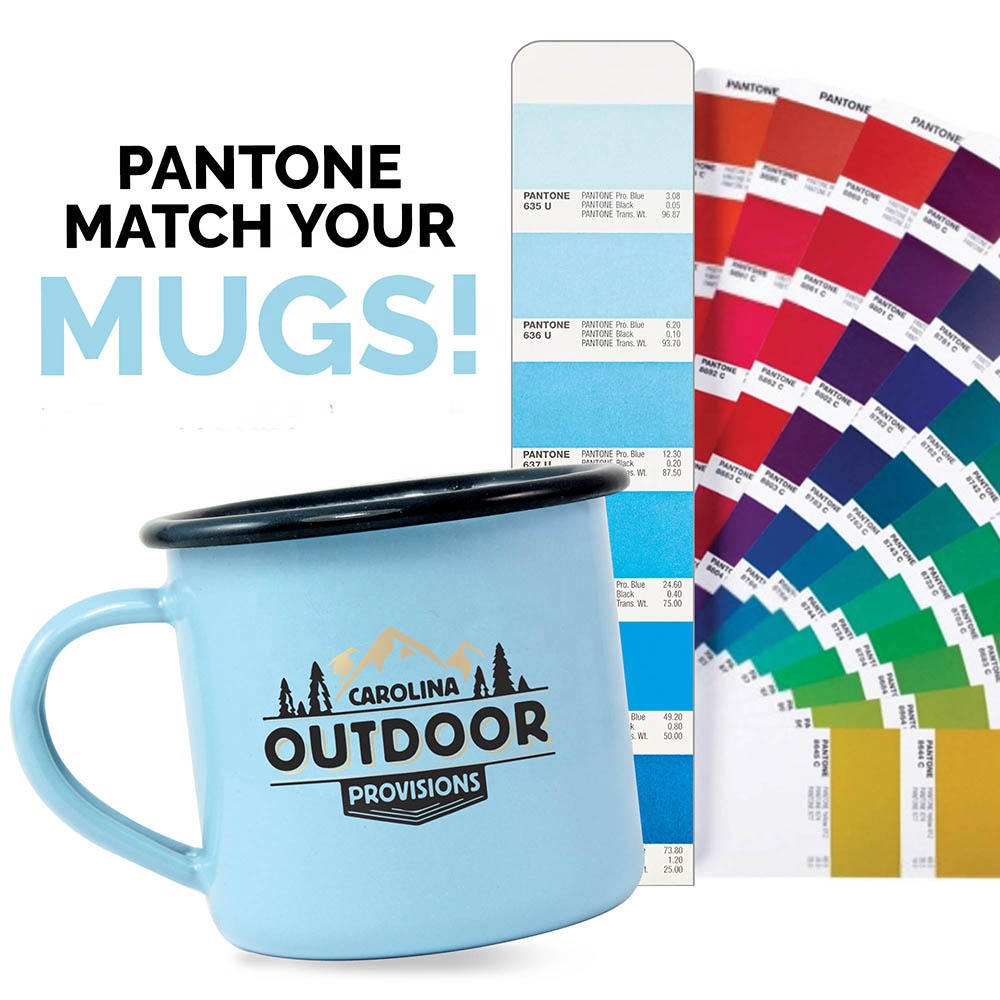
The second colour page goes further: a light-blue mug sits in front of a vertical tint-step strip – the same blue broken into graded percentages from pale to saturated – and beside an opened fan deck of chips. That is the full buying conversation in one image. Your brand manual gives us a reference; the tint strip shows how we read lightness and saturation, not just hue; the mug in front proves the coat survives the curve of a rolled body. If your brand lives across a primary, a secondary and an accent, we can quote three colourways against the same print artwork and keep them in one shipment.
Here is how the matching workflow runs when a colourway has to be exact rather than close. You send a PMS reference – or mail us the physical chip from your own brand kit – and our coating line prepares enamel against that standard. We fire a reference mug and courier it to you before artwork goes to press, so the colour is signed off on the actual body, under your own lighting, not on a monitor in two time zones away. The photographed tint-step strip is the same logic you already use with your printer, applied to a fired coat: percentages step pale to saturated so the approval conversation is about lightness and chroma, not adjectives. Once a colourway is approved it becomes your locked reference in our records, and every reorder of that SKU is pulled against the approved physical sample – the one your program manager signed – instead of re-guessing from a screen proof. Programs that run seasonal colour drops typically hold two or three locked references at once, and because the MOQ counts each colourway as its own design at 100 pieces, a capsule of two colours plus a hero colour is a 300-piece order that ships as one consolidated drop.
Two practical notes on reading the chart before you commit artwork. First, the codes beside each mug are printed colour references for the body coat – the same reference you will quote into your own tech pack – and the red approximate-colours warning exists because fired enamel under studio lighting always photographs slightly richer than the carton sample; never let a screen pixel be your only approval. Second, the chart labels the body as 10oz, and that is the only size figure printed anywhere on this page’s photographs; if your program needs a different capacity or a taller body, ask for the tooling sheet in the same email as your colourway list and we will send dimensions rather than invent them here. Matching cost is front-loaded and one-time: the reference mug and card request ride on the sample schedule of 3-5 days, so your colour approval and your artwork approval can run in parallel instead of sequentially. Buyers who try to approve colour from photography alone routinely discover the mismatch at first carton – after the print setup is already sunk – which is exactly the expensive loop the physical-card method exists to prevent. Treat the mailed chip exchange as part of sampling, not as an extra step, and the 7-15 day production window you booked stays untouched.
What past artwork looks like on the front panel
Choosing how much ink a camp mug needs is really a question about your price ladder. A single-colour emblem keeps setup light, photographs cleanly against a saturated body, and lets the enamel colour carry the shelf presence – the configuration most festival and outfitter programs repeat year after year. Two-colour marks add a second screen pass and open up knock-out effects, where the body colour itself becomes part of the logo. Full illustration – photographic detail, gradients, tiny type – is priced per colour count and confirmed in the mock-up before it is quoted into the tier, because dense detail over a fired coat behaves differently than over paper: edges soften a fraction at the rim curve, and our studio flags files that will not hold before the sample, not after. Send what you have – vector art, a one-colour stamp, a scanned drawing – and the proof stage tells you honestly which rung of that ladder your artwork belongs on.
The four-up stacks make the single-colour print case: a red mug with a blue rim carries script-and-banner lettering reading Mountains are calling and I must go over a mountain-range silhouette; a navy mug with a white rim shows a tent-and-pines line illustration under curved text; a yellow mug with a teal rim prints an antler silhouette whose negative space forms a peak above the line Be wild and free; a powder-blue mug with an indigo rim runs a treeline row under the words Explore more. All four are one-colour prints on coordinated retro palettes – the cheapest way to look intentional, and the reason single-artist merchandise programs keep this line in rotation year after year.
Those four slogans are decorative artwork from our own sample run, not licensed characters or anyone else’s brand marks, and they show the realistic ceiling of what one spot colour can do: a script word that keeps its curves at mug scale, a line illustration fine enough to survive the rim-to-base distance without filling in, and a banner shape that stays legible after the print wraps the shoulder of the body. If your file needs that fidelity, the free digital mock-up previews it on the actual body radius, and the 3-5 day physical sample confirms ink density against whatever coat colour you chose – navy on powder blue reads differently than navy on yellow, and the stacks photograph proves the contrast pairs that work before you commit the order. Outdoor retailers in particular order this configuration because a single-colour emblem on a saturated body costs less than a full-colour wrap while photographing sharper in a lifestyle shot – the nostalgia silhouette is the product, and the print just signs it.
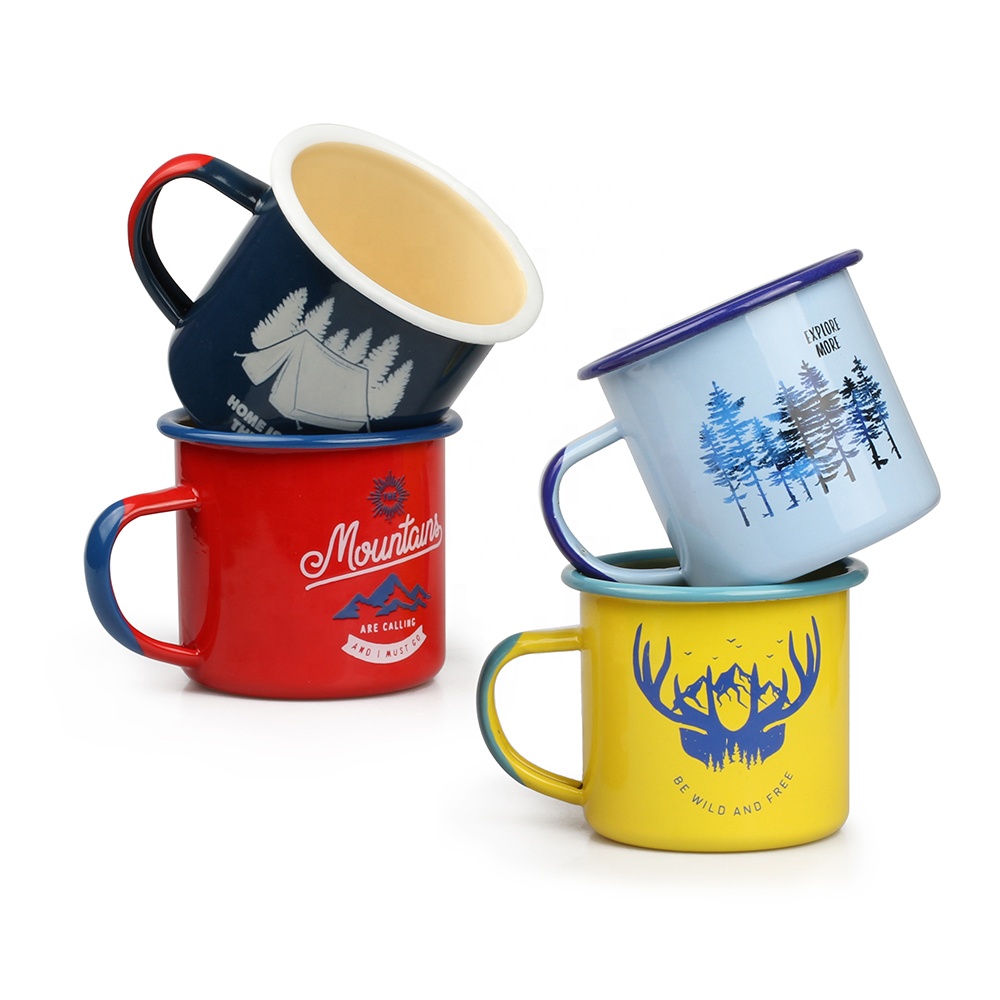
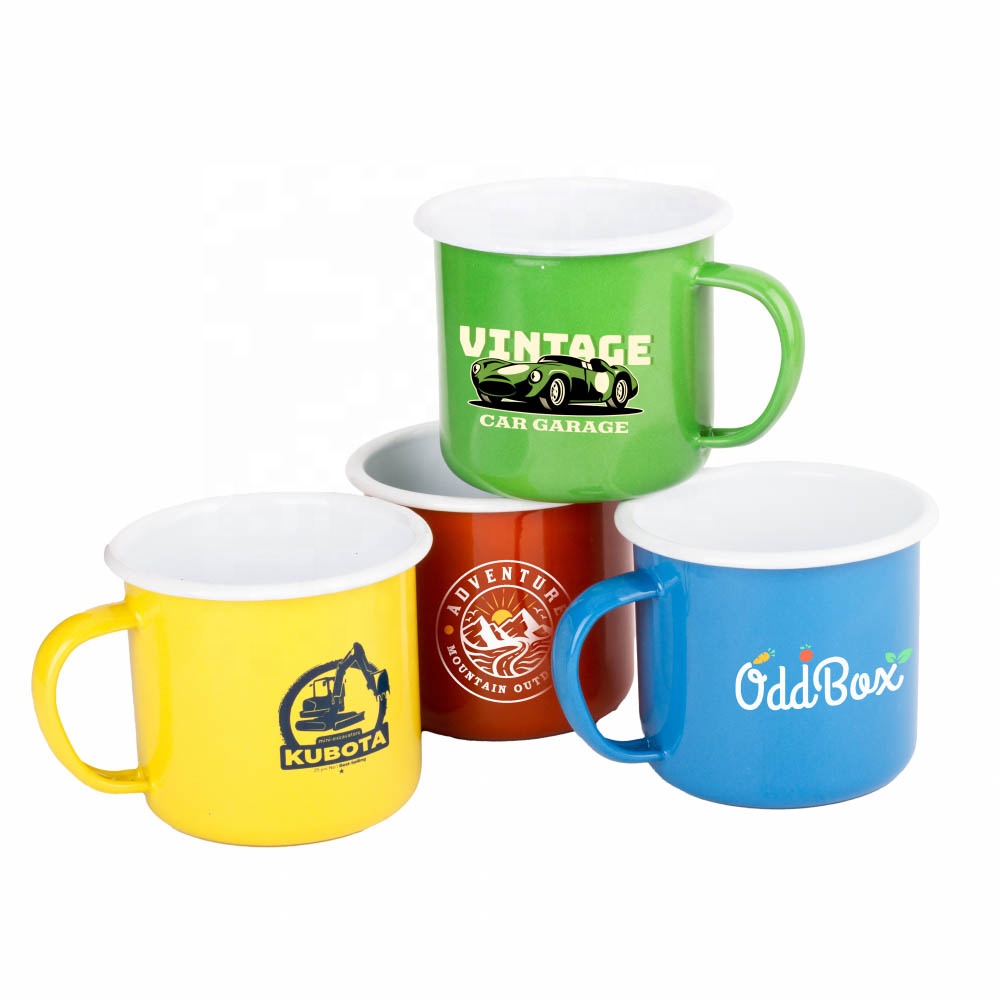
Two more things the stacked pair format tells a purchasing team. The mugs rest base-into-rim in mirrored tilts, which is both a photography device and an honest packing hint: nested orientation with interstitial protection is how these bodies ride in bulk cartons, and the rim bead – the same rolled lip you approve by colour – doubles as the nesting seat. And the handles in the photo are two-tone, picking up the accent colour at the top attachment before fading into body colour around the loop; that dip-matched handle finish is a coating decision, quoted separately from the print, and it is the detail that makes a shelf of four colourways read as one designed collection instead of four random stock mugs. Programs that sell the camp look in a boxed set of four use exactly this trick – coordinated rim, handle and interior accents across a palette – and the photograph is the specification you can attach to your own planogram request.
Where one page of your art replaces all of it:
Those slogan graphics are decorative artwork from our own sample run, which is exactly how we treat your file: one spot, two spots, or a four-colour illustration scaled to the flat panel opposite the handle. Where the print wraps depends on your art – a front panel only, or a wrap that meets behind the handle – and the digital mock-up shows both options before you approve anything. The pyramid photograph answers the question resellers always ask in the last email before ordering: does the coat stay glossy over a dense print area? The pasted-on look you sometimes see from commodity suppliers does not appear on these samples, and the article you sign becomes the receiving standard for every carton after it. A program that wants both appearances – plain emblem wall one week, patterned capsule the next – books both as separate design lines on one purchase order and receives them consolidated inside the 7-15 day window, mixed-cartoned so your shop floor can rack each family straight off the pallet without a sorting step.
Full-wrap patterns and two-tone interiors
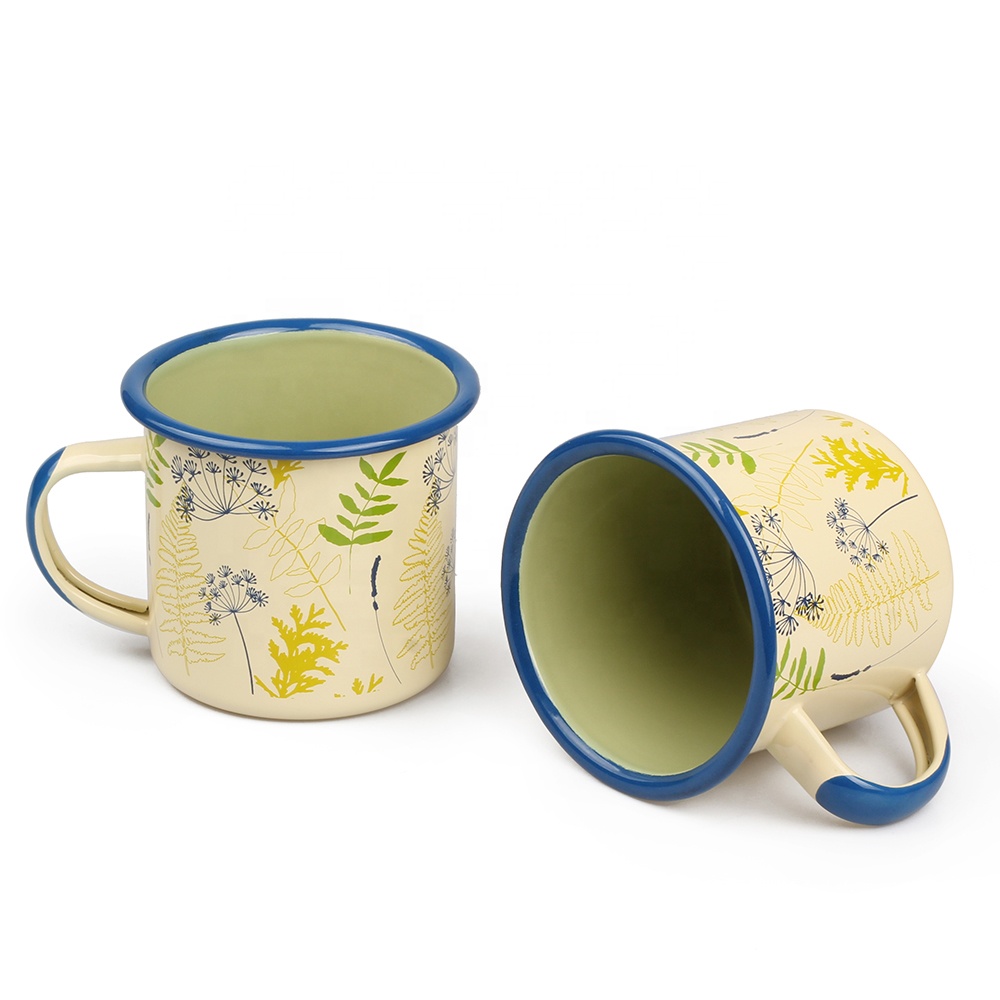
If your program is more illustration than emblem, the botanical pair shows the ceiling. A cream body carries a continuous meadow wrap – fern fronds, umbellifer heads, lobed leaves and seed strokes in leaf green, mustard yellow and slate blue-grey – while the rim stays a solid cobalt bead and the interior a solid sage. The second mug lies tipped so the camera looks straight into that green interior, showing exactly what the buyer’s customer sees with every pour. Colour-blocked rims, colour-blocked interiors and a patterned exterior are three separate coating decisions; we quote them as a combination so the accent colours can differ from the print inks.
Everything you can set at quotation
- Body colour: chart colourways as photographed, or any spot colour you supply as a PMS reference or mailed physical chip
- Rim and interior contrast: matched or deliberately different, per the tipped-pair and stacks photos
- Print zone: front panel, wrap meeting behind the handle, or full-wrap pattern
- Print colour count: single spot to full illustration, quoted from your artwork file
- Handle orientation and packing style per sales channel (carton drop tests noted on the spec sheet)
- Carton: bulk pack for resale, individual boxes for gift programs; FBA labelling available
Specifications at a glance
| Row | Detail |
|---|---|
| Item | Enamel camp mug, vitreous enamel coat over steel body |
| Set contents | One mug; no lid or accessory shown in our photographs, and none assumed |
| Material / components | Steel core with glossy fired enamel exterior, rolled lip, white or contrast enamel interior, colour-matched C-handle |
| Colour | Photographed chart: teal, light blue, pink, yellow, grey with printed reference codes; tint-step cards support spot-colour matching against physical colour standards |
| Logo | Front panel or wrap; single spot to full colour; free digital mock-up before production |
| Packing | Bulk cartons or individual gift boxes inside export cartons; FBA prep and labelling on request |
| MOQ | 100 pcs per design (one artwork on one colourway) |
| Sample time | 3-5 days |
| Lead time | 7-15 days after artwork approval |
| Capacity | Body labelled 10oz on the photographed colour chart; further size tooling quoted on request |
How sampling and production actually run
MOQ runs 100 pcs per design, and the definition matters when you plan a colour family: every artwork-and-colourway pairing counts as its own design line. Send vector artwork if you have it; send a photo of a hand-drawn mark if you do not, because the free digital mock-up is where both get resolved. Physical samples leave us in 3-5 days after mock-up sign-off, and approved artwork moves to bulk in 7-15 days. Across our gift lines the floor turns 1,000,000 pcs per month, so neither a 300-piece museum restock nor a 40,000-piece festival run needs to be apologised for – the small order ships complete, the large one ships on the calendar you gave us at approval, and both share the same colour cards and the same inspection protocol.
Packing, freight and the FBA path
Enamel rides to market better than ceramic, which is half its commercial appeal: the fired coat on a steel body takes pallet stacking and parcel drops that would crack a porcelain equivalent, and the rolled rim spreads impact around the mouth. We pack bulk in nested carton quantities or individually in gift boxes per your channel, then consolidate into export cartons. Freight runs by sea for replenishment stock, by air against a hard event date, or courier – DHL, UPS, FedEx, TNT – for samples and small reorders. FBA sellers get unit labelling and carton prep done here so the shipment is receivable without a sortation visit elsewhere.

Questions purchasing teams ask first
Can you match our brand blue exactly?
Does enamel chip or peel like painted metal?
What does one design cost at 100 pieces?
Can the artwork wrap around the mug?
How many colourways can share one order?
Do you handle Amazon FBA prep for this mug?
Where this mug sits in our drinkware lineup
Pair it deliberately. The 30oz insulated tumbler covers the big-capacity commuter shelf while these camp mugs own the rustic table display; for desk and café channels, printed porcelain mugs offer the shapes chart from latte tapers to two-handled bowls. Gift-set buyers who need boxed presentation instead of bare mugs should check the notebook, pen and flash drive sets and the umbrella plus fan sets, then browse the full cups subcategory or the Other Gifts catalogue.
Order the colour cards
Before you sample with artwork, order the physical colour references – it costs a day and saves a re-print cycle. Write to [email protected] or call +86-15967739086 with your PMS references, or use the request-a-quote form and attach your logo. From mock-up to shipped carton we run samples in 3-5 days and bulk in 7-15 days after artwork approval, 100 pcs per design.