Custom LED Temperature Display Water Bottles With Logo
$3.20
Stainless bottle family with a touch-activated LED temperature display in the screw cap, photographed lit and unlit across sage, coral, black and white shells. Exploded views show the threaded steel neck, mesh strainer, gasket and centre sensing contact. Readouts in our photos are demo values — tolerance, battery life and capacity figures travel on the spec sheet with your quote, never invented here. MOQ 100 pcs per design, samples in 3-5 days, production 7-15 days after artwork approval, FBA-ready cartons by sea, air or courier freight. The displayed figure anchors the 100-piece tier only.
A custom LED temperature display water bottle earns its place in a gift programme for one reason: the cap answers a question nobody had to be taught to ask. Somebody picks the bottle up, taps the lid, watches numbers light behind the black window, and the product has introduced itself — no salesperson, no card, no explanation. That self-demoing behaviour is the entire argument on this page, and it is exactly what our photography documents: a stainless bottle family with a touch-activated display lid, photographed lit and unlit, boxed and bare, assembled and stripped down to four parts. We describe what the frames prove and hand the rest of the engineering file to your quotation, because a listing page is not where a compliance team should have to fact-check a supplier.
The Lid Is the Demonstration
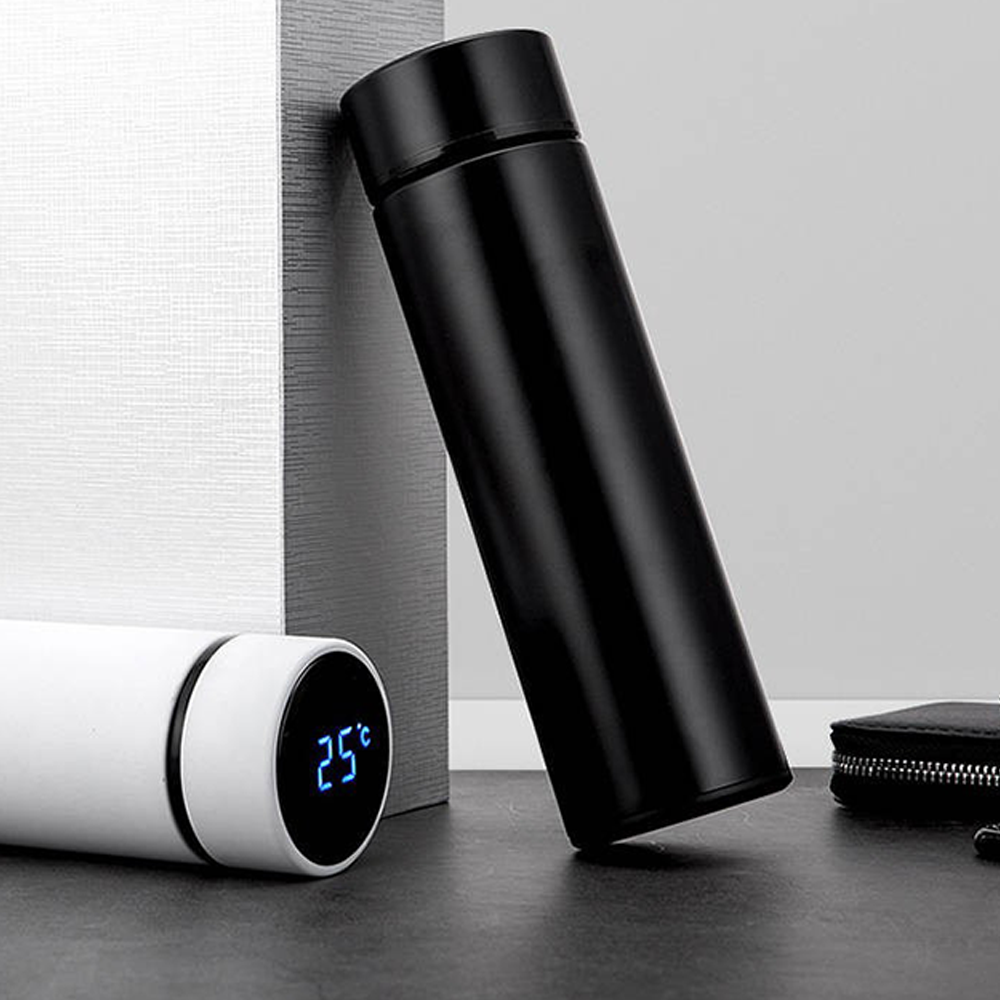
In the staged group photograph, a white bottle lies with its cap turned to camera while a black unit leans casually against a blank textured gift box, a zippered pouch resting at the frame’s right edge. The cap face is a glossy black lens set flush into the colour-matched shell, and a numeric readout glows behind it in bright segmented figures. Nothing about that composition is accidental: the white bottle shows the feature working, the black bottle shows the family it belongs to, and the box plus pouch show the tier the product can be packed at. Palm, thumb, glance — the whole interaction takes two seconds, which is roughly how long a trade-show attendee gives any booth item before walking on.
That two-second window is why gifting buyers keep choosing this model over plainer steel. A logo bottle is recognised; a display bottle is operated. Operated products get picked up twice, shown to a colleague, and photographed — three brand impressions from one unit of spend, and every one of them happens without your marketing team standing nearby with a script. Corporate year-end boxes, real-estate closing gifts, dealer-convention swag bags and dealership lobby displays all buy against the same logic: the gift should perform the meeting for you. The pouch in the frame is a staging prop, not a guaranteed inclusion; whether your units carry a pouch, a plain carton or a printed gift box is a configuration line settled in the quotation, priced line by line rather than assumed from a photograph.
What the Product Photos Actually Show About the Display
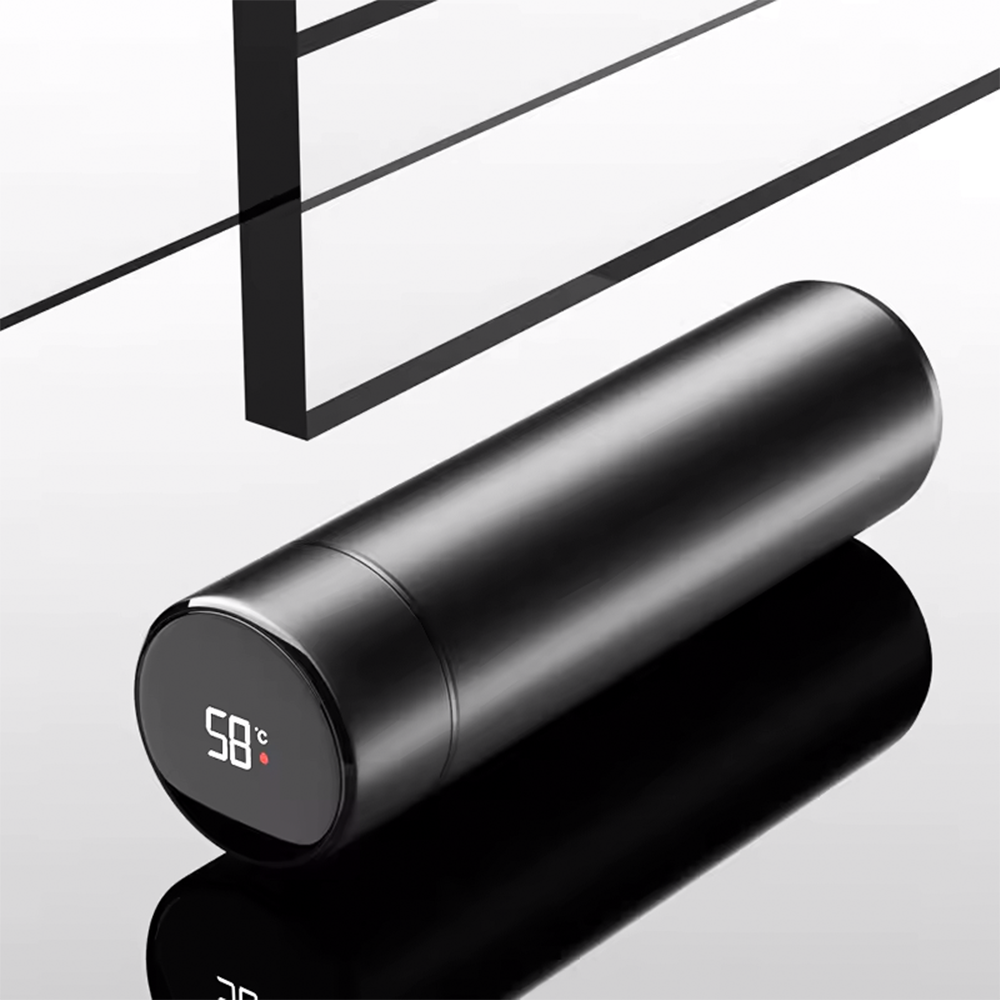
We keep the display claims exactly as wide as the images. In the photographs, the cap window lights with white segmented numerals, a small unit symbol and a tiny red status dot beside the digits. The reading changes from shot to shot: one beauty frame holds a Fahrenheit figure on a stripped-down cap, another carries a Celsius reading on the white bottle from the staging shot, and the third — a single black bottle lying diagonally on a mirror-dark surface, the lit readout facing camera with its reflection doubled underneath — shows a warm-drink Celsius value against the gloss. The red dot’s meaning is not annotated in any of our frames, so we describe it as a status indicator and leave its behaviour to the module documentation rather than inventing a colour code.
That restraint is a production reality as much as an editorial one. Promotional electronics change modules between lots without warning — supplier revisions arrive, component stocks rotate, and a listing that promises three decimal places of meaning about a cap display becomes a complaint file by the second reorder. Everything a lit photograph legitimately proves is on this page in plain language; everything a photograph cannot prove is pushed onto the paperwork, where it can be signed, dated and matched to your exact shipment. It also protects your own repeat business: gifting teams that reprint year after year hate discovering that year two’s cap behaves differently from year one’s, and a quotation locked to a named module prevents exactly that drift between orders.
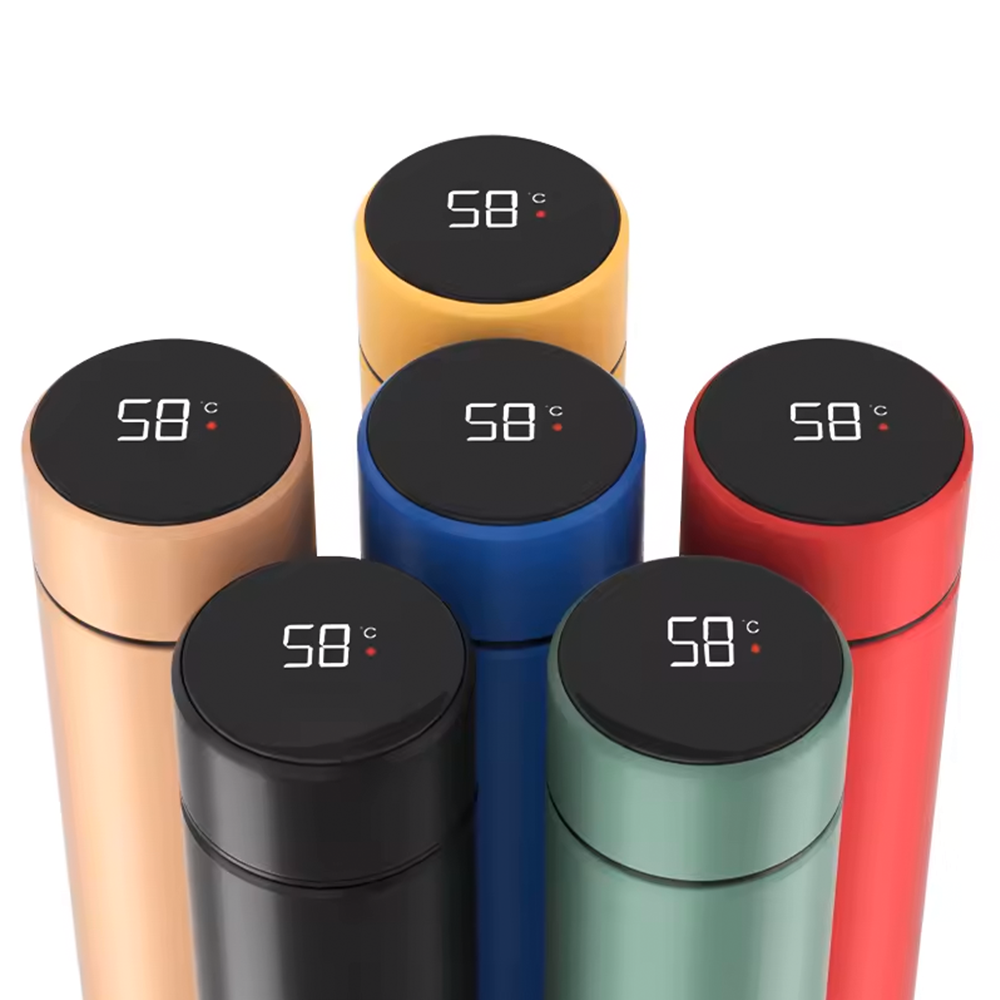
Then there is the six-bottle shot at the top of the listing: gold, champagne, blue, red, black and green shells clustered upright, every cap lit with the same identical value. Read correctly, that frame is powerful evidence and honest evidence at the same time. It proves the readout hardware is present and uniform across every colour in the family — no mystery about whether the green unit skipped the electronics — and simultaneously it proves nothing about precision, because the number repeated six times is a demo value rendered for marketing, not a laboratory trace.
So here is the discipline we hold ourselves to, and that your compliance reviewer is welcome to hold us to by email: nobody on our side prints a tolerance figure, a response time, a battery-life number or any approval mark into your listing, your artwork proof or your carton labels unless it travels on the engineering sheet attached to your quotation. If your procurement file needs sensor documentation, request it with the sample — the pack is issued per display-module variant, because the electronics differ between builds, and we would rather quote the module you actually receive than guess in public. What the photographs do support, we state plainly: a touch-activated numeric display on the cap, as photographed, on every colour in the family. If you need that sentence in a slide deck for a purchase committee, use it; it is the one display claim these images can carry.
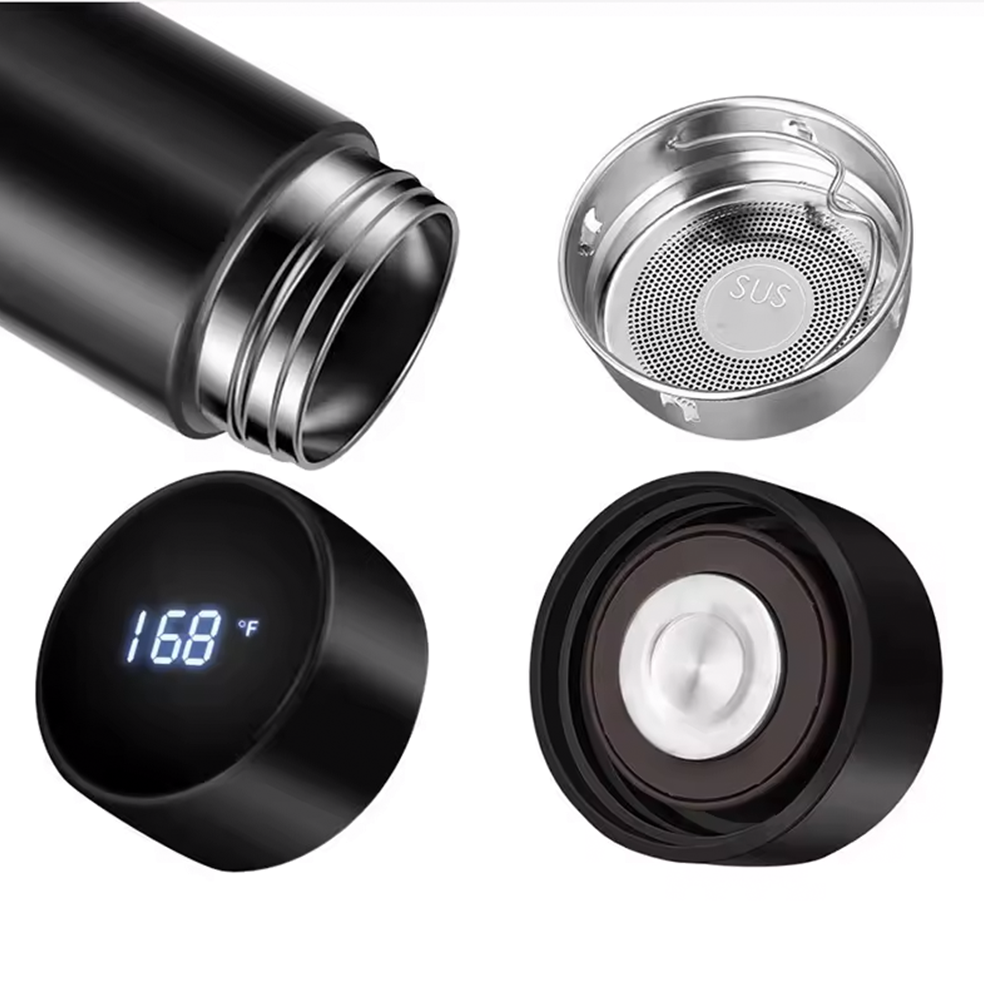
Opened Up: Body, Strainer and Cap Assembly
The exploded studio photograph lays one unit into its real components on seamless white, and for once the arrangement tells a procurement story rather than a beauty story. This is the image that converts a gift product into a manufacturable object: four parts, four visible interfaces, and no hidden plastic pretending to be steel. Quality reviewers forward it to colleagues because every question a purchasing committee asks — what touches the drink, what seals it, what screws where, what does the decoration print on — has a corresponding surface in the frame.
Top-left, the bottle body: a satin black cylinder ending in a bare, threaded stainless neck — machined metal at the mouth rather than a moulded plastic collar, with three visible screw threads and a bright interior wall you can inspect with a fingertip. That bare-metal finish at the drinking edge is the detail beverage engineers look for, because the mouth is where coatings fail first on cheaper flasks.
Top-right sits the removable perforated strainer basket, a shallow stainless dish with a pin-hole screen floor, a bent wire lift loop, and a rolled grade stamp at its centre marking the steel family. The basket is the component that quietly widens the gift audience: tea drinkers, fruit-water people and anyone who cannot drink loose-leaf from an open neck will choose a bottle that carries one, and a programme that ships it is handing out an option rather than a limitation. The lift loop is a small engineering courtesy with a large practical effect — an infuser that can be pinched out with two fingers gets cleaned daily, while one that must be fished out with a knife quietly stops being used.
Bottom-left, the smart cap from the outside: a drum of colour-matched shell with the recessed circular display lens, matte around the rim, glossy in the window. Bottom-right, the same cap inverted, and this is the frame that answers half the questions engineers email us about — internal screw thread, a dark sealing gasket ring running around the perimeter, and a polished metal contact disc at the dead centre. That disc is the sensing point: it meets the liquid surface when the lid is screwed home, which is why gasket condition and reading stability share a single maintenance point on this design, and why the seal, the sensor and the threads all live on one face you can photograph, replace and inspect. The exploded shot is also the most useful image to forward to your own quality reviewers: every part number they will ask about appears in one frame.
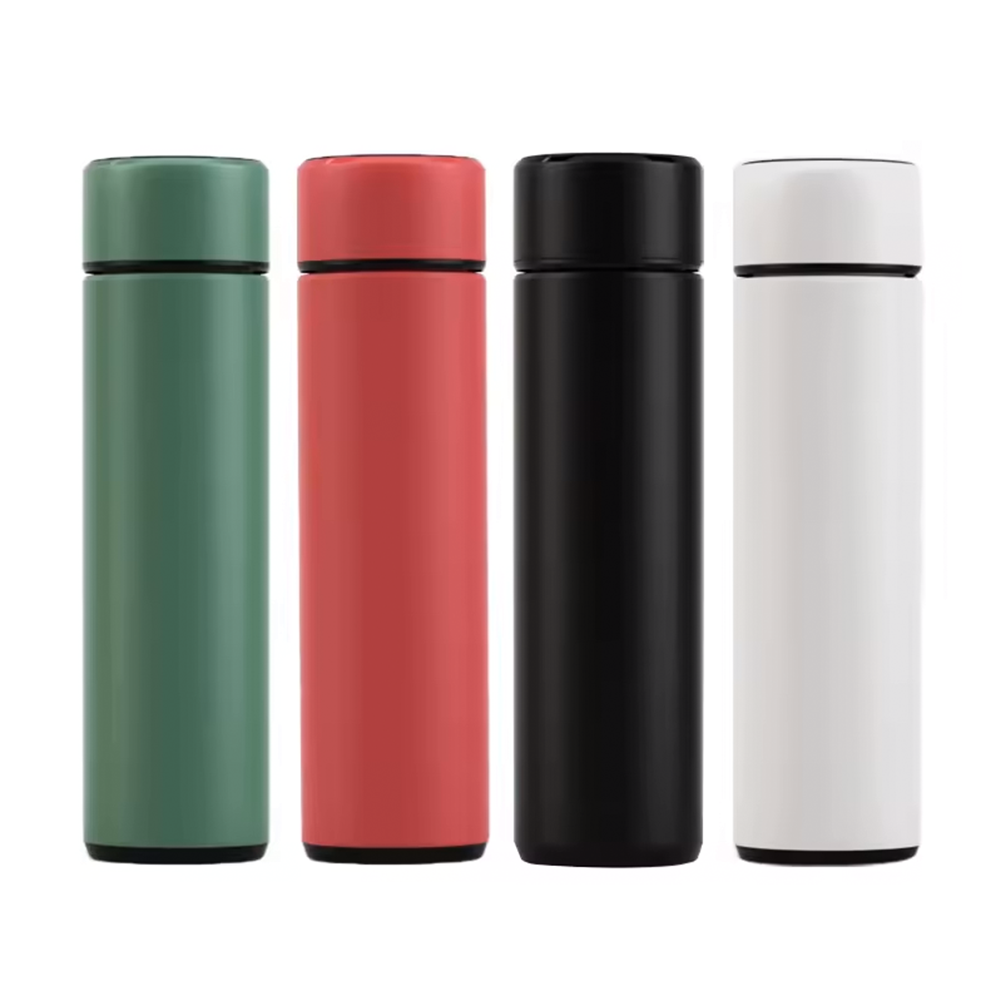
Colourways and the Unlit Window
Four bottles stand in a row on seamless white in the lineup frame: sage green, coral red, black and white. Each wears a colour-matched screw cap, and each cap carries the same dark circular window — unlit in this photograph, which is worth noting because an unlit window is still a window. The display hardware is integrated across every colour rather than bolted onto a single hero SKU; you can see the identical recess in all four shells. Every bottle shares the same proportions too: a tall straight cylinder, rounded shoulder, thin dark seam line where the cap meets the body, and a dark anti-slip ring at the base that reads black even under the white and green shells.
The wider family documented in our catalogue photography extends the lineup into gold, champagne and blue, all finished in the same satin coated exterior. Two practical consequences for brand programmes. First, colour matching becomes a real service: supply a PMS reference and we shortlist the nearest stock shell before sampling, so your corporate green arrives as the same green across thousands of units instead of an approximation chosen by whoever guessed at the pigment lot. Second, print planning has a hard line nobody should cross: the cap lens is glossy electronics packaging, the barrel is satin coated steel, and decoration belongs on the barrel, where laser marking or pad print sits crisp and permanent. Nobody should be talked into printing across a curved black display window, and the free digital mock-up we issue with every quotation maps your artwork onto barrel positions and sizes before a single file is approved.
Why the Display Justifies the Upgrade Over Classic Steel
Everyday vacuum bottles do their job quietly; this model does its job out loud in the recipient’s hand. Three buyer patterns keep repeating order after order. Corporate gifting teams stack it into year-end boxes because a glowing cap reads as technology, lifting perceived value above the cash spent without moving the unit into a luxury price bracket — the same budget that buys a plain bottle with a ribbon buys this bottle without one. Real-estate and automotive closing desks favour it because the object survives the walk from office to lobby: the tap-and-light demo works even when the flask holds nothing hot, so the moment lands on an empty bottle at a kitchen counter a month later, which is exactly when a referral is worth the most.
Trade-show distributors treat it differently again: a display bottle restocked on a booth table gets handled at ten times the rate of an identical plain one, and handling is the only product demo that scales at events. That is also why the unlit lineup photograph matters commercially — buyers want to confirm the feature exists across the range before committing a mixed-colour order, and four dark cap windows in a row answer that before the sales call ends. If your programme is a hospitality welcome kit rather than a booth, the same logic applies at cabin or suite scale: the guest taps once, the number appears, and your brand gets the only product in the room that responds.
Decoration Options and Configuration Lines on the Smart Bottle
- Shell colour from the photographed family, or matched to your PMS reference
- Laser marking or pad print on the barrel; single-position, front-and-back or wrap layouts
- Gift-box tier: blank textured box as staged, or printed lid with your mark, per quotation
- Strainer basket included or omitted, stated line by line in the set-contents column
- Zippered carry pouch as an add-on where the staging configuration matches your programme
- Individual carton, FNSKU labelling and Amazon inbound prep as quoted line items
- Mixed colour splits inside one order — each colour-plus-print combination counts as one design
Smart Display Bottle at a Glance
| Item | Custom smart water bottle with LED temperature-display screw cap |
| Set contents | Bottle body with threaded stainless neck, display cap with gasket and centre sensing contact, mesh strainer as configured in the quotation |
| Construction | Coated steel cylinder, double-wall profile per model spec sheet; capacities, tolerance and battery figures travel with your quote, not this page |
| Colour | Sage green, coral red, black, white as photographed; gold, champagne, blue across the wider family; PMS match on request |
| Logo | Laser mark or pad print on the barrel; free digital mock-up before approval |
| Packing | Individual gift box, export cartons, FBA-ready labelling optional |
| MOQ | 100 pcs per design |
| Sample time | 3-5 days |
| Lead time | 7-15 days after artwork approval |
| Capacity | 1,000,000 pcs per month across our gift lines |
Quoting the Display Bottle: Samples, Tiers and Reorders
The displayed figure on this page anchors the 100-piece tier; it is not a standing unit price, and it moves with quantity, decoration method and the box-or-pouch configuration you choose. Send artwork and quantities, and the quotation answers in writing everything this page deliberately refuses to publish: the sensor documentation pack, the display module variant with its unit configuration, the capacity options per shell size, and the delivered freight number. Physical samples return in 3-5 days, production closes 7-15 days after artwork approval, and monthly output across our gift lines runs to 1,000,000 pcs — which means a Q4 reorder slots behind nothing except the purchase orders you already placed.
Two ordering habits save weeks on this particular SKU. First, fix your event or embargo date before requesting the mock-up: year-end gifting programmes all compress into the same six weeks of the calendar, and buyers who approve artwork in the first window are shipping while the late negotiators are still arguing about champagne versus rose-gold shells. Second, treat mixed splits honestly against the MOQ rule of 100 pcs per design, where a design means one shell colour plus one decoration specification — three colours with identical artwork means three qualifying lines of one hundred, not one lucky blend of three hundred. A single launch colour with a second colour added at reorder pricing is the pattern that most programmes actually end up ordering.
Boxed, Palletised, Labelled: Freight and Fulfilment Work
Each bottle packs into its own box, nested with dividers inside master cartons rated for multi-tier pallet stacks so the display lenses never carry a stacked load. Barcodes and carton marks align to your purchase order on request. Freight leaves by sea for volume, by air when a programme date is already booked, or door-to-door on DHL, UPS, FedEx and TNT for samples and top-up quantities. FBA preparation is standard work on this line: individual labelling, poly-bag compliance and carton routing to your chosen fulfilment centre happen before the shipment books, and reference photographs of packed cartons go back to you before despatch so your receiving team audits against pictures rather than prayers.

Does the temperature readout switch between Celsius and Fahrenheit?
What is the sensor accuracy and how long does the battery last?
Is the tea strainer included in every unit?
Can we put our logo on the cap?
What does the displayed price on this page cover?
Are these ready to send to Amazon fulfilment centres?
Related Lines to Pair or Compare
If your shortlist is still open, the small-mouth stainless steel bottle runs the classic everyday argument with no electronics at all, and the flip-top plastic sports bottle covers gym, campus and race-day volumes where grams beat gadgets on the freight invoice. For boxed programmes, the luxury water bottle gift sets pair steel bottles with companion items at a higher shelf tier, and the 30oz thermal tea and coffee mugs hold the large-capacity desk position. Venue buyers often add the handled plastic beer cups for the bar while keeping this bottle for the boardroom. Browse everything under the cups category or step back to the full Other Gifts range for the rest of the catalogue.
Put the Cap to Work in a Mock-Up First
Send your logo, target colours and delivery destination to the quote desk, or reach the team at [email protected] / +86-15967739086. The reply bundles a digital mock-up on the barrel print zone, the module documentation sheet, and tiered pricing that replaces every number this page refuses to invent.