Custom Plastic Beer Cups With Handle, Pub Style Mugs
$0.30
Pub-style handled mugs for venues that wrote glass off the risk register: matte speckled bodies in ten photographed colours, a flat tab handle that doubles as a secondary print zone, and a taper that nests three-high in the barback’s crate — the colour lineup proves the stack. Mouth 8.5 cm, height 10.5 cm, base 7.5 cm, taken from the dimension callouts printed in our own product image; fluid capacity and wash or heat tolerance come on the spec sheet with your quote, never invented in a listing. MOQ 100 pcs per design, samples in 3-5 days, production 7-15 days after artwork approval, nested-carton sea freight, air or courier with FBA prep on request. The displayed figure anchors the 100-piece tier.
Custom plastic beer cups with handle are bought by people who have watched a glass mug shatter on a stadium concourse at two in the morning and now run a simpler rule: if the venue has a glass problem, a plastic handled mug answers the serving problem and the security problem with one line item. These pub-style mugs photograph warm rather than glossy — matte, finely speckled bodies in solid colours, a flat angular handle that reads modern instead of novelty — and every measurement quoted on this page comes straight from the dimension callouts printed inside our own product image, so the numbers in the listing and the numbers in the spec photo are the same numbers. Breweries, festival bars, cruise galleys and beer gardens buy this silhouette for the same three reasons: no glass, a handle guests actually use, and a blank front face waiting for a print.
The Silhouette, Measured From Our Own Spec Shot
Start with the one object the page will not argue about. The dimension image frames a single cream mug against white with three black arrows and printed figures: 8.5 cm across the mouth, 10.5 cm from rim to base, 7.5 cm across the foot. Those callouts are part of the photograph, not marketing overlay, which means a bar manager can copy them into a shelf plan or a crate layout without asking a supplier to confirm anything. The body tapers gently from rim toward a rounded base edge; the wall and handle run in one moulded piece with a visible, uniform surface; the open rim is a smooth slightly rounded lip, and the inside is the same cream and the same fine speckle as the outside. The handle is the design’s signature: a flat strap of the same material fused near the rim, arching out and descending as a squared, rounded-end tab rather than the curved loop of a ceramic pub mug.
Read the taper as a serving fact too. A mug that is 8.5 cm wide at the mouth and 7.5 cm at the base sits stable on an uneven bar top yet stacks into the next mug below it, which is the single physical property that decides how many units a barback can move in one crate and how much shelf space a taproom spends on glassware that is really printed plastic. The three-figure set is the evidence; everything about storage, serving feel and print area on this page can be derived from it, and none of it requires a claim nobody can check.
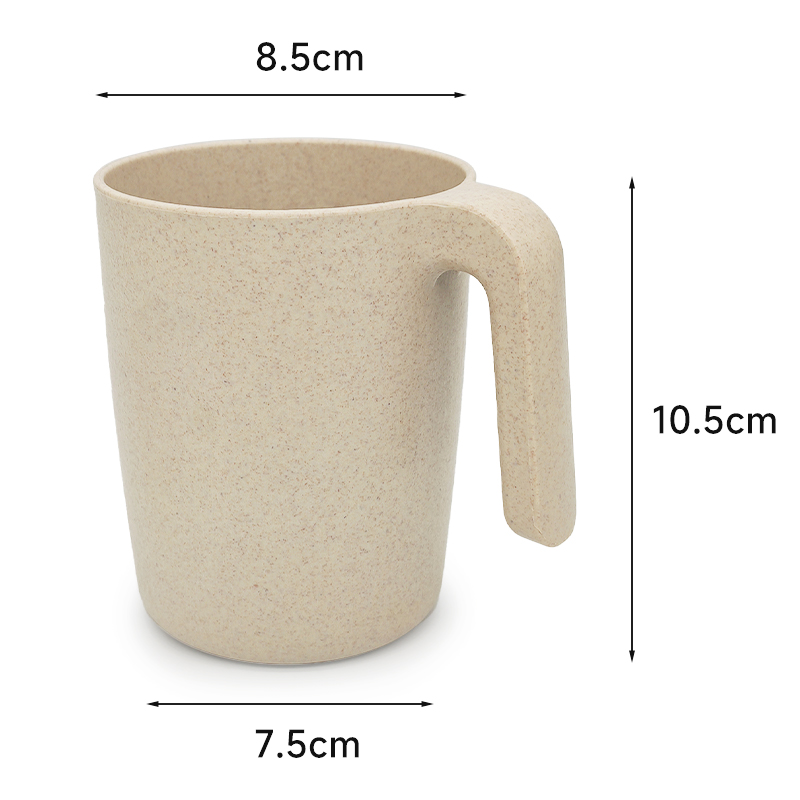
What the images do not show is equally deliberate, and a B2B buyer should read the gaps as carefully as the callouts. No millilitre or fluid-ounce figure is printed on any mug or card in these photographs, so no capacity is claimed anywhere in this text; if your bar team needs fill volumes per size, the spec sheet travelling with your quotation carries them per build. The speckle across the surface is described strictly as a finish — a fine mottled texture distributed through the moulded body colour — because nothing in the photography proves a composition beyond that, which is why no ingredient-level material wording appears on this page, and the same restraint keeps any environmental or food-safety endorsement language entirely out of the copy. What the photographs do prove, and what this listing commits to in writing: a tapered handled vessel, matte through-colour walls, the three dimensions above, and a completely blank front face that arrives unprinted and leaves with your mark on it. Heat tolerance, wash-cycle endurance and dishwasher behaviour are engineering figures that belong on documents with version numbers, not next to a price; ask the quote desk for the sheet on your exact build and audit it there.
Why the Handle Is the Product
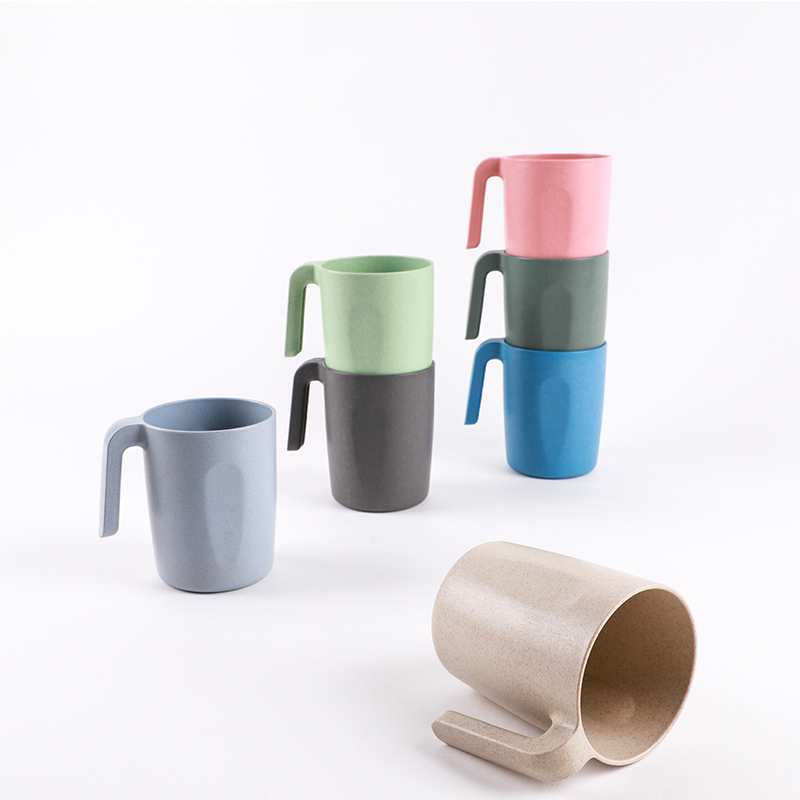
A handled mug is a different serve from a handleless cup, and venues discover the difference in the first month of service. The flat tab handle — a squared-off bar mounted high near the rim and moulded in the same colour as the body — keeps fingers off the bowl where condensation forms, lets a server carry two per hand along a crowded rail, and gives a guest something to grab in a dark stand without touching the rim. In the colour lineup photograph, every upright mug shows the handle in the same plane and posture: it is an integral part of the mould, not an attached clip that loosens, discolours or snaps through a washing cycle. The tipped tan mug in the foreground confirms the handle is solid through-colour, resting flat on its side with the interior wall visible to camera.
Handle geometry also rewrites the reorder maths. Handleless stadium cups get treated as consumables: they go missing, they get crushed, they are repurchased like napkins. Handled mugs get kept — they hang on hooks, live in racks and survive seasons — so breweries, cruise lines and beer gardens order them as durable barware once and reprint the same artwork annually rather than restocking disposables weekly. That is the purchase logic of this page in one sentence: one mug, printed once, poured into thousands of times, with the handle doing more work toward that repeat number than any print finish can.
There is a security argument underneath the comfort argument. Venues with glass bans still want guests to drink from something that reads as a proper pint rather than a paper cone; a handled mug fills that slot because the handle plus the pub silhouette does most of the psychological work of glassware at a fraction of the hazard. Nobody has to say the word plastic out loud at the bar when the serve looks like this.
Colour Lineup and Stackability on One Frame
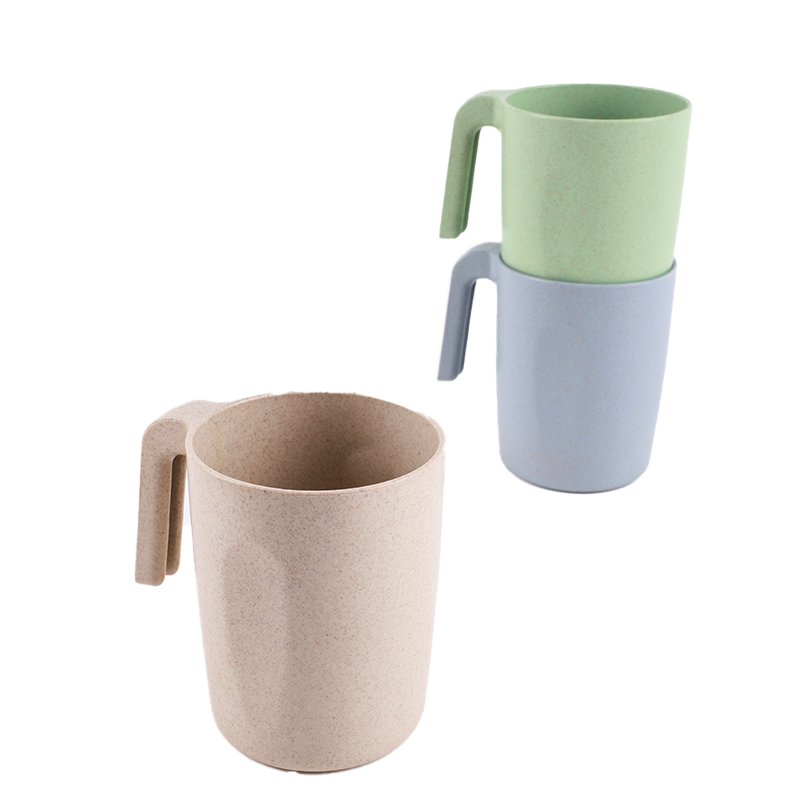
The group photograph arranges seven mugs in stepped stacks that double as both a colour chart and a storage demonstration: a slate blue-grey standing alone at the left, sage nested over charcoal two-high in the centre, pink over forest green over true blue three-high at the right, and the natural tan mug tipped in the foreground with its mouth facing camera. Those nested columns are the barback’s argument made visible — the 8.5-to-7.5 cm taper means units seat into each other, so a crate holds multiples of what a straight-walled tumbler fits, and the shelf depth your taproom spends on glassware drops by the same ratio.
Colours photographed here run dusty blue-grey, sage, charcoal, soft pink, forest green, true blue and natural tan, with the listing’s featured frame adding beige, mint and periwinkle to the same family. The speckled matte texture reads consistent across all of them, which matters for programmes that mix colours without mixing product lines — every hue looks like it came off the same tool, because it did. For venue planning, colour is a floor plan: three tappable colours across three bars separates stout from lager lines without labels or wristbands, corporate suites take brand colours, and shelf neutrals go to general admission. The through-colour walls carry the same tone inside and out, so the wear pattern of a busy bar shows up as dulling rather than a chipped colour line at the rim.
Print Zones on a Matte Face
Every mug in these photographs is blank, which is the correct state for a customisation listing: the tapered front is the print field, and the dimension callouts size it — a mark working within roughly the middle third of an 8.5 cm mouth and 10.5 cm height is the comfortable envelope for pad print or transfer on this texture. Matte speckled surfaces take opaque ink well; fills sit over the fine mottling rather than swimming in it, and a single-colour mark one step below the panel maximum keeps small type — sponsor lines, bar names, cruise ship monograms — legible across the slight taper. The flat handle tab is the overlooked real estate: a secondary micro-mark prints there without competing with the front face, and it never touches a guest’s lips.
Two-colour artwork wraps the front and back faces; full-colour files with gradients and photographs are better reserved for the flatter handle plane or an attached sleeve, and we say that at mock-up stage rather than apologising after a press run. Every artwork goes onto a free digital mock-up mapped to these zones before approval, and the physical sample that follows carries production art, not a placeholder. Mixed programmes follow house rules unchanged: each colour-plus-print combination is one design, MOQ 100 pcs per design, so a four-bar venue ordering three colours of one mark is really three orders of one hundred that ship together.
Who Reorders This Mug, and Why
Brewery taprooms buy it because a handled vessel photographs as beer service — the pub silhouette is the entire visual contract with the guest — and it survives the bar top without the glass-safety conversation that follows one shattered pint into an insurance review. Event venues buy it because shatter risk comes off the risk register and security screening treats plastic without ceremony, which keeps concourse throughput moving on gates that ban bottles and glass alike. Cruise galleys and beer gardens buy it because the stack profile cuts storage under crowded bars and the through-colour body hides handling wear between washes, so a mug stays presentable for seasons rather than weeks.
None of that requires a hero claim, which is why this page keeps its claims the same width as its photographs: a taper that stacks, a handle that serves, a matte face that prints. The reordering behaviour is the proof buyers actually care about. Consumable cups resell themselves through loss; handled mugs resell themselves through breakage avoidance and reprint cycles — the brewery that printed one run for its anniversary keeps the tooling conversation cheap the following year because the mug design, colours and dimensions above all match what already lives on the shelf.
Print Fields and Packing Choices for the Mug
- Mug colour from the photographed speckled family; solid custom colour lots at committed volumes
- Front-face print: pad print or transfer, single position or front-and-back wrap
- Secondary micro-mark on the flat handle tab
- Size selection per the spec sheet with your quote; the 8.5 / 10.5 / 7.5 cm figure set is the photographed model
- Loose nested packing for bar restock, individually bagged for retail, boxed for gift-shop tiers
- Barcode stickers, hang tags and FBA-style prep for teams reselling merchandise online
- Mixed colour splits, each qualifying at one design’s MOQ
Mug Dimensions and Order Terms
| Item | Custom plastic beer cup with handle, pub-style mug |
| Set contents | Single mug with integrated tab handle; no lid, no straw, no sleeve in the standard set |
| Dimensions | Mouth 8.5 cm, height 10.5 cm, base 7.5 cm as printed in the listing’s dimension image; fluid capacity on the quote sheet |
| Finish | Matte, fine speckled texture, through-colour body and handle |
| Colour | Blue-grey, sage, charcoal, pink, forest green, blue, tan, beige, mint, periwinkle as photographed |
| Logo | Pad print or transfer on the front face; optional handle-tab mark; free digital mock-up before approval |
| Packing | Nested bulk cartons, individual bags or gift boxes; FBA prep on request |
| MOQ | 100 pcs per design |
| Sample time | 3-5 days |
| Lead time | 7-15 days after artwork approval |
| Capacity | 1,000,000 pcs per month across our gift lines |
Season Dates, Restocks and What the Price Anchor Means
The 0.3 figure displayed on this page anchors the 100-piece tier and moves with quantity, print complexity and packing choice — a sub-dollar unit price is exactly why carton density and freight mode decide the real landed cost of this line, more than any print option ever will. Festival dates and season openings set the clock: samples return in 3-5 days, production runs 7-15 days after artwork approval, and monthly output across our gift lines reaches 1,000,000 pcs, so a mid-season sell-out restock is an email and a re-approved artwork file, not a new supplier search.
One planning habit we push on every venue buyer: order the printed mug against the bar’s real serve size, confirmed from the spec sheet’s capacity figures, not against a mock-up’s optimism. A mark that looks balanced on a screen can read small across an 8.5 cm tapered mouth at the distance a guest actually holds it; we re-scale on the free digital mock-up, then prove it on the physical sample in 3-5 days before the design’s 100-piece minimum commits. Send the season calendar with the artwork file and the schedule builds backwards from opening night rather than forwards from a quote request.
Nested Cartons, Sea Shipping and Merchandise Prep
Nested-to-pallet is the standard ship: mugs seat rim-to-base with interleaving between units, dense colour-sorted columns inside master cartons marked to your purchase order, cushion layers sized to the taper so nothing transfers a nick through a container stack. Bulk bar restocks go by sea on volume schedules; season-launch top-ups move by air, and single-colour emergency runs finish door-to-door on DHL, UPS, FedEx or TNT. Teams reselling printed merchandise online get individual bagging, barcode application and fulfilment-centre carton routing as quoted prep line items, with packed-carton reference photos before despatch, so the inbound your seller account creates matches the outbound our floor built.

What are the exact dimensions of the mug?
Are these clear glass-look mugs?
Can the handle carry a logo?
Will the mugs stack for bar storage?
How many colours can one order contain?
Are they safe for hot drinks or commercial dishwashers?
Lines That Sit Next to This One in a Venue Order
A bar programme rarely stops at one SKU. For hydration stations and gym floors, the flip-top plastic sports bottle shares this mug’s lightweight freight logic; the small-mouth stainless steel bottle covers the keep-cold retail tier, and the LED temperature display bottle handles the corporate gifting end of the same venue’s budget. Umbrella-and-drinkware welcome kits pull from the Other Gifts catalogue, and the complete drinkware shortlist lives under the cups category.
Get the Spec Sheet and a Blank Sample First
Quantity, colour split and print brief go to the quote desk; direct conversations land at [email protected] or +86-15967739086. The first reply bundles the digital mock-up on the 8.5-by-10.5 cm face, the spec sheet with capacity and tolerance figures for your exact build, and the 3-5 day sample that lets your bar manager make the final call against a real mug in a real hand.