Custom Printed Ceramic Mugs Wholesale, 27 Mug Shapes
$0.70
Twenty-seven photographed body shapes – latte tapers, diner cylinders, faceted squares, bellied cups, footed pedestals, wide bowls and a two-handled loop – all printed on glossy white porcelain with your artwork. The samples on this page carry the range: crisp single-colour line art, full-colour photographic panel grids, coordinated two-tone interiors and a colour-change pair that reads empty-to-charged in one shot. 100 pcs per design, free digital mock-up, samples in 3-5 days, bulk in 7-15 days after artwork approval. Sea, air or courier freight with FBA labelling and prep; the displayed figure anchors the 100-piece tier, and your working number travels with the written quotation.
Custom printed ceramic mugs wholesale, chosen by shape first
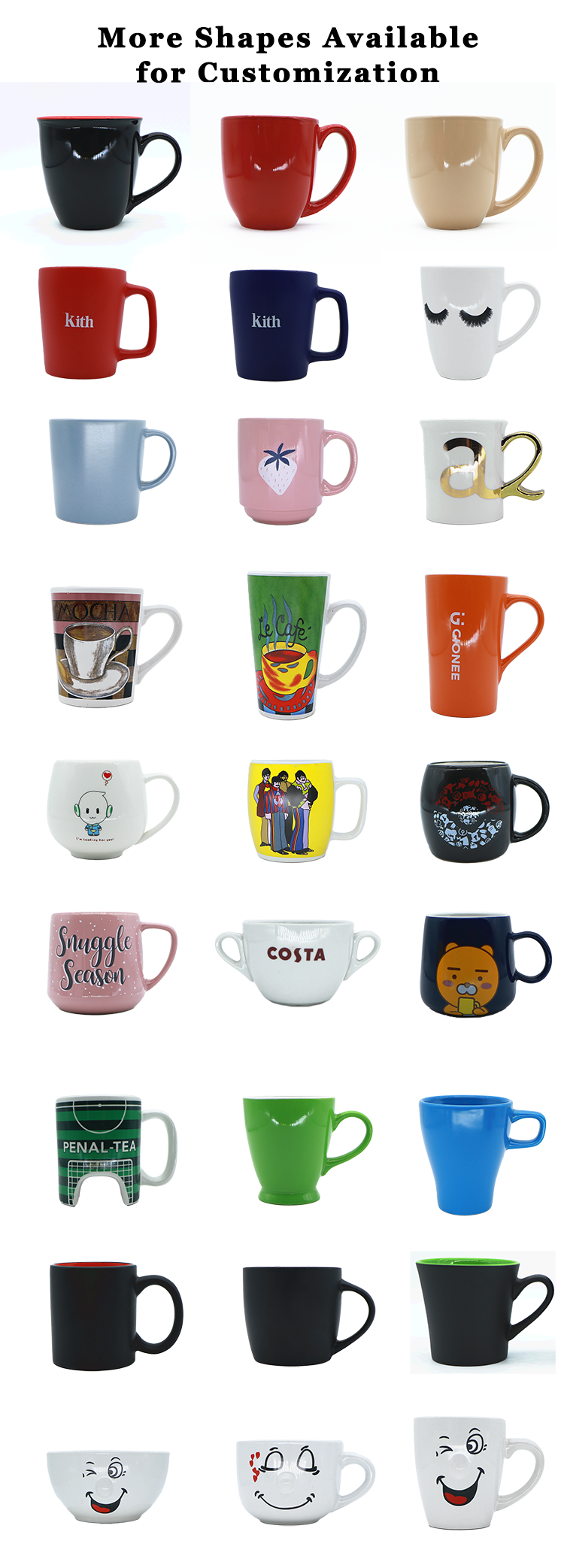
Most mug suppliers make you take the shape they own; our custom printed ceramic mugs wholesale program starts from the opposite question – which silhouette fits your shelf – and the answer lives in the catalogue chart on this page: twenty-seven mugs photographed in a three-by-nine grid under the printed heading More Shapes Available for Customization, from tall latte tapers and straight diner cylinders to faceted geometric bodies, bellied cups, footed pedestals, wide bowls and a low two-handled loop. Every one accepts the same full-colour print on glossy white porcelain, and every one is a distinct reorder decision a museum shop, café chain or retail buyer can make once and keep making. The price displayed here anchors the 100-piece tier; shape, print method and colour count set your working number on the quotation.
Because the shapes chart is the strongest single argument this line has, we wrote this whole page around what it photographs. Where a spec is not visible in our pictures – capacities, millimetre toolings – it is not typed here either; dimensional drawings travel with your quote instead of pretending to be facts on a product page.
Reading the twenty-seven-shape chart like a buyer
The grid mixes bare solid-colour blanks with printed examples on purpose, so you can separate the two decisions that price an order: which body, and what happens to its surface. Among the photographed forms: tall latte tapers that flare at the rim and narrow to the base, the barista-standard shape for flat whites and filter; straight-sided diner cylinders with an open loop handle, the workhorse for high-turn café reorder; squared, faceted bodies that catch light on flat panels – the best canvas for geometric artwork because the surface barely curves under the print; squat bellied cups for mascot art; a footed green mug on a short pedestal stem for boutique gift walls; wide bowl forms including one low bowl with a loop handle at each side, which reads as soup-and-cocoa merchandising rather than coffee; a novelty rounded body with an arched cut-out at the base; and solid colourways from plain black to a speckled pink glaze.
Two-tone variants matter most for wholesale programs: black exteriors photographed with contrasting red or green interiors, plus matte-dark interiors visible inside the open rims, let a retailer hang one SKU family across a colour story without changing the print file. Some bodies on the chart even carry metallic accents – a gold handle and matching gold lettermark photographed as one coordinated finish. The chart prints no size numbers, so treat shapes as the decision framework and ask for the tooling sheet for your shortlist; the shape you choose determines cap volume more than any figure we could invent here. A practical way to use the chart in a buying meeting: photograph the three rows that match your shelf brief, send us the crop, and we confirm tooling availability and dimensional drawings against those exact bodies. Buyers regularly discover the silhouette they described in words – the tall barista taper, the squat cocoa bowl, the faceted cube for a design-museum wall – is already one of the twenty-seven photographed, which means no new tooling charge and a sample in 3-5 days instead of a months-long mould program. Where a genuine custom shape is required, that is a separate tooling-development conversation quoted against your annual volume, never a number hidden inside a unit price.
What the print zone can carry
The single-colour proof mug shows the restrained end: a tall straight-walled white body, glossy glaze, C-handle at three o’clock, and a crimson print stacked in three tiers on the flat panel – an arched hand-lettered word, a polka-bow cartoon figure with dot eyes and sparkle accents, and a compact oval badge near the base. That past-order sample proves one-colour line art prints crisp on a curve, with the artwork reading undistorted from rim to foot. It is exactly the structure a band or label brand wants: mark, character, badge, one ink colour, maximum shelf legibility at minimum cost.
That tiered structure – arched wordmark over character over badge – is why this proof earns its place on the page. Licensed and heritage artwork arrives with tight rules: the badge oval holds a fixed ratio to the figure, hand-lettering cannot thin at the rim curve, the red must match a printed reference across every carton in the run. A single-colour print on plain white porcelain is the most unforgiving canvas in drinkware because every line-weight error reads from a metre away, and this sample clears that bar – which is also why former clients’ marks on our catalogue sheets are kept as zone examples rather than reproduced brand walls. Your file’s rules travel with your artwork; the mock-up stage is where geometry gets argued, the physical sample is where ink gets approved, and the approved sample becomes the reference article for every reorder after it.
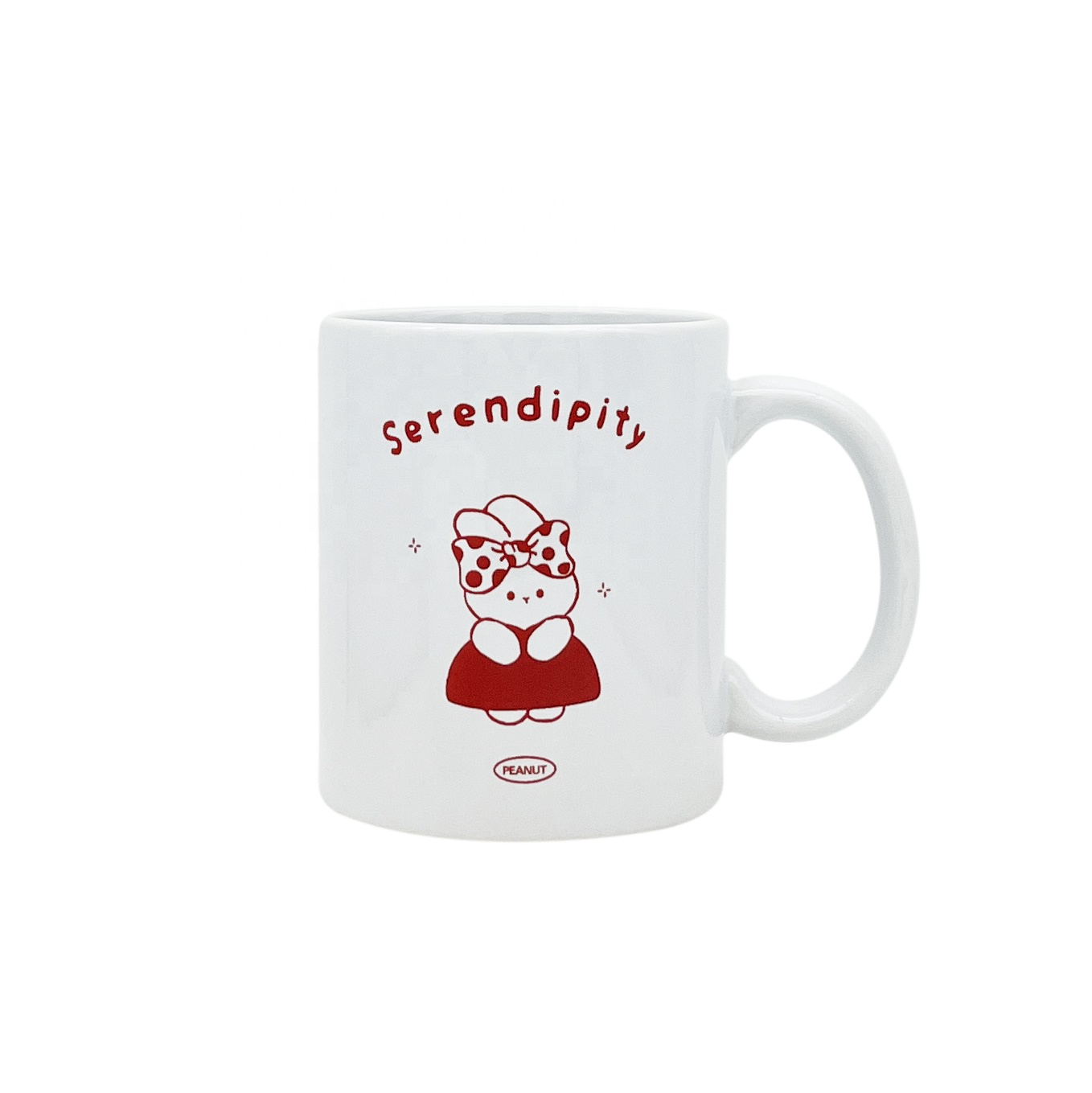
Two practical notes for anyone moving artwork into production on this style of body. First, the tall straight wall is a discipline asset: unlike a taper, a cylinder keeps a logo’s horizontal lines visually parallel from top to bottom, which is why typographic brands and badge-based marks photograph so much better on the cylinder rows of the shapes chart than on the tapers. Second, the white glaze is doing half the work: a single crimson ink on a high-gloss ground reads saturated and deep without a four-colour pass, because the glaze reflects light straight back through the print. Where a one-colour mark says logo, this canvas says legibility – and legibility at shelf distance is the metric retail buyers actually score. When your file has both a one-colour lockup and a full-detail version, the mock-up renders both on the same body so the buying call is made against equivalent canvases, not two different shapes that muddy the comparison.
Set-up economics also reward the restrained print. One screen pass, one ink register, one colour to sign off against your brand book – a single-spot emblem program can run dozens of design variants across a season on the same bodies without the cost escalation that full-colour artwork carries per design line. That is the trade a museum shop or gallery store is actually making when it asks for an artist series: twelve illustrators, one mug shape, one ink, twelve small runs that each clear the per-design floor without drowning in setup fees. Send us the variant schedule and we will build the quote as a program, not as twelve disconnected orders – shared tooling, staggered production, one consolidated freight invoice at the end.
The full-colour end is the photographic-panel mug: six portrait frames laid in a two-by-three grid with thin white gutters and a generous margin, the print block centred on the face opposite the handle. Where a one-colour mark says logo, a photographic panel says product – the format record labels, media accounts and fan-merch programs reorder season after season because the print holds its edges through dishwasher rotation. Both examples sit on the same porcelain body, which is why a wholesale program can run an emblem series and a photo series against one tooling. Note what the gallery does not do: the artwork in the photograph is past-order customer content, reproduced here only as a print-capability demo, and any likeness or IP inside it belongs to whoever commissioned it. Rights clearance on your file is your side of the deal; we print what you own, and the mock-up stage is where a legal review of licensed imagery typically happens before anything reaches a kiln.
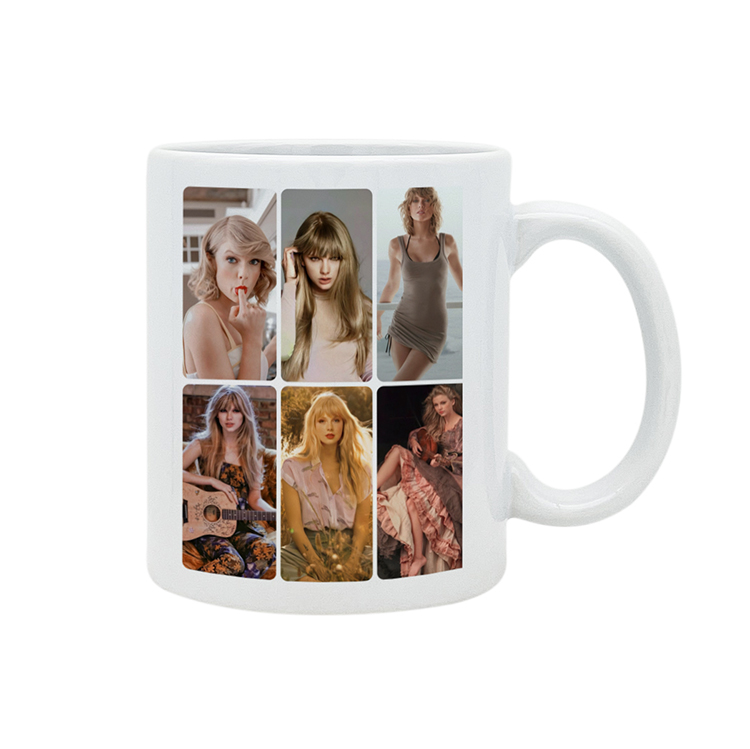
Full-wrap coverage is the third option the same body accepts: edge-to-edge colour that runs behind the handle seam, turning the mug into a printed surface rather than a logo carrier. Wrap artwork needs a bleed discipline your designer should see in the mock-up – the seam is where two print passes meet – and we will show you exactly where the wrap closes before files are locked. Front panel, wrap behind handle, or full 360 coverage: three placements, one tooling, priced in your quote against whichever the artwork suits best.
Colour-change bodies that print on black
The matched pair of glossy black mugs demonstrates the heat-reactive coating as photographed: the same five-segment battery outline printed on both, empty and white-outlined on the left mug, fully charged in olive-green segments on the right after hot liquid. The behaviour reads in one product shot, which is why colour-change mugs sell themselves on a retail end-cap – and why we describe them the way the photo describes them: a coating state, an outlined graphic, two visible results. Trigger temperature, sensitivity duration and coating process are specification-sheet items that travel with your quotation; they are not marketing copy and we do not type invented numbers for them.
What the pair does prove, photographically, is print registration across a state change: the white outline sits over the reactive coat while the green segments live underneath it, so the graphic’s geometry stays locked in both states and only the fill appears or vanishes. A colour-change mug whose outline shifts or fades along with the coat is a failed print, not a feature, and the side-by-side states are how you inspect that before approving a run. Quote your outline colour and your reveal colour as separate instructions – say in the artwork notes which layer should read cold and which hot – because the two-stage print is built exactly that way, with the overlay pass registered over the reactive base. We recommend ordering the proof pair as samples: one mug kept empty, one photographed after a pour, so your product listing gets honest before-and-after imagery instead of a mock-up render. Budget-wise the reactive body sits a step above the plain white line because of that second pass, but it stays inside the same tier logic: one design, one colourway, counted against the 100-pieces-per-design floor like everything else on this page, and reorders of an approved coating pull against the same signed reference article your program manager first initialled – which is the document every later carton is graded against, from ink registration to reveal contrast.
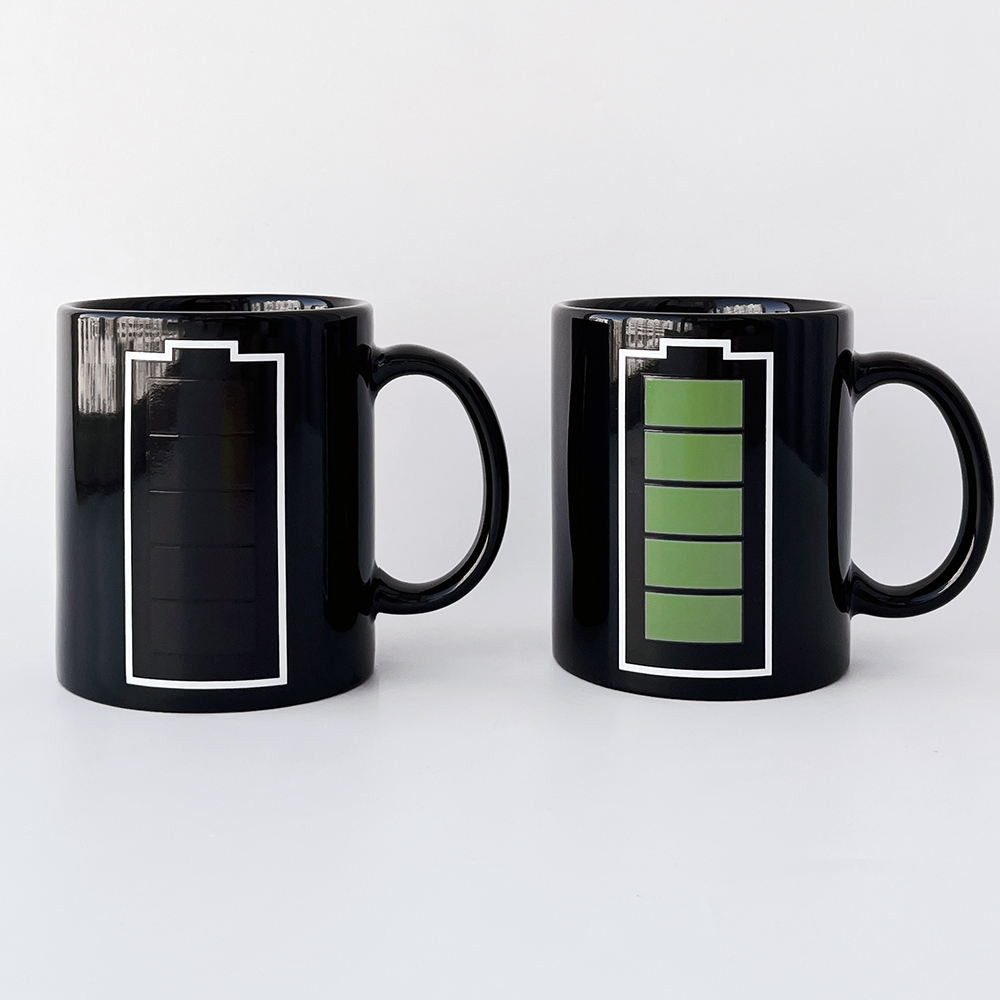
Beyond the gag gift, the format earns real shelf turns for corporate and campus programs: a startup’s swag line, a university shop, a podcast merch drop – one icon, two visible states, an obvious demo clip for social sellers, and a reorder story that plain white mugs cannot tell. Black glossy bodies with contrasting red or green interiors, visible on the shapes chart, belong to the same family and can be quoted together, so a program that wants colour-change hero mugs plus a steady classic body builds both from one shipment. Because the reactive coating covers the exterior, artwork files for these bodies are checked in the mock-up stage for coverage zones – full-bleed reactive panels versus spot-coated windows behave differently under a pour – and the coverage decision is written into the specification that comes back with your quote rather than left to chance in a production file.
Proof before production: the two-mug method
Colour-change is only half the specification conversation; the other half is care. A reactive coating is a surface layer, so dishwasher and microwave guidance for these bodies belongs in your retail insert rather than our guesswork – we supply the wording on the spec sheet, tuned to whichever coating window your sample proved, and resellers typically reprint it inside their own brand template. Handles on the black bodies match the coating rather than contrasting, visible in the photo as the same matte-dark loop on both states, which keeps the battery icon as the only visual event on the product. If your artwork relies on the reveal reading differently at different pour temperatures – a half-charged icon, a staged message – describe that intent in the mock-up notes; the two-stage registration handles deliberate partial reveals, but they need planning in the file, not wishful thinking at the kiln. One practical merchandising trick our retail buyers copy: ship the pair as a set, one mug sealed cold for the shelf, one photographed mid-reveal for the card, and the demo sells the product before a single customer ever pours a cup.
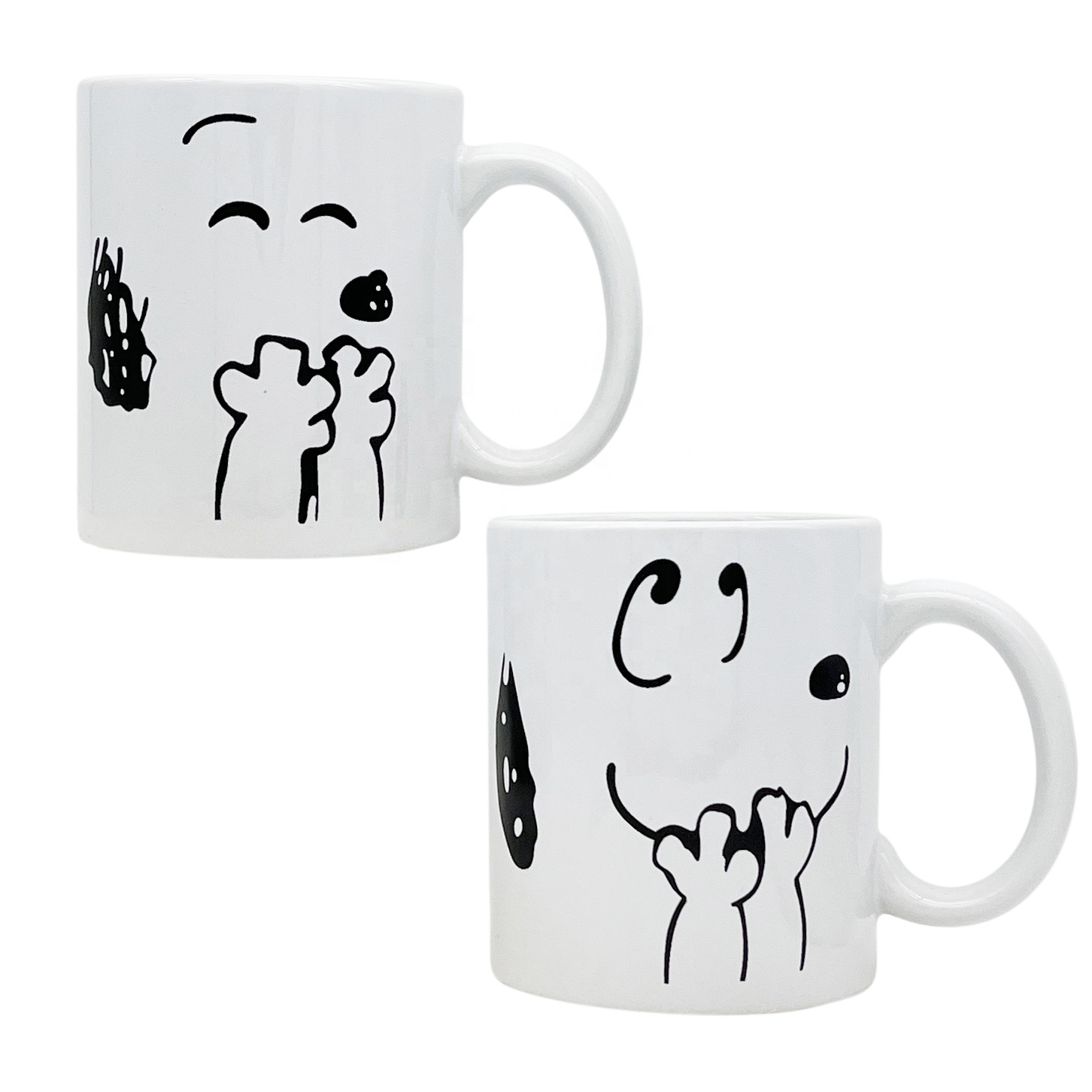
The pair of white mugs wearing the same cartoon character in two expressions – one shy-laughing with paws at the mouth, one peeking with a wide smile, both solid-black line art on glossy glaze – shows how artwork proofs come back from our studio. Two variants, same curve, same handle orientation, so a brand can see which expression reads at arm’s length before the file is committed. The free digital mock-up does the same job on screen a stage earlier; this photographed pair is what physical approval looks like, and it scales to as many design variants as your program carries, each variant counting against the 100 pcs per design floor as its own design line in the quote.
Everything configurable on this line
- Body shape: any silhouette from the photographed 27-shape chart – taper, cylinder, faceted, belly, footed, bowl, two-handled loop, novelty form
- Glaze colour: white gloss as shown, solid colourways, speckled glaze, or two-tone exterior with contrasting interior
- Handle finish: standard gloss or metallic accent handles as photographed
- Print zone: front panel opposite the handle, wrap meeting behind the handle, or full-wrap coverage
- Print type: single spot, multi-colour illustration, photographic panel, or colour-change coating state pair
- Artwork variants: each design line quoted separately against the per-design MOQ
- Carton program: bulk pack for cafés, individual boxes for retail, gift-set pairing with other lines
Specifications at a glance
| Row | Detail |
|---|---|
| Item | Custom printed ceramic/porcelain mug program, gloss-glazed bodies |
| Set contents | Mug with printed artwork zone; gift box or bulk pack per chosen packing program |
| Material / components | Glazed ceramic body, integral C-handle (loop or double-loop per shape), glossy or speckled glaze, optional two-tone interior, optional colour-change exterior coating |
| Colour | Photographed on chart: white gloss, red, navy, light blue, gold-accent white, orange, green, yellow, black, bellied black with floral band, speckled pink, red/green two-tone interiors |
| Logo | Front panel, wrap or full-wrap print; single spot to photographic full colour; free digital mock-up |
| Packing | Bulk cartons or individual boxes inside export cartons; FBA labelling and prep available |
| MOQ | 100 pcs per design |
| Sample time | 3-5 days |
| Lead time | 7-15 days after artwork approval |
| Capacity | Set by chosen body from the shapes chart; tooling dimensions travel with the quote – no size figures are printed on this page’s photographs |
Reorder logic for café, retail and shop programs
Ceramic printed mugs are a replenishment category, and the buying pattern shows it: a shop launches a design, sells through, then reorders the same artwork on the same tooling quarterly. That is where 100 pcs per design earns its keep – a museum shop can rotate an artist series one print at a time, while the shape stays constant so shelf fixtures and planograms never change. Samples return in 3-5 days after mock-up approval; approved artwork ships in 7-15 days; and with 1,000,000 pcs per month across our gift lines, a seasonal spike – holiday box sets, graduation runs, tour merch – slots into the calendar without the queue jumping you get from trading-company middlemen who own no kilns at all.
Packing, freight and FBA
Printed porcelain leaves in individual boxes where the channel needs them (retail hang, gift wall, subscription crate) and bulk cartons where it does not (café service stock, promotional volumes). Internal dividers and corner protection are specified for parcel carriers, not just container stacks, because the reorder that arrives cracked is the reorder that never happens. Freight runs sea, air, or courier – DHL, UPS, FedEx, TNT – and FBA sellers get units labelled and cartons prepped to Amazon requirements here at the factory. Food-contact documentation for your destination market is available on request; the specification sheet that travels with your quotation carries it.

Wholesale questions, answered plainly
Which mug shapes can I print on?
What is the wholesale minimum per design?
Can you print photographs, or only logos?
How does the colour-change mug behave?
How fast can a reorder cycle complete?
Do you support gift-box presentation and FBA?
Round out the order with sibling lines
Buyers who land here rarely leave with one mug family. The rolled-rim enamel camp mug page owns the rustic steel look that sits beside these porcelain shapes on outdoor and festival walls, and the double-wall 30oz steel tumbler fills the commuter-capacity slot. For boxed gifting rather than bare drinkware, compare the water bottle gift sets and the notebook, pen and flash drive sets, then widen to the cups subcategory or the full Other Gifts catalogue for the rest of the program wall.
Send the shape shortlist and the artwork
Tell us which chart silhouettes matter – photograph the chart rows, or just name the form: taper, cylinder, faceted, bowl, two-handled – and attach your art. You get a free digital mock-up, a written tier quote anchored to the 100-piece displayed reference, and a calendar built backwards from your on-shelf date. [email protected], +86-15967739086, or the request-a-quote page. Samples 3-5 days; production 7-15 days after artwork approval; 100 pcs per design.