Custom Jumbo Oversized Birthday Cards 36×24
$1.49
Custom jumbo oversized birthday cards built for retail greeting shelves and club-store resets, where one three-foot face does the margin work of five standard SKUs. A photographed comparison chart marks the jumbo card face 36 inches high by 24 wide against a 22 by 14 standard outline – roughly triple the printed artwork area per card. Mock-up views show a teal HAPPY BIRTHDAY headline over a dripping-frosting cake and a party-scene band, blank back and left-interior panels for stickers or notes, and flat full-color printing with no foil or emboss. Cards pack flat for export; a plain jumbo mailing envelope with tuck-tab flap is available as a program add-on. MOQ 100 pcs per design, samples 3-5 days, bulk 7-15 days after artwork approval, FBA labeling and per-door shippers supported.
Custom jumbo oversized birthday cards that earn their own shelf
These custom jumbo oversized birthday cards exist because physical size sells on a greeting aisle: a face close to three feet tall stops a cart in a way a standard A6 never will. The photographed size chart stakes the format claim in plain numbers – the jumbo card face is marked 36 inches high by 24 wide, set beside a blank conventional-card outline measured 22 by 14 – so a planogram buyer evaluating a club-store or drug-chain set gets the scale argument straight off the listing art. The program serves retail greeting purchasers, club-store packagers and promo resellers who want one oversized SKU carrying the impulse margin that five regular facings used to. The sample artwork pairs a teal HAPPY BIRTHDAY headline with a dripping-frosting cake, striped candles and a full-width band of tiny illustrated party-goers under bunting; your own art replaces it at no structural change, and every panel prints flat and full-color with no foil and no emboss, which keeps plate cost linear as runs scale.
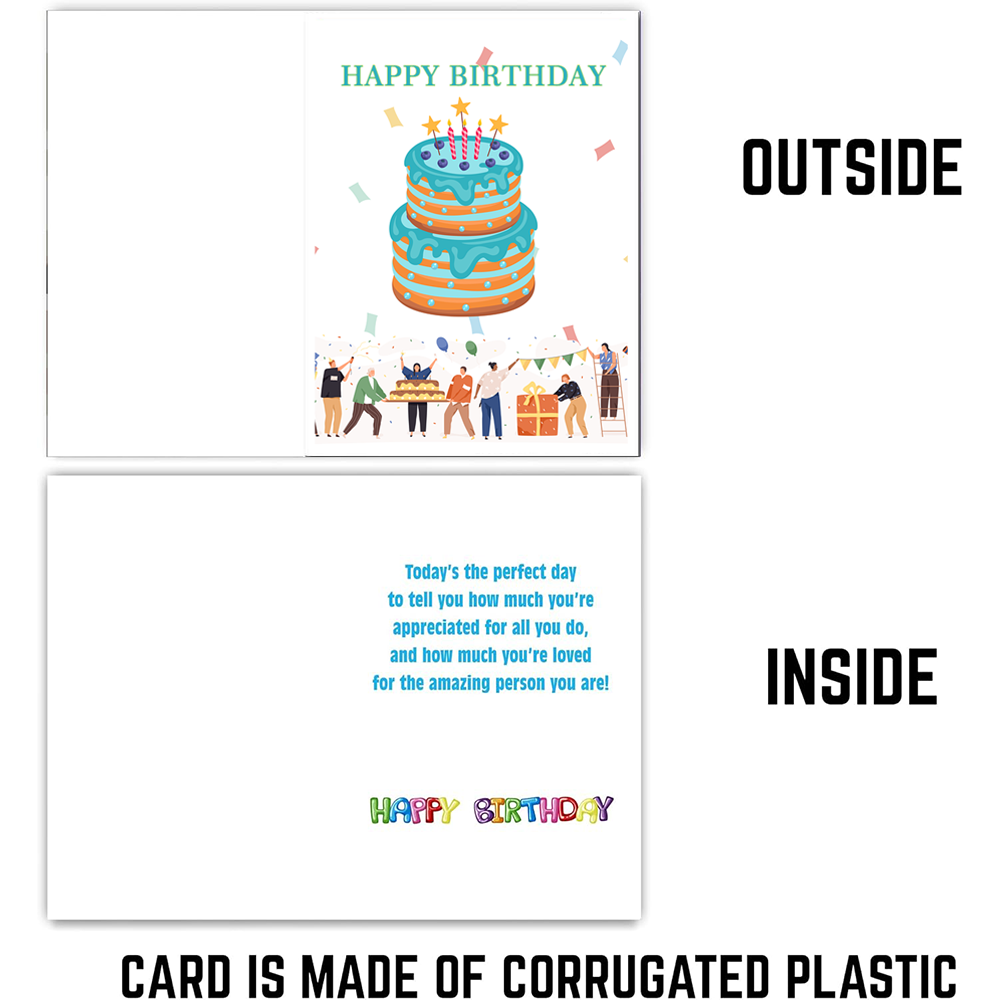
What the outside-inside view proves about the build
The stacked mock-up opens the product like a spec sheet. Outside view: the left back panel prints completely blank white – shelf-facing real estate you can reserve for a price sticker, an aisle tag or a retailer return strip – while the right front carries headline, cake and party band with even white margins framing all four sides. Inside view: a centered multi-line message block in a clean cyan sans-serif sits in the upper half of the right panel, closed by a playful balloon-letter sign-off in mixed bright colors, and the left interior panel stays empty for the giver’s handwritten note. That layout logic tells a category buyer exactly where variable stickers, legal text and seasonal greetings can live without touching artwork. The blank left interior is not wasted space – it is the reason a jumbo card replaces a card-plus-note combination, because the message zone at scale gives well-wishers room to write a real paragraph instead of two cramped lines. A printed caption under the two views names the panel material used in this photographed configuration; we repeat it only as it appears on the image and verify exact substrate, thickness and finish on request against your artwork, because a three-foot panel can be engineered several ways depending on how it is handled in store. Neither view shows gloss coating, spot UV or raised texture – all ink sits flush, which matters under bright open shelving where reflections would wash the artwork out at shopping distance. The fold between panels is a clean scored line, and the two-up presentation mirrors how the card is die-cut: one continuous sheet, folded, no separate spine piece, no glued parts to fail at a peg hook.
For the wholesale reader, the blank back panel is also the compliance panel: country-of-origin marks, barcode fields and distributor imprint live there without touching the art, which is exactly how an oversized card crosses from a domestic greeting program into an import shelf plan. Interior copy is treated the same way – send your own verse and it replaces the photographed sample block at the same size and position, or order the interior bare and let the giver write at full scale, something guests genuinely do with a panel this large. Finish options that quote against this format: a soft-touch laminate for boutique chains, a single foil pass on the headline letters for a premium tier, or uncoated matte as photographed, which remains the default because it photographs without hotspot glare in retailer line sheets.
Stand-up presence: how the fold reads at three meters
The standing shot props the folded card tent-style against white, front cover square to camera: teal-and-orange HAPPY BIRTHDAY type near the top, the blueberry-and-star-pick cake at center, confetti rectangles scattered through the field, and the celebrating-figures band anchoring the foot – popper, gift box, ladder with pennant string. Two facts matter for retail from this one image. First, the bi-fold holds its own weight: the fold creases clean and the panel stands on a tabletop without a prop, which means floor-stack demos and endcap layouts photograph well for line sheets and retailer catalogs without styling tricks. Second, the type-to-art ratio is tuned for distance: a shopper walking past at three meters reads the greeting before the cake detail resolves, the correct hierarchy for an impulse fixture beside balloons and wrap where the decision happens in seconds, not minutes. The offset outline behind the headline letters gives the type a sticker-like punch that survives being printed at scale – an effect lost on standard-size cards where the same treatment turns muddy. For co-brand programs the headline zone is the natural logo slot, the party band recolors to a chain’s seasonal palette, and the balloon-letter sign-off inside can switch to a localized blessing line or a retailer wordmark panel. Merchandisers consistently report that oversized cards get held before they get picked up, so the front should survive being grabbed: flat matte ink on a rigid-ish panel does, a gloss laminated paperboard under heavy hands does not. The rigid panel also explains the ship-flat decision covered further down – a three-foot face that arrives with a dented corner is a markdown, not a sale, so carton engineering here is a margin conversation, not a packaging detail.
Scale also changes the handling story. A card this size behaves like a small poster when unfolded, so artwork that reads as busy at postcard scale resolves cleanly at three feet: the individual party figures – the popper, the ladder, the tray with a berry-topped cake – become readable vignettes instead of texture, which is why the sample front uses a detailed bottom band rather than a solid block. Retailers who test oversized cards consistently see the same pattern: the item gets unfolded at the counter, photographed for social posts, and only then written in, meaning the interior graphic earns its screen time too. Design your interior block for that phone-camera moment, or leave the panel white and let the handwritten message do the work. Either way the fold stays the structural hero – one scored sheet, no moving parts, and a tent that props itself on a checkout counter without a stand, which is free merchandising every store associate will thank you for.
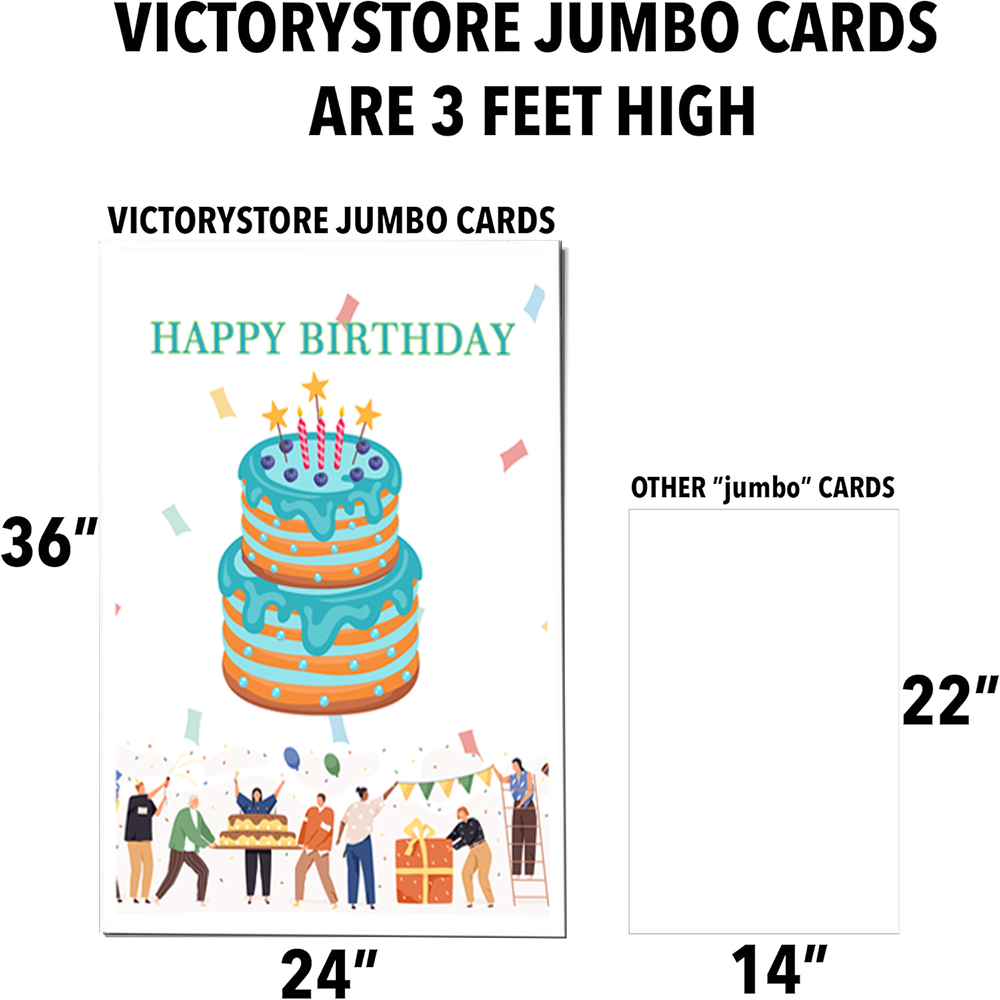
The size math a planogram buyer actually needs
Read the chart as photographed specification, not marketing: 36 vertical against 24 horizontal on the printed face versus 22 by 14 on the standard column – roughly 864 square printed inches against 308, close to triple the visible artwork area per SKU at one facing slot. That geometry changes the aisle equation. One oversized card absorbs the whole birthday-gift gesture, so shoppers pair it with balloons instead of doubling up on cards, and the higher ticket lands in a single facing the retailer already pays for. It also forces three real questions a category manager will ask on day one. First, mailing: a 36-by-24 folded face will not enter a standard #10 envelope, and the chart page answers that problem in the next photo down – the program’s plain jumbo mailing envelope. Second, fixture: the card does not fit a standard spindle, so floor packs, shelf stands or peg-top hang displays need pre-agreement on shipper count and header-card artwork, all of which we build into the packing spec before production. Third, cube: at three feet tall, carton dims ride the edge of air-cargo size breaks, so the per-door freight math has to be quoted carton-by-carton rather than per-thousand, which is exactly the calculation our order desk runs against your port. Weights stay manageable because the panel prints flat rather than padded; the comparison column’s plain white placeholder carries no product – it exists only to set the scale line for the eye. Custom options on the jumbo face: seasonal scene swaps in the party band, name-zone personalization panels for club-store kiosks, bilingual interior message blocks, and a premium tier with one foil pass on the headline letters – priced as a discrete upgrade so the base SKU stays at insert-card economics.
Freight reality check before you fall in love with the number: at 36 inches tall, the panel defines the carton, and the carton defines the freight bracket. Ocean shipments care little – oversized cartons nest into standard pallet footprints with minimal dead cube – but express parcels do, so sample quantities of jumbo cards almost always ship folded rather than flat to stay inside courier dimensional rules. That is why we quote jumbo programs per lane instead of per piece: the same ten-thousand-unit order changes shape depending on whether it lands in a container, a pallet of air freight, or a courier carton to a test door. Lock your pilot quantity first, validate the folded flat-pack on the sample run, and scale from a proven carton spec rather than a drawing.
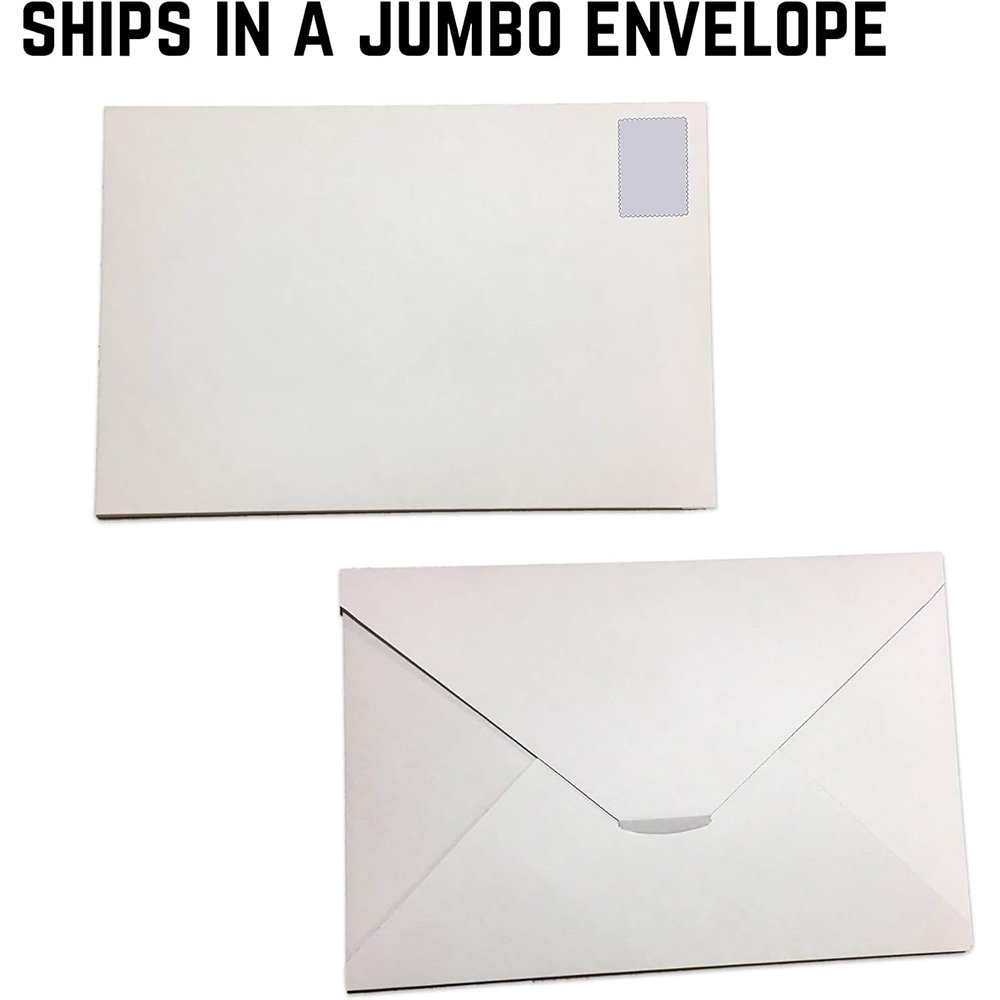
Shipping flat, then mailing whole: the envelope step-up
Factory-fresh jumbo cards travel unfolded and flat-packed, which protects corners inside ocean containers and keeps carton density respectable for a panel this size; retail-ready folded units ride inside per-door shippers with corner cards between stacks. But the end shopper still wants to send the card by post, and the photographed answer is the program’s jumbo mailing envelope shown in two faces: neutral light paper stock, a dashed stamp-placement box outlined at the top right of the front, a pointed flap with a tuck-tab closure and clean diagonal seams on the back, no print, no window, no branding. Envelopes at this scale ship as a program add-on for gift-counter and e-commerce bundles – a card sold at a pet-store checkout often goes home in hand, while an online greeting seller needs the mailing step solved before the customer hits send. Sizing, paper weight and closure options are quoted on request against whichever card format you lock. Mixed cartons are routine on this line: ten folded jumbo cards banded with five oversized envelopes per shipper, or shrink-sleeved card-plus-envelope value sets for club packs. The headline above the envelope photo is the listing’s own answer to the one question retail buyers always raise about three-foot cards – how it reaches the recipient intact – and the plain tuck-tab image is the evidence, shown front and back rather than claimed in text. Freight mode follows the buyer’s window: ocean for reset volumes, air or express for fill-ins between planogram cycles.
The Jumbo Build in One Table
| Item | Jumbo oversized bi-fold birthday card (envelope as program add-on) |
| Size | Photographed chart marks the jumbo face 36 in high x 24 in wide; other oversized formats quoted on request |
| Stock & Finish | Panel material stated in the printed caption under the outside/inside view; exact substrate and grammage verified on request; flat matte print, no foil or emboss shown |
| Printing & Artwork | Full-color print; blank back and left-interior panels; free digital mock-up before production |
| Envelope or Extras | Plain jumbo tuck-tab mailing envelope as photographed; optional retail sleeves, header cards, belly bands on request |
| Packing | Ship-flat cartons; per-door retail shippers or plain export boxes with corner protection |
| MOQ | 100 pcs per design |
| Sample time | 3-5 days |
| Lead time | 7-15 days after artwork approval |
| Capacity | 1,000,000 pcs per month across our gift lines |
Proof cadence for a seasonal greeting drop
Birthday SKUs run all year, but oversized club-store programs land on reset dates, so manage the calendar backwards from your planogram lock. Artwork sign-off triggers a free digital mock-up, then pre-production samples in 3-5 days – enough time for a category manager to hold the panel and judge scale in person before a buyer meeting. Bulk production closes 7-15 days after artwork approval. The listed page price is a 100-piece reference tier; final quotes rebuild by quantity, format and freight mode, and never print as a fixed unit rate here. Monthly capacity across our gift lines is 1,000,000 pcs, which means an oversized reset order does not queue behind your companion stationery lines – a card-plus-envelope program clears the press in a single window if both files proof together.
Export packing and delivery channels
Cartons move by sea, air or DHL / UPS / FedEx / TNT express; Amazon programs get FBA labeling with jumbo panels packed flat to inbound carton dims, and mixed inbound boxes can combine cards, envelopes and any insert promo from the same reset. The composite below shows the warehouse racking, sortation line and courier setup standing behind every shipment.

Is 36 by 24 inches the only oversized size you print?
Do the cards arrive folded or flat?
Can a shopper actually mail a card this big?
Which edits ride the same design file and which start a new one?
How do FBA and club-store shipper programs get handled?
Related pages for a birthday retail set
Round out the aisle with our fill-in birthday invitation cards for class-party volume, pet birthday cards with envelope for the gift-holder shopper, and thank-you card and envelope sets for receipt-counter add-ons. The broader cards line and the full printed items catalog hold the rest of the program; send planogram dimensions through the quote desk.
Put a jumbo panel on your next reset
Email [email protected] or call +86-15967739086 with door count, format and envelope spec; a digital mock-up and a 3-5 day sample slot follow.