

Custom Branded Merchandise Gift Sets | One-Colour Rollout
$3.00
Custom branded merchandise gift sets built as one enterprise programme: caps, insulated steel tumblers, drawstring packs, laminated totes, foil-lined coolers, hooded windbreakers, notebooks, click pens, sticky-note sets, keychain tags, silicone wristbands, metal USB drives, lanyards and umbrellas – every surface in one company colour from one artwork master file, with the same lockup held in the same relative position across the family. MOQ 100 pcs per design per component line, free digital mock-up of every print zone, samples in 3-5 days, bulk production 7-15 days after artwork approval, 1,000,000 pcs per month capacity across our gift lines. Per-office cartons, phased regional waves, FBA prep for reseller channels and live reorder references between annual top-ups. Send your artwork master and distribution plan to [email protected] or +86-15967739086.
One Company Colour, Everywhere It Matters: Custom Branded Merchandise Gift Sets
An enterprise rollout fails on logistics long before it fails on design: fifteen suppliers, fifteen shades of your brand red, fifteen artwork versions circulating in email. A custom branded merchandise gift set is the opposite architecture – apparel, drinkware, stationery, bags and desk tech produced as one programme, in one company colour, from one master file, against one set of line references your procurement team can actually reorder from. The spread photographed on this page proves the concept end to end: umbrella canopy, hooded windbreaker, lanyards, notebooks, a foil-lined cooler tote, drawstring packs, stress balls, cap, metal USB drives, a sticky-note set, wristbands and a tumbler trio, every surface the same signal red with the same white lockup in the same relative position.
Why the single-colour discipline works commercially: brand recognition inside an organisation behaves like recognition outside it. When field staff, office teams and resellers all carry visibly identical goods, the merchandise stops being swag and starts being uniform-adjacent – it signals belonging internally and consistency externally at every customer touchpoint. This page walks the programme family by family: what each photographed component is, where its print zone sits, and how the rollout maths (MOQ per design, sampling cadence, reorder codes, freight) keeps a company-wide distribution clean across years instead of one launch.
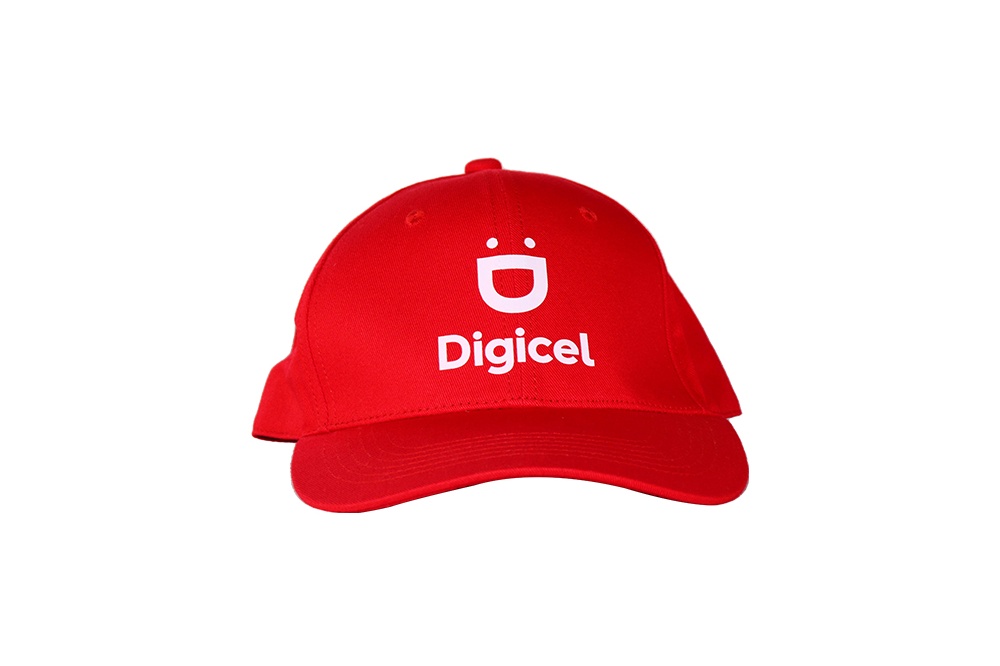
Headwear: The Cap Is the Programme’s Front Page
The cap photographed for this programme is a six-panel twill build in true brand red – fine diagonal weave, matte hand feel, tonal red topstitching across the crown seams and the concentric rows running over the curved brim. Ventilation eyelets are ring-stitched in matching red thread rather than contrast, the fabric-covered top button is tonal, and the front crown carries one centred white print block: symbol over wordmark, flat and crisp against the twill.
Two construction details deserve a buyer’s attention because they decide reorder satisfaction rates. First, the low-profile dad-hat shape is size-tolerant: a soft crown with an adjustable back fits an entire workforce from one SKU, which removes the size-curve forecasting that structured caps demand. Second, the white mark sits as a print panel in the photograph – a flat heat-transfer or screen layer rather than raised embroidery – which keeps hand feel light and the artwork cost flat across quantities; embroidery can be quoted against the same position if your brand book demands raised thread. Whatever method you lock, the cap is the component your teams wear into customer-facing space, so lock its red against a printed colour reference at sample stage, not against a monitor. For mixed-fieldrollout programmes, order one quiet line – tonal red-on-red front panel – alongside the high-contrast white, and both stay under the same design file.
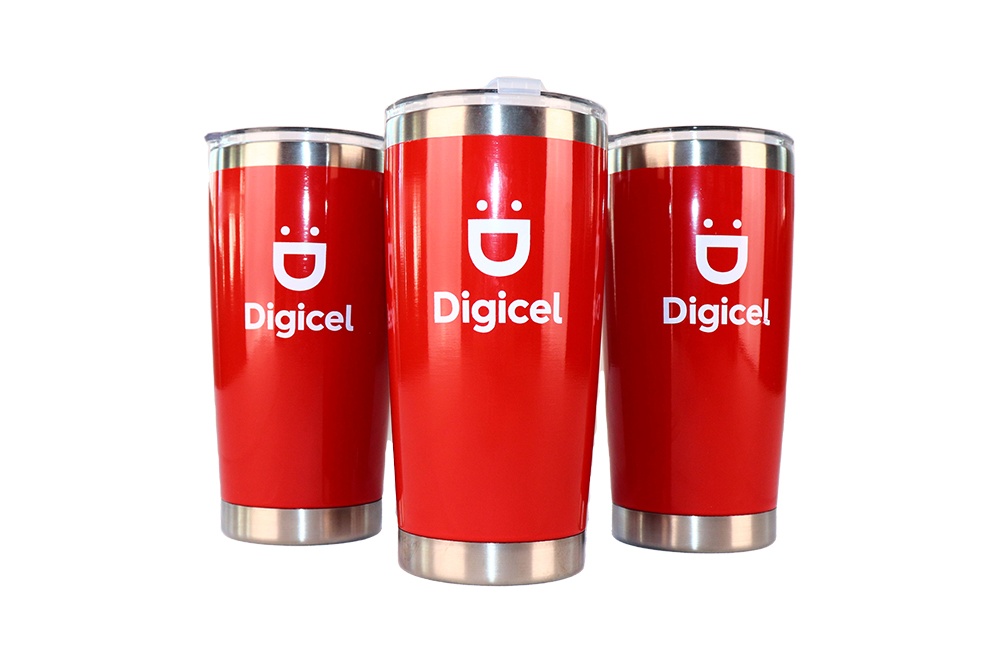
Drinkware: Tumblers That Survive the Reorder Cycle
The tumbler trio in its packshot shows the drinkware branch as it should be photographed for an internal catalogue: three red insulated steel cups in a row, centre cup forward and tallest, bodies tapering from a bare stainless rim to a bare stainless base band, the centre cup under a clear plastic lid with a small slider tab. The red is painted to a high-gloss finish – you can read the vertical specular streaks down each cup – and the white lockup sits centred on the upper body where a held cup faces the room.
The material logic for enterprise programmes is durability and reprintability. A double-wall steel tumbler outlives ceramic in a vehicle or a job shed, keeps drinks cold through a field shift, and its cylindrical body takes the same centred one-colour print across every size in the family, so your 12 oz desk cup and your travel lid cup read as one product line. The bare-metal rim and base aren’t cosmetic trim: exposed stainless at both ends prevents the paint-edge chip that fully coated cups show first, which is the defect that turns launch stock into end-of-year embarrassment. When your reseller channel asks for a co-branded variant, only the lower print zone changes – the cup, lid tooling and colour standard all stay locked.
Two more procurement notes on the cup line. Lid style is a spec fork worth settling before the sample: the photographed centre cup runs a clear slider lid, and an open-rim variant on the two flanks, so one programme can field both a hot-drinks desk cup and a cold-drinks field cup off the same body colour and print position. And because tumblers are issued against headcount rather than consumed, order launch numbers once and let the reorder sheet carry only damage replacements – the rare line in this catalogue that should shrink year over year instead of growing.
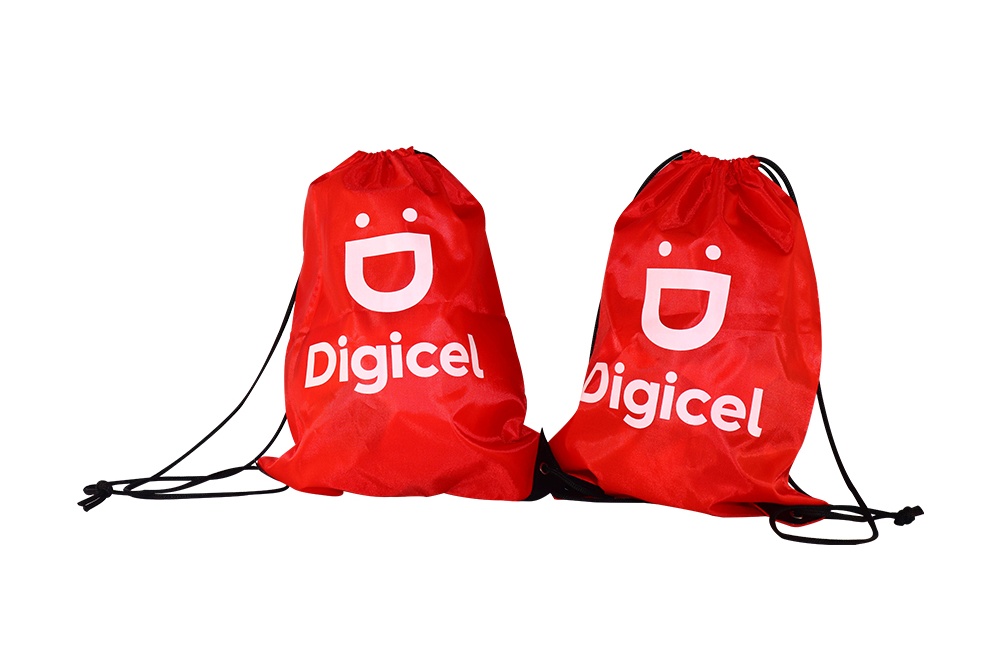
Bags: Drawstring Packs, Totes and the Foil-Lined Cooler
The drawstring packs photographed for this set are the volume workhorses: red synthetic shells with a soft satin sheen, gathered cinch tops, black cords trailing from the hem, and a large white lockup centred on the front face. One pack stands frontal, the second tilted, which is exactly how the print behaves in use – readable whether the bag hangs flat or bulges with a change of clothes. Sacks like these anchor town-hall door bags, sports sponsorships and warehouse-issue kits, and because they fold to nothing, distribution freight across offices is a rounding error rather than a line item. The cinch format also carries a branding geometry advantage: the gathered top means the front panel hangs flat below the print zone, so the lockup never distorts the way a tote’s print does when the bag is overloaded – one more reason the sack line photographs better at events than any other component in the family.
The wider spread extends the carry family in the same red: totes in laminated non-woven with colour-matched handles, an open-top cooler tote whose foil thermal lining shows in the photograph – a laminated interior that keeps the exterior print uninterrupted – and a hooded windbreaker with a black front zip, black chest zip pocket and the programme’s white lockup on the left chest. The jacket is the single most expensive unit in the family and the one with the longest service life; the cooler and totes are the highest-volume; the sacks are the fastest to issue at an event. Budget conversations become easy when the family is laid out that way: same colour standard, three price tiers, one artwork file across all of them. Cord colour on the sacks, handle webbing on the totes, and lining on the cooler are all spec points that stay brand-red or go dark-on-red for contrast, decided once and frozen for every future wave.
One logistics detail decides whether the bag tier actually lands at your offices: nesting. Sacks fold to a fraction of their open volume, totes flat-stack, and cooler totes collapse without crushing their foil seams, so a single carton can carry a mixed bag assortment sized to each site’s headcount. That is why the bag family is usually the first shipment a phased rollout dispatches – it arrives, opens and distributes without a receiving dock needing pallet space for hard-goods trays. For teams that will wear their kit rather than carry it, size the windbreaker curve separately from the rest of the programme: a measured field-team roster beats an assumed bell curve every time, and one unisex cut in brand red keeps the curve small enough to order once.
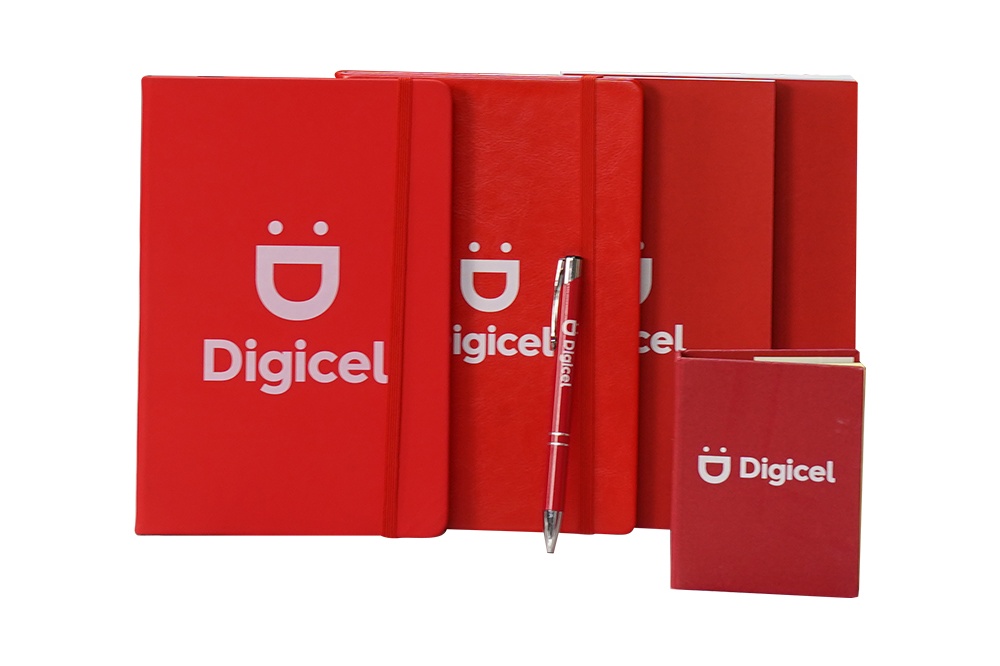
Stationery and Desk: Notebooks, Pens and the Note Set
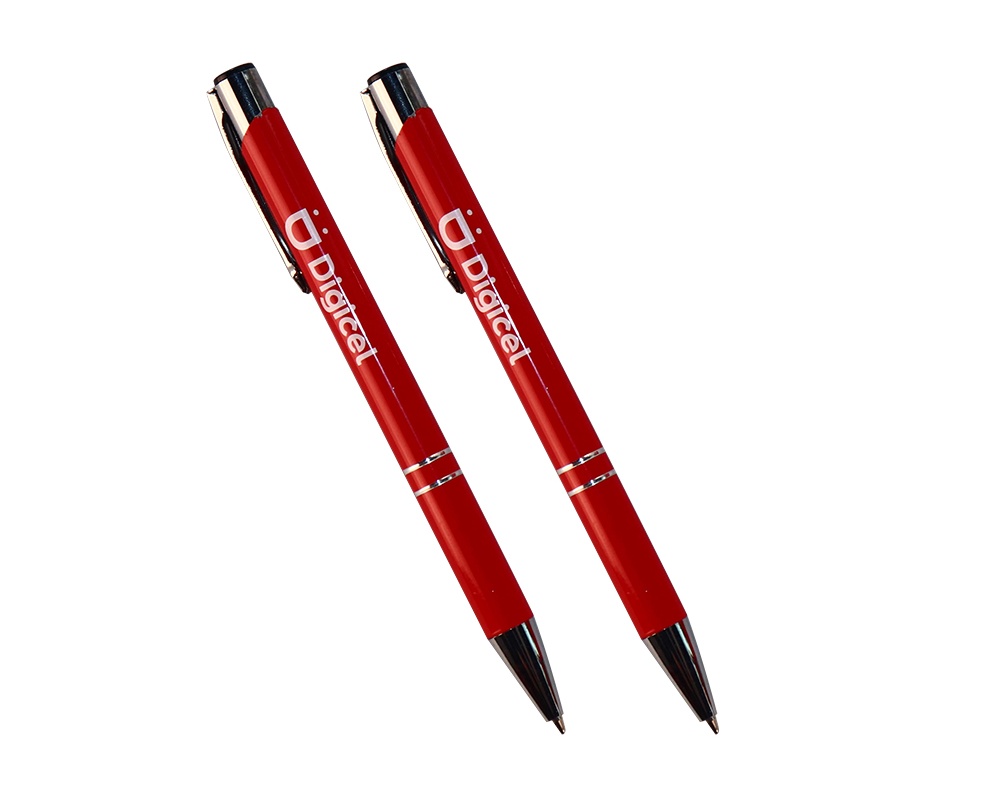
The stationery photograph layers three red hardcover notebooks with one propped click pen, and the layering itself is the lesson: the front cover is smooth laminated board, the middle cover carries an embossed faux-leather grain, the back panel is plain matte – three surface textures, one red, one white lockup. Each notebook closes with a tonal red elastic band, and the pen leaning against the stack runs a glossy red barrel with a polished chrome clip, twin metal rings and a cone tip, printing the lockup down the upper barrel in white. The dedicated pen packshot shows that pair layout even more clearly: two identical click pens, chrome plunger buttons catching the studio light, red barrels glossy enough to mirror the softbox, the same compact lockup on both.
Desk stationery is the reorder engine of an enterprise programme. Pens and notebooks get consumed, borrowed and lost at rates headwear never approaches, which means they cycle through replenishment orders while the jackets and tumblers stay fixed – and because their print file never changes, a quarter’s pen top-up simply reuses the line reference from launch. The spread adds the sticky-note/memo set in a red sleeve with multicolour tabs, the metal keychain tags printed at miniature scale, silicone wristbands for events and visitor access, and the brushed-metal USB drives your IT team can preload before a rollout. Every one of those surfaces takes one or two colours maximum, so a company red with a white reverse is a file that prints cleanly everywhere – which is precisely the constraint that made this programme cheap to maintain across five years of reorders.
Spec a pen for how it will actually die, not how it will look on the launch photo: the photographed build uses a moulded clip and twin chrome rings because both survive shirt-pocket flex better than glued trim, and the click mechanism outlasts capped refills in shared desk trays where the cap is the first thing lost. Notebooks deserve the same operational thinking – the elastic band in the photograph keeps the cover shut in a laptop bag, and the hardcover protects a launch-day agenda through a commute that a soft pad would not. Small build choices like these are what separate a stationery line that gets replaced quietly from one that gets re-ordered by name. The note set adds the last desk surface worth specifying: a red sleeve holding yellow pads with green, yellow and pink index tabs, printed lockup on the flap – the component that lives in front of a monitor all year and never leaves.
What You Can Specify Across the Programme
- Component families: cap, tumbler, drawstring sack, tote, foil-lined cooler tote, windbreaker, notebooks, pens, sticky-note set, keychain tags, wristbands, USB drives, lanyards, stress balls, umbrella
- Red standard locked against a printed colour reference at sample stage, shared across every line
- Print method per surface: screen or heat transfer on cap twill, one-colour wrap on metal, pad print on barrels and tags
- Contrast decisions: white-on-red as photographed, or tonal red-on-red quiet lines for executive batches
- Lid, cord, zip and handle colours: brand-red or black accents, frozen per component line
- Co-branded variants for reseller channels with a second lower print zone
- Kitting: full launch kits per office, or bulk component cartons for local distribution
- Reorder packaging: line-reference labels on every carton so stores can issue without opening cases
Reference Pricing
As low as $3.00 per piece for branded merchandise gift sets (MOQ 100 pcs). Final unit price depends on size, paper weight, printing and quantity.
| Quantity | Unit price range |
|---|---|
| 100–999 pcs | $4.80 – $7.20 |
| 1,000–9,999 pcs | $3.60 – $5.40 |
| 10,000+ pcs | $3.00 – $4.20 |
*Base pricing for the size and finish shown; custom sizes, foil and special stocks quoted on request — get a quote for your exact spec.
| Item | Custom branded merchandise gift set, enterprise rollout programme (line reference AG-BM1031) |
| Set contents | Assembled to your rollout plan from the photographed family list above – any subset, any quantities |
| Materials as photographed | Cotton/poly twill cap; painted double-wall stainless tumblers with plastic lids; polyester sacks and windbreaker shell; laminated non-woven totes with foil-lined cooler variant; board-and-PU hardcovers; plastic-and-chrome click pens; silicone wristbands; metal-cased USB drives |
| Colour | Signal red primary with white print and black hardware accents, as photographed |
| Logo | Artwork scales surface by surface off one file – fifteen items, one version of the truth |
| Packing | Components individually poly-bagged; kits or bulk cartons; line-reference carton marking |
| MOQ | 100 pcs per design |
| Sample time | 3-5 days |
| Lead time | 7-15 days after artwork approval |
| Capacity | 1,000,000 pcs per month across our gift lines |
Rollout Math: MOQs, Reorders and the One-File Rule
The 100 pcs per design floor applies per component line, and the programme counts as one design provided all zones pull the same master artwork – which is why mixed rollouts do not multiply your minimums. Order the cap, tumbler and sack lines at full headcount; order the notebooks, pens and USB drives at consumption-weighted numbers (they replenish); order jackets at field-team counts only, since size curves cost real money when they misfire. The displayed figure on this product anchors the 100-piece tier, and quantities above it get a per-line quotation sheet instead of a page-side guess. A working rollout sheet keeps three columns per line: initial issue count, replenishment cadence, and the reorder reference copied from launch – if a line cannot name its reference, it will resurface as an orphan SKU with a stale artwork version inside eighteen months, and the one-file rule dies one forgotten line at a time. Treat the wristband and keychain tiers as event fuel rather than permanent issue: they move in waves tied to your conference calendar, and keeping them on the same file means a rush order for next month’s expo is a quantity change, not a new project.
Ordering, Sampling and Approval Flow for a Company-Wide Launch
Send the artwork master and your distribution plan; the free digital mock-up places every zone – chest, crown, barrel, cup face, sack panel, notebook cover – before anything enters production. Sampling takes 3-5 days from there, and the sample carton should be reviewed by the brand owner and the logistics owner in the same sitting: colour against swatch book, position against spec, hardware against budget. Bulk production lands 7-15 days after artwork approval. For multi-region rollouts, one consolidated production run with per-office cartons beats regional repeat orders on every metric that matters: colour drift, approval drift, freight brackets, and the number of places an old artwork version can hide. Approval hygiene has one more rule worth writing into the project charter: every zone gets signed off as a pair – mock-up plus physical sample – and nothing between those two approvals touches the production floor. That double lock sounds slow and is actually the fastest path, because a single unapproved colour shift discovered at the receiving dock costs a full reprint cycle, while the sample week costs three to five days and one courier run. One final calendar point for publicly listed organisations: if the rollout has to land inside a quarter-end or a product launch week, freeze the distribution plan before the artwork approval, not after, so the 7-15 day production window and the freight booking lock the same week your finance close does.
Packing, Freight and Channel Prep
Soft goods fold, hard goods nest: sacks and shirts at the carton floor, tumblers and drives in compartmented trays, notebooks boxed flat with corner protection so a distribution centre can store the whole rollout without special handling. FBA labelling and prep are available when resellers order through marketplaces, and single-unit boxing works for executive batches shipped direct. Freight moves by sea, air, DHL, UPS, FedEx or TNT against your rollout dates, and annual top-ups run against production capacity of 1,000,000 pcs per month across our gift lines without restarting approvals – the line references from launch stay live as long as the file does. Because the programme’s volume tier (sacks, pens, bands) is bulky-light while its value tier (tumblers, jackets, drives) is dense, mixed cartons rate better than single-line pallets; we build the pallet sheet around that mix so your first shipment and your tenth anniversary top-up both travel in the cheapest bracket they can legally sit in.

Does one artwork file really cover every product in the family?
How do we match the red across painted metal, twill, laminate and silicone?
Can resellers add a co-branded version without reopening the programme?
Which lines reorder fastest in a company-wide programme?
What happens to the programme when the brand refreshes mid-contract?
Do you ship partial kits for phased regional rollouts?
Where This Programme Sits Among the Other Sets
The enterprise red rollout is one intent in the sets catalogue. First-week boxes are built in custom corporate welcome gift sets, field and event handovers in the custom picnic blanket gift set, sector-colour outreach in custom wellness promotional gift sets, ballot-season packs in custom election campaign gift sets, and hot-weather field kits in the umbrella and electric fan gift set – electronic specifications on that line are quoted exactly on request. Boxed-pack configurations live under box-packed gift sets, the full range under gift sets, and the artwork intake starts at request a quote.
Start the Rollout File, Then the Machine
Send your artwork master, headcount plan and launch calendar to [email protected], or ring / WhatsApp +86-15967739086. One colour standard, one file, one set of reorder codes – 100 pcs per design per line, 3-5 day samples, 7-15 days production after artwork approval.


