Custom Baby Shower Prediction Cards – Onesie Game Packs
$0.60
Onesie die-cut prediction cards sold as bulk party packs: guests guess birth date, time, weight, length, eye and hair color, tick ALL MOM or TOTALLY DAD resemblance boxes, and leave three lines of advice – then the parents keep every card. One master artwork file covers the fixed field plate plus a swappable cover greeting, so reveal-party and classic-shower channels share the same die and imposition. Flat matte spot print chosen so party pens write clean, pack counts rescaled from 24 to 50 sheets without new tooling, MOQ 100 pcs per design, samples in 3-5 days, and FBA co-packing with matching shower invitation SKUs available.
Custom baby shower prediction cards are the one party product that gets used twice: guests fill them in during the shower, and the parents keep them forever. That double life sets every spec on this page. A guest fills in a bodysuit-shaped card in four minutes standing around a snack table, so the field stack has to be legible, thumb-friendly and forgiving of bad pens; the box it ends up in twenty years later has to survive a nursery closet, so the stock choice and ink layout matter more than a “cute printable” listing implies. We print these as bulk game packs for party wholesalers, event-rental companies, and on-demand sellers who bundle them with matching invitations – and the four photographs below are the actual production grammar, face by face.
The Onesie Die-Cut: Why The Shape Does Half The Selling
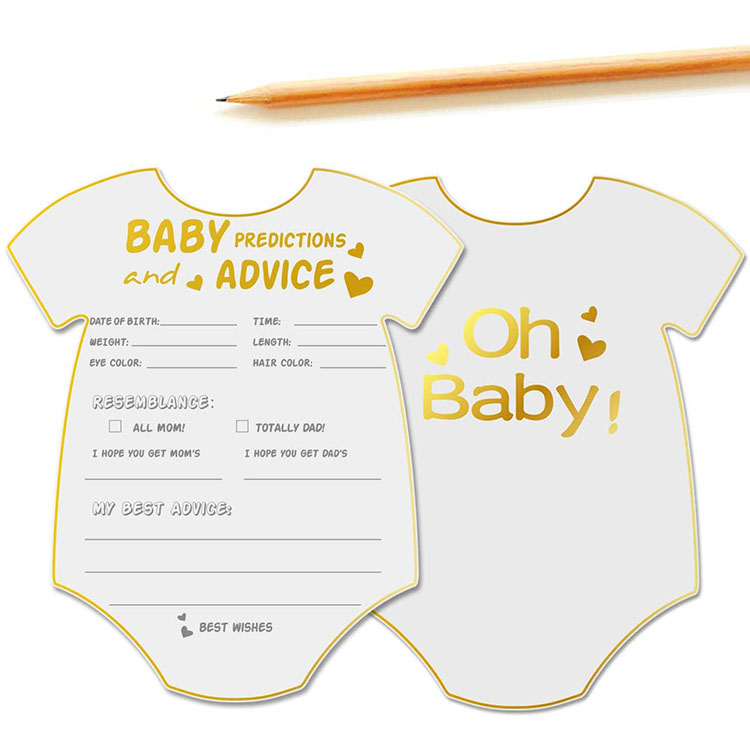
Plain squares sit flat on a table and disappear. The first specimen shows the alternative: the card cut to the silhouette of a baby bodysuit – raglan shoulders, short sleeves, rounded neckline, snap-crotch tab at the bottom – with a thin gold keyline tracing the cut about a millimetre inside the edge. The left piece is the working face: a gold headline naming the game, small heart glyphs flanking the words, and a two-column stack of labelled fill lines below. The right piece is the cover face, carrying nothing but a two-line “Oh Baby”-style greeting in gold with three small hearts – the piece that faces out when the cards sit in a basket on the gift table. A sharpened wooden pencil lies across the top of the frame, which is the merchandising point: this is an activity, not a decoration.
Cost-wise, the die-cut is a flat one-time tooling line item, and the per-piece premium after that is cutting time plus slightly worse sheet utilisation – we gang the onesies on the imposition so the sleeves of one card nest into the legs of the next. Because the shape has no fragile points, the cut cards count, stack and poly-bag like rectangles; nobody’s shower gift arrives as a puzzle of snapped bodysuit sleeves. Ask any supplier who skips the keyline inset, by the way: a gold border printed too close to the cut line shows white slivers the moment the die drifts half a millimetre, which is the difference between the sample and a complaint. Our artwork templates park the keyline inside the cut deliberately, and the digital mock-up stage is where that gets locked.
Scale sanity is the other thing the die-cut settles early. A bodysuit card reads as a toy at party size and as clutter at envelope size, and the photographs fix the honest middle: one-handed, chest panel big enough for a six-field form, cover face big enough for a greeting to be legible across a table. Guests also, invariably, want the decorated side visible after writing, which is why the two-face split exists at all – the cover faces up in the basket, the form faces down until a pen reaches for it. That usage detail, not the silhouette, is why front and back carry separate plates and separate artwork zones in every quote we build for this format.
The die itself is the quiet fixed cost to understand before a season. A steel-rule onesie tool holds registration through print runs that party channels measure in seasons, not orders, which is why a restock of an approved shape never re-pays it; what does move is sheet utilisation as artwork changes. A caption block that pushes the bodysuit six millimetres taller can drop a whole row off the imposition, and that geometry change, not the illustration, is what shows up as a per-piece delta on the restock quote. When we ask to see the game text at artwork stage, it is because the die and the count maths have to be married before the first carton, and a design that flatters the card on a laptop can be a bad neighbour on the sheet.
The Field Stack: Engineering Four Minutes Of Guest Handwriting
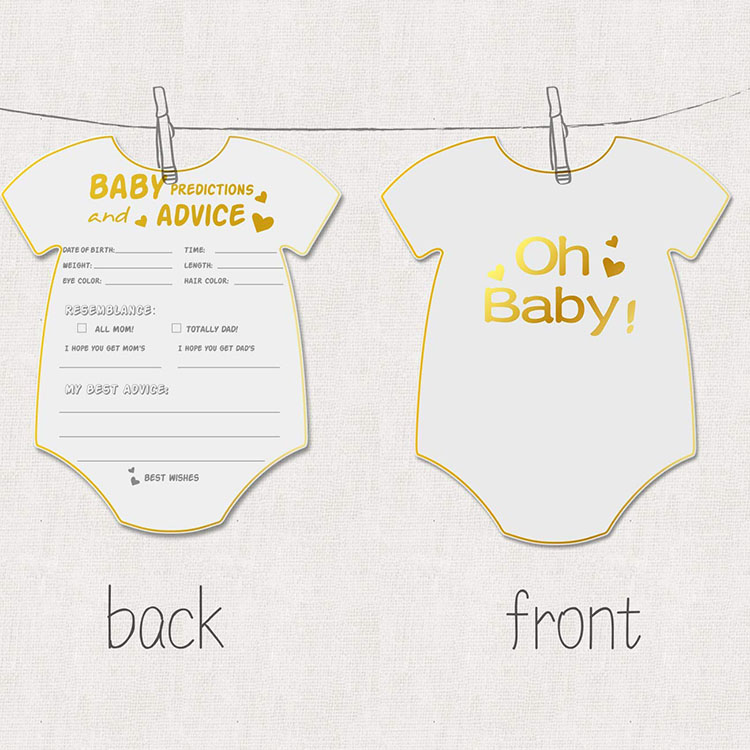
Flip to the back face and the layout reveals its logic. Six data fields run in a two-column block under the headline – DATE OF BIRTH and TIME share the top row, WEIGHT and LENGTH take the second, EYE COLOR and HAIR COLOR the third – each a small grey caps label above a short blank rule, sized so a rushed guess fits in four or five characters. Below sits the RESEMBLANCE section: two empty checkboxes reading ALL MOM! and TOTALLY DAD!, each followed by an “I hope you get mom’s / dad’s” prompt line, which turns a tick into a sentence and gives the host something to read aloud when prizes get handed out. Then MY BEST ADVICE opens three full-width ruled lines – three, not ten, because advice at a party is a fortune cookie, not an essay – and a small heart-plus-BEST WISHES footer closes the legs of the bodysuit.
The clothesline specimen shows the same architecture as a hung pair, front and back pinned side by side, which is how we proof both faces together: the headline block has to clear the neckline die geometry, the footer has to stay inside the snap-tab zone, and the middle column must avoid the sleeve notches where a writing line would run off paper. Every one of those is a print-area question, not a design-taste question, and it is why a template ported from a rectangular card onto a die-cut always needs re-spacing before the first press. The same care applies to the gutter between faces: front-plate and back-plate artwork bleed toward each other across the cut line, so a heart glyph printed two millimetres proud becomes a clipped heart on the finished card, and our layout review moves decoration inward before the plate room ever sees the file. Buyers running personalised versions – parents’ names, a due date, a baby’s surname on the cover face – keep the field stack fixed and swap only the greeting zones; the data file lands one variable block per face while the rest of the plate never moves.
Two handwriting realities shape the rule lengths, learned from return-mail rates. Guests write bigger than designers expect – a weight prediction at party volume comes out as eight-month-old printing – so every rule on this card carries slack rather than fit, and the grey label weight stays light deliberately so the guest’s ink reads as the content and our type reads as furniture. Second, ink colour drifts across a table of borrowed pens: black, blue, one metallic, one gel that never dries. Flat grey print survives all of them photographically; a pale printed form would let half the answers disappear into the page, and a disappearing answer is a missing prize category when the host reads the pile aloud.
Pen behaviour is the field-note nobody sends and everybody needs. Party tables produce gel pens, fine ballpoints, metallic Sharpies and one aunt with a lipstick; a matte uncoated face takes all four without beading or skating, which is the reason this line is not laminated despite the request frequency. Gloss laminates sell better on a mock-up render and write worse in a real shower, and since these cards exist to be written on before they exist to be photographed, we quote the matte as standard and let buyers downgrade from a sample, never from a spec sheet. The proof sample lands with a pen test strip on the back of the packaging insert for exactly this argument.
Sheet Imposition: How A Bulk Game Pack Actually Comes Off The Press
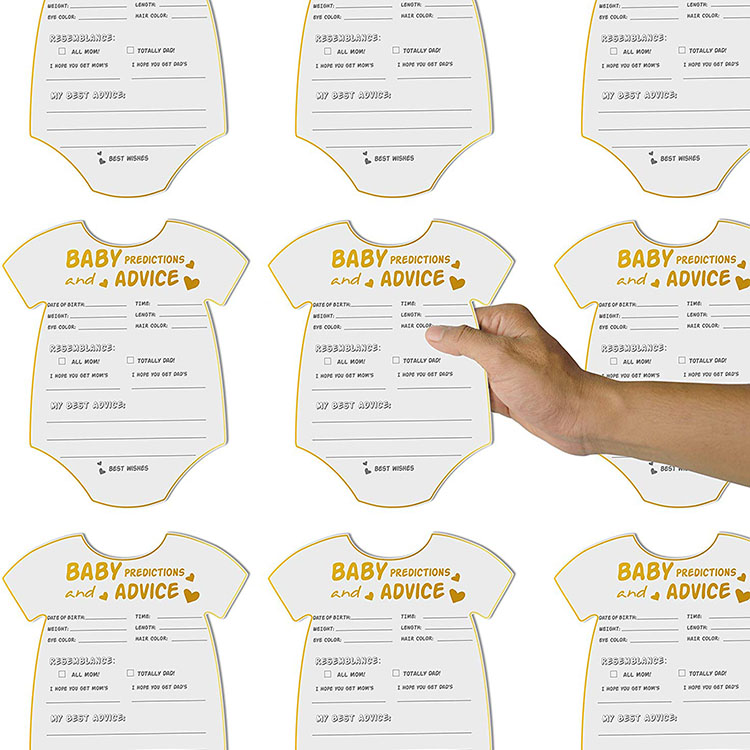
The grid specimen is the unglamorous hero shot every event-wholesaler should demand: nine die-cut cards in a three-by-three sheet layout – top row showing the back face, lower rows the titled front face – with a hand lifting one from the centre to set scale. Read what that proves. The front and back plates register across the whole sheet at once, so a pack of forty or fifty cards prints as a handful of sheet passes, not fifty individual feeds. The nesting is tight but the gutter keeps cut dust off printed faces. And the hand tells you the true unit size: these are pocket-class cards, comfortably one-handed, common pocket sizes quoted on request against the die you approve.
For buyers the maths is straightforward: pack quantity is a stacking decision, not a tooling decision. One sheet layout reprints as twenty-four-sheet packs or fifty-sheet packs without touching a plate, which is exactly how a party channel tests one price tier and scales into another mid-season. The mixed-design question comes up every autumn for reveal-party bundles: two or three cover-face greetings sharing one field-stack back. Each cover greeting is its own 100 pcs per design line, but they gang onto shared sheet runs whenever the back plate is identical, so the artwork fee amortises the way a single design’s would. And note the flat spot-print in these photographs – the gold is ink on matte stock, not foil and not emboss. On a card that gets written on with ten different pens at a party, tactile finishes buy scuffing risk, not luxury; the value goes into the cut and the pack count instead.
Plate hygiene for variable programs rides on the same file architecture: the fixed artwork lives on one layer, the swappable greeting block on a data-driven second layer, so a print-on-demand seller running five cover greetings through a season renews text only and never touches the die or the field plate. That layering is agreed at artwork approval, not discovered mid-season; buyers who send flattened artwork of the mockup end up paying for separations we rebuild from scratch, which we quote honestly as an artwork fee rather than burying it in the per-piece rate.
Pack graphics should copy the count claim exactly as the carton lists it: a header promising fifty that ships forty-eight because of an overage-band misunderstanding becomes a marketplace return with a photograph attached. We print pack counts from the approved packing list, and if your listing wording and your inner sleeve disagree, the disagreement gets settled at boarding stage rather than in a review thread.
Pack Merchandising: The Number That Sells Is A Count, Not A Discount
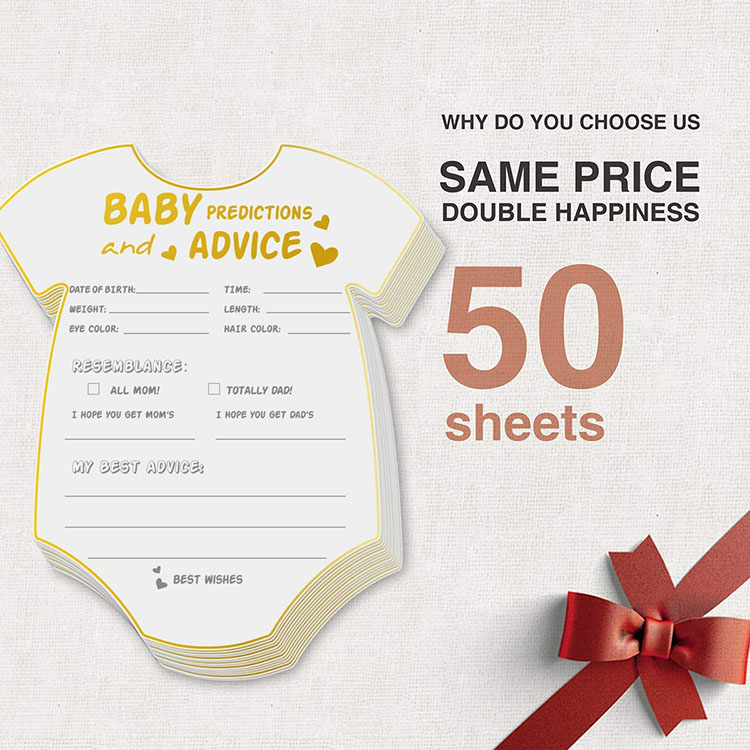
The retail-facing specimen is a stack shot: the top card leaning into a fanned pile whose stepped gold edges simulate quantity, a bold value block beside it promising the same price for double the sheets – fifty of them – and a burgundy satin bow in the corner doing the gift-anchor work no card can do itself. Look past the styling at the claim structure, because that is what converts at a register: party game cards are bought by guest count. A host expects sixteen to twenty-four attendees; a twenty-five-sheet pack covers every chair plus spares for the two aunts who want to write two answers. “Same price, double the cards” works as positioning because the cost of fifty die-cuts at our capacity is dominated by the sheet, not the setup – the buyer’s perceived deal and our real margin both come from the same imposition efficiency.
If you sell these as a print-on-demand or marketplace seller, treat that value block as your own copywriting brief in physical form: state the sheet count on the front of the pack graphic, because the number is what shoppers compare across listings, and the design only enters the decision once counts tie. Wholesalers take the opposite merchandising route – loose cards in a basket beside the invitation shelf, priced per pack, sold on the die-cut shape a guest picks up. Both routes run off identical stock; the difference is just whether the poly bag carries a printed header. Either way, samples run 3-5 days, so a pack claim can be validated against a real fan of cards before the season’s orders open, and bulk finishes 7-15 days after artwork approval once counts lock.
Spare-maths matters for event rentals more than retail: a host who loses four cards before the shower needs replacements without a re-run, so most pack quotes board with an approved overage band – five or ten percent loose in the carton depending on format – printed in the same sheet pass rather than added as a favour later. A fifty-sheet pack with five loose stays one design line because the extra sheets never met a new plate, and the same logic is why committee orders and marketplace sellers price so differently off identical machinery.
Worth flagging for first-time ceremony buyers: the pen you supply at the signing table is part of the spec. Fine-points skip on dotted rules and ultra-bold markers bleed across them, and the mid-weight ballpoint we ship in sample kits is chosen for exactly the ink width these guides hold. Ask for the pen reference with your proof and test it before your committee does.
Customisable On This Game Line
- Die shape: onesie silhouette standard; rectangle or rounded-corner variants reuse your artwork without the keyline inset changes
- Field stack: six prediction fields, resemblance checkboxes, parent-prompt lines and three advice rules, reorderable or reducible at template stage
- Cover face: greeting line, optional parents’ names or due date as the only variable zones on the front
- Palette: headline and keyline recolour per season without new plates; field labels stay high-contrast grey for pen legibility
- Pack count: 24 or 50 sheets typical, rescaled on the same imposition; header-carded poly packs or loose basket counts
- Bundle file: one master artwork exported to the matching invitation and thank-you faces on shared stock
Specification Summary
| Item | Baby shower prediction and advice game cards, die-cut packs (front and back faces as photographed) |
| Size | Common pocket sizes quoted on request; onesie die-cut format from the proof sheet |
| Stock & Finish | Matte uncoated cardstock, written-on friendly; no tactile coating specified because guest pens do the finishing |
| Printing & Artwork | Flat spot-colour print, gold rendered as ink; front/back plate registration per sheet; free digital mock-up before tooling |
| Envelope or Extras | Not standard for game cards; optional gift basket tags and header-carded poly packs quoted per pack format |
| Packing | Cards individually poly bagged or banded in pack counts, master export cartons by format |
| MOQ | 100 pcs per design |
| Sample time | 3-5 days |
| Lead time | 7-15 days after artwork approval |
| Capacity | 1,000,000 pcs per month across our gift lines |
From Artwork File To Party Table
The sequence for a game-pack order is short because the tooling is simple: approve the field stack, approve the die, approve the pack count. We return a digital mock-up free showing both faces against the onesie geometry – neckline clearances, gutter safety, the keyline inset – then physical samples in 3-5 days if you want the cut card in your hand before a season commits. The figure displayed on this listing anchors the 100-piece tier; contact us for pricing on other quantities, and remember the per-design rule splits only on artwork, not on pack size – a single design sold as both 24-count and 50-count pods is one line item, two skus of packing. Late text changes before approval cost a re-proof; after approval they cost a plate, which is why the cover-face greeting gets frozen early and the field stack, being fixed anyway, never does.
Packing And Ship-To-Channel
Game packs are count-checked, banded or individually poly bagged, then cased by the hundreds in master export cartons with stiffener boards between pack layers so the die-cut sleeves ride out transit unbent. Sellers moving through Amazon get full FBA prep here – labelling, poly compliance, and the option to co-pack prediction cards with matched shower invitation SKUs in one inbound carton, since the two products share a shelf season and a customer anyway. Freight runs by sea, air, or express with DHL, UPS, FedEx and TNT, timed around the shower calendar: late-spring events mean sea stock landed by March, and a viral reveal-season design gets rescued by an express carton rather than a lost quarter.

What Party-Channel Buyers Ask Us
Will ballpoint pens smear or skip on the card stock you specify?
Can one artwork file serve both gender-reveal and classic shower channels?
What is the cheapest change that makes these cards look more expensive at retail?
How do you handle a pack claim of fifty if a guest-count order only needs twenty?
Do the resemblance checkboxes need a special pen for the tick to show on camera?
Neighbours On Our Event Shelf
The invitation that drives guests to a table of these cards is our baby shower invitation line, built to share one artwork suite with this game; both sit inside the wider cards catalogue under printed products. When the same fill-in mechanic gets bought for June instead of October, the graduation advice cards run that season; when it gets bought for December, the Christmas bingo decks do. Premium gift-box channels pair these packs with the embossed and foil program, and bundle sellers price against the gift sets tree. For a pack-count quote, the quote desk answers within a working day, or reach [email protected] or +86-15967739086.
Bring the guest count and the cover greeting; we bring back the die layout and a free mock-up of both faces.