Custom Phonics Flash Cards – Learn to Read Deck Sets
$1.20
Custom phonics flash cards engineered for curriculum buyers: publishers, tutoring centers and school boards that reorder by stage. Every photographed card repeats one field architecture: a white hexagon holding the target grapheme, a set-number tab, a two-by-two grid of picture-word pairs with the focus chunk color-coded red inside each word, and a decodable sentence strip along the foot. Ring colors separate program stages, the printed carton announces the method in plain bands, and the sample card is annotated 4.8 by 3.6 inches on 350gsm art card. Your word list drops into locked template coordinates, so a ninety-six-card program proofs as text swaps, not new systems. MOQ 100 pcs per design, free mock-up, samples 3-5 days, 7-15 days after approval, FBA-labeled classroom cartons available.
A reading program is a sequence, and sequence is what a phonics deck must survive on a shelf. Custom phonics flash cards built for curriculum buyers carry that sequence physically: one target grapheme per card face, set numbers on corner tabs, ring colors that separate stages at a glance, and a box that states the method plainly. The photographs on this page show exactly that architecture, from a single -an rime card up to a four-ring progression, and this copy is written for the publishers, tutoring centers and school boards who reorder it term after term.
The difference between a reading deck and a picture deck is structural, not decorative. A toddler’s first-words product teaches by recognition; a phonics product teaches by decoding, which means every printed element must be locked to one sound unit at a time, or the method leaks. That constraint drives the whole build you see photographed here: one grapheme in one hexagon per face, a fixed word grid that trains the eye to the same spot, and a sentence strip that closes the loop from isolated sound to connected text. Get those fields right once and the deck family scales to any language program; improvise them per card and the same artwork budget produces teaching noise. Curriculum buyers should read the rest of this page as a checklist of what stays constant while your scope-and-sequence keeps growing.
The Anatomy of a Teaching Card, Field by Field
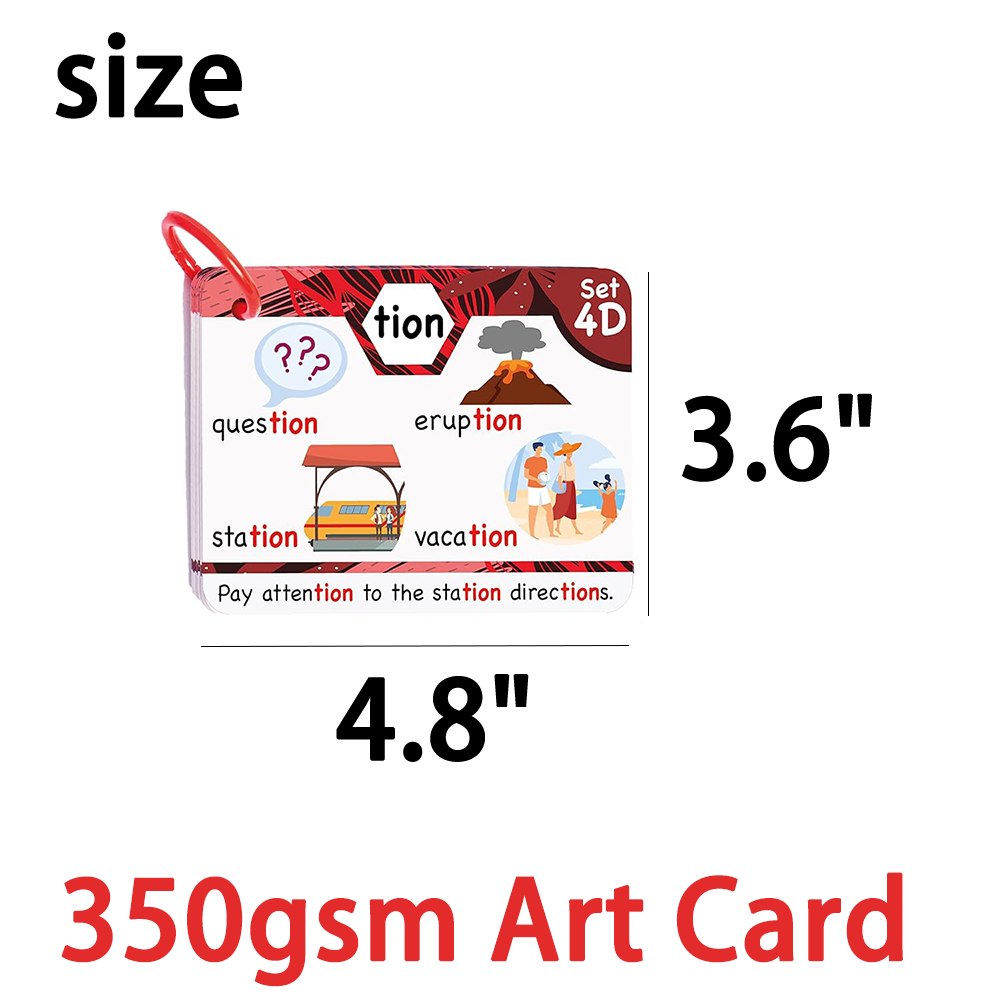
Start with the clearest specimen: a ring-bound card annotated at 4.8 inches wide by 3.6 inches tall. Its top edge holds a white hexagon outlined in black, and inside sits the lowercase target chunk tion. Beside it, a red disc badge marks the set number. Below, a two-by-two grid pairs flat vector illustrations with words, and here the pedagogical coding shows: each word prints its stem in black and the target ending in red, so question, eruption, station and vacation all light up the same chunk. A footer strip runs a model sentence across the full width with every matching occurrence recolored red to reinforce the pattern. The listing graphic stamps the sheet as 350gsm art card and threads a red open ring through a punched top corner. Every element on that face has a job in the lesson, and every job is a reproducible field your content team can populate deck after deck.
Procurement should notice how little custom illustration that format demands once a series exists. The hexagon, badge, grid boxes and footer band sit at identical coordinates across every card in a set, so a ninety-six-card program is ninety-six text-and-picture swaps against one locked template. Picture assets come from your illustrator or from a shared style library we maintain across a series; either way, consistency of field positions is what lets a teacher point at the hexagon and say “today’s sound” without relearning each page. That is also why proofs for phonics decks get checked differently from gift print: we verify the red highlight lands on the correct letters in every word, because a color-coding error teaches the wrong chunk, and a teaching deck with one mis-coded card costs a program’s credibility, not just a reprint.
Progression Lives in the Rings, Not Just the Cards
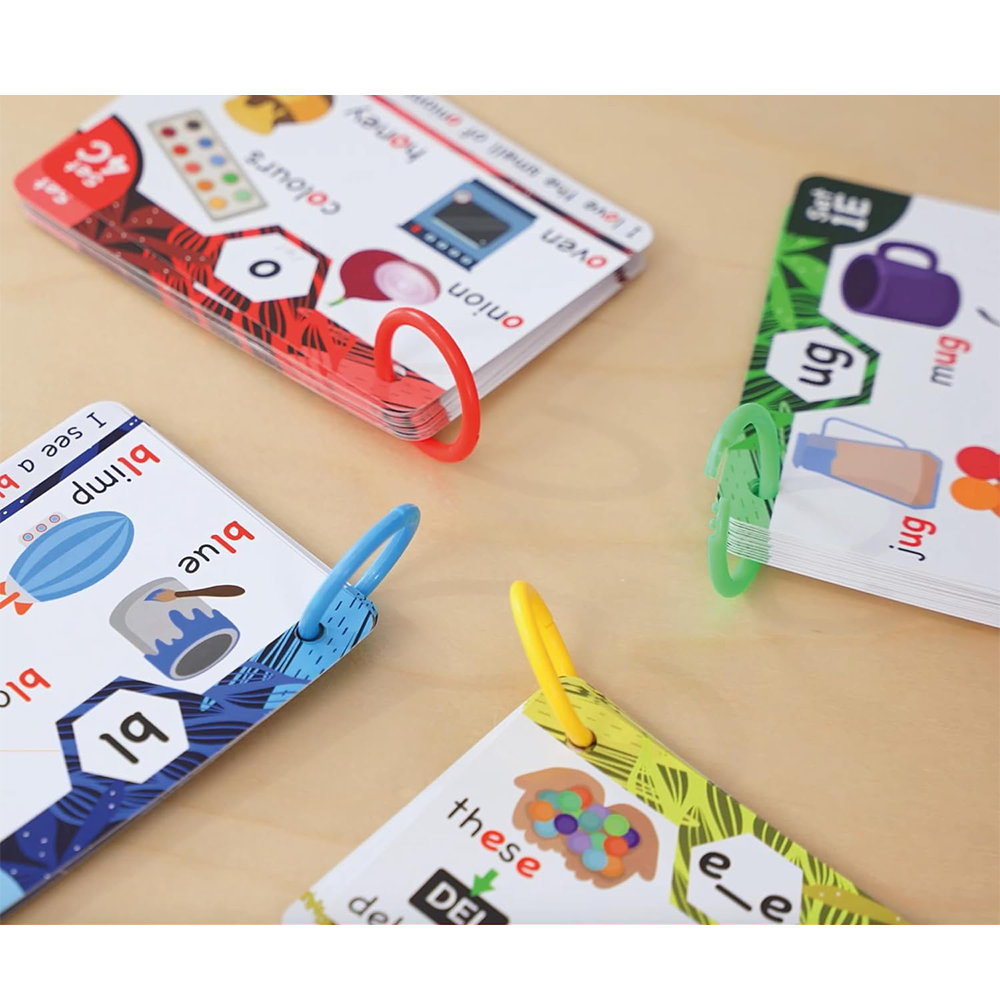
The four-stack photograph is the one a curriculum committee reads fastest. Four ring-bound sets rest on pale plywood, each held by a colored C-clip ring, and each top card exposes a different stage of the reading ladder. The green ring carries the rime ug under simple CVC words with matching pictures. The blue ring shifts to a consonant blend, bl, with words built around it. The red ring focuses a single grapheme for short-vowel word families. A fourth stack runs a split-vowel letter pattern in its hexagon. Same card architecture, four different difficulty placements, four colors to brief a teaching assistant in one sentence: hand out the green rings this week, blue next month. Set tabs on the corners number the sequence, so a classroom set that migrates between rooms comes home to the right shelf slot. For buying cycles this means something concrete: you can order stage three alone when the scope grows, and stage one keeps printing identically because nothing else in the system moved.
Two quiet details make the color-ring system survive real classrooms. The punched hole sits in the patterned spine strip rather than in the artwork field, so ring wear never scars a readable face; when a hole elongates after a year of handling, the deck stays legible and only the ring needs replacing. And because each ring color is assigned to a stage rather than to an individual deck, mid-year substitutions stay painless: a school that loses its green rings to a flooding shelf re-supplies four rings and two cents of labor, not the entire stage-one inventory. For buying desks that means breakage parts deserve their own line item on the annual order, quoted low because snap clips are cheap stock, and the reorder form gets simpler every year the program runs. Publishers selling kits direct to families use the same color logic in reverse, marketing the rings as visible progress milestones children ask to unlock, which converts a consumable into a retention feature.
Tutoring chains add a scheduling wrinkle worth pricing early. If each franchise location orders independently, the rings, spines and cartons must stay identical across every invoice so a student transferring between branches carries no relearning cost. That is a file-control problem, not a print problem, and it argues for one archived master per stage that every branch order reprints against. Our line planners keep those masters exactly so a mid-year branch expansion draws from the same 7-15 day window as the original adoption order, with no re-proofing detour and no drifted color between campuses that parents would absolutely notice and complain about.
The Complete Kit, Laid Out Like a Scope-and-Sequence
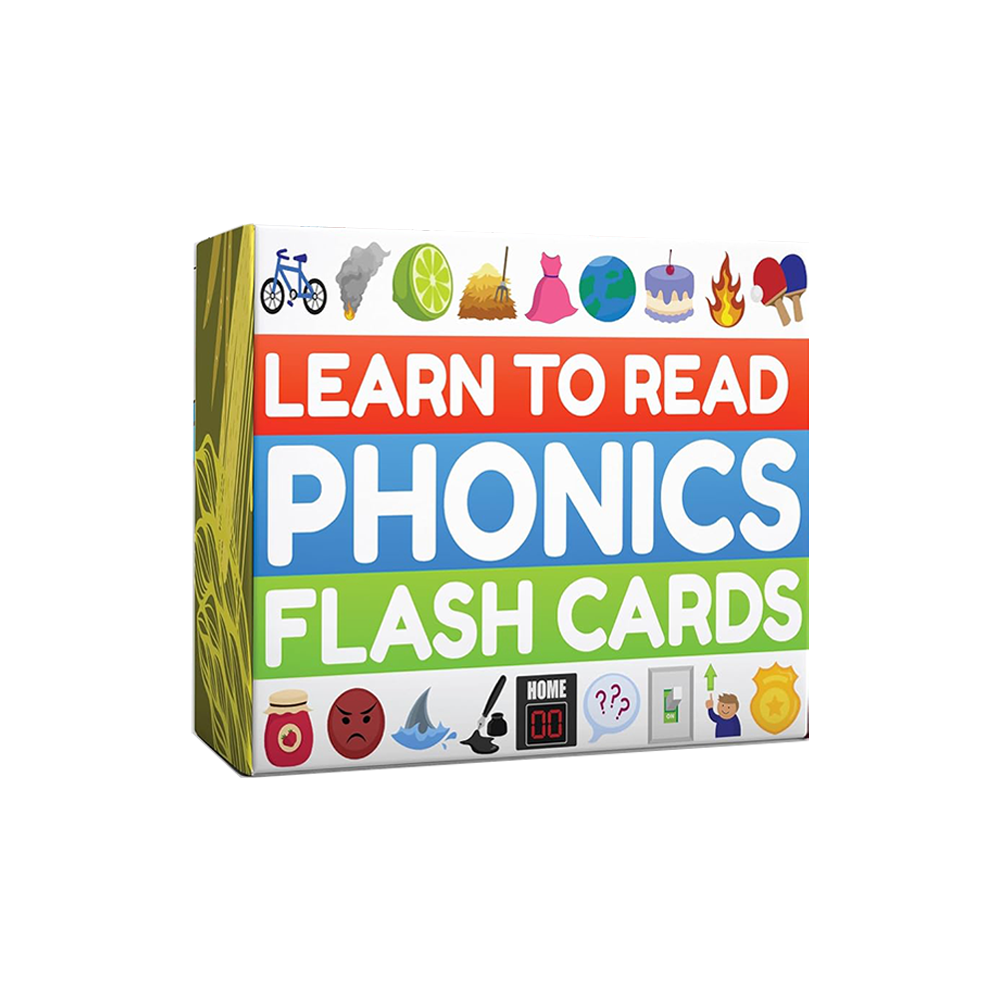
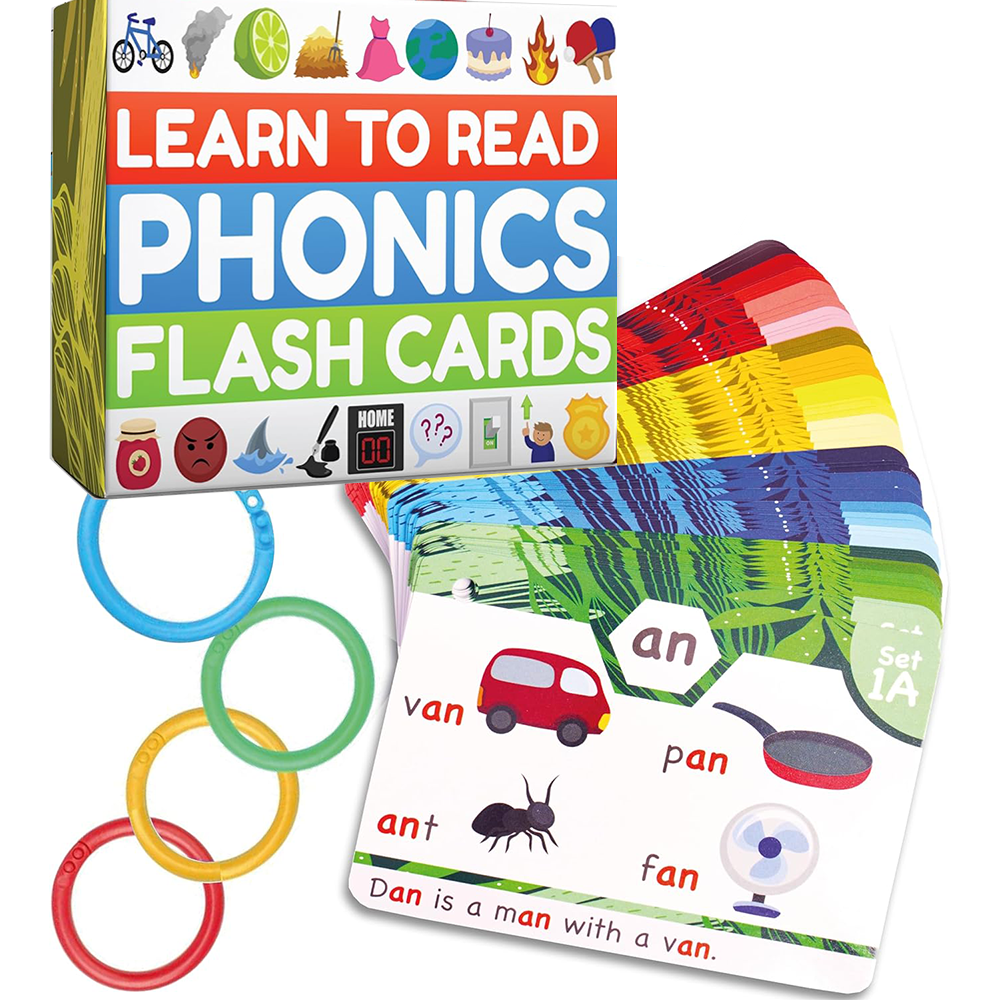
The third photograph unpacks the whole product in one frame. Left: the printed storage carton, olive textured side panel, front face divided into three solid color bands, red, blue and green, knocked-out white capitals reading LEARN TO READ, PHONICS and FLASH CARDS, each band framed top and bottom by a row of flat pictograms that double as a silent catalog of the sounds inside. Center-right: a fan of card backs whose leaf-line spine pattern steps through a rainbow of set colors, maroon through gold through blue, so a face-down deck still telegraphs which ring it belongs to. In front: one face-up card on the -an rime, hexagon tab grid sentence strip, the same field order as the suffix card, words coloring the shared chunk red across a van-pan-ant-fan grid and a decodable model line beneath it. Bottom-left: four loose snap rings, blue, green, yellow, red, waiting to be assigned. Read left to right, that is packaging, card stock, teaching face and binding hardware, an entire SKU decomposed for a procurement form.
That decomposition also settles the perennial question of what actually gets bought. A purchasing office can quote each element separately: carton, card stock, print faces, rings. When a program wants to cut cost without touching pedagogy, the spine pattern on the backs can drop to one color across all sets, saving setup without changing a single lesson. When a program wants to grow, the box pictogram rows are content real estate, and swapping their icon sets re-skins the product for a new market without re-inking the cards themselves. Nothing hidden, no forced bundle, which is the opposite of how single-SKU reading kits usually get priced by branded competitors who lock you into buying the whole ladder whenever one stage sells out.
The carton’s front bands deserve a merchandising note: they announce method, not brand. School purchasers respond to that. A box that names the pedagogy on five feet of hallway distance outsells a box that names a cartoon, and your program name can occupy the same hierarchical slots when you supply the artwork.
One more observation from that fan of backs. The rainbow sequence is not decoration for its own sake: it is an inventory-control system disguised as pattern. A teacher sweeping a shelf can spot a blue-spined deck shoved into the green stack instantly, and a parent photographing the fanned deck sees at once that the kit contains multiple stages, justifying the price point without a single word of marketing copy. If your program names its stages, map stage colors to those names before artwork, because recoloring a spine pattern after a school year has started breaks every classroom’s muscle memory, and teachers will tell you so on the reorder call.
What Your Content Team Controls per Set
- Target grapheme per card: single letters, blends, rimes, digraphs or suffix chunks placed in the hexagon
- Grid logic: two-by-two picture-word pairs, with the focus sound color-coded inside each word
- Sentence strip: your decodable line, matched to the words on the face and the student’s current stage
- Set numbering and tab color: the sequence your scope-and-schedule already uses
- Ring assignment and count: one ring per set, snap-clip style, as loose or pre-threaded
- Spine pattern color: the face-down identifier repeated across the deck backs
- Box art: title bands and pictogram rows re-skinned for a second language or a parallel series
Specifications Before the Reorder Form
| Item | Custom phonics flash cards, ring-bound decodable deck sets with printed carton |
| Size | 4.8 in x 3.6 in as annotated on the sample card; other classroom sizes quoted against your card count |
| Stock & Finish | Heavy art card noted at 350gsm in the sample graphic; matte flat print with rounded corners as photographed |
| Printing & Artwork | Hexagon, tab, picture-word grid and sentence strip fields in four color; free digital mock-up from your word list |
| Envelope or Extras | None applicable; loose or pre-threaded snap rings, spare rings and teacher guide cards quoted as extras |
| Packing | Ring-bound sets inside the printed carton; cartons into inner and export master boxes per freight chart |
| MOQ | 100 pcs per design |
| Sample time | 3-5 days |
| Lead time | 7-15 days after artwork approval |
| Capacity | 1,000,000 pcs per month across our gift lines |
Buying Against a School Calendar
Termly adoption has a fixed spine. Curriculum buyers typically lock files six to eight weeks before a term starts, and the production math supports it: approve the proof, then 7-15 days of manufacturing, then the freight lane that fits the remaining window. Sea freight suits annual textbook-scale orders sized months ahead; air and courier lanes rescue mid-year expansions when one more grade adopts the program. A physical sample deck in 3-5 days lets the methodology lead verify that the red-highlighted chunk actually reads at the back of a classroom before a board signs a purchase. Reorders are the quiet strength of this format: set designs freeze once validated, so a spring replenishment prints from archived files with only quantities changing, entering the same 7-15 day window without a new proofing cycle. Listed pricing anchors to the 100-piece tier as reference; district quantities get quoted per set count and ring configuration.
Packing and Freight for Ring-Bound Sets
Rings and card stock travel differently from loose print. Sets ship flat in fitted inner cartons so no ring presses a card face through the wall in transit, masters are counted per school with a pick list if you distribute across campuses, and classroom-shipment consolidation can add a guide card or a workbook to the same box. We quote sea, air, DHL, UPS, FedEx and TNT, and marketplace sellers of reading apps get FBA-labeled cartons with kits pre-assembled at our line, ring already threaded, shrink as requested.

Curriculum Desk Questions
Can each stage of our scope-and-sequence be a separate reorderable design?
How do you handle a word that cannot be illustrated cleanly?
Do the rings survive a classroom year of handling?
Is the 350gsm art card stated in the photo the only stock available?
Can the same card system print for a different alphabet or language?
What is the fastest realistic path from brief to classroom shipment?
Print Lines Adjacent to Your Reading Program
Parents and gift-shop buyers looking for a younger sibling product land on our custom flash cards for kids learning, while this page’s architecture serves staged readers. Explore the cards category for companion print and the printed items index for full catalog range; holiday-season reading gifts bundle well with custom christmas postcards and festival gift sets. District quotes start at the quote page, [email protected], +86-15967739086.
Send the scope-and-sequence, the word lists and the term date. The hexagon, tab, grid and sentence fields are waiting for your content; samples prove the ladder in 3-5 days.
Curriculum desks and parents judge the ladder before the first card leaves the ring, so your proof should show four fanned sets like this — hexagon, set tab, picture grid and sentence strip all readable from across a room. We return that view as a free digital mock-up, then ring a sample set in your colour order within 3-5 days for the desk to flip through.