Custom Faux Leather Lined Journal Notebook with Logo
$1.98
Corporate-grade PU leather hardcover journal built for onboarding kits, hotel guest books, and service awards: pebbled faux leather cover with rounded corners, vertical elastic closure, ribbon marker, expandable inner pocket on the back board, and thick ruled cream sheets photographed between 100 and 120 gsm. Your wordmark goes on the grain via hot stamp, foil, or blind deboss; belly band or bare packing per program. MOQ 100 pcs per design, free digital mock-up, samples in 3-5 days, bulk in 7-15 days after artwork approval, sea, air, or courier freight with FBA labeling available.
A custom faux leather journal with your logo is the most-reordered object in corporate stationery: it survives onboarding kits, anchors a hotel front-desk guest book, and still reads appropriate as a year-end award. This page is the construction file for that object. The photographed build is a hardcover journal in pebbled PU leather with rounded corners, a vertical elastic closure band, a ribbon marker, an expandable inner pocket, and thick ruled cream sheets, all customizable with one hot-stamped or debossed wordmark.
Purchasing managers compare journals on anatomy, not adjectives, so every claim below is tied to a specific photograph on this listing: what the spine shows, what the pocket holds, what the paper overlay states. Read the four images against the text, and the spec table becomes something you can audit when the sample arrives.
What the Belly Band on This Journal States
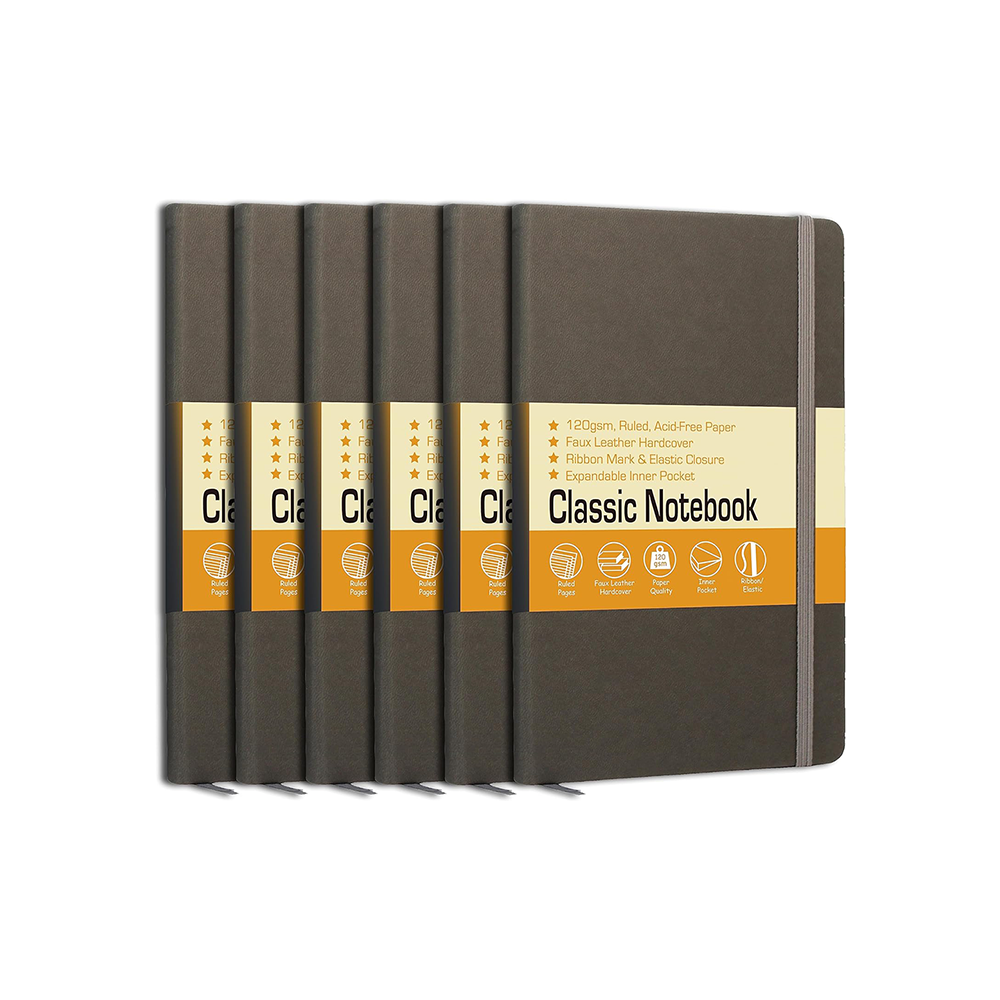
The hero image lines up six identical journals in an overlapping row, each wrapped in a two-tone paper belly band that works as the product’s own spec sheet. The cream panel lists four star-bulleted features in printed type: 120gsm ruled acid-free paper, faux leather hardcover, ribbon mark and elastic closure, and an expandable inner pocket, under the headline Classic Notebook. Five white line icons on the amber strip repeat those claims: Ruled Pages, Faux Leather Hardcover, a paper-quality glyph carrying the number 120, Inner Pocket, and Ribbon & Elastic.
Two things follow from that. First, the 120 gsm figure and the acid-free phrase are photographed spec text from the belly band, quoted here as what this build’s label says; they are not a certification claim, and your production band can carry your own feature list in that same print zone. Second, the band itself is a customizable component: the blank cream field is where your product name, campaign line, or feature list goes for retail-shelved journals, and unband units ship bare for gift-boxing downstream.
Cover, Corners, and Closure: the Leather-Grain Argument
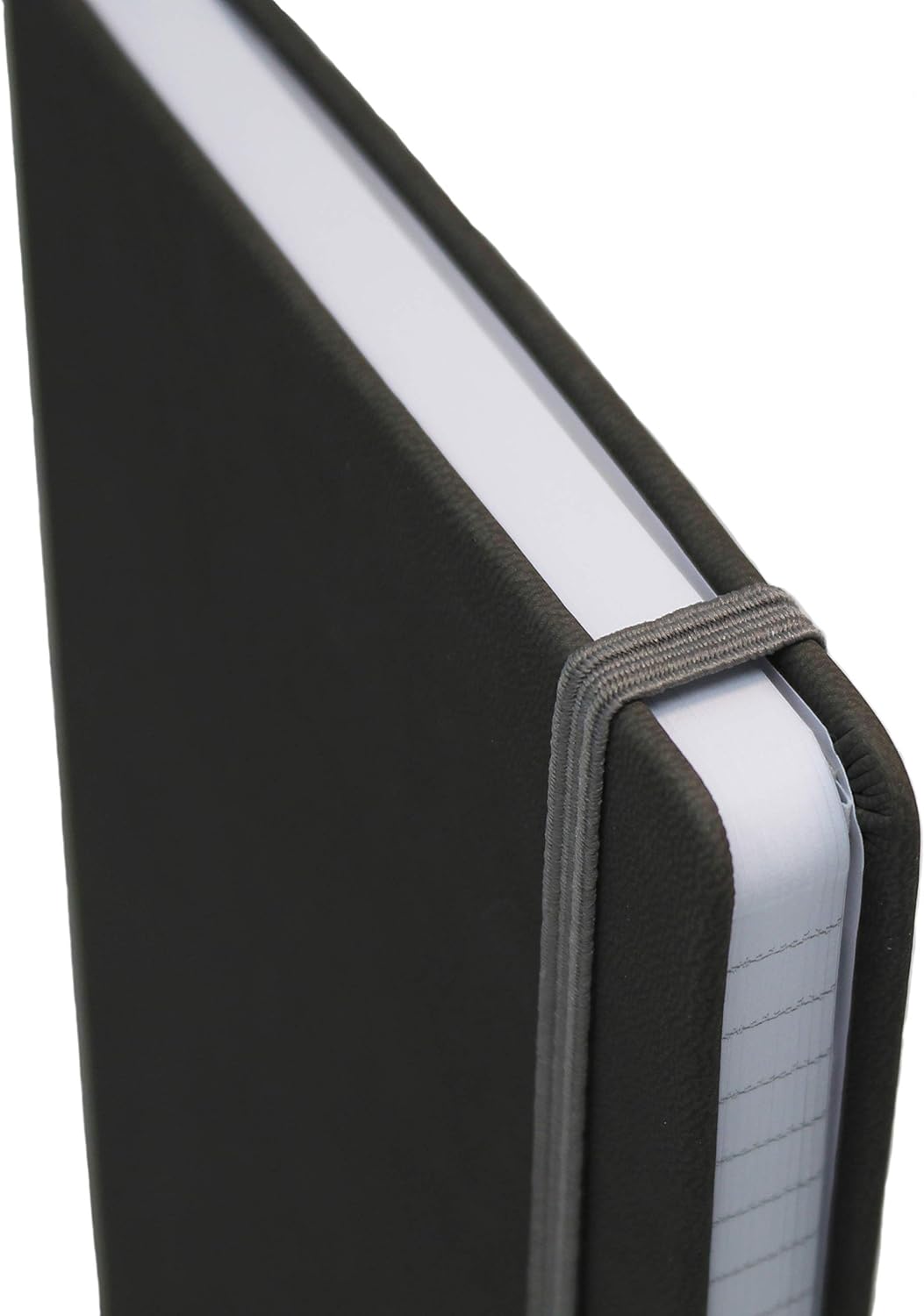
The detail shot of a closed journal shows why PU rather than coated paperboard earns its keep on a desk. The cover is a rigid board wrapped in fine-pebbled faux leather with a low-sheen matte finish, rounded corners that resist the white-creasing that squared hardcover corners pick up in six weeks, and a gray woven elastic band looping over the front to hold the book shut in a laptop bag. The white page block sits crisp against the dark cover edge, and the ruling on the exposed top sheet is a clean horizontal line pattern.
For brand application, that grain is the whole point. Hot stamping, foil, or blind deboss bite into leather texture in a way they cannot on gloss board: a single wordmark debossed into taupe or black PU reads as a gift rather than as swag. Cover color options include the photographed taupe, black, and forest-green edges, with Pantone-matched PU runs quoted on request for programs that need a corporate color at the shelf.
Grain choice is a budget conversation with a texture answer. Fine pebble, the photographed pattern, balances three demands at once: it hides shallow scratches from keys and zippers, it accepts foil and deboss without the crispness loss that smooth lacquered board causes, and it stays matte under office lighting instead of glowing like cheap vinyl. Larger croc-style embossing reads louder and prices higher per sheet; micro-grain finishes look executive in a photograph but show fingernail marks in service. Corporate programs that expect three years of daily commute order the middle of that range, which is precisely where the photographs on this page sit.
Inside the Cover: Ribbon, Elastic, Pocket
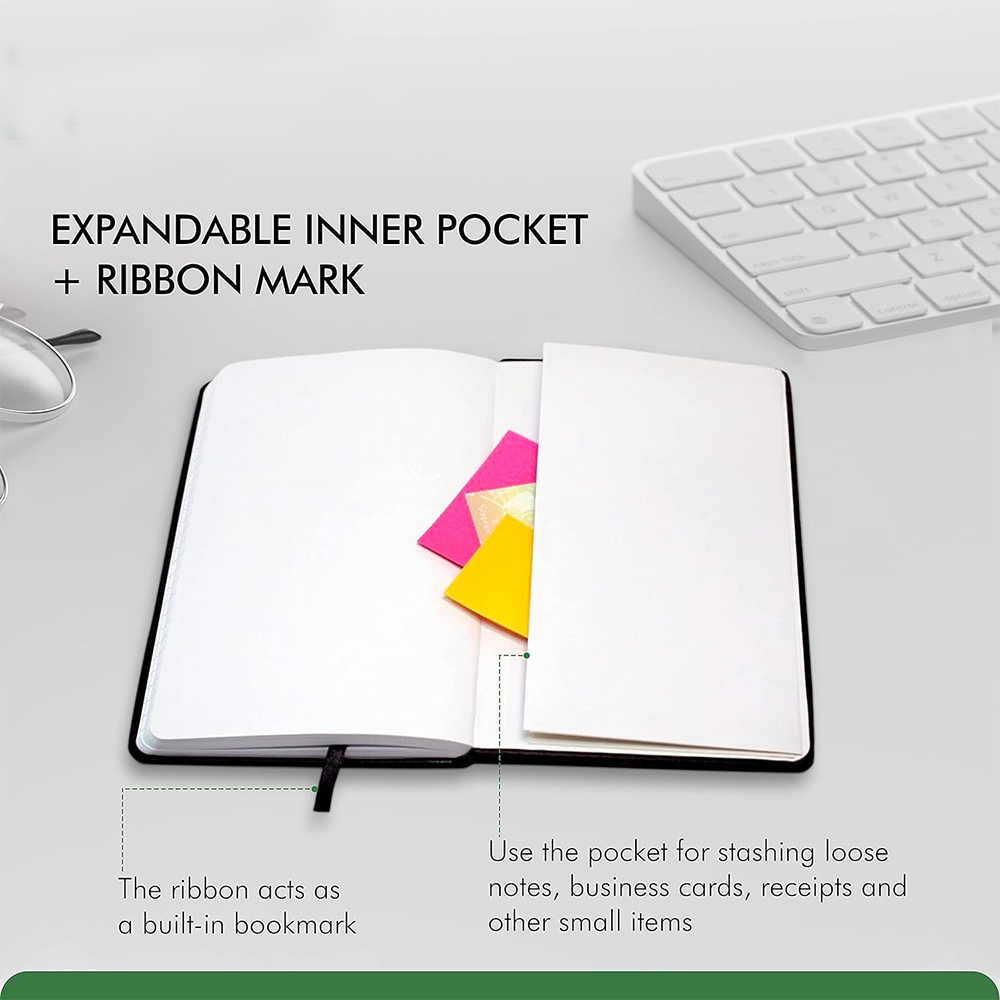
The three working parts live inside, and the desk photograph proves each one with props rather than promises. A black satin ribbon emerges from the spine and hangs below the closed edge: the built-in marker, dyed to match or contrast the cover on request. The expandable inner pocket is a paper gusseted envelope on the inside back cover, shown holding two note cards and a translucent card, which is the honest way to demonstrate capacity: loose notes, business cards, receipts, boarding passes, and a folded expense memo fit without bulging the back cover.
One correction this page will not make: the keyboard, eyeglasses, and note cards staged in that photograph are props for scale and context, not included accessories. Your order is the journal itself. The elastic closure keeps the book shut around that pocket’s contents, and the ribbon stays indexed to the last page you touched, which is the small engineering loop that makes a journal feel considered instead of cheap.
The Paper: Weight, Ruling, and Lay-Flat
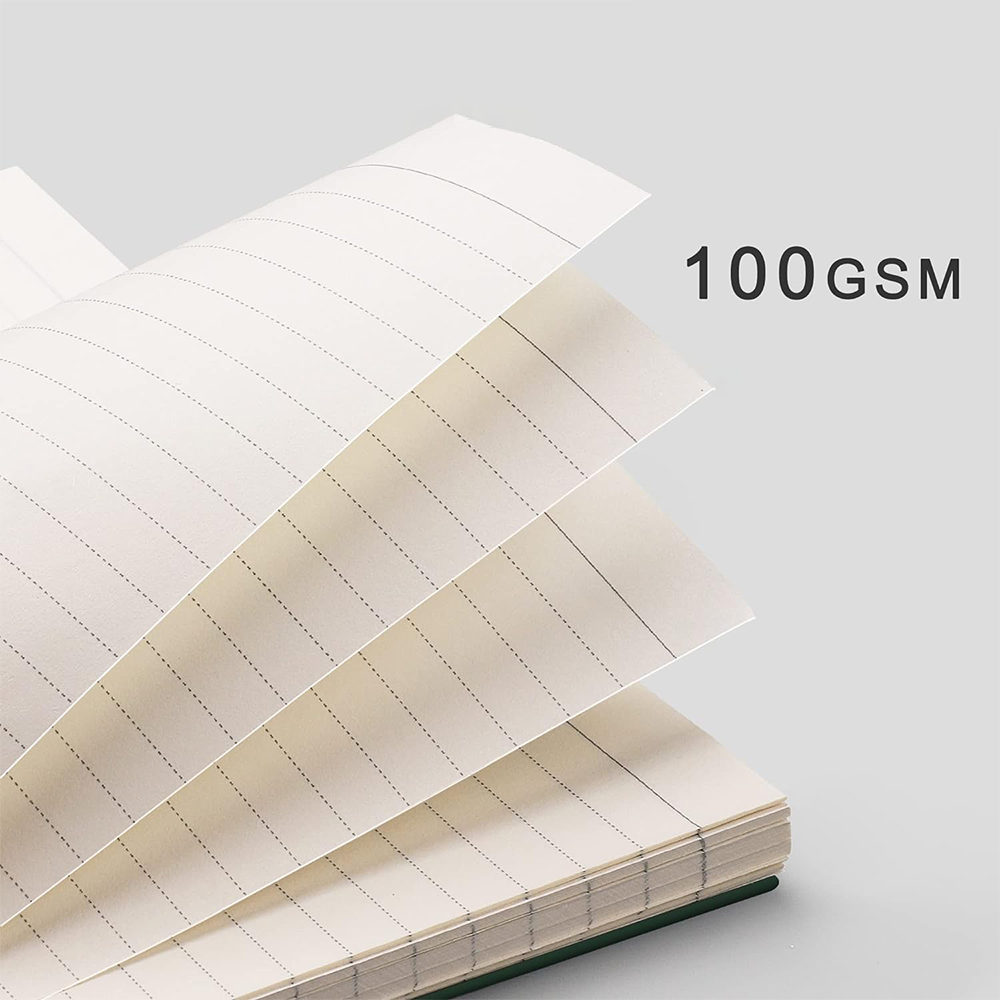
Paper claims here stay inside two photographs. The fanned-sheet shot carries a printed 100GSM overlay and shows cream, matte, uncoated sheets holding a stiff arch, with a sewn spine edge and a green cover strip visible at the bottom; the belly band on the hero shot states 120 gsm. So the honest summary is this: the photographed builds run between 100 and 120 gsm, ruling choices include solid line and dashed-line patterns as shown across the images, and the cream tone is warm rather than bright white, which photographs well and reduces eye glare under office lighting.
Because heavier paper is what makes a journal bleed-proof with fountain pens and gel inks, the gsm you specify changes the unit price materially: confirm the exact weight for your quantity on the sample, not from this page.
Spec discipline on the paper decision is simple if you sort programs by their ink. Onboarding kits and conference giveaways are ballpoint-and-rollerball environments, and the photographed mid-weight stock is already generous for them. Executive desk pieces bought by people who own fountain pens are the exception, and the honest answer is a heavier sheet tested with that exact pen on the signed sample before artwork approval. Hotel front desks sit in between: signing pens with fine tips, thousands of open-close cycles, and the elastic keeping the block compressed against a pocket full of key cards, which is why the band tension gets specified on the build sheet rather than left to a default. The gray woven band in the cover close-up and the matching ribbon tip under the belly-band row show the tonal hardware set as photographed; contrast colors for ribbon and elastic quote against swatches on request.
Other facts that hold across photographs: sheets are ruled full-width without a margin rule, the text block is sewn rather than glue-only so the book opens flat past the midpoint, and page counts for alternate thicknesses are quoted on request against a physical sample you sign.
The cream-versus-white choice is worth a paragraph because it decides how your program photographs. Bright white stock pops in catalog renders but glares under desk lamps and shows every highlighter stroke as a puddle; the warm cream in these images stays legible under mixed office lighting and takes gel, ballpoint, and rollerball without the tip drag that bright coated paper produces. For hotel guest books, that same tone hides fingertip oils on the first ten pages, which is the difference between a keepsake and a scuff report at audit. Ruling pattern follows buyer type on request: the solid line is the default writing grid, the dashed variation in the fanned photo reads lighter on the page and suits signature and note-taking stock, and the band’s printed 120 gsm claim is the heavier end of the family where ink discipline matters most.
Lay-flat engineering sits underneath all of it. A sewn signature block lets a journal open on page one with the whole spread writable, which is what turns a gift into a working object: meeting notes across two pages, sketches without a gutter shadow, signatures on the first leaf at an onboarding desk. Perfect-bound competitors crease their spines within a week of carry; the stitch row visible in the fan shot is the reason this shell is priced as a keeper rather than a giveaway, and it is the first thing a procurement auditor checks when the sample lands.
Customizable Components
- Cover material and color: pebbled PU leather in photographed taupe, black, or green-edge variants; Pantone matches quoted on request
- Logo application: hot stamp, foil, or blind deboss on the front cover or lower-right grain
- Elastic band color: matched or contrast, gray and black as photographed
- Ribbon marker color: black as shown; other dye options per run
- Ruling: solid line, dashed line as photographed, or blank, dotted, and grid alternates quoted on sample
- Paper weight: between the photographed 100 gsm overlay and 120 gsm belly-band figures; final weight fixed at sample
- Inner pocket: expandable gusset as standard; slip-loop and twin-pocket alternates on request
- Belly band or gift box: printed band as shown, bare unit, or rigid box for award programs
- Page count and trim: A5 and letter alternates quoted on request against the signed sample
Reading the list as a cost sheet: every line above is a print-file or component swap, not a new tool. The decisions that genuinely move unit price are paper weight, elastic and ribbon color matching against minimum dye lots, deboss versus foil versus band print, and the move from bare or banded units to individual boxes. A program that standardizes on one cover color, one ruling, and deboss-only artwork stays on the lowest tier at any quantity; the moment a launch demands Pantone-matched PU and foil in three ribbon colors, the same 100-piece floor applies per design but each design quotes separately, which is the arithmetic behind every mixed SKU order we accept.
Sample etiquette saves a week: request the physical copy loaded the way your program uses it, pocket stuffed, ribbon on page one, logo at production depth. Signing an empty shell tells you nothing about whether the band creases the deboss edge or whether the elastic weakens after a dozen cycles on your specific grain. The 3-5 day sample window exists for exactly that kind of audit, and the PO clock is friendlier when every surprise is consumed by the sample rather than discovered by the recipient.
Two packing lanes carry this journal through a program year. Banded units with the printed sleeve are the retail shelf lane: the band’s cream field takes product copy, the icons repeat the spec list, and the bare journal never touches cardboard until a customer boxes it as a gift. Boxed units are the ceremony lane: the journal rides in a rigid or magnet-close presentation box for awards, with the band removed and the deboss doing the talking instead. The same 100-piece floor governs both, the same cover tool serves both, and switching a program from banded to boxed between waves is a packing spec change that never reopens the approved artwork file.
Build Sheet in One Table
| Item | Custom faux leather lined journal notebook with logo (corporate gifting build) |
| Size | A5-class hardcover trim per chosen shell; alternate trims quoted on request |
| Paper & Ruling | Ruled cream sheets; photographed weights 100 gsm (spec overlay) and 120 gsm (belly band text); dashed-line and solid-line rulings shown; blank/dotted/grid on sample |
| Cover | Pebbled PU (faux) leather hardcover, rounded corners, gray or black elastic closure band |
| Binding | Sewn text block, lay-flat opening, ribbon marker from spine |
| Logo & Finish | Hot stamp, foil, or blind deboss on leather grain; matte PU finish as photographed |
| Packing | Optional printed belly band; individual box or poly bag; export cartons with inner packs; FBA labeling available |
| MOQ | 100 pcs per design |
| Sample time | 3-5 days |
| Lead time | 7-15 days after artwork approval |
| Capacity | 1,000,000 pcs per month across our gift lines |
Where Corporate Programs Actually Use This Shell
Three repeatable scenarios, each with different anatomy tweaks. Onboarding desk kits take the black cover with company deboss, dated first page optional, matched to the lanyard program; quantities run 200-2,000 with staggered hires handled by splitting one design across release waves. Hotel concierge and guest books run the taupe grain with contrast ribbon, pocket loaded with property cards at check-in, elastic keeping the book closed on a luggage cart.
Year-round awards are the third motion: 25 or 50 units of the same journal moved from service milestones to sales contests to retirement send-offs. For that life, the engraving-adjacent logic favors deboss over foil, because foil edges a wordmark on a box lid but deboss survives a decade of backpacks. When an award needs its box, the boxed journal-and-pen presentation page on this site covers that lid-and-insert build instead; this page’s band-and-bare packing is for stationery volume, not ceremony stock.
Sampling, Ordering, and Lead Windows
The path is short. Send the logo file, the cover color reference, and the ruling choice; a free digital mock-up returns on the real shell template; approved physical samples ship in 3-5 days so you can feel the grain, pull the ribbon, and test your pens on the actual sheet. Bulk production completes 7-15 days after artwork approval. The displayed price on this listing anchors the 100-piece tier for one design; the same design reordered at 1,000 units prices from the tier table, not from a new conversation.
Calendar discipline matters more than speed here. Year-end award programs want deskside boxes in early December, which means artwork approval by late October at the latest once freight is added; onboarding kits ordered against a hiring forecast should bank the 7-15 day production window twice per quarter rather than one giant run, because headcount shifts make stale journals shelf clutter. Capacity across our gift lines runs to 1,000,000 pcs per month, so quarter-close surges slot without re-qualification.
Freight and Packing Lines
Journals ship belly-banded or bare per your packaging spec, individually boxed or sleeved, into inner boxes and five-layer export cartons with fixed counts per SKU so pallet plans stay reproducible across reorders. Freight runs by sea for volume programs, by air or by DHL, UPS, FedEx, TNT for samples and award-deadline top-ups. FBA prep with unit labeling and carton compliance is handled before containers leave the dock for resale sellers.

Questions Procurement and Gifting Teams Ask
Is this journal dated or undated inside?
Which paper weight do I actually get, 100 or 120 gsm?
Are the note cards and pen shown in photos included?
Deb or foil: which logo survives daily carry?
Can I order 50 black and 50 taupe under one MOQ?
How do I verify the acid-free phrase on the band?
Related Pages for the Same Buyer File
When the same gift program needs neighbors to this journal: the dated leather agenda covers executive calendar stock, the travel folio with document pockets covers field and hospitality kits, and the boxed journal-and-pen set covers ceremony awards. The full notebook category collects every shell, and specs open at the quote desk.
Put Your Wordmark on the Grain
Send the logo, cover color, and ruling choice to [email protected] or +86-15967739086. The mock-up is free, the sample lands in 3-5 days, and the anatomy above arrives exactly as audited, down to the ribbon tail poking past the fore-edge.