Custom Executive Journal and Pen Gift Set, Presentation Box
$2.10
Recognition-grade journal shell with the hardware an award needs: gray fine-grain PU hardcover, rounded corners, vertical closure elastic plus a horizontal spine strap that carries the paired pen, blank logo field for foil or blind deboss, and 80 gsm ruled cream pages, 160 per the printed photographs. Boxed programs add a rigid presentation box, fitted or die-cut insert, and an engraved plate for citation text, all confirmed at sample stage. MOQ 100 pcs per design, free digital mock-up, samples in 3-5 days, bulk in 7-15 days after artwork approval, sea, air, or courier freight with FBA labeling available.
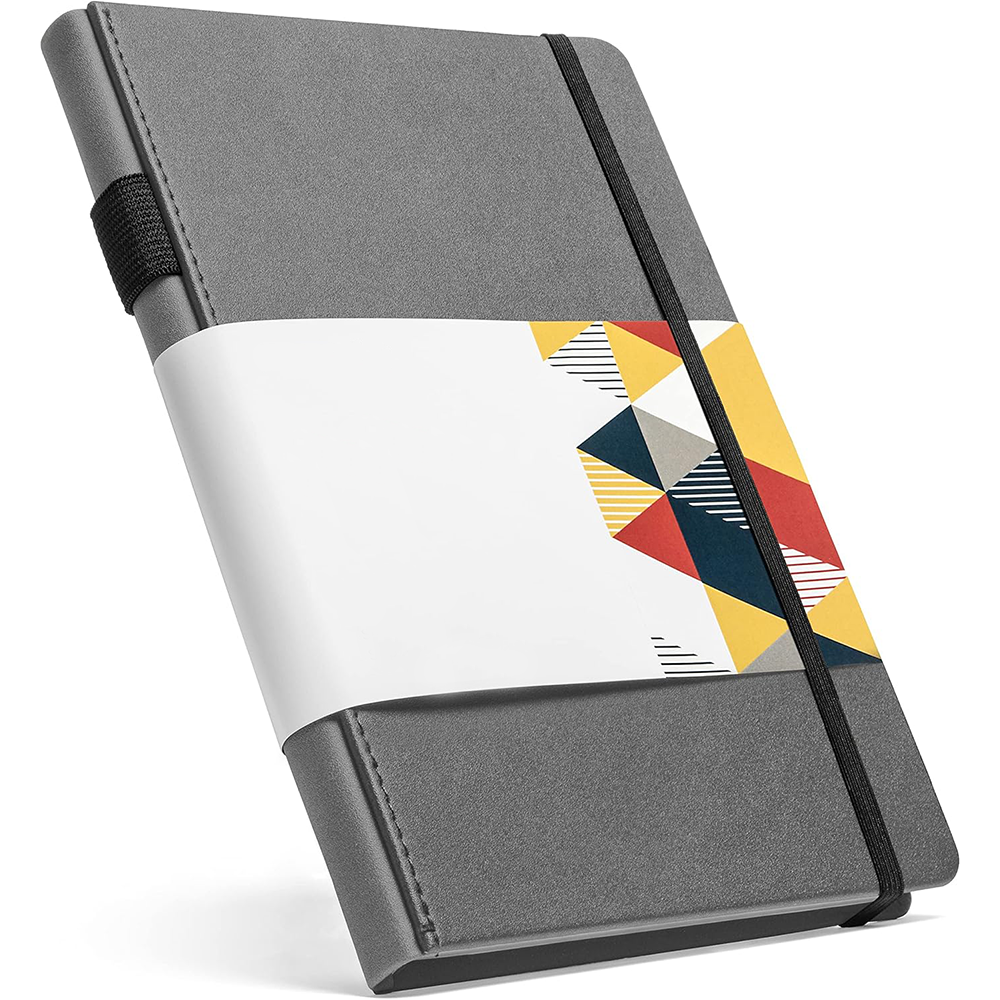
A custom executive journal and pen gift set is the object a company hands over at the moment that has a name on it: fifteen years of service, a board seat, a retirement. The photographed build here is the journal half of that equation, shown with the hardware that makes boxed gifting work: a gray grained hardcover with rounded corners, a black vertical closure elastic plus a second strap across the spine, a blank print zone on the belly band where the program’s mark lands, and ruled cream sheets behind it. The box, pen, and plate finish for this line are assembled from that same shell, and every addition below is marked as spec-to-confirm rather than implied by the frame.
Recognition stock gets judged in three seconds and three years: the three seconds it takes to open the lid at the ceremony, and the years the mark survives on a desk afterward. This page splits what the photographs prove from what the program adds, so your PO reflects the object a recipient actually keeps.
The Journal Shell, as Photographed
The hero shot shows the cover in fine gray grain over rigid board, corners rounded against the white-crease failure mode of squared edges. Two black elastic elements are visible: the standard closure band running vertically over the front cover, and a short horizontal strap crossing the spine near the top. That second strap is the pen-keep feature the executive set exists around, a stitched elastic bridge sized to hold a writing instrument parallel to the spine so the pair travels as one object; on bare journal runs it ships as a cover strap, and once the pen joins the program, its barrel diameter gets verified against that strap on the signed sample.
Wrapped across the lower cover sits the belly band, and it is doing two jobs in one photograph. Its wide cream field is blank except for its own edge, the honest placeholder where your program name, award title, or company line prints; its end carries a geometric triangle pattern in mustard, brick, teal, and gray, showing that the band is a designed component, not a stock wrapper. For boxed runs the band usually comes off, because lid printing and the plate replace what a sleeve carries, and bare shells nest cleaner in trays. Keep it for retail shelving at the desk; drop it once the box does the talking.
The double-strap detail is worth reading slowly because it separates an executive set from a plain notebook. The vertical band over the front is closure hardware, keeping the block shut against a packed bag. The short horizontal strap across the spine is the pen bridge, the piece a boxed set program lives or dies on: a barrel too thick stretches the elastic past recovery in a month, a barrel too thin wanders loose and scratches the adjacent gilded edge. Standardizing the paired pen at the same 100-piece floor, with its diameter recorded against the strap during sampling, keeps the ceremony set intact through the decade of desk life an award is supposed to have.
Recognition awards lean toward the heaviest option the budget allows for a reason nobody advertises: the recipient’s first instinct at the ceremony is to pick the box up and weigh it. A journal that feels light turns a formal moment into an apology before the plate is even read. That is why the paper photographs anchor this page rather than the cover alone: gray grain and deboss look executive in a catalog, but the stack in the hand closes the argument.
Board-pack buyers should also read the strap as a desk feature, not just travel hardware. On a meeting table the closure elastic keeps a half-written document block from fanning open mid-meeting; the spine bridge keeps the paired pen exactly where the next signer looks for it. Two small elastic components doing two ceremonial jobs, and both get tension-checked on the same signed sample before your first holiday run ships.
Paper the Award Recipient Will Actually Write In
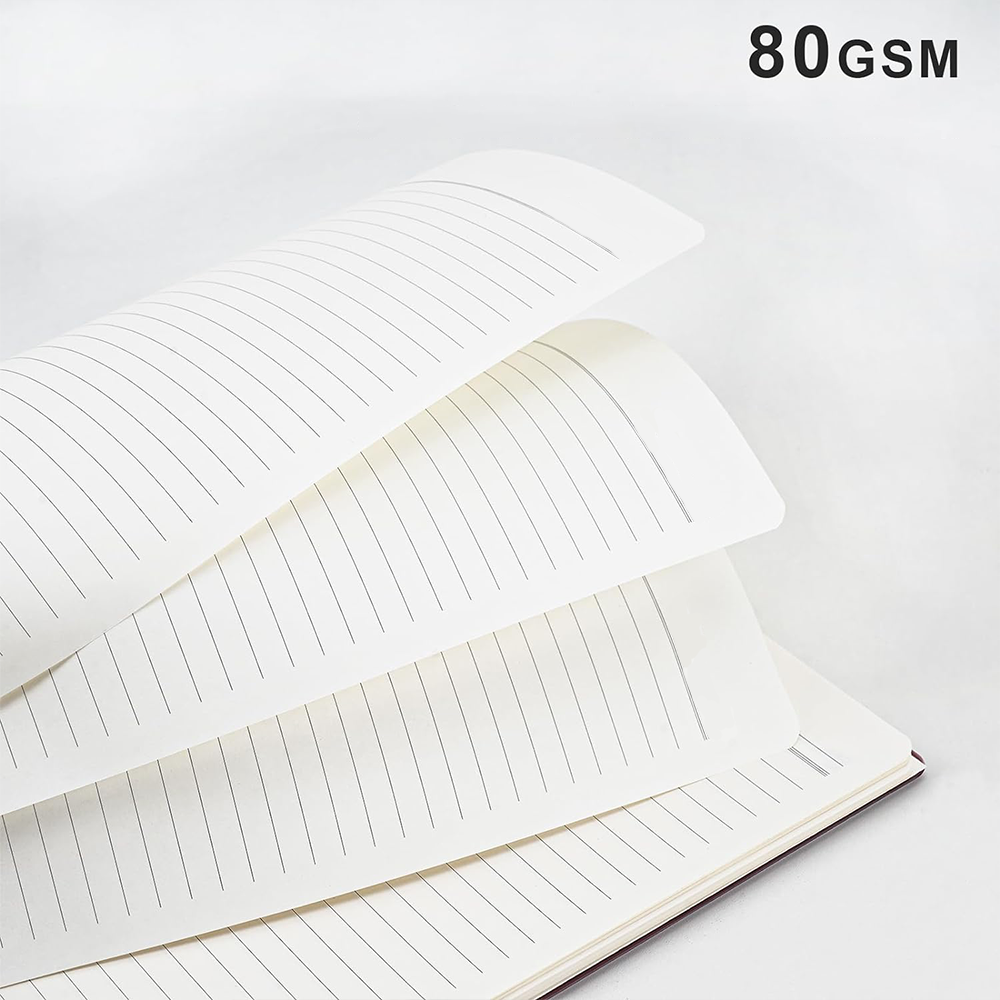
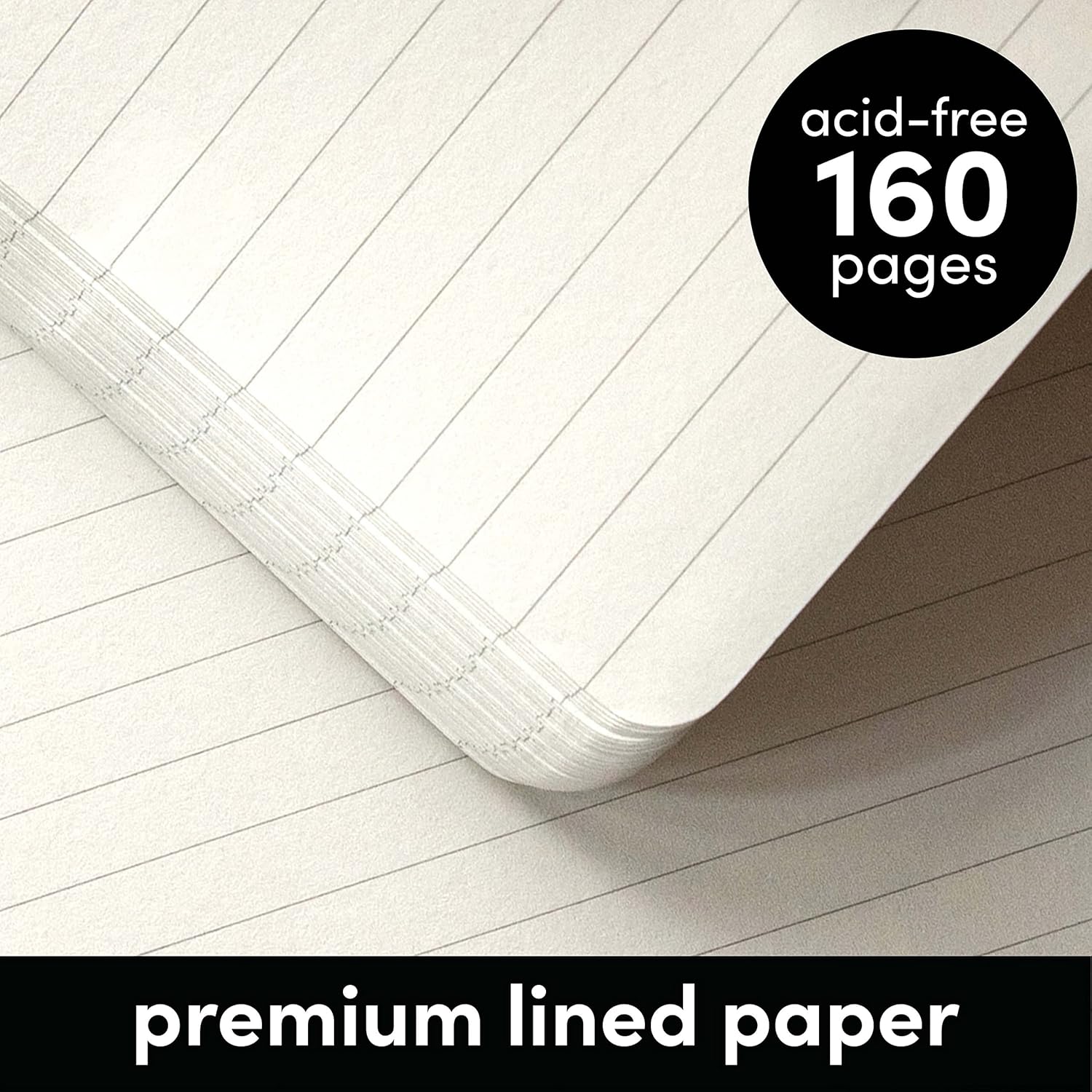
Two specification photographs anchor the interior claims. The first shows fanned cream sheets under a printed 80GSM overlay, the pages holding a stiff arch with a dark maroon cover edge and a sewn spine visible at the fold. The second is an extreme close-up of a thick ruled stack with printed badges: a circular mark reading acid-free and 160 pages above a full-width banner reading premium lined paper. Those are photographed figures from this listing, quoted as the label states them: 80 gsm, 160 pages, ruled single-line, warm cream stock, and the band’s own choice of wording printed on the product photography.
Why those numbers matter for gifting specifically: a retiree opening a box expects weight in the hand, and 160 pages at 80 gsm delivers a text block that reads substantial without becoming a brick. Cream paper photographs warm in announcement decks and reads softer under lamps than bright-white stock. If the award must survive fountain-pen signatures on the first page, move up within the 80-120 gsm band against a sample sheet, priced on the tier table and fixed at proofing. Alternate page counts for desk-pad companions or slim desk diaries are quoted on request, and heavier weights get verified on your actual inks, never assumed from a badge.
The listing photographs are honest about one thing a gift buyer needs to see: the paper is described, not implied. A fanned sheet can hold its arch at 80 gsm because the fiber is uncoated and stiff; a limp page would flatten into the stack and the photograph would look like a memo pad. That visible stiffness is the same property that keeps a signed first page from cockling around a wet fountain nib during the ceremony itself, which is the moment an award journal gets judged by everyone watching.
Edge and finish notes for the paper program: the cream text block photographs with a clean, square fore-edge, and gift runs commonly add painted or gilt edges as a quote-stage upgrade because a colored edge reads premium the instant the lid lifts, long before anyone opens the book. The maroon cover edge visible in this fan shot belongs to the shared spec photography of the build family; your ordered shell carries the gray grain of the hero image unless a different cover color is specified and signed on sample.
Interior Choices for the Same Shell
Where a journal earns its weight in the hand: a 160-page block at 80 gsm lands at roughly the same heft as two slim desk pads, which is exactly the sensory cue a boxed award should deliver. Presentation stock that feels insubstantial is forgiven once, by no one, twice. Recipients of service awards keep these objects for decades and judge them once, at the moment the lid comes off, so the interior block is the part the ceremony actually tests.
Decision support for the finance reader comparing tiers: the ruled default carries no layout surcharge because the plate set already exists from the photographed build, while grid, dotted, and blank variants share that same plate family and change nothing at press setup beyond the file swap. What does move the unit number is the inscription pass: a printed first-page block adds one cylinder or one digital print run per unit, and a hand-signed leave page adds none. Programs that budget tight usually pair the company-wordmark first page with the hand-signed note, keeping ceremony warmth and production economics in the same book.
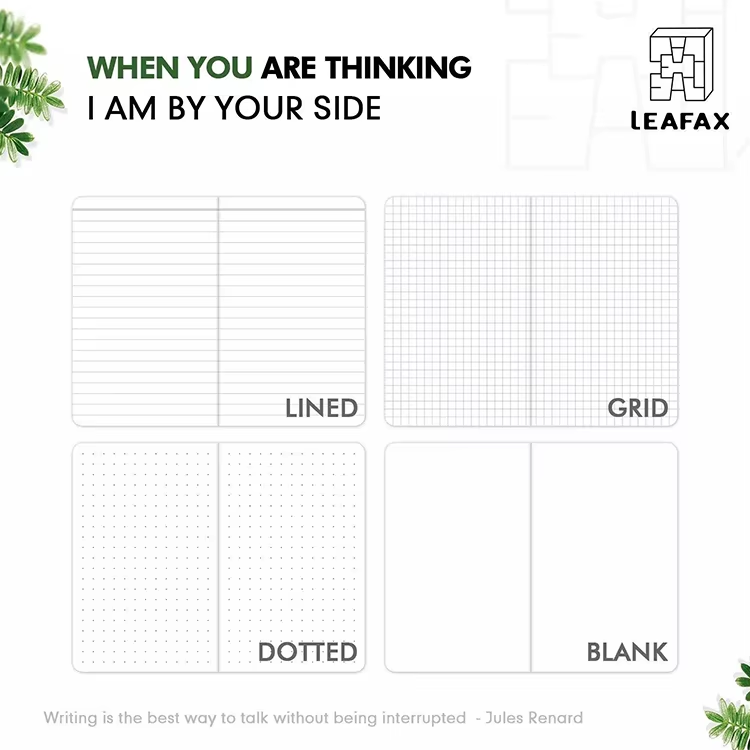
The ruling-options graphic repeats the sample-grid treatment on this listing: four open spreads, corner-stamped with the plain interior names LINED, GRID, DOTTED, BLANK. Every executive program starts from lined, the writing-default of the photographed journal and the safe choice for minutes, notes, and the first-page inscription. Grid sells into engineering and finance recipients who box their numbers, dot grid into planners who rule their own structure, and blank into sketchers and letter-writers. One ruling per design keeps the 100-piece floor clean; a program that stocks three ruling variants simply books three designs against one cover tool.
The inscription itself deserves a spec line. First-page foil printing, a printed title block for the date and occasion, or a blank leave-page for a hand-signed note are all artwork choices fixed at proofing, and the physical sample will carry your exact wording so the ceremony never discovers a typo. That pre-printed first page is also the low-cost way to make an undated journal feel dated-to-the-moment without serial work.
Rationale for the neutral default: recognition stock ages badly once it is over-templated. A first page printed with fifteen years of service is wrong for the twenty-year retiree; a page printed with the company name is fine forever, and a hand-written note absorbs every edge case the HR calendar invents. Programs that expect mixed cohorts usually land on a discreet printed wordmark low on the first leaf, nothing else, and let the plate and the pen carry the occasion’s specifics. Whatever you choose, the same layout file runs through every copy of the design, which is the practical meaning of one design at one 100-piece floor.
The Box, the Pen, and the Plate: Program Components
Plainly stated: the four photographs on this listing show the journal itself, not the finished gift box. The set is assembled from the same shell into a rigid presentation box with a fitted insert that holds the journal flat and a metal pen seated in its own channel, lid printing or deboss matching the cover mark. Pen pairing runs from a simple lacquered ballpoint to weighted metal barrels; the engraving plate mounted on the lid or the inner tray is where the citation lives, and names, dates, and small serifs resolve cleanly on plate artwork, which is why serialized per-recipient text belongs there and not on the journal cover.
Because the box, pen, and plate are quote-stage components for this product’s photography state, treat their exact dimensions, plate size, and insert style as confirmed on your mock-up and physical sample rather than from this page. Recognition programs usually tier: standard deboss cover with generic plate for volume service awards, foil cover plus individual engraved plate for the small senior cohort, both built off one journal tooling. The band-printed shell in the hero photo is the same object that nests into the tray, so mid-program upgrades reuse approved cover art.
Insert choice carries the ceremony’s last engineering decision. A friction-pocket insert lets staff restock the journal without touching the tray, a die-cut cavity holds journal and pen at exact centers so the lid opens to a composed picture on camera, and magnetic flap boxes read premium at the point of handing but add board weight to freight. Award programs that get photographed for the internal newsletter usually pay for the die-cut cavity because the open-lid frame is the artifact everyone remembers; programs shipping quarterly recognition at volume often pick friction pockets because restocking speed beats composition. Either choice lives on the same quote line as the box itself, so decide it once at proofing and bank it for the year’s waves.
What a complete set spec sheet carries:
- Journal: gray grained PU hardcover, rounded corners, vertical closure elastic plus spine strap as photographed
- Interior: 80 gsm ruled cream sheets, 160 pages per the printed badges; grid, dotted, or blank alternates; inscription page optional
- Cover mark: foil stamp or blind deboss replacing the blank band zone’s placeholder role
- Pen: barrel and finish chosen against the spine-strap clearance on the signed sample
- Box: rigid presentation box, fitted insert, lid print or deboss matching the cover; plate engraving for citation text
- Program tiers: volume award spec and senior-cohort spec as two designs, one tooling family
- Packing: individual boxed sets, inner packs, five-layer export cartons; FBA labeling available
Set Terms in One Table
| Item | Custom executive journal and pen gift set, presentation-boxed recognition build |
| Size | Journal-class hardcover trim per chosen shell; alternate sizes quoted on request |
| Paper & Ruling | 80 gsm, 160 pages per printed photographs; ruled as shown; grid, dotted, blank alternates; inscription page optional |
| Cover | Gray fine-grain PU leather hardcover, rounded corners, vertical closure elastic and spine strap |
| Binding | Sewn text block; lay-flat writing opening on the photographed build family |
| Logo & Finish | Foil or blind deboss on cover; band print on unboxed runs; plate engraving for citation text |
| Packing | Presented sets in rigid box with fitted insert (box, pen and plate quoted at sample stage); export cartons; FBA labeling available |
| MOQ | 100 pcs per design |
| Sample time | 3-5 days |
| Lead time | 7-15 days after artwork approval |
| Capacity | 1,000,000 pcs per month across our gift lines |
Recognition Calendars and the Approval Chain
Award stock runs on ceremony dates, and ceremony dates do not move. Anniversary and retirement cohorts typically land on service months spread across the year, so the practical model is a banked base quantity in the standard spec plus rolling per-recipient plate engraving. Board-cycle packs order against a meeting calendar two quarters ahead. Year-end recognition for a global company concentrates in November and December, meaning cover artwork and plate fonts approved by October, because the free digital mock-up, a 3-5 day sample, and 7-15 days after artwork approval stack before freight, not after it.
Approval chains matter more than production speed in this niche: HR owns the citation wording, facilities owns the budget, and someone’s assistant owns the deadline. Lock typography on one proof covering cover mark, inscription, and plate at the same sign-off; three separate approvals on one ceremony is how gifts miss the event and arrive as apologies. The displayed price on this listing anchors the 100-piece tier for one design, and design here means one cover-mark plus band or lid artwork combination.
Packing and Freight for Fragile Presentation
Boxed sets ship as retail objects: each unit in its presentation box, nested in inner packs that stop corner bruising, then five-layer export cartons with fixed counts per SKU so a distribution center can receive on the manifest alone. Ceremony deadlines that survive neither ocean nor a customs queue move by air or by DHL, UPS, FedEx, TNT as a split shipment, with the balance following on water. FBA prep and unit labeling are handled before departure for resellers stocking the same set as a purchasable award line.

Questions HR, Awards, and Board-Package Buyers Ask
Is the pen actually included, and can we swap it for our executive pen?
Can each retirement gift carry a different name and year?
Do these pages lie flat for signing at the ceremony?
The photos show a belly band, not a box. Which does my order arrive in?
What does the acid-free badge on the paper photo mean for our archive copies?
Can the band’s geometric print be replaced by our own artwork?
Pages a Gift Program Reviews Next
If the box is overkill for the volume tier, the same cover lives on the plain desk page: the faux leather journal with logo documents the band-and-bare build. Executives who asked for calendars go to the dated leather agenda, frequent travelers to the travel folio with document pockets, and desk-plus-tech bundles to the notebook, pen and flash-drive gift sets. Full range at notebooks, specs filed at the quote desk.
Build the Ceremony Spec
Send the citation wording, cover mark, and quantity tiers to [email protected] or +86-15967739086. One proof covers band, box, plate, and pen; the signed sample answers the rest; and the ceremony arrives at the desk exactly as approved.