Custom Hardcover Notebooks | Plain, Lined, Dotted
$0.90
Private-label hardcover notebook program for Amazon sellers and DTC stationery brands: choose lined, plain, dotted or section/grid inner stock per SKU, in the A5 and B5 formats printed on the photographed covers, with a diamond logo zone recoloured per ruling variant and colour-coded spine tapes that make four SKUs photograph as one family. Retail-ready from our packing stage — barcode print or label, compliant poly bags, multi-packs and FBA-compliant carton builds. MOQ 100 pcs per design, samples in 3-5 days, production in 7-15 days after artwork approval, restock from stored artwork.
A private-label notebook program is won or lost on three decisions most suppliers never separate: what the inner stock does, what the cover survives, and whether the unit can land on a marketplace shelf without a repack stop. This page is the ruling-options and retail-readiness build of our custom hardcover notebook line — the lined, dotted, plain and section interiors that sell as separate SKUs, photographed here in A5 and B5 formats, with kraft or printed covers carrying your diamond-zone logo and packing that goes straight into FBA or retail channels. Minimum order stays 100 pcs per design, so testing four ruling variants as four SKUs is a 400-book decision, not a warehouse bet.
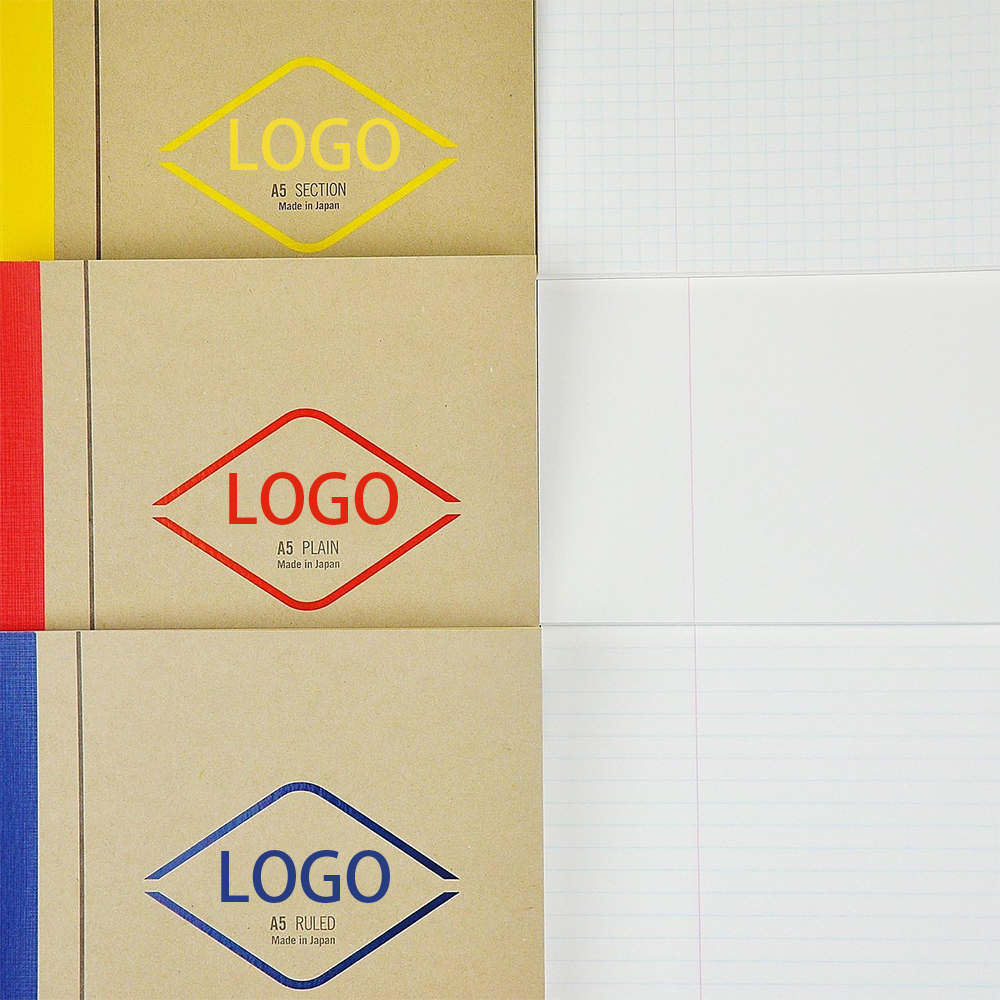
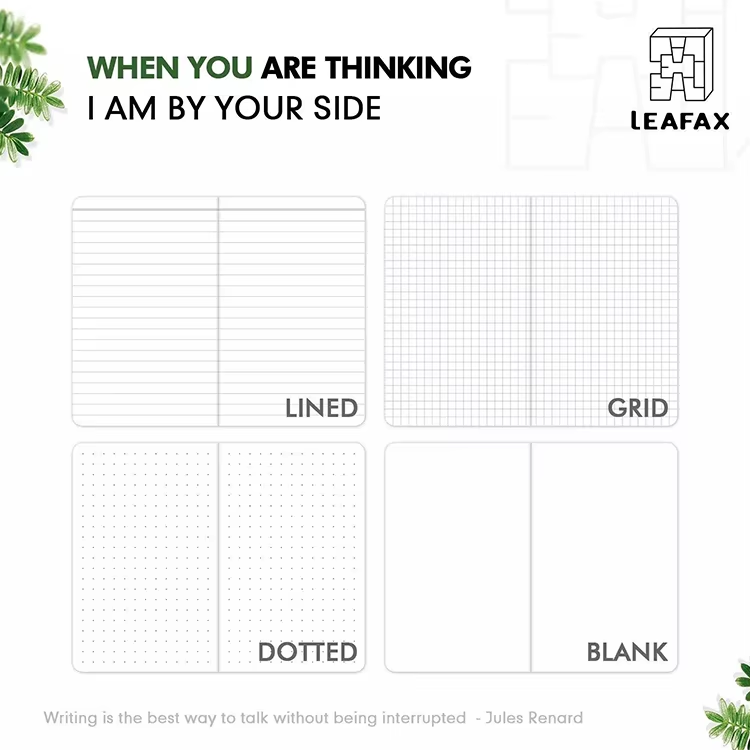
The photographs are the spec sheet. One shows an open book lying flat with blank white sheets within a solid teal matte cover; one lays three kraft notebooks in a column so their interiors can be compared against each other — A5 section (a fine square grid), A5 plain, and A5 ruled with a margin line — each cover printed with an open-diamond logo placeholder under the ruling name. A fourth image is a page-format chart presenting four ruling zones in a two-by-two panel: lined, grid, dotted and blank, each with a header rule and a vertical centre divider. Together they answer the question every listing manager asks first: which stock does my customer actually write on?

Picking the Stock: Four Rulings, Four Different Customers
Ruling is not decoration; it routes behaviour. Lined pages sell to writers, students and meeting-notes buyers — the line pitch printed on the photographed B5 sample reads 6 mm, a classic comfortable rule for average handwriting. Plain pages collect sketchers, math work and people who resent being ruled at all. Grid and section stock belongs to planners, engineers, bullet-journalists and anyone laying out two-column tables — the swatch panel shows exactly how a header rule plus a centre column divider turns a page into a structured worksheet. Dotted is the quiet bestseller of direct-to-consumer stationery: enough guidance for tables and boxes, invisible enough for sketching.
Each of those four audiences types a different search into a marketplace box, and that is the private-label argument in its purest form: ruling is a keyword on the page and a physical fact in the hands. A seller running one SKU for all four customers ends up ranking for none of them, photographs a lined page for a dotted-intent buyer, and eats the review that says so. The page-chart photograph — four zones, one frame — exists because the honest commercial move is exactly the boring one: build one cover system, print the ruling truth on the cover, let each variant hunt its own keyword. Four designs, MOQ 100 pcs per design, one production slot.
The three-book comparison photo is the honest way to show this range, and it is how we recommend you build a listing set: one cover family, several ruling SKUs, each named on the cover the way A5 SECTION, A5 PLAIN and A5 RULED are named in the photograph. Naming the ruling on the cover is a retail decision with conversion consequences — the buyer after dotted never opens the ruled notebook, so a visible ruling name does the filtering before the lid lifts.
Margin structure follows the same logic. Reorder revenue in stationery is SKU-level, not brand-level: a customer who bought dotted and liked it comes back for dotted, not for your lined version at a discount. Locking ruling into the SKU architecture from the first mock-up is what turns a first order into a restock cadence, and restock cadence is the only reason a 100-piece test becomes a 5,000-piece quarter. The variant naming convention on the photographed covers is yours to copy or replace — pick it once and keep it, across listings, cartons and the cover itself.
A cautionary note from the other direction: resist the urge to invent a fifth ruling. A hybrid layout — half dotted, half lined, one page per spread — photographs beautifully and returns badly, because the buyer after dotted gets lined pages in their week and says so publicly. The four-zone chart exists as a boundary, not a menu with unlimited rows; every variant beyond those zones needs a data-backed reason before it earns its plate. Legitimate requests — a wider margin for lecture notes, a custom header row, a heavier stock for fountain pens — the artwork desk has handled before and quotes like any other ruling, one design at a time.
The Cover Zone, Proven Three Ways
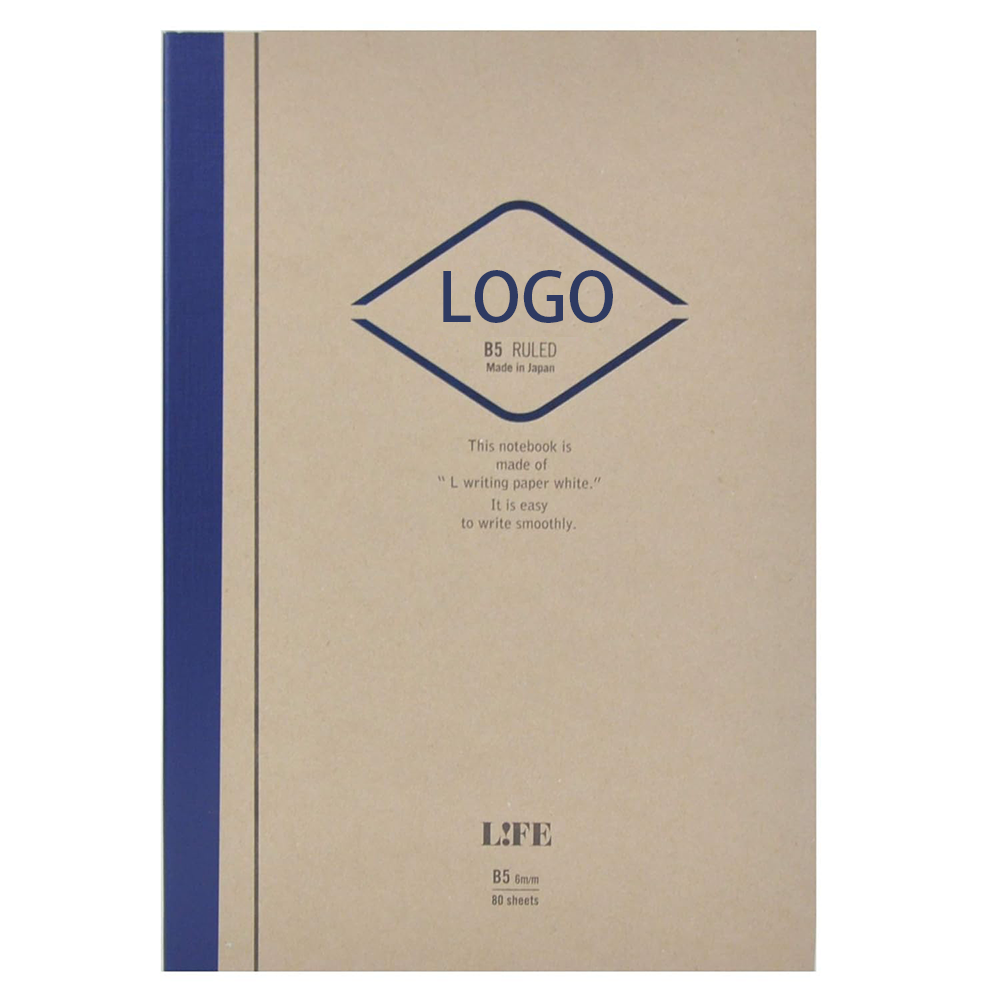
Look at what each photographed cover leaves empty. The kraft B5 sample prints a single open-diamond emblem around a LOGO placeholder, then a short type block naming size and ruling, then a grey spec paragraph and size lines — nothing else. The three-book shot repeats the same architecture in three spine-tape colours: yellow, red and blue mark section, plain and ruled, with the diamond and logo text recoloured per variant.
Read that restraint as a cost sheet, not a style choice. Every printed element on these covers earns shelf value: the ruling name means the SKU filters its own buyer, the diamond zone means the brand mark sits in one consistent geometric spot across the whole range, and the grey type block means the format data lives on the object instead of only in a listing. A private-label buyer inherits all of that structure by sending one logo file. A buyer ordering a stock notebook with a stamp on it inherits none of it and pays the marketing difference later in returns and reviews.
That restraint is the private-label template. Your lockup drops into the diamond zone; size and ruling text become your SKU convention; the colour-coded spine tape becomes your range architecture — same cover, one spot colour per ruling, which is how a four-SKU line photographs as a family on a product page instead of four unrelated products. A solid-colour case (the teal book, open and flat on white) is the other route: a blank board for foil or printed logo wherever you place it, favoured by corporate programs that want the mark isolated rather than integrated.
Two practical art rules keep either route cheap. First, the diamond zone prints in one spot colour per variant — recolouring it across your ruling SKUs costs plate time, not press time, which is why the photographed range stays in single-ink branding even with four formats running. Second, the cover type block should mirror your listing titles verbatim: once the words on the board match the words in the search result, the unboxing photograph stops being a liability and starts being a review-generation asset.
There is a third, less obvious route the kraft samples point at: the colour-coded spine as a merchandising device on its own. On a shelf photographed straight-on — the angle marketplace image guidelines effectively force — the spine is the only surface a browser sees between buying decisions. That single centimetre of dyed tape does the range-navigating work of an entire front cover, which is why stationery brands with more than two SKUs should treat spine colour as brand architecture, not trim. We quote spine tape dyeing per range, and the sample round lets you reject a colour under warehouse lights before it is bound into every unit.
Formats That Travel: A5 and B5, Nothing Exotic
The photographs name A5 and B5 explicitly, and there is a retail-reason to keep it boring: these two formats clear an existing habit. A5 slips into standard tote pockets and fits desk drawers; B5 sits between A5 and letter, which is why it reads as a proper study book without the bulk of a notebook you need a bag for. The B5 sample’s printed text states 80 sheets at a 6 mm rule; A5 variants are shown opened flat in section, plain and ruled layouts. Every other count, weight and size in the family is quoted on request against your tier — but a marketplace seller building a first catalog should start exactly where the photos are: the two formats with the widest existing search demand, split by ruling.
Format choice is also a freight choice, and Amazon-seller margin knows it. A5 and B5 cartons cube into standard fulfilment size tiers; odd custom sizes often tip a shipment into oversize handling or waste cubic space that you still pay ocean freight to move. The two photographed formats are not just what the market searches — they are what the logistics grid is built around, which is why every variant we quote for sellers starts from one of these two footprints and only drifts once sales data justifies the freight penalty.
One engineering detail the comparison column proves: the tape-bound spines let each book open face-flat against the desk while you write. Lay-flat is a construction property, not a marketing word — it comes from how the sheet sections attach to the spine tape, and it is the feature listing photos of planners and dotted journals fight over. Our sample stage exists to demonstrate it on your specific stock before you commit a quantity.
Write-on behaviour across the photographed stock is worth a line too, because review sections punish it. The uncoated interior takes standard ballpoint and gel without feathering the rule edges, and the pale grid and margin lines stay light under highlighter rather than blooming into neon soup — the quiet reason dotted and grid journals photograph well for DTC brands and resell on that photograph. Ink that ghosts through to the reverse of a thin sheet is a bond-weight conversation, which is precisely why weight belongs in the sample round rather than in a guess on this page.
There is also a restocking reason to keep formats boring that catalogue buyers learn too late. Repeat customers re-order the SKU they remember, not the one closest to it: a shopper who loved an A5 dotted book wants the same A5 dotted book in four months, and a range that drifted to a new size with each season quietly breaks that loop. Sellers who treat format stability as part of the brand — fixed sizes, fixed ruling names, rotating only covers and season colours — report exactly the pattern the photographed range was built for: one recognisable object, many repeatable orders. Our stored-file system exists to make that drift impossible: the next 100-piece run pulls yesterday’s dieline unless you explicitly change it.
Retail Readiness: The Part Most Notebook Factories Skip
A private-label notebook is a retail object with paperwork. The unit needs a scannable barcode — printed on the back cover during production, applied as a label, or both depending on your channel rules. The poly bag needs the suffocation warning print if it opens wider than the marketplace threshold. The carton needs to hit shipment-plan piece counts and per-carton weight limits without being repacked by you at a third location. None of this is exotic, and all of it is cheaper done within our packing stage than in your garage or on a 3PL’s surcharge schedule.
For Amazon sellers specifically: send the FBA shipment plan structure with your artwork and the pallet leaves configured to it — label placement, carton contents, weights on file. For DTC brands fulfilling from their own warehouse or a 3PL, retail-ready packs (shelf-ready counts, optional header cards or sticker-sheet bundling) are quoted the same way. Multi-pack logic for marketplaces (3-packs, 5-packs) is a carton-build decision at our end, and it rides in the same production slot as the singles, so one artwork approval covers the whole channel map.
What a Private-Label Design Can Specify
- Ruling per SKU: lined (6 mm pitch as photographed), plain, grid/section, dotted — from the four-zone page chart
- Format: A5 or B5 as printed on the sample covers; further sizes quoted on request
- Cover: kraft tape-bound with colour-coded spine tape, solid matte board, or fully printed wrap
- Logo zone: diamond emblem area on cover, recoloured or replaced by the buyer’s lockup; foil on solid boards
- Cover type block: your size/ruling naming convention, SKU line and spec copy wording
- Retail prep: barcode print or label, compliant poly bags, multi-packs, FBA carton builds
- Sheet count and bond weight: 80 sheets photographed on the B5 sample; other counts quoted per tier
Programme Specification
| Item | Private-label hardcover notebook line: ruled / plain / dotted / section options, A5 & B5 |
| Size | A5 and B5 as printed on the photographed covers; alternate formats quoted on request |
| Paper & Ruling | Lined at 6 mm pitch, plain, grid/section, dotted (four-zone chart); B5 sample printed at 80 sheets; other counts and bond weights quoted per tier |
| Cover | Kraft board with colour-coded spine tape and diamond logo zone as photographed, or solid matte case |
| Binding | Tape-bound / case construction opening flat as shown; exact build confirmed at sample stage |
| Logo & Finish | Printed lockup in the photographed diamond zone; foil or deboss on solid boards quoted per design |
| Packing | Barcode-ready bagging, retail multi-packs, FBA-compliant carton builds |
| MOQ | 100 pcs per design |
| Sample time | 3-5 days |
| Lead time | 7-15 days after artwork approval |
| Capacity | 1,000,000 pcs per month across our gift lines |
From Test SKU to Restock Cadence
The private-label math favours small first orders. One ruling, one cover colour, 100 pieces: that is a real marketplace listing with real photographs, at minimal inventory risk. If it moves, the restock decision is the easy part — same stored artwork, 7-15 days of production after approval, and reorder cadence set by sales velocity rather than a factory calendar. The displayed listing figure anchors the 100-piece tier; once a SKU graduates to volume, the quote re-tiers without changing construction. Sellers launching three ruling variants at once are running four-design MOQs (their fourth: blank), and the free digital mock-up covers the whole family before anything gets printed.
Outbound: Cartons That Match Channel Plans
Units leave bagged and counted into five-ply export cartons built to your channel — bulk classroom or office counts for distributors, FBA piece-and-weight compliance for Amazon, mixed cartons once one production week serves two channels. Ocean for the restock cadence, air if a listing is about to stock out, DHL, UPS, FedEx or TNT express for the sample books a seller needs in hand before committing. Every freight quote we return carries the packing dimensions, because a private-label buyer’s margin lives or dies on volumetric weight as much as unit price.

Do lined, plain, dotted and section versions each need their own minimum order?
Can the barcode print directly on the back cover instead of a sticker?
Which ruling actually sells best for a first private-label listing?
Will the sample book be my actual production stock or a generic one?
Can you ship straight to an Amazon fulfilment centre in multi-pack cartons?
How do A5 and B5 differ for a US-facing store?
Compare Before You Lock the Launch Line
Adjacent builds split by persona: the classic marbled composition book owns the US back-to-school keyword, the printed hardcover line covers full-bleed art editions, record-driven buyers belong on the laboratory notebook page, and gift-set operators can bundle any ruling variant into the notebook-pen-USB set. Category-level browsing lives in notebooks and printed items.
Spec the Launch SKU
Send ruling choice, format, cover colourway, quantity split and your channel (FBA plan or warehouse), to [email protected] or +86-15967739086 — or the form below — and the mock-up comes back with your lockup already sitting in the diamond zone.