Custom Composition Notebooks Wholesale | Marbled 96-Sheet
$1.80
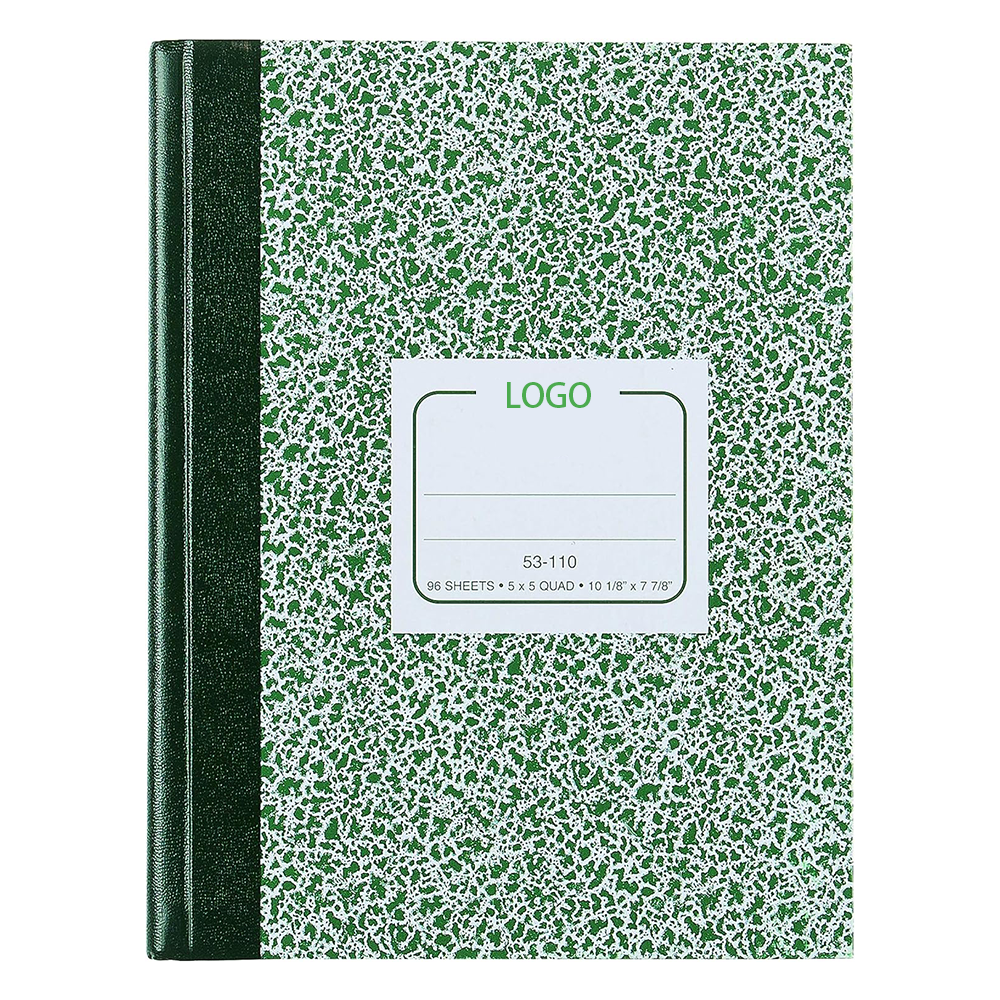
Custom composition notebook wholesale built on the book every teacher already recognises: green-and-white marbled laminate cover, centred name label with your crest or brand replacing the printed LOGO placeholder, 96 sheets of 5 x 5 quad rule at 10 1/8 in x 7 7/8 in — figures photographed directly on the cover spec line. Marbled colourways, ruling substitutions, sheet counts and multi-pack carton builds quote per design. MOQ 100 pcs per design, samples in 3-5 days, production in 7-15 days after artwork approval, with back-to-school freight planned backwards from a September receiving date. FBA prep available on the same run.
Custom composition notebook wholesale orders live or die on a very specific recognition test: does the book look exactly like the one every American teacher already knows? Green-and-white marbled cover. Name-and-subject label in the middle. Quad-rule pages inside, the five-to-the-inch blue grid. Ninety-six sheets. The photographed sample passes every point of that test on its face: the front cover carries the speckled pattern, the centred label prints the classic layout, and the spec line beneath it reads 96 SHEETS, 5 x 5 QUAD, 10 1/8 in x 7 7/8 in — numbers we can quote because they are printed on the book in the photograph, not remembered from a datasheet.
That picture is the product. A district classroom order, a church-school supply bundle or a multi-pack retail listing needs no other proof of what it is buying. What our factory changes is everything around the recognition object: your school name or brand replaces the LOGO placeholder, cover colour swaps to the marbled palette your program uses, and the wholesale mechanics — MOQ 100 pcs per design, samples in 3-5 days, production in 7-15 days after artwork approval — get arranged back-to-school-first, counting backwards from the day the first bell actually rings.
Why the Marbled Pattern Is the Whole Purchase Decision
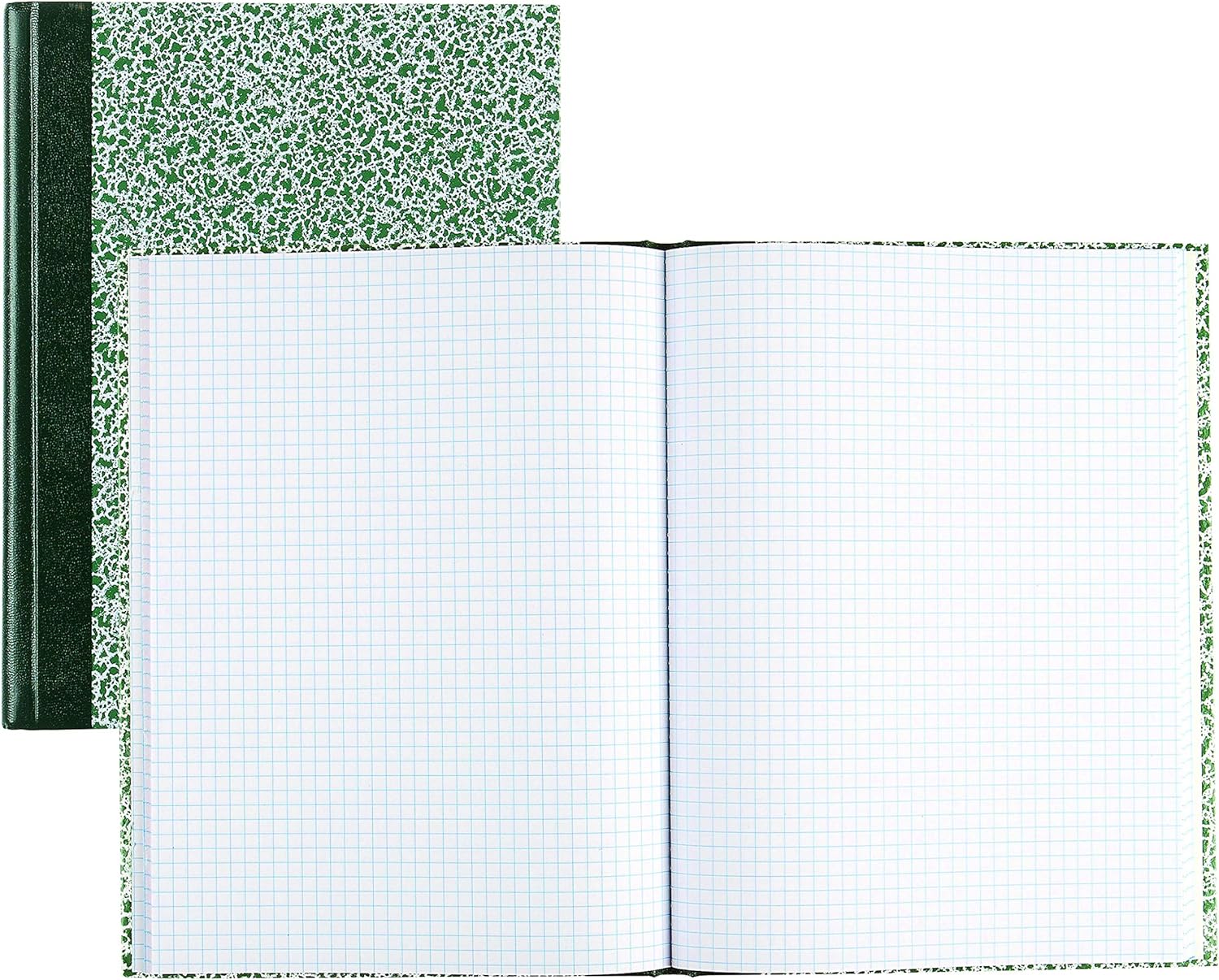
Teachers do not evaluate composition books; they recognise them. The speckled green laminate signals ninety-six pages of quad rule in about four seconds, and four seconds is what a back-to-school purchase window gives any supply item. The pattern carries weight and cost meaning that no printed copy can: it says this is the book that survives a backpack, and parents who bought it themselves read the cheap-and-right decision instantly. Replace it with a glossy photo cover and you have a different product on the same shelf line — see our printed hardcover page for that build.
The marbled effect is a printed laminate, which is good news for customization. The speckle can be re-coloured — navy and white, black and white, red and white for house colours and grade-level coding — without touching anything else in the construction. Districts that hand out one colour per grade have been doing marbled coding for decades precisely because the pattern hides scuffs better than a solid colour, and the laminate is what makes that re-colour cheap: it is a plate swap at the cover print stage, not a material change.
Two construction facts are visible in the closed-book photo, and they matter for volume buying. The cover is glossy laminated paper over board, reflecting studio light across the speckle field, and a single debossed seam runs parallel to the spine edge. That groove is where the book flexes open; on a cheaply grooved case it cracks through the laminate by November. Ours gets scored and tested at the sample stage, which is the one step a wholesale buyer should insist on seeing before committing a classroom quantity — hence the physical 3-5 day sample ahead of any large order.
The Label Zone: Ninety Years of Layout Still Working
Dead centre on the photographed cover sits the composition book’s signature element: a white rectangular label with a green border, two blank writing lines for name and subject, and at the top of that label a LOGO placeholder waiting for your mark. The layout is the one students fill in with a pencil on the first day of every school year, and its psychology is worth a paragraph for anyone specifying it for resale or institution use: the label makes a mass-produced book into a claimed object. Supply that costs cents more per unit, gets written on, and stops getting lost.
For private-label programs, that placeholder does real merchandising. A stationery brand’s lockup sits top-centre where the sample shows LOGO; the two writing lines stay, because removing them breaks the recognition test above. A school orders the same layout with the crest and the year. Retail chains order the label blank except for a barcode zone — that variant and its label-stock spec get quoted on request like everything else in the customisation list below. The spec print at the label foot — the model number and the 96 sheets / 5 x 5 quad / 10 1/8 in x 7 7/8 in line seen in the photo — is redrawn to carry your SKU or kept stock-style for school orders; it is print, not tooling.
Quad Rule: The Grid That Teaches Alignment
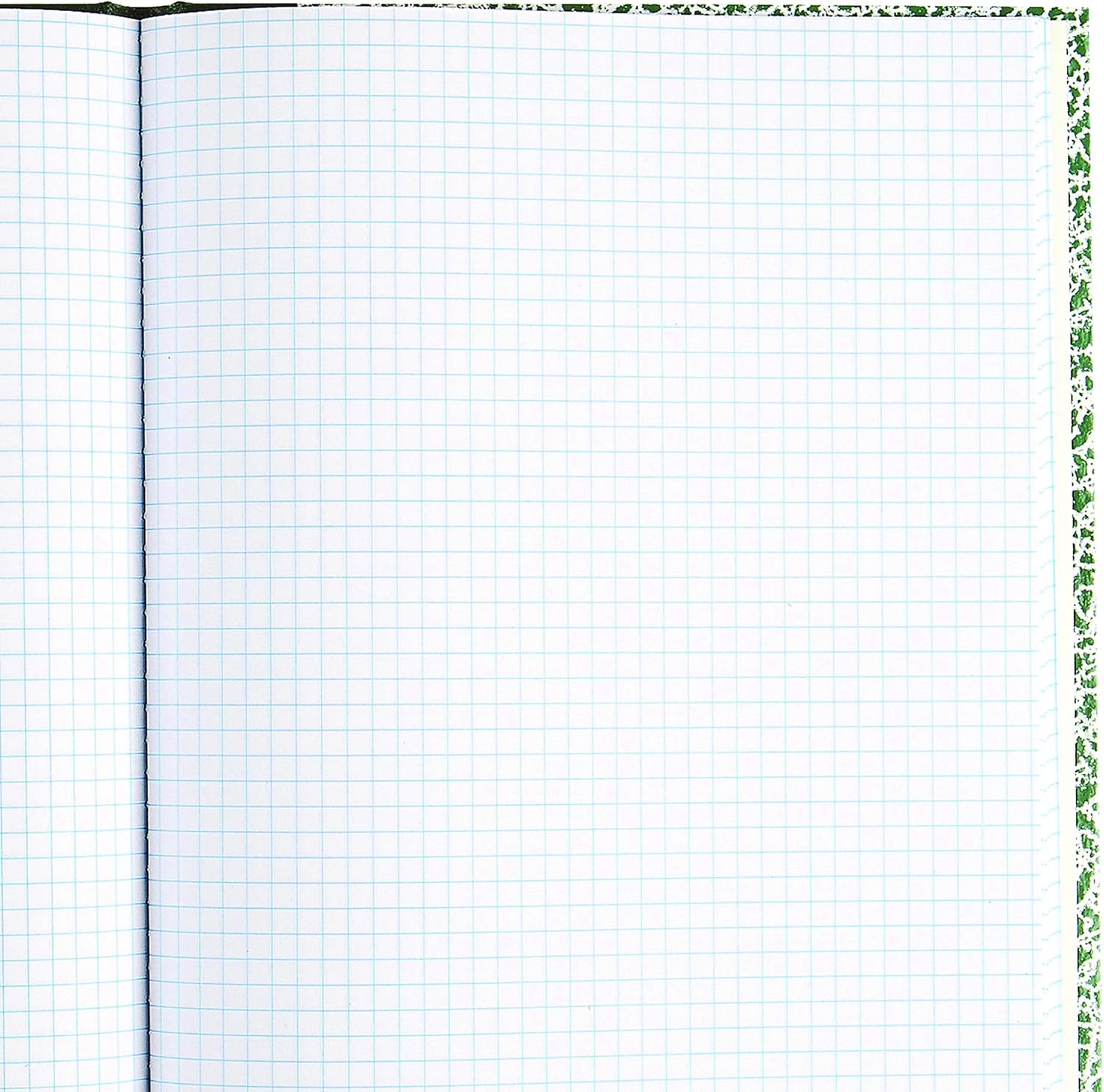
Open the book and you see why the ruling is a grid instead of lines. The 5 x 5 quad pattern — five squares to the inch, printed in pale blue on white uncoated stock, both pages and the gutter shown in the photograph — is a tool for handwriting alignment, column addition, spelling words with one letter per box and science tables that stay straight. Young handwriting lives inside boxes; that containment is the whole reason the US bought quad-rule over college-ruled paper for elementary classrooms for decades. When a district line-item reads ‘composition book, quad rule’, this is the page being ordered.
There is a supply-chain corollary to that recognition: quad rule is a line item that survives purchasing transitions. A new superintendent, a rotated purchasing clerk or an outsourced supply vendor does not need convincing about the format — the spec string already exists in state procurement vocabulary, warehouse catalogs and parent supply lists. Choosing a different ruling for a classroom program means educating every downstream buyer about your deviation, which is a marketing cost nobody budgets in a supply order. The quad grid is the path-of-least-resistance SKU, and the photographs on this page prove we stock the path, not a variant dressed up as one.
Interior options exist but belong in the margins of this page: college rule, wide rule, plain and primary-with-picture-line stock are all quotable substitutions. But a buyer switching ruling is buying a different book for a different grade, and our advice to program purchasers is to split the ruling choices across separate 100-pc-per-design lines rather than dilute the quad standard. Sheet counts: ninety-six is printed on the photographed label and anchors this build; 70-, 100- and other sheet packs shift cover depth and laminate grammage and get quoted on request.
Bond behaviour is visible in the open spread: the blue grid sits under a matte, uncoated surface that takes pencil and ballpoint without skateboarding. Children press hard. Coated interior stock turns pencil to graphite dust and smears gel ink across a nine-year-old’s palm; the photographed pages are the opposite construction — the stock absorbs, and pencil erases cleanly off it without pulling fibre, which is exactly what a quad-rule purchase is for.
Sheet-level economics finish the ruling argument. A ninety-six-sheet quad book gives one hundred ninety-two writing sides per child per year, which is enough for a full year of spelling, math journals and science logs without a second book — and the sheet count is printed on the cover precisely so teachers can budget it. A program that drops to lighter stock saves a fraction per unit and reorders twice, which reverses the freight math at district volume. When you request alternate sheet counts, ask for the quote both ways — per-book and per-year-per-student — and the ninety-six-sheet standard usually defends itself.
Buying by the Cartload: How Wholesale Runs Actually Work
Supply-chain people order this book in three shapes. District and parochial-school purchasing runs single-design, high-quantity, delivered to a central warehouse in July or port-side in June for split-site years. Resellers and distributor private-label programs order the same construction under their own label placement, in multi-colour assortments that split by cover colour rather than format. Promotional buyers order it as a back-to-school giveaway — nonprofit supply drives, employee-dependent programs — with a sponsor mark in the label zone.
All three hit the same constraints. The order date is fixed: September does not move, so artwork approval by roughly early July keeps a container-sized lot on water freight, while late files price air. MOQ applies per design, which is the mechanism that lets a five-colour assortment or a grade-coding program qualify at 100 pcs per colour instead of a combined minimum. The displayed listing figure anchors the 100-piece tier; classroom-quantity pricing is quoted off your design breakdown and total volume, not by multiplying the page rate. And across all three shapes, samples carry the decision — a run this recognisable only survives procurement review if the object matches the picture, which is precisely what the 3-5 day sample round is for.
What a Wholesale Design Can Change
- Label-zone print: school crest, brand lockup, sponsor mark or blank-with-barcode, replacing the photographed LOGO placeholder
- Marbled colourway: green as photographed, plus navy, black, red and other speckle palettes per design
- Cover label text: the spec line can carry your SKU, sheet count and dimensions in your format
- Interior ruling: quad rule standard as photographed; college, wide, primary and plain quoted per line
- Sheet count: 96 sheets per the printed spec; alternate counts change cover depth and quote separately
- Size: 10 1/8 in x 7 7/8 in as printed on the photographed label; alternate case sizes quoted on request
- Carton build: school-quantity bulk packs or retail-ready multi-packs with banding, per channel
Specification Snapshot From the Photographed Book
| Item | Classic marbled-look composition notebook, quad rule, custom label print |
| Size | 10 1/8 in x 7 7/8 in, as printed on the photographed cover label |
| Paper & Ruling | 96 sheets, 5 x 5 quad rule in pale blue on uncoated white stock (both figures printed on the photographed label) |
| Cover | Green-and-white marbled printed laminate over board, glossy finish, solid spine band with score seam |
| Binding | Composition-style bound spine as photographed; exact construction confirmed on the physical sample before bulk |
| Logo & Finish | Centred label zone with LOGO placeholder — replaced by crest, brand or retail lockup at artwork stage |
| Packing | Bulk classroom cartons or retail multi-pack banding; counts matched to your receiving plan |
| MOQ | 100 pcs per design |
| Sample time | 3-5 days |
| Lead time | 7-15 days after artwork approval |
| Capacity | 1,000,000 pcs per month across our gift lines |
Counting Backwards From the First Bell
Back-to-school is the tightest calendar in stationery. The practical chain for a container lot: artwork with label print and colourway approved by early July; samples out in 3-5 days and signed within the week; bulk production 7-15 days after approval; ocean transit booked against the port date your forwarder names. Late programs still ship — that is what the air lane and express couriers exist for — but the freight delta between July discipline and August panic is usually the largest single line in the landed cost. Distributors who reorder the same design year after year skip straight into production because the file stays on our side; first-year programs get one extra mock-up loop folded into the same calendar at no charge.
Cartons, Pallets and Dock Reality
Composition books ship in shrink-wrapped brick counts inside five-ply export cartons, palletised to your receiving spec so a warehouse can count cartons without opening film. Weight per carton is controlled deliberately: classroom volume means adults lifting these stacks all day, and we plan brick counts to keep cartons within single-lifter limits rather than maximising raw cube. Freight leaves by sea on the summer wave, by air for late reorders, or by DHL, UPS, FedEx and TNT for samples and top-ups. FBA sellers listing the book get prep included — unit poly-bag and barcode, carton builds to Amazon shipment-plan weights — routed to the fulfilment centre instead of a freight-restricted residential address.

Are the 96 sheets and 5 x 5 quad measurements printed on the book itself?
Can a school district put its name and crest on the cover label?
What does a multi-colour classroom order cost at wholesale?
Is the marbled pattern limited to green and white?
When should a September order be placed for ocean freight?
Can these composition books ship directly to an Amazon fulfilment centre?
Where This Book Sits in the Notebook Range
For the ruling-first buyer, the sibling page on plain, lined and dotted hardcover composition notebooks is the comparison; school-record buyers looking at pagination usually switch to the laboratory notebook line, and gift-program planners pair supply orders with the printed hardcover journals or check thread-sewn planner books for staff-facing items. The full notebook category and the wider printed items catalogue cover the rest of the back-to-school basket.
Start a Back-to-School File
Total pieces, colourway split, label artwork and delivery month to [email protected] or +86-15967739086 — the form below feeds the same desk — and the quote comes back with a tiered landed-cost view, not just a unit number.